Eloquent Images by Gary Hart
Insight, information, and inspiration for the inquisitive nature photographer
2025 Horsetail Fall: Success—and a Surprise

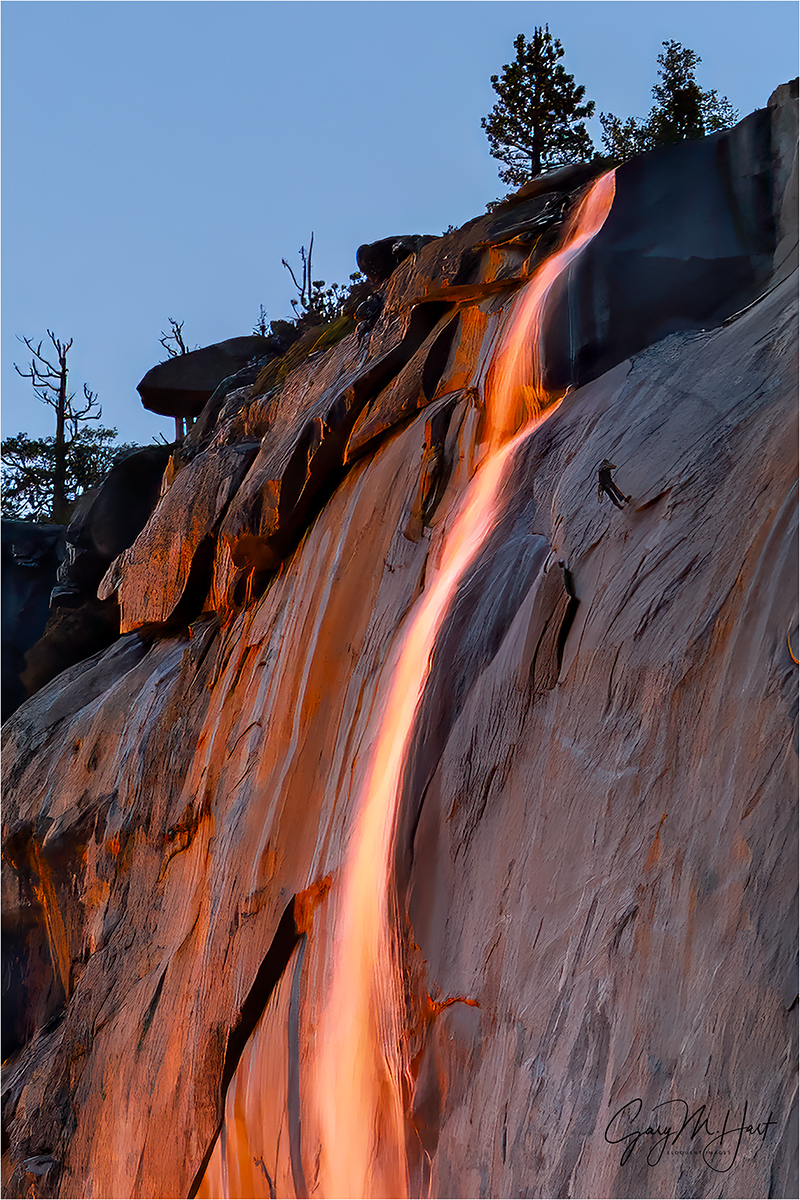
Molten Stripe, Horsetail Fall, Yosemite (5:43 p.m., February 20, 2025)
Sony a7R V
Sony 100-400 GM
ISO 100
f/10
1/6 second
I just returned from Yosemite, where I basked in another year of Horsetail Fall mayhem. But before I get into this year’s experience, let me just sing the praises of the Horsetail Fall experience in general. Horsetail Fall (don’t call it the Firefall) is a narrow, unassuming waterfall that, for a couple of weeks each February, gets thrust into the spotlight when a fortuitous confluence of location and light sets it ablaze with sunset color.
So what’s going on? With no clouds blocking the sun’s rays, in mid-afternoon a vertical shadow appears on El Capitan’s south-facing wall and commences an eastward march across the sheer granite. As this shadow marches eastward with the descending sun, the sunlit section of El Capitan shrinks and its light warms. Though the sun is no longer visible from the valley floor, towering El Capitan remains lit past sunset—when the unseen (to Horsetail gawkers) sun reaches the horizon, the only part of El Capitan not in shadow is the narrow strip of granite that includes Horsetail Fall. For a few glorious minutes, this normally anonymous waterfall is bathed in orange that resembles flowing lava, framed by dark shadow. Occasionally, when all the stars align, this thin stripe of orange turns a seemingly impossible shade of red that rivals the best sunset color you’ve ever seen.
I know it’s fashionable for some photographers to look down on any subject so popular and heavily photographed, and Horsetail Fall seems to be the poster child for these feelings. But I believe that, first and foremost, true nature photographers pursue their craft as much to marvel at, and honor, Nature’s gifts as they do for the images they capture. Camera or not, the Horsetail Fall spectacle should be experienced by all who find joy in natural beauty (which should be ALL nature photographers).
I’ve been photographing Horsetail Fall long enough to remember the days when I could arrive 30 minutes before sunset and join a small handful of other photographers in on the secret. But the photography renaissance spurred by digital capture, combined with social media saturation, has made the phenomenon a must-see (and must-photograph) event for the masses. I used to lament the crowds, but since the National Park Service implemented management and control measures that (slightly) limits the crowds, and (more importantly) the viewing locations, I’ve come to enjoy the tailgate-party atmosphere the phenomenon engenders.
Having witnessed the range of Horsetail Fall’s annual display at least 50 times, from disappointing flops (no water of sunset light) to absolute euphoric splendor, today it’s the vicarious thrill I pull from the crowds that keeps me coming back. Last week was no different, and I’ll be back next year.
Success
The amount of water in Horsetail varies from year to year, ranging from bone dry, to wet stain, to rainfall run-off infused gush. And while I wouldn’t say it was gushing this year, the flow was at least average, and definitely photographable.
The Horsetail crowds this year, at least for the four sunsets I was in Yosemite (February 18-21), were by far the most I’ve ever encountered. Since I usually do my Horsetail Fall workshop a week earlier, largely to avoid the crowds of February’s third week (because that’s when the light has been labeled “best”), it’s hard to know how much this year’s crowds were just a function of my timing, or whether there really were more people than previous years. I suspect it was some of both.
Consensus says that the best Horsetail Fall light, when it’s most tightly focused on the fall, comes 2 or 3 days either side of February 20 (where we are in the leap year cycle matters too). The reason I usually schedule my Horsetail Fall workshop for weekdays a week earlier is that contenting with significantly fewer people more than makes up for any minor difference in the perceived quality of the light. In fact, some of my best Horsetail Fall experiences have come around February 10. But this year, knowing I’d have just returned from Iceland, I pushed the Horsetail Fall workshop back a week.
I also wonder if this year’s extra people were a byproduct of the new NPS reservation system that’s designed to keep weekend crowds more manageable. It’s possible that those who would ordinarily go on a weekend but couldn’t score a reservation, or maybe they just decided not to hassle with the reservation system, just took advantage of the unrestricted entrance weekdays offer.
Whatever the reason, the crowds are only a problem where parking is concerned—once you park and get yourself to the viewing area, there’s plenty of room for everyone. Back when Southside Drive was in play (closed now due to riverbank damage and unruly photographers), people who opted for that (arguably much better) vantage point had to contend with an order of magnitude more photographers than there was space to accommodate them—not to mention all the tension (and hostility) that comes with that. Not only are there many more viewing sites on NPS-approved and mediated Northside Drive, the view there (being closer to El Capitan) is more up and over the heads of the throngs of gawkers. Since it’s primarily a telephoto shot, even when stacked multiple people deep, no one is in anyone’s way. The result is a genuine tailgate party vibe that I’ve grown to love: frisbees, barbecues, and actual socialization among friends and strangers alike.
After monitoring last week’s weather forecast, I decided to pass on Horsetail for my workshop’s first two days, targeting Thursday, with Friday as a backup. And though Wednesday turned out to be an absolutely epic Horsetail Fall event for all who stuck it out through the clouds that delivered rain right up until sunset (we weren’t in the Horsetail Fall viewing area, but did have a good view of the fall), my group got something better Wednesday evening (if you like rainbows), and still experienced the coveted Horsetail Fall red light the next evening. Win-win! The rainbow is a story for a different day, but waiting until Thursday freed us to take advantage of all my other favorite Yosemite locations in relative peace (because most of the photographers were congregated beneath Horsetail Fall) the rest of the week.
And even though we photographed Horsetail Fall just once, we did drive through the viewing area each evening, sometimes multiple times, which gave us a firsthand view of the bedlam. How crowded was it? I have no idea when the Yosemite Valley Lodge parking area—the closest dedicated Horsetail parking, an easy 1 1/2 mile walk—filled each evening, but I know we saw it barricaded with “Full” signs as early as 2:30 p.m. Not only that, all of the ADA parking within the viewing area was full and closed as well. This concerned me because I’ve never seen ADA parking fill so early, and I had a participant with an ADA placard, plus a couple of others who weren’t crazy about a 2 or 3 mile roundtrip walk.
I have a few parking tricks up my sleeve, so on Thursday evening we were able to deposit limited carload just slightly more than 1/2 mile from the viewing area (less than ideal but manageable), while the rest of us found parking about 1 1/4 mile away. By 4:30—more than an hour before the 5:43 sunset—we were all set up beneath El Capitan with fingers crossed, ready for the show.
The morning had been cloudless, but by mid-afternoon patches of thin clouds had drifted in, never completely extinguishing the direct sunlight, but intermittently dulling it significantly as the sun dropped. Every time the sunlit granite brightened, I advised my group to start clicking, because we never know when the light will disappear for good.
The light teased us like this all the way up until go-time, about 5 minutes before sunset. Then, as if a magic hand was keeping the clouds at bay, the sun brightened and held steady all the way until sunset (the picture at the top of this post). When the light started to fade slightly, we heard applause and cheering in the distance as other groups of viewers assumed the show was over, but I told my group (and, it turns out, a number of other people eavesdropping nearby), that we’re not leaving until at least 5 minutes after sunset because the fading we were seeing now was caused by clouds, not the sun dropping below the horizon. Turns out, the show had just begun….

Last Light, Horsetail Fall, Yosemite (5:48 p.m., February 20, 2025)
Sony a7R V
Sony 100-400 GM
ISO 100
f/10
1/5 second
A minute or so later, Nature dialed its rheostat back up and the light returned—but this time it was red. As the red intensified, a shadow crept up from the bottom of the fall, extinguishing the lowest light. The image below was captured 5 minutes after sunset, and you can see the bottom third of the fall isn’t lit. Shortly after this, the light faded uniformly and the show was over. The red we got this evening was as red, and as brilliant, as I’ve ever seen on Horsetail Fall. I’ve seen it get this red a handful of other times, but never any redder than this.
Horsetail Fall Climber, El Capitan, Yosemite (February 20, 2025)
Surprise
The evening’s biggest surprise wasn’t pointed out to me until our image review session the next day. Apparently, unbeknownst to us at the time, we’d been photobombed by 3 climbers on El Capitan, including one dangling right next to the fall. You can see him (or her?) in both of the top-to-bottom fall images above, but immediately above is a tighter crop of the first image, showing the climber more clearly.
Here’s my article on getting the most from the Horsetail Fall experience
Join me in a Yosemite Photo workshop
Workshop Schedule || Purchase Prints || Instagram
Horsetail Fall Through the Years
Click any image to scroll through the gallery LARGE


 Eloquent Images by Gary Hart
Thanks Gary for that nice report on the “Natural” Firefall! As photographers (at least long-time photographers) shooting the falls is as easy as rolling off a log, right? However the real challenge in shooting the event is the logistical shenanigans that we have to go through to be in place at show-time…I kind of dread it so I haven’t been to Horsetail Falls for several years now.
There are many of my nature-loving, outdoor friends (non-photographers) that look in disdain in attending such a circus event, but it truly is a loss for them. I believe it is a beautiful, 100% natural event (unlike like the original Firefall on the other side of the valley), that is just as spectacular as any other landmark in the valley and truly worthy of being admired. Just another reason why Yosemite is so beautiful, and very special in many ways, and we here living in California (Northern) are very lucky to live so close to it.
Regards,
Greg P.
You’re very welcome, Greg. While I agree that the natural nature and unpredictability of the Horsetail Fall light makes it special, I also have a very special place in my heart for the original Firefall. Even though it wasn’t natural, I feel like it was a Yosemite spectacle for so long that it gets grandfathered in. I don’t wish its return, but I feel quite blessed to have witnessed it (both from Camp Curry and Glacier Point). And I completely agree that viewing Horsetail Fall is very much worth dealing with the circus. In recent years, thanks in large part the the NPS’ efforts to manage the crowds, it’s lost much of the competitive energy and now feels more festive.
A few years ago, I got the golden yellow of a sunrise on Yosemite Falls. Not so well known but just as grand.
Yes, Yosemite Falls gets great morning light——unfortunately, the timing of the best angle (winter) doesn’t match the timing of the best flow, but when we get a good warm winter rain, it can really get Yosemite Falls going. Sounds like you timed it just right, Larry.