Eloquent Images by Gary Hart
Insight, information, and inspiration for the inquisitive nature photographer
Horsetail Fall (Yosemite)

Horsetail Fall, El Capitan, Yosemite (from the Merced River south bank)
Canon EOS-1Ds Mark III
1/4 second
F/8.0
ISO 100
220 mm
2026 Horsetail Fall Update (21Feb2026)
For starters, your best source of Horsetail Fall information comes right from the horse’s mouth (so to speak).
I just returned from a week in Yosemite, where we enjoyed spectacular (and voluminous) snowfall. An unfortunate byproduct of the snow was the complete washout of any Horsetail Fall sunset light opportunities (but I’ll take the snow any day). Before last week’s storms, Horsetail was essentially dry; during the storms, it was so cold that there was no opportunity for the essential snowmelt runoff, so Horsetail still wasn’t flowing. But with the suddenly robust snowpack, if the sun comes out and the temperatures warm enough, or if next week’s promised rain manifests, Horsetail should start flowing wonderfully. Sadly, with just a week left in the Horsetail Fall window, the forecast for the necessary sunlight isn’t quite as optimistic.
While most of what I share in the article below is unchanged from previous years, here are updates based on my recent visit:
- No reservations are required this year, making it even more important to arrive and pick your spot early.
- The Southside Drive closure remains, and is likely to be permanent.
- If you can’t find parking in the designated Horsetail parking areas within reasonable walking distance, you can park at the Yosemite Village overflow lot and Curry Village, and take the free shuttle to the viewing area. There is also limited parking in and near the viewing area for people with Disabled Plates or Placards.
Photographing Horsetail Fall

2021 Horsetail Fall Crowd, Northside Drive, Yosemite :: For nearly a mile, scenes like this one from a small section of Northside Drive, repeated themselves every couple hundred yards.
For eleven-plus months each year, Horsetail Fall may just be Yosemite’s most anonymous waterfall. Usually dry or (at best) a wet stain, even when flowing strong this ephemeral cataract is barely visible as a thin white thread descending El Capitan’s east flank. When it’s flowing, my workshop groups can be standing directly beneath Horsetail and I still have to guide their eyes to it: “See that tall tree there? Follow it all the way to the top of El Capitan; now run your eye to the left until you get to the first tree…”. But for a couple of weeks in February, the possibility that a fortuitous confluence of snowmelt, shadow, and sunset light draws photographers like cats to a can-opener.
The curtain rises in the second week of February when, a couple of hours before sunset, a vertical shadow begins its eastward march across El Capitan’s south face. As the shadow advances, the sunlight warms; when the unseen sun (direct sunlight is gone from the valley floor long before it leaves towering El Capitan) reaches the horizon, the only part of El Capitan not in shadow is the narrow strip of granite that includes Horsetail Fall—for a few minutes, when all the photography stars align, the fall is bathed in a orange or (if you’re lucky) red glow resembling flowing lava, framed by dark shadow.
Some years Horsetail delivers February sunset after sunset, while other years administer daily doses of February frustration. Unfortunately, it’s impossible to predict when all the tumblers will click into place: I know photographers who nailed Horsetail on their first attempt, and others who have been chasing it for years.


Don’t call it “Firefall”
One important thing before I continue. To avoid outing yourself as a Yosemite rookie, don’t make the mistake of calling Horsetail Fall the “Firefall” (I even see NPS signs in Yosemite wrongly using “Firefall”). Yosemite’s Firefall was a very real nightly display of burning embers pushed from Glacier Point every summer night that all Yosemite veterans remember fondly because it was as spectacular as it sounds. The phenomenon started in 1872 and continued until the National Park Service, concerned (among other things) about the crowds it drew, terminated the Firefall show in 1968.
Anyone who has witnessed or seen pictures of Horsetail Fall would agree that “Firefall” would be a great name for it, but those of us fortunate (and old) enough to have witnessed the actual Firefall know the difference between Horsetail Fall and the Firefall, and will never confuse one for the other.
(Oh yeah, and it’s Horsetail Fall, not Horsetail Falls.)
Where does the red come from?
Horsetail Fall turns red for the same reason clouds turn red at sunset. When the sun drops below the horizon, shorter wavelengths start getting absorbed by the atmosphere; the last rays to make it through the atmosphere are the longest, red wavelengths. El Capitan, towering more than 3,000 feet above Yosemite Valley, is high enough above the western terrain between it and the sun to receive extended exposure to these red rays.
Horsetail Fall’s sunset color varies between orange and red. The color’s hue and intensity is a function of atmospheric clarity—the cleaner the air, the more vivid the red will be. You can read more about sunrise/sunset color in my Sunset Color article.
When to photograph Horsetail Fall
The “when” of Horsetail Fall depends on the convergence of three independent conditions:
- The sun’s angle is refreshingly predictable, lining up perfectly only in February (and October, when the fall is almost always dry). Common wisdom says the shadow on El Capitan most precisely targets Horsetail Fall at sunset during the third week of February, from around the 15th through the 22nd (or a little later). While I won’t dispute this, I’ve had some of my best success a week earlier, and my favorite Horsetail shot (at the top of the page) was captured February 9. I’ve also had success photographing it right up until the end of February. But the stripe of sunset light on El Capitan is thinnest (and therefore most tightly focused and photogenic) from around the end of the third week of February to the beginning of the fourth week—the benefit of doing it a week earlier is fewer people.
- Water in the fall varies greatly from year to year, depending on recent rainfall, how much show has fallen on the fall’s extremely small watershed, and how much of that snow is currently melting. A large snowpack and warm daytime temperatures are ideal. Sometimes Horsetail can be frozen solid in the morning, but afternoon warmth can be enough to get it flowing in time for the show. And a heavy rain can get it going strong for a few hours or even a day or two.
- Direct sunlight at sunset is the most fickle aspect of the Horsetail experience—for every tale of a seemingly perfect evening when the sunset light was doused by an unseen cloud on the western horizon mere seconds before showtime, there’s another story about a cloudy evening when the setting sun somehow threaded a gap in the clouds just as tripods were being collapsed.
The problem with targeting February’s third and fourth weeks is that this timing isn’t a secret, so I generally prefer sacrificing Horsetail perfection in favor of Horsetail near perfection along with far fewer photographers. But I’ll leave that decision up to you. (And the reservation system may have mitigated the crowd problems a little, but I suspect that reservations are easier to be had outside “prime” time.)
Where to photograph Horsetail Fall
It’s fun to circle Yosemite Valley on pretty much any mid- to late-February afternoon just to watch the hordes of single-minded photographers setting up camp like iPhone users once did on “Release Day” (remember that?) In fact, one non-scientific way to find a spot to photograph Horsetail is to simply set up where everyone else has set up. Unfortunately, as Horsetail’s popularity grows, so does the number of inexperienced viewers, and today you might find people congregating at a poor location simply because one photographer ignorantly did, and others wrongly assumed, “this must be the place.”
Once upon a time, when Southside Drive was open, I advised those for whom Horsetail Fall is on the top of their bucket list to pick their spot and show up early—really, really early. But today, with the reservation system and access limited to Northside Drive, 90 minutes early is fine. But of course the earlier you arrive, the shorter your walk will be, so there’s that….
The downside of putting all of your photography eggs in the Horsetail Fall basket is that the best locations for Horsetail aren’t especially good for anything else, you’ll sacrifice a lot of quality Yosemite photography time waiting for something that doesn’t end up happening.
And no one has commanded that you worship with the rest of the Horsetail congregation: Experienced Yosemite photographers know that any west-facing location with a view of the fall will do. If you find yourself in Yosemite with time to kill, try walking the Merced River between Cathedral and Sentinel Beaches—any place with a view to Horsetail will work. But because of their open space and relative ease of access, two spots have become the go-to Horsetail spots for most photographers.
El Capitan Picnic Area / Northside Drive
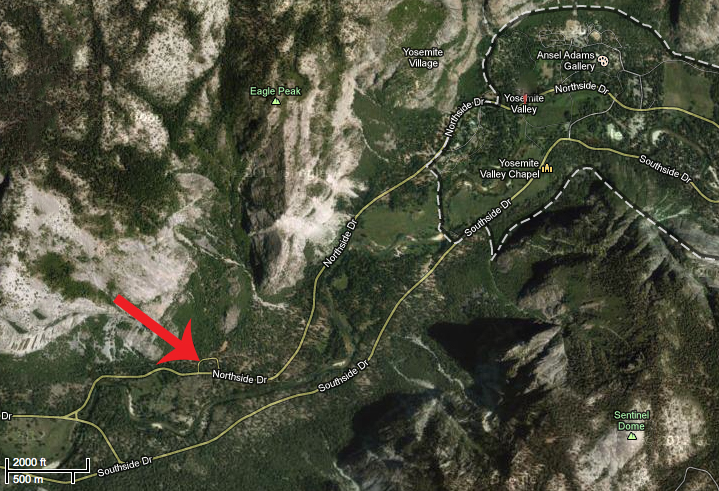
El Capitan Picnic Area, GPS: 37.72782N 119.61844W
The El Capitan Picnic Area (highlighted by Galen Rowell) on Northside Drive for years was the epicenter of the Horsetail Fall experience. The picnic area’s advantages are that it is the closest view of Horsetail Fall, has the most parking, has the most room for photographers (by far), and has a bathroom (plug your nose). The downside is there really isn’t a lot of composition variety here, and thousands of others will have already captured something as good as or better than what you’ll get.
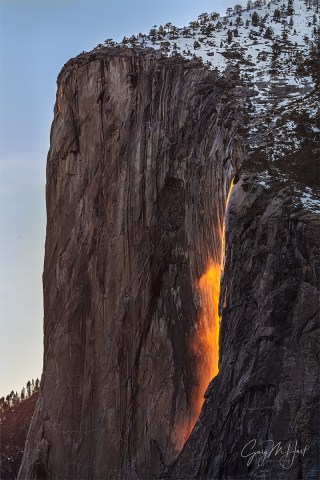
Horsetail Fall and El Capitan, Four Mile Trail, Yosemite
If you like people, the El Capitan Picnic Area is the place to be—more than any other Horsetail vantage point, this one has a festive, tailgate atmosphere that can be a lot of fun. I suspect that’s because people arrive so early and there’s little else to do before the show starts. And since everyone is pointing up with a telephoto, it’s pretty much impossible for anyone to be in anyone else’s way, which eases much of the tension that often exists when shooting among large crowds.
You’ll find the parking lot, with room for twenty or so cars, on Northside Drive, about two miles west of Yosemite Lodge (now only open to people with disabled parking permits). You can shoot right from the parking lot, or wander a bit east to find several clearings with views of the fall.
There are variations of the picnic area view all along Northside Drive that in recent years have surpassed the picnic area in popularity (crowds). My suggestion is to scout El Capitan views in any month that’s not February; if your only Yosemite visit is the day you’re there to photograph Horsetail Fall, scout early in the morning. Or, as you set out to photograph Horsetail Fall, simply walk Northside Drive (one lane is blocked for pedestrians walking from Yosemite Valley Lodge) until you find a view that you like (but don’t expect to have it to yourself).
The farther east you set up, the better your view of the top of El Capitan. But some of the east-most views are too aligned with El Capitan’s face, giving you a more side view of Horsetail that makes it very hard to see. You can also try venturing off into the woods to get a better angle, but doing that also means trying to avoid trees that obstruct your view.
And wherever you set up, please respect the people nearby and (especially) the natural surroundings. Southside Drive was justifiably closed to Horsetail Fall viewing because of abuse by photographers. If that happens on Northside Drive, the NPS won’t hesitate to do whatever is necessary to protect its natural resources, including closing all access to Horsetail Fall viewing.
Merced River south bank bend (now closed to parking and pedestrians and strictly enforced—don’t even think about photographing on the river along Southside Drive)
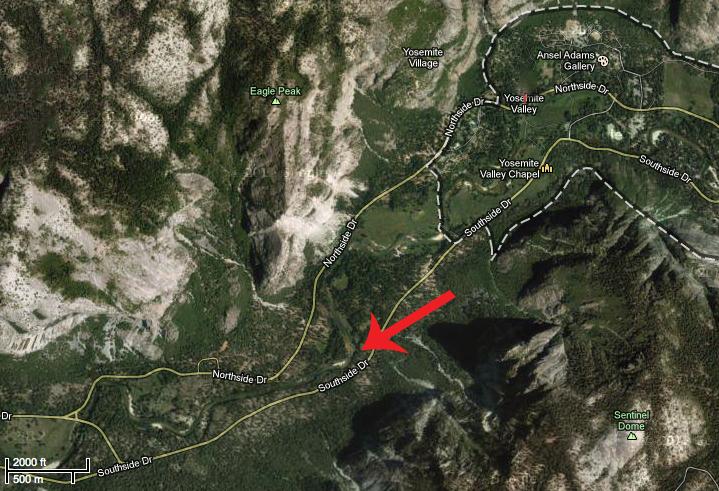
Merced River south bank bend, GPS: 37.72885N 119.60743W
Due to extreme crowds and the damage they’ve caused, in 2021 the National Park Service closed Southside Drive to all Horsetail Fall viewing. While I’ve heard no official word that this closure is permanent, I have no reason to believe it isn’t (in fact, it would surprise me if it’s not permanent). So, until further notice, the information below is strictly historical.
Photographed from a bend on the Merced River’s south bank, El Capitan’s extreme sloping summit creates the illusion that you’re somewhere above Yosemite Valley, eye-to-eye with the top of Horsetail Fall—it’s a great perspective.
I like this location because the river greatly increases the variety of possible compositions, and also because you can pivot your view upstream to photograph Upper Yosemite Fall, and behind you toward Sentinel Rock (which also gets fantastic late light), almost directly above while you wait for Horsetail to light up. The downside to photographing here is that there’s precious little room, both to park and to photograph. This requires getting there a couple of hours early, and also can lead to a bit more tension as people jockey for position.
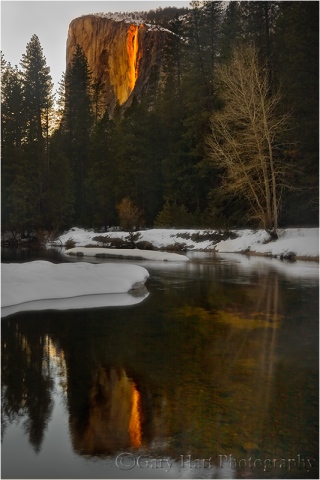
Horsetail Fall reflection from the Southside Drive Merced River view
Driving east on one-way Southside Drive, you’ll parallel the Merced River for most of 1.2 miles beyond the turn for Cathedral Beach. The Horsetail Fall spot is right where the road and river diverge. Parallel park right there in one of two narrow but paved parking areas on opposite sides of the road, where you’ll find room for about a dozen cars.
Since there’s so little parking here, and Southside Drive is one-way eastbound, if you find no parking (don’t try to squeeze in where there’s no room—I’ve seen rangers doing traffic control and ticketing cars that don’t fit), it also helps to know that the spot is about a ½ mile from the 4-Mile Trail parking area and ¾ miles west of the Swinging Bridge parking area—an easy, flat walk.
Because of the potential for crowds, the best strategy here is to arrive early and forego what may be a great view from the elevated riverbank (that is sure to be blocked by late-arrivers trying to cram their way in), in favor of getting as close to the river as possible. Standing at river level gives you many more compositional choices, and nobody else can block your wide shots. (But if there are other photographers already set up on the elevated riverbank when you arrive, please don’t be the one who sets up in front of them.)
How to photograph Horsetail Fall
Regardless of where you set up to photograph Horsetail Fall, it’s pretty difficult to find something that nobody else has done. But that doesn’t mean you shouldn’t try. Even with Southside Drive shut down, there are definitely other places in Yosemite Valley with view of Horsetail Fall, they just take a little hunting—I suggest walking the south bank of the Merced River and ascending the 4 Mile Trail and looking for vantage points above Yosemite Valley. Wherever you end up, you’ll likely be doing lots of waiting, so take advantage of the downtime to experiment with compositions.
Strategy
When the light begins to warm, it’s time to shoot. Because you never know when the light will shut off, don’t wait until the light is perfect—it’s best to start early and photograph often. Until the light goes away completely, my rule of thumb is that the light now is better than the light a minute ago—just keep shooting . I’m not suggesting you hold your shutter down in burst mode until your card fills; I usually tell my workshop groups to fire a frame every minute or two until the fall turns amber, then pick up the pace as it goes (fingers crossed) pink and (if you’re lucky) red. T
The best light is in the final five minutes before sunset up to about 5 minutes after sunset (that’s the flat-horizon “official” sunset posted for Yosemite Valley). Regardless of what the conditions look like, don’t make the mistake many others make and leave too early—I’ve seen (multiple times) evenings when the light has completely shut off, or never appeared, only to magically return 2 or 3 minutes after sunset. You’ve waited this long already—waiting a couple of minutes longer won’t kill you.
Composition
Viewed from the picnic area, there’s not a lot of visual interest surrounding Horsetail; your most obvious compositions will be moderate telephotos, up to 300mm or full frame. I use my Sony 24-105 and 70-200 (or more recently, my 100-400) lenses almost exclusively here. Use the trees to frame your shots and let them go black; with a telephoto you can isolate aspects of the fall and eliminate the sky and some or all of the trees.
The Merced River bend near Southside Drive is farther away from the fall, with more foreground possibilities, including the river and reflections, so you’ll be able to use a greater range of focal lengths here. Don’t get so caught up in photographing the fall that you overlook wider possibilities that include the river.
From most locations I think vertical compositions work best (there’s a reason you don’t see lots of horizontal Horsetail Fall images), but that doesn’t mean there aren’t horizontal opportunities too. I like to identify a go-to composition based on the conditions, then vary between wide/tight and horizontal/vertical. If the sky is boring (cloudless), minimize or eliminate it from your composition. If there are clouds that make the sky interesting, by all means include them.
A frequent rookie mistake is cutting the waterfall off at the bottom. I’m not saying there’s never a reason to do that, but unless you consciously decide to truncate the fall because you think it’s the way to compose your frame, make sure you include at least some of the diagonal ridge that Horsetail disappears behind.
Filters
Years ago I used to use a graduated neutral density filter to keep from washing out the color in the bright sky, but today’s cameras all have enough dynamic range to handle the exposure if you monitor your histogram.
A polarizer cuts reflections and will alter your results, but I wouldn’t call it essential. If you do choose to use a polarizer, make sure you check its orientation. Photographing Horsetail Fall, I often have a difficult time deciding between maximizing and minimizing the reflections with my polarizer, so I hedge my bets and shoot it both ways. I’ve found that when Horsetail is flowing, minimizing the reflection is best; when Horsetail is simply a wet or icy stain (bummer), maximizing the reflection works better. Either way, it’s best to just shoot it both ways and decide later.
A conventional neutral density filter will allow you to blur the water, but I usually find my ND of little value because the low flow in the fall minimizes the blur effect, and it can also hide the wind-blown spray that can be quite spectactular.
Exposure
Automatic metering can be problematic in extreme dynamic range scenes when color is paramount, so I always recommend manual exposure, spot metering on Horsetail Fall or the adjacent sunlit granite. To maximize the color on the fall and El Capitan, I usually underexpose slightly. Because the trees rarely add value beyond framing, they usually work better when very dark green to black, a fact that’s completely lost on your meter (which thinks everything should be a middle tone). And monitor your RGB histogram to ensure that you haven’t washed out the red (Horsetail and El Capitan) or blue (sky) channels.
Highlight Alert (blinking highlights) is your friend. While you should never make your final exposure decision based on the highlight alert, when you see the highlights flashing, check your histogram and adjust if necessary.
And finally
And perhaps most important of all, don’t get so caught up in the photography that you forget to appreciate what you’re viewing. Just take a couple of seconds to stand back and allow yourself to appreciate the amazing spectacle unfolding before your eyes.
Join me in a Yosemite Photo Workshop
Horsetail Fall Through the Years
Click any image to scroll through the gallery LARGE


 Eloquent Images by Gary Hart
As always, I so appreciate the time you take writing up information for others in order to find the “perfect” spots!! I am heading there on the 22nd and hopefully won’t miss it! Also taking advantage of a full moon that weekend.
I agree with Denise! Thanks Gary…
Pingback: Horsetail Fall: Yosemite’s natural firefall « Eloquent Nature by Gary Hart
You are the most knowledgeable and generous professional photographer out there Gary. You are a great writer with an excellent descriptive and easy to follow style. I have always enjoyed you as an instructor in person as well. Long may you run!
Thanks, David, I really appreciate hearing that. Photography should be fun, and there are no secrets!
Pingback: Greetings from Squirrel Rock « Eloquent Nature by Gary Hart
Gary, I can’t say it any better. I completely agree with what David and Denise have said above. It has ALWAYS been such a joy and inspiration to read and think about your words, think about them carefully and let my imagination and senses get the full measure of it. One of my favorite artists, Natalie Merchant, had a wonderful song that was entitled, “Kind and Generous” and that;s what we get every time we read your words. I know, out there on the ground, as workshop students, those folks are getting the best of the best and I know they are being challenged to be their best. I long for that day myself. Thanks for this really wonderful and inspirational post and have a great time next week with that guy from Hollister :-)! Thank you SO very much, Gary!. All the best 🙂 dj
Gary — some great shots and thoughtful advice. Thank you very much for sharing.
Thanks so much for the excellent recommendations for shooting. I just shot yesterday how long Northside Drive shooting with a 200 to 500 mm. Will try to find options for climbing and shooting off 4 mile trail today.