Eloquent Images by Gary Hart
Insight, information, and inspiration for the inquisitive nature photographer
I Was There
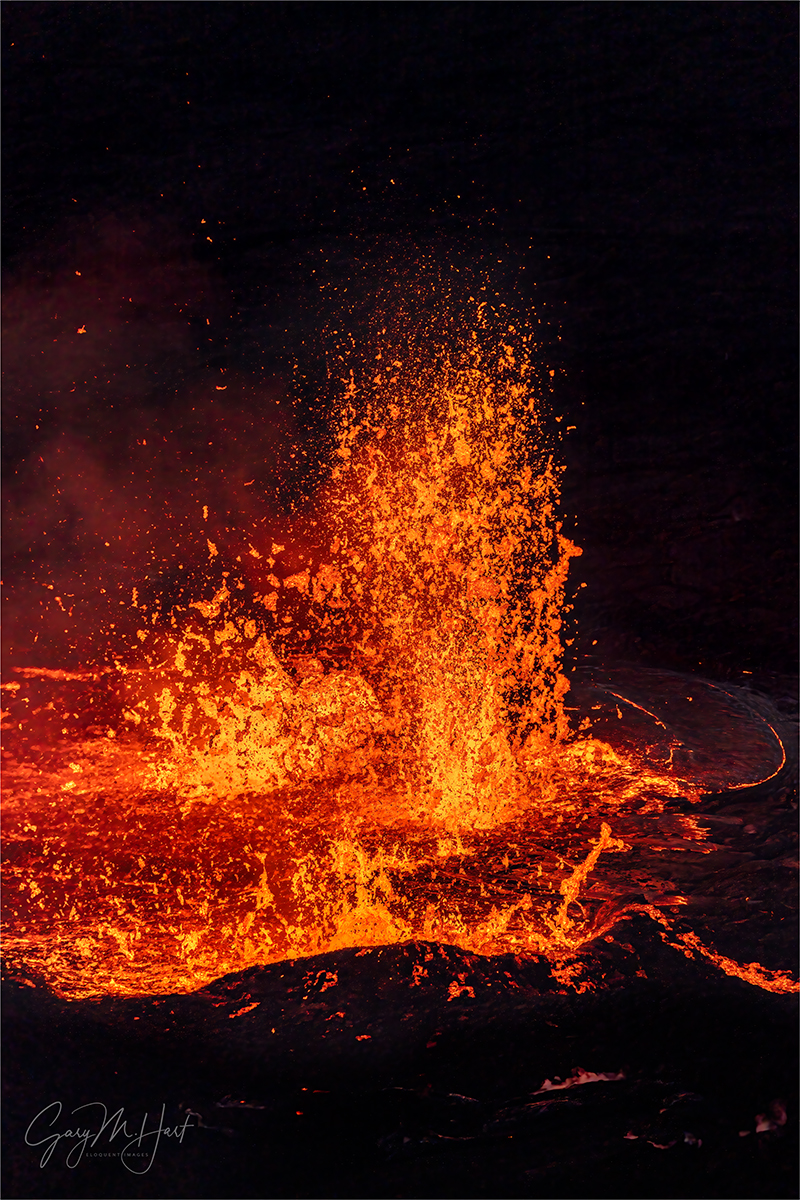
Fountain of Fire, Kilauea, Hawaii
Sony a7R V
Sony 100-400 GM
ISO 800
f/5.6
1/1250 second
I have several childhood memories of the natural world that are forever etched in my brain. The oldest is probably the time in Yosemite when I helped my dad with an ill-advised lightning shoot atop Sentinel Dome, then later that evening, just down the road at Glacier Point, enjoyed rainbow across the face of Half Dome. Another was waking in the predawn darkness to view my first comet, 0 magnitude (very bright) Comet Bennett. Then there was the first time I laid eyes on the impossible blue of Moraine Lake in Banff National Park, Alberta.
All of these experiences laid the groundwork for my life as a photographer, fostering an unconscious desire to save and share them before the memory faded. Of course no picture can accurately convey the experience of “being there,” but I somehow found comfort in the knowledge that, because I’d preserved a small piece of the event, a part of me could revisit it any time I wanted to.
With my camera to prod me, the frequency of these indelible “I was there” moments with Nature has increased: a rainbow over Yosemite Valley; lightning strikes, accented by a small rainbow, on the rim of Grand Canyon; the Milky Way above erupting Kilauea (many times); a total solar eclipse; a rim-to-rim rainbow from the bottom of Grand Canyon; the northern lights dancing in the Iceland dark.
On Sunday of this week I was gifted another. With my annual Hawaii Big Island workshop starting Monday, my brother Jay and I arrived Friday so I could check on all my workshop locations. For the first seven years I did this workshop, I never had to worry about Kilauea because it had been erupting continuously since 1983. Then Pele sent a “don’t ever take me for granted” message in 2018 with a dazzling pyrotechnic display, before promptly rolling over and going to sleep.
Since then Kilauea has stirred periodically, but scheduling workshops more than a year in advance means relying on luck to catch Pele awake. I missed in 2018, 2019, lost 2020 to COVID (no eruption anyway), and just missed it in 2021. I completely lucked out in 2022 with one of the best displays I’d ever seen. But this year things appeared to be back to business as (recent) usual. The volcano had been quiet since June, and though Pele had been showing signs of stirring for a couple of months, by the day before my workshop I’d resigned myself to another year without a Kilauea eruption. Not the end of the world—there is more than enough to photograph here without an active volcano—but a disappointment for all of us who had been crossing our fingers.
Jay and I spent Sunday afternoon out of cell phone range, scouting along the Puna Coast. So imagine my surprise when we emerged from cellular darkness to see two notifications from the USGS in my inbox. When I saw Kilauea in the subject line, my heart jumped. But when I opened the first e-mail and saw that it started with, “Kilauea is not erupting,” I quickly skipped to the second one, which had a timestamp just 26 minutes later.
The first sentence jumped out at me: “Kilauea is erupting.” I didn’t bother to read further before punching the gas and detouring straight toward the volcano. The eruption had started at 3:15 p.m., and at exactly 5:00 p.m. we were rolling up to the Visitor Center. There we learned that we could view the eruption right across the street, from Volcano House.
We raced over there and could clearly see the smoke and orange glow above the caldera rim, but only occasional bursts of lava that jumped high enough to crest the steep crater wall. Rather than photograph there, I decided to see if there might be a better view. At the steam vents we found more of the same. But while there we ran into a couple who told us the best view was at Keanakakoi, on the other side of caldera. So off we went.
At Keanakakoi we snagged one of the last parking spots, grabbed our camera bags, and bolted down the trail (a paved road now closed to non-official vehicles). After a brisk one mile walk, we made it to the vista about 10 minutes before sunset.
I’ll never forget sight greeting us directly below: the caldera floor churned with at least a two-dozen lava fountains of varying size, surrounded a honeycomb of just-cooled black lava separated by thin, glowing cracks. Splitting this fiery orgy was a large lava river and several smaller ones. We instantly joined the throngs who had jumped the improvised rope placed no doubt to prevent us from plunging to our deaths (safety-schmafety).
What followed was a clicking frenzy. I started with my 24-105 lens, eventually switching to my 100-400. (I also snuck in a couple of quick iPhone photos—the lava field was close enough to fill the frame without cropping). Monitoring my RGB histogram, I quickly determined that an exposure that completely spared the red channel skewed the rest of the histogram far to the left, which of course made perfect sense and was no problem because pretty much the only thing that mattered in this scene was the orange lava.
So focused was I on scene below me that it was a couple of minutes before I registered that I was working in what might be the windiest conditions I’ve ever photographed in. I’ve probably experienced stronger gusts (I’m looking at you, Iceland), but this wind was steady, brutal, and relentless. So strong in fact that it nearly ripped the glasses of my face, and forced me to actually keep one hand on them most of the time.
Given the rapidly approaching darkness, with most subjects this wind could have been a significant problem. But because my primary (only?) subject was imbued with its own built-in light source, and was in constant, frenetic motion that required an extremely fast shutter speed anyway, I found it all quite manageable—I was actually more concerned about getting blown into the maelstrom than I was about camera shake.
Throughout the evening I varied my exposure settings, shooting wide open with shutter speeds varying between 1/500 and 1/1500 second, and ISOs ranging from 800 to 3200. Focal lengths ranged from fairly wide (wider than 50mm at the start) to 400. In fact, many of my 100-400 frames were closer to the 100 range so I could include groups of fountains. I tried to time each shot for peak explosiveness in whatever fountain or fountains I’d targeted, but honestly, since these peaks came every second or two, that wasn’t much of a challenge.
Every once in a while I got a strong whiff of sulfur, a reminder of the risks of being so close to a volcanic eruption. It seemed like we’d been out there at least an hour when I was aware of shouting behind me. I turned to see rangers running around shoeing us from the edge and at first thought all of us on the other side of the rope were in trouble, but it turns out we were being evacuated, and they meant business. A review of the timestamps on my images showed that what seemed like more than an hour was in fact only 33 minutes.
How close were we to the eruption? The image I share today, a simple isolation of one of the eruption’s many lava fountains, is 400mm uncropped. (I learned later that we’d been only 1/2 mile away.) Unfortunately, this very-close view has been closed since our evacuation that evening, with no guarantee it will open again until the eruption abates. With this closure in place I was concerned that I wouldn’t be able to get my group a good look at the eruption—a concern that was erased in spectacular fashion Tuesday night. But that’s a story for another day….
Join me in Hawaii
I Was There
Click any image to scroll through the gallery LARGE


 Eloquent Images by Gary Hart
Gorgeous images as usual Gary. I relate to your wanting to preserve those precious moments and places, sharing the beauty with others, and hoping we can do more to restore and maintain these places.
Pingback: Sometimes It’s Better To Be Lucky Than Good | Eloquent Images by Gary Hart
Larry Saunders
Gary, I saw your image of Kilauea and it is just beautiful. Talk about being at the right place at the right time. Wow!
Pingback: 2023: The Year of Fire and Ice | Eloquent Images by Gary Hart
Pingback: Kilauea Eruption Episode 33, Part 2: Grand Finale | Eloquent Images by Gary Hart