Eloquent Images by Gary Hart
Insight, information, and inspiration for the inquisitive nature photographer
One Morning in Middle Earth
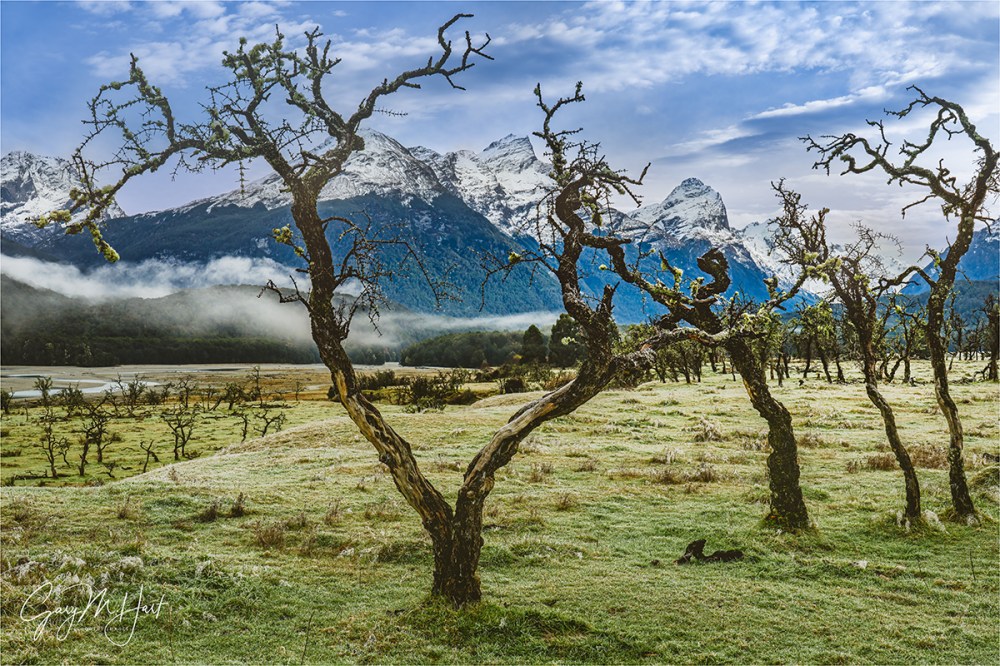
Middle Earth Morning, Matagouri Trees Near Glenorchy, New Zealand
Sony a7R V
Sony 24-105 f/4 G
ISO 100
f/16
1/40 second
Having reached a much anticipated break in my workshop schedule, I’m excited for the opportunity to carve out a little time to process images from past trips. For as long as I’ve been doing this photo workshop thing, I’ll return from a workshop, take a cursory trip through my captures, process one or two (maybe a couple more if time permits), make a mental note of the images I want to return to, then get to work on the business stuff that has to take priority. But about 80 percent of those “return to” images just seem to languish on my hard drive like the books on my Kindle that I always plan to get to later.
With no illusions of making a significant dent in this multi-year image accumulation, I started browsing my 2023 trips with no particular agenda, finally landing on the folder from the New Zealand workshop Don Smith and I do each June (winter Down Under). I got no farther than the images from our first morning…
Journey With Me
After leaving Queenstown (FYI, without a doubt the most beautiful city I’ve ever laid eyes on) dark and early, our sunrise stop is a sheltered cove on shore of Lake Wakatipu. Despite dense, low clouds obscuring the cross-lake mountain views Don and I love so much about this spot, our group enjoys nice reflections in the always crystal clear water (people actually drink from the lakes in New Zealand!)—not spectacular, but a lovely start to a day that will soon get much better.
I love the drive along Lake Wakatipu’s northeast shore. I’ve made it more times than I can count, and each time I like to imagine I’m being transported back to Middle Earth. This morning is no different.
A few miles beyond our sunrise spot, the clouds start teasing us with ephemeral views of the Thomson Mountains’ snowy summits across the lake, but the overcast’s overall persistence only adds to the drive’s ethereal feel. With clouds still ruling the sky as we enter the tiny village of Glenorchy at the top of the lake, we stop at Mrs. Wholly’s General Store for warm greetings, hot coffee, and tasty treats (not to mention handmade New Zealand wool goods), and to allow the overcast time to clear for the journey’s next leg. Clouds or not, this stop has become something of a workshop tradition.
The world really starts changing after putting Lake Wakatipu, Glenorchy, and the paved road in the mirror—a transformation enhanced this morning by patches of blue sky and a brightening landscape that hints at the sun’s imminent arrival. Despite the missing pavement, the road is quite smooth as we approach tiny Paradise, known in Middle Earth as Parth Galen and Lothlórien. Just beyond is Mt. Aspiring National Park—Isengard and more Lothlórien.
Now the undulating terrain is punctuated by native matagouri trees; in the distance, the highest peaks of the Humboldt and Richardson Mountains are starting to emerge in all their snowcapped glory and our transition to Middle Earth feels complete. The view is spectacular and the group wants to stop to photograph, but Don and I know this route well and ask our driver to continue to a spot that will allow us to add a foreground of matagouris to our dramatic mountain background. In a couple of minutes we round a bend and pull to a stop in front of a stand of twisted matagouri trees jutting from a frosty pasture.
Seeing the trees and the distant mountains haloed by the last vestiges of the diaphanous clouds, I barely avoid getting trampled as the group rushes out to capture the scene. As beautiful as the mountains are, I’m especially thrilled by the trees and want to find the best way to feature them without diminishing the peaks.
I digress
Rendering our three dimensional world in a two-dimensional medium requires a paradigm shift for photographers accustomed to capturing the world as it appears to their eyes. But while it’s impossible to create a true three-dimensional image, it is possible to create the illusion of that missing dimension.
Creating illusion of depth starts with of a couple of simple principles. First, never settle for your primary subject. When your primary subject is in the distance, look for a complementary element nearby. Conversely, when your subject is in the nearby, pay special attention to the image’s background.
While leading lines, like a fence, road, creek, or lakeshore, can guide the eye through the frame, you can also create virtual leading lines with a prominent rock, shrub, or tree that your viewers can subconsciously connect to other visual elements. Your complementary subjects don’t need to be especially compelling, they just needs to provide a brief stopping point that starts your viewer on a visual journey between the scene’s near and distant elements. When possible, I try to connect my complementary elements diagonally to move my viewers simultaneously across both of my (2-dimensional) image’s planes.
An easily overlooked flaw that can rob a scene of depth is merged visual elements on different front-to-back planes. For example, even though to your eye that distant rock is clearly behind the tree right in front of you, unless the two are completely separated horizontally (left/right, up/down), in the camera’s two-dimensional world they’ll appear at first glance to be a single object. Often the solution is as simple as moving left/right, forward/backward, or up/down.
Meanwhile, Back in Middle Earth
I start by scanning the scene to identify the most striking tree, then position myself to put the tree front-and-center in my frame. Once there I realize that I can actually frame the tallest peaks with the tree’s most prominent branches and set up at a spot that puts the other nearby trees along a more or less diagonal line that recedes from the primary tree. I compose the scene as tightly as I can to minimize the now empty sky and relatively bland grass at my feet.
While the exposure itself isn’t particularly difficult for my camera, the way I achieve it is important—given the need for front to back sharpness, I start by stopping down to f/16. With no wind this morning, I just go with ISO 100 and dial my shutter speed until the histogram looks good.
The final critical decision I need to make is exactly where to focus. The closest tree is about 10 feet away; at f/16, my hyperfocal app gives me a hyperfocal distance of about 13 feet. But those numbers are never precise and in fact vary depending on many variables, so I always like leaving myself some hyperfocal wiggle room. Focusing on the tree itself will soften the mountains, and focusing right at the hyperfocal distance will still give me nearly 4 feet of sharpness in front of the tree that I don’t need (since focusing on the hyperfocal point gives “acceptable” sharpness from half that distance to infinity). So I focus a little farther back—using that small piece of wood about 3/4 of the way to the second tree—to ensure distant sharpness. Click.
After leaving here we continue into the dense forest of Mount Aspiring National Park. No Elves or Hobbits this time, but it’s only our first day…
Don and I still have a couple of openings for New Zealand 2024
Workshop Schedule || Purchase Prints || Instagram
The Illusion of Depth


 Eloquent Images by Gary Hart
One of my favorite locations during the workshop, a perfect morning!
So many great locations, but this was a great start to the workshop!
beautiful images.
Thank you.