Eloquent Images by Gary Hart
Insight, information, and inspiration for the inquisitive nature photographer
Lightning Safety (for Photographers)

Lightning and Sun, Amistad, New Mexico
Sony a7R V
Sony 24-105 G
1/4 second
F/18
ISO 50
If you’re reading this post and hope to stay completely safe from lightning, just stop right here and simply go indoors at the first flash, and stay there until 30 minutes after the last flash. (You’re welcome.) But if you would like to assume the risks of photographing lightning while staying as safe as possible, read on….
It’s a personal calculation
I share a lot of lightning pictures. Which of course means I spend a fair amount of time outside, in and around electrical storms. In fact, if I didn’t usually have to travel so far to so much as see lightning, I’d absolutely be out there chasing it a lot more than I do. But based on my many lightning images, it occurs to me that some might believe I’m risk taker (I’m not), or that I’m just plain foolish (perhaps, but not where lightning is concerned). Believe it or not, there is method to this madness.
I was already thinking about dedicating a post to lightning safety when I recently read an article on that very topic from the June 2024 “Outside Online” magazine. While there wasn’t a lot of new info there, that article did underscore for me how much most people have wrong about lightning safety, and how that ignorance puts them at risk. Given that sharing lightning images as much as I do might be construed as tacit encouragement to go out and do this inherently unsafe thing, I think the time for my safe (-ish) lightning photography post is now.
I want to start by acknowledging that photographing lightning is dangerous, no matter how careful you are. But life is continual series of calculated risks that start when we get out of bed in the morning, and continue until we turn off the light at night. (And have you ever considered that even after you’re “safely” tucked away with the lights out, a meteor could be speeding toward your bed? If only you’d have been outside photographing lightning, you’d have escaped perfectly unharmed.)
Whether it’s driving a car, sharing our lives on social media, taking a jog around the neighborhood, managing finances online, or free-soloing El Capitan, there is some degree of risk in virtually every decision we make. Yet we go ahead and expose ourselves to these potential dangers anyway, when we believe the benefits outweigh the risks.
As a nature photographer with a significant and lifelong attraction to Nature’s astonishing power in many forms, my personal risk/reward calculation deems the thrill of witnessing and photographing lightning worth the inherent risks. But that doesn’t mean I blindly rush outside at the first thunder crack—if anything, my desire to experience as much lightning as possible is a great motivator to become as familiar with lightning safety as I possibly can be.
Safety first
The 2000 (or so) people killed worldwide by lightning each year had one thing in common with you and me: they didn’t believe they’d be struck by lightning when they started whatever it was they were doing when they died. The key takeaway here is, don’t get cocky.
The foundational elements of lightning safety are:
- Preparation: If we knew in advance exactly where the next lightning bolt would strike, the risk of getting struck would be almost zero. Of course that’s not possible, but you can at least give yourself an advantage by learning as much about thunderstorms and lightning as possible, and by relying on lightning experts who know far more than you do.
- Weather forecasts are your friend. Find a reliable source very familiar with the area you want to photograph lightning, and monitor the forecast constantly. For me, that’s the National Weather Service, who has forecast offices throughout the US that are staffed with genuine weather experts, and in fact provides most of the data the other forecasters rely on.
- Thunderstorms have personalities, and while you should always assume they’ll behave unpredictably, they do have “tells” that can hint at their behavior for anyone who understands the how, where, and why of thunderstorm development. Learn to recognize the stages of thunderstorm development and their various components (inflow, outflow, updrafts, downdrafts, anvil tops, wall clouds, hail zones, etc.) that reveal important things like the storm’s direction of motion, intensity, and where its lightning is most likely.
- Awareness: Never get so caught up in the spectacle of an electrical display that you lose track of everything happening elsewhere. And it’s more than just your eyes you need to rely on—lightning safety is very much a multi-sensory effort. For example:
- A wind increase or direction change often signals an approaching storm.
- The sound of thunder is usually an indication that the storm is too close. You generally don’t hear thunder that’s more than 8 miles away (at 5 seconds per mile, thunder from lightning 8 miles away would arrive in 40 seconds), yet lightning can easily strike 10 miles or more from its prior strike. Though I’m not usually close enough to hear my lightning’s thunder, when I am, my vigilance goes on overdrive.
- Hair on your head, arms, or legs standing up is a sign of grave danger, indicating a nearby strike is imminent. This is the time to run, not get one more shot.
- Similarly, the smell we normally associate with burning electronics is another indicator of the electrically charged (ionized) atmosphere that immediately precedes a strike.
- Escape plan: Before setting up to photograph lightning, always have an escape plan—a safe place immediately (within seconds) accessible if lightning surprises you.
- The best escape plan is to never let the lightning get close enough that you need to escape in the first place. That’s why I prefer photographing lightning at distances great enough that I can’t hear the thunder, using my moderate to long telephoto lenses (24-105 and 100-400) and a Lightning Trigger (www.LightningTrigger.com) that senses daylight lightning more than 50 miles away—not too uncommon at Grand Canyon, where I’ve done the majority of my lightning photography. (And any time you find yourself reaching for an extreme wide lens, such as a 12-24 or 16-35, just assume the lightning is too close.)
- But for those times I might need to escape, before setting up I want to know exactly where my safe shelter is and how long it will take me to reach it. For me, that shelter is almost always my car, and I don’t like it to be more than a 30-second sprint from where I’m photographing (yes, I realize sometimes even 30 seconds isn’t fast enough—see risk calculation reference above).
Of course, since an electrical storm always has a first lightning bolt, all the vigilance in the world won’t save you if you’re just plain unlucky enough to catch one before you have a chance to retreat. But if you’ve done your preparation, use all of your senses to remain hyper-aware of the conditions in all directions, you’ve greatly improved the odds that lightning won’t surprise you. And when you do see, hear, smell, or feel anything that causes you to think the lightning risk is increasing, it’s always better to retreat to your pre-determined shelter (building or car) too soon than too late.
Under fire
With those common sense basics out of the way, let’s get to what I think is the greatest risk facing lightning photographers: General ignorance of lightning safety in the field that causes them to feel safer than they actually are while photographing it. There’s just a lot of misinformation out there.
The safest place to be in an electrical storm is in a fully enclosed structure that has plumbing and/or wiring that will channel a lightning strike around the perimeter and into the ground and away from occupants. Contrary to what many believe, shelter from rain does not equal shelter from lightning. You are not safe in an open structure (such as a covered patio, bus stop, shed, etc.), beneath a tree or overhanging rock, or in a cave. In other words, if you find yourself outside with no fully enclosed structure to retreat to, you’re kind of screwed.
But if your goal is to photograph lightning, you’ll no doubt want to be outside, with a bit more mobility than a solid building provides. Fortunately, lacking an enclosed building (with plumbing and/or wiring), the next best shelter is a hard-top, metal vehicle with the windows closed. Though fiberglass bodies don’t work, modern composite car bodies usually contain enough metal to safely channel the lightning.
Lightning myth buster: A car’s lightning safety is courtesy of its metal frame and has nothing to do with its rubber tires. You’d be just as safe sitting in a vehicle that’s perched on 4 bare rims as you would be in a vehicle atop massive truck tires.
So the combination of safety and mobility makes my car an integral component of my lightning-photography safety protocol. When I chase lightning, I make sure the vehicles are within a few seconds sprint from wherever I (and my group) are set up. And I never set off into the wilderness any time there’s even a slight chance of electrical activity—regardless of how clear the sky is now, or how great the potential photography.
The last resort
If you follow the guidelines I’ve outlined above, you should be able to avoid most lightning dangers. But most is not all. Maybe you wandered a little far from shelter and got caught off guard because the storm acted completely unpredictably, or (more likely) you got so caught up in the spectacle that you missed a warning sign or strayed too far from shelter. Now you’re exposed and fear that the next bolt could target you.
If you do ever find yourself caught outside in an electrical storm with no available shelter, shame on you. But I get it—on the Grand Canyon North Rim, my groups take the 1/2 mile walk to Cape Royal, where we have indeed photographed lightning. Being 1/2 mile from safe shelter is outside my standard lightning comfort zone, but the visibility here is distant enough that we can (and have) photographed lightning 50 miles away, and I’m extremely quick to pull the trigger on our retreat with even the slightest indication that nearby lightning might be possible.
If you do find yourself exposed to lightning without safe shelter, here’s some knowledge that will improve your chances:
- Lightning is quite lazy and always follows the path of least resistance, so you should avoid proximity to conductors like metal, water, power poles, cell towers, and trees (which contain lots of water). While these things don’t actually attract lightning, they do provide the easiest path for lightning to follow—unless you get too close, in which case you may become the path of least resistance.
- Whether you use an aluminum or carbon fiber tripod makes no difference.
- Sadly, the human body is mostly water, making it an excellent conductor. Your job is to minimize the chance that you will be the lightning’s conductor of choice.
- Avoid high ground.
- Avoid exposed areas.
- Stay at least fifteen feet from other people, to minimize collateral damage.
- Do not lie down. Lying down to reduce your height might slightly improve your chances of a direct hit, but it also greatly increases your surface area that’s in contact with the ground, thereby greatly increasing the chances a nearby strike will use your (waterlogged) body to discharge itself.
- If you’re surrounded by trees, position yourself near shorter trees, as far from the trunks as possible
- Rubber soled shoes provide no lightning protection. And despite assertions to the contrary, neither does a foam sleep pad.
- The “lightning position”—crouching on the balls of your feet, with your feet together and your hands covering your ears—is of very little value. Some consider it the solution of last resort, but many lightning safety experts now believe you’d be much better off spending the time you’d be in the lightning position running to a safer location.
- Safety is relative, so sometimes the best you can do when there is no safe location, is to find a safer location:
- Head to lower ground—basically, just run downhill, and keep going until you can’t get any lower (but avoid standing beneath or even getting too close to elevated ridges).
- Stand in a grouping of uniform height, shorter trees.
At the risk of repeating myself…
If you’re risk averse, just stay inside. But if you find beauty in Nature’s power, few natural phenomena provide a better opportunity to experience that power than lightning. And while lightning isn’t as predictable as a moonrise, not only is lightning’s unpredictability a big part of what makes it special, lightning isn’t as unpredictable as those who don’t understand it believe. If you learn the science, remain vigilant, and always respect the risks, photographing lightning can be one of the most thrilling things you do with your camera.
About this image
Today’s image is one of many from what became one of the most memorable photo days of my life (from my June 2025 storm chasing workshop). To read about the shoot that produced this image and several others, click here.
Here’s the bounty from the storm chasing afternoon that produced today’s image (June 7, 2025)
-
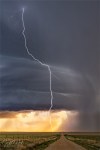
- Lightning and Road, Amistad, New Mexico
-

- Down the Middle, Rainbow and Lightning Near Amistad, New Mexico
-

- Double Rainbow and Lightning, Amistad, New Mexico (vertical crop)
-

- Alien Spaceship, Amistad, New Mexico
-

- Lightning at Sunset, Eastern New Mexico
-

- Sunset Supercell Lightning, Amistad, New Mexico
-

- Lightning and Thunderhead, Eastern New Mexico
-
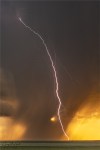
- Lightning and Sun, Amistad, New Mexico
Read my Photo Tips article on photographing lightning: Lightning
And here are my lightning-centric photo workshops:
Grand Canyon Monsoon
Storm Chasing
Lots of Lightning
Click any image to scroll through the gallery LARGE


 Eloquent Images by Gary Hart
WOW!!!
very informative article and, for me, some news like why the car is secure (I’m thinking was the tires).
About the stuff like a tripod have you a suggestion?
thank you
I’m predominately a hiker who just happens to take a lot of photos. But even so, this was a really helpful reminder for the times I do find myself out in the wilderness as storms are rolling in. Thanks!