Eloquent Images by Gary Hart
Insight, information, and inspiration for the inquisitive nature photographer
Still Learning
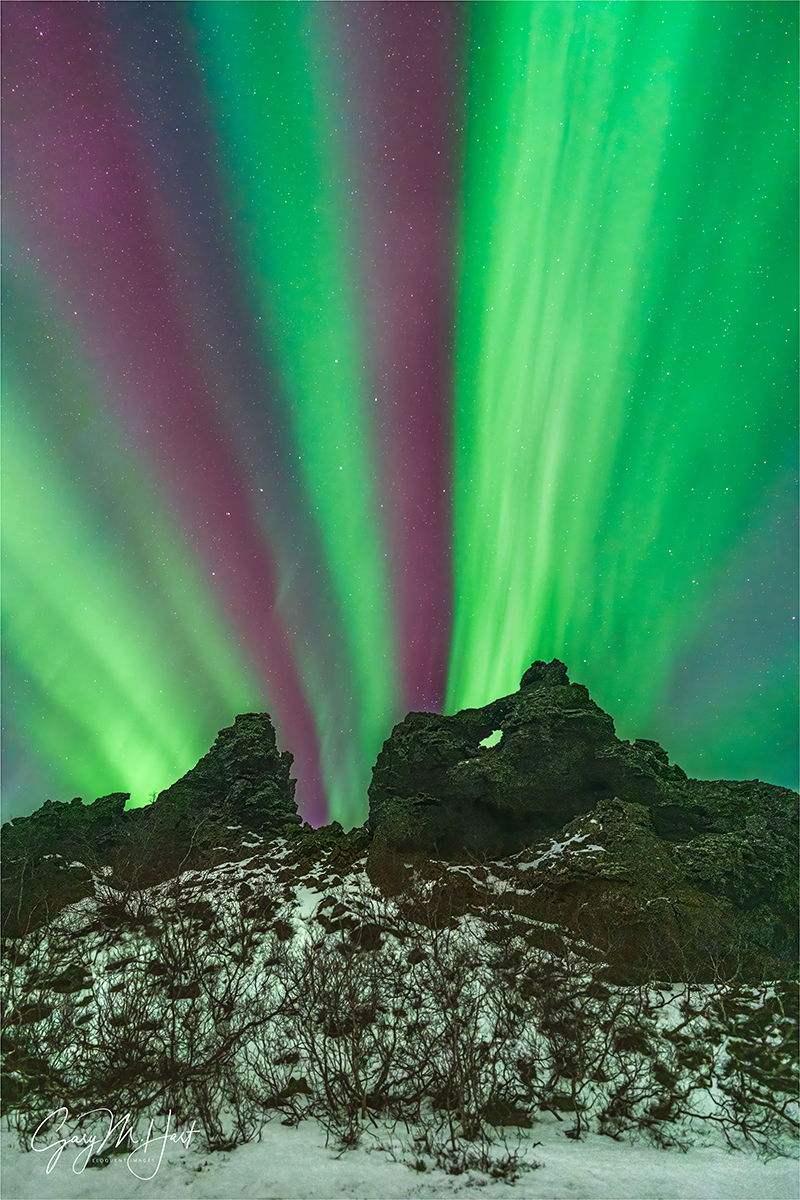
Aurora and Big Dipper, Dimmuborgir Lava Fields, Iceland
Sony α1
Sony 14mm f/1.8 GM
ISO 4000
f/1.8
4 seconds
Whether it’s rafting Grand Canyon, gaping at a comet, or chasing supercells and tornados across the Midwest, instead of scratching an itch and moving on (as I’d expected would happen), checking-off a bucket-list item only seems to fuel my desire for more.
Case in point
I saw my first aurora in 2019. As with all my prior bucket-list experiences, the aurora experience actually exceeded my lofty expectations. Puzzling over why sights I’ve dreamed of for so long so consistently exceed my expectations helped me appreciate the power of experience over simple observation. For me, the experience component—that feeling like I’m part of something—is what motivates me to learn as much as I can about my subjects. Speaking only for myself (your results may vary), simply photographing beauty without taking time to understand just feels superficial.
Though I’d done a little research on auroras before my first Iceland visit, that obsession to truly understand what was going on didn’t fully kick in until I actually stood beneath those multi-colored shafts and sheets and watched them twist and fold above my head. Game on.
I learned about solar cycles, solar storms, the solar wind, Earth’s polarity, the magnetosphere, the magnetotail, ionization of atmospheric molecules, and how all these elements conspire to put on this dazzling show. And since, for photographers, a significant aspect of aurora science centers on the ability to predict when and where it will appear, I paid special attention to the Kp index: the measure of aurora-causing electromagnetic activity in Earth’s magnetosphere that is the prime focus of most aurora prediction resources.
So, armed with just enough knowledge to be overconfident, and a Kp-based app that validated it, I enjoyed reasonable aurora success in subsequent Iceland visits. But despite this success, and access to Kp forecasts that stretched out 30 days, it didn’t take long to realize that predicting tonight’s aurora activity by Kp-tracking alone is not very reliable—less reliable even, than a weather forecast that says it’s going to rain in 7 days. While there was a clear correlation between high Kp values and an active aurora, I couldn’t figure out why so many high Kp nights disappointed, and low Kp nights dazzled.
What was I missing?
Digging deeper, I saw that my aurora app measured a lot of electromagnetic behavior besides Kp. I’d never really paid a lot of attention to these other cryptic values, but having become pretty comfortable with aurora-science basics, I thought my brain cells might be primed to dig a little deeper. The first thing I learned was that many of these measurements, while significant to solar scientists, aren’t terribly useful to aurora watchers. But I did identify one that is: Bz.
In the simplest terms possible, Bz measures the north/south orientation of the interplanetary magnetic field (IMF) that originates at the sun and propagates outward, eventually interacting with Earth’s magnetic field. Turns out, for predicting auroras, the Bz orientation might just be more important than the Kp index.
In fact, the Bz value can completely make or break an aurora show. Without getting too deep into the scientific weeds (by diving into knowledge that’s far beyond my pay grade), a south-oriented IMF, represented by a negative Bz value, stimulates Earth’s magnetosphere in way that greatly increases the chances for an active aurora; when the IMF is positive (north oriented), the IMF subdues magnetosphere activity and stifles the aurora.
The problem—and likely the reason aurora forecast apps focus mostly on Kp—is that while Kp can be (kind of) predicted days or (more dubiously) weeks ahead, Bz can only be measured, not predicted. The best we can do is park satellites at the gravitationally stable Lagrange Point 1 (L1)—where Earth/Sun gravity balance each other—to monitor the solar wind as far out in space as possible (about 932,000 miles from Earth). Depending on the speed of the solar wind, the IMF can take from 15 to 60 minutes from the time we measure it until affects the magnetosphere and delivers an aurora show (or not).
Though Bz can’t really be predicted, the 15 – 60 minute lag time between measurement and arrival does provide one extra benefit: the ability to see what’s coming in the next hour or so to decide whether or not this would be a good time to pack up and go home, or maybe stick around a little longer.
Applying my new knowledge firsthand
This year’s Iceland Aurora photo workshop was the first opportunity Don Smith and I had to put our Bz knowledge to the test. Regardless of the Kp forecast, we always go out unless the sky is completely covered by clouds, with no hope for clearing. This year we made it out 4 nights, at 3 different locations.
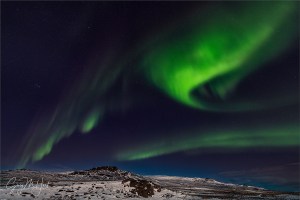
Winter Night, Aurora Over Vatnsnes Peninsula, Iceland
Our first attempt was at Kirkjufell, but the Kp was low and the Bz stayed positive and, as expected, the aurora was never more than a faint green, invisible to our eyes and barely visible in our images. We ended up having a beautiful moonlight shoot at one of the most photogenic mountains in the world, but no real aurora display.
The next night was on Vatnsnes Peninsula in far north Iceland. Despite a similarly low Kp forecast, when we finished dinner and saw stars overhead, we went out aurora chasing again. When we started the aurora was definitely better than the prior night, but nothing spectacular. Then the Bz turned moderately negative about half-way through our shoot—it was as if someone had flipped a switch to give us firsthand demonstration of what a negative Bz can do. The show this night far from the most dynamic that Don and I have seen, but it was very nice—especially for the first-time aurora viewers in our group.
The next night we had clear skies again, so our guide took us to Dimmuborgir Lava Fields. With a network of trails that wind beneath striking volcanic rocks (used in Game of Thrones), this turned out to be a fantastic spot for the northern lights—sadly, despite a pretty good Kp forecast, the Bz didn’t cooperate and the aurora that night, while better than the Kirkjufell show, didn’t come close to the prior night.
Which brings me to the workshop’s final northern lights shoot. With a forecast for clear skies, a decent Kp, and a Bz that had been mostly negative for several hours, we returned to Dimmuborgir with high hopes. From the second we exited our van and saw the lights dancing overhead, I knew we were in for a treat. Since the group had already been here twice—once for that earlier aurora shoot, and then again the next afternoon, Don and I just gave everyone a be-back time and set them free (then stood back to avoid being trampled).
I took a lot of pictures of this spectacle, but had almost as much fun watching everyone’s reaction to it. All the while, I monitored the Bz on my aurora app, further confirming its correlation with the brilliance and spread of the aurora above us.
The show this night might not have been the most spectacular northern lights display I’ve ever seen, but it was definitely in my personal top 5—made even better by a location that provided the best variety of striking foreground subjects I’ve ever had for an aurora. And being able to include the Big Dipper with this scene was an unexpected treat.
Join Don and me for next year’s Circle of Iceland Northern Lights photo workshop (a brand new itinerary)
Workshop Schedule || Purchase Prints || Instagram
The Lights Fantastic


 Eloquent Images by Gary Hart