Eloquent Images by Gary Hart
Insight, information, and inspiration for the inquisitive nature photographer
Selecting the Right Tripod

Morning Light, Wildflowers and Upper Yosemite Fall from Sentinel Dome, Yosemite
Canon EOS-1Ds Mark II
1/50 second
F/16
ISO 400
105 mm
More than just a platform to eliminate camera shake, a sturdy tripod is an essential part of a landscape photographer’s creative success. Read the reasons here: The Tripod Difference
A photography axiom (popularized by Thom Hogan) says that photographers purchase three tripods:
- Your first tripod is a cheap, flimsy, aluminum/plastic monstrosity that sags when even moderate weight is added, and vibrates like jello with the slightest breeze
- Next comes a sturdy but heavy “value” tripod that does the job but you quickly tire of lugging it
- Finally, you spring for the tripod you should have purchased in the first place—a sturdy, light, expensive tripod that serves you for decades
In other words, you’ll save yourself tons of money by biting the bullet and just starting with the tripod that you covet (and probably already know you’ll eventually end up with).
Purchasing a tripod can be an expensive, daunting process, fraught with opportunities for error. While there’s no one-size-fits-all option, there are things you should know as you search for your tripod life-partner.
Sturdy
Sturdiness is the single most important quality for a tripod/head that’s so obvious I shouldn’t have to spend a lot of time on it. But “sturdy” is a subjective term, and sturdy enough for an APS-C mirrorless system may be woefully inadequate for a DSLR mounted with long telephoto.
Factors that can a affect a tripod’s sturdiness are:
- Weight: All things equal, a heavy tripod is sturdier than a light tripod. But the best (and usually most expensive) tripods compensate for their lighter weight by combining better materials with quality design and construction.
- Build material: Most tripods are made of aluminum or carbon fiber. Pound-for-pound, carbon fiber is stronger than aluminum, but it’s also more expensive.
- Number of leg sections (usually 3 or 4): The advantage of more leg sections is that the tripod will collapse smaller; the downside is that the intersection of leg sections is inherently weaker than the rest of the leg. So it stands to reason that the fewer leg sections, the sturdier the tripod. My experience has been that, for real-world use, with a quality tripod, the number of leg sections makes very little. On the other hand, the number of leg sections could be a problem for the budget tripods.
- Centerpost: Simply put, the centerpost is the least stable part of any tripod system. I prefer tripods with no centerpost; if I have a tripod that has one, I try not to use it, or to only extend it a few inches. Of course no centerpost means longer legs to reach a comfortable height, which generally means more expensive too.
Payload
If you have a mirrorless system, you can probably get away with a lighter tripod than someone who still shoots with a DSLR because mirrorless bodies and lenses are smaller. When considering tripods, a good place to start is weighing your heaviest body/lens combination, then check the specifications for the tripod and head (usually sold separately) you’re considering for a “Maximum Weight” rating.
Most tripods and heads offer this payload information, but it’s often (usually?) more driven by marketing than empirical data, and can vary from manufacturer to manufacturer. While I wouldn’t take the payload number too literally, it’s useful for comparison purposes. I would never try to use a tripod whose listed maximum payload is close to the maximum payload I might use. To be safe, in general, I recommend avoiding any tripod or head whose maximum weight isn’t at least double the maximum weight you might put on it. (More on heads below.)
How tall?
Stooping, even just a few inches, may not seem like a big deal at first, but it gets old really fast (especially if, like me, you feel like you’re getting old really fast). Ideally, your primary tripod will be tall enough to elevate your camera to eye level without extending the centerpost (or, like mine, with no centerpost). While not essential, even taller than eye level is better because extra height adds compositional flexibility, the ability to elevate above obstacles, and makes it easier to handle uneven terrain.
Your own minimum tripod height (MTH) determines the shortest tripod you can use without stooping or raising the center post. Of course it’s not as simple as selecting a tripod that’s as tall as you are because you’ll be mounting a camera and head atop the legs (and I’m guessing your eyes aren’t on top of your head either).
Here are the steps for determining if a tripod is tall enough for you to use without extending the centerpost:
1. Start with the tripod legs’ fully extended height (legs extended, center post down), easy to find in the manufacturer’s specifications. 2. Add the height of the head you’ll be using—don’t have a head yet? Go with 3 or 4 inches. 3. Add the distance from the base of your camera to its viewfinder. 4. Subtract 4 (or so) inches from your height with shoes on (unless you photograph barefoot), to account for the distance from the top of your head to your eyes.The height you get is the minimum height you should be looking for in your “forever” tripod.
Variables dictated by need and preference (let’s review)
- If budget is a concern, it’s okay if your tripod has a centerpost, but ideally your tripod will be tall enough to use without one because a centerpost is less stable, adds weight, and makes it impossible to lower your camera all the way to the ground (without a convoluted system).
- Carbon fiber is lighter and and less prone to vibration than aluminum, but more expensive (see Tripod axiom above). Carbon fiber also doesn’t feel as cold on those frigid winter mornings.
- Three leg-section tripods are less work to set up and take down; four leg-section tripods collapse smaller. In theory, the more leg sections a tripod has, the more it’s prone to vibration (each junction is a point of weakness), but I haven’t found this to be a big concern with a quality tripod.
- And speaking of leg sections, you’ll need to choose between twist locks and flip locks. That’s a personal preference thing. I find the flip locks a little easier when I’m fully extending and collapsing the tripod at the beginning and end of a shoot, but the twist locks easier for partial adjustments of the legs while I’m shooting. The flip locks can be noisy, and can catch on things. All of my tripods have twist locks.
Tripod head
For landscape photography, I strongly recommend a ball head (pivoting ball that can be controlled by loosening and tightening a single knob) rather than a pan/tilt (a lever for each axis of motion). And beware of the pistol-grip ball heads—they may seem cool, but I’ve found that they don’t handle weight well.
As I mentioned earlier, every reputable tripod head manufacturer provides maximum weight guidelines for their heads, but take these numbers with a grain of salt. All things equal, the heavier the head, the better it will handle weight. Frustrations with having an inadequate head include wind-induced vibration and camera droop after the head is tightened. If you want a lighter head that’s also sufficiently sturdy, you’ll need to spend more money.
Quick-release system
You’ll definitely want some kind of quick-release mechanism that allows you to quickly attach/detach the camera to/from the head. The simplest kind is a metal plate (don’t even consider anything with plastic parts) that mounts to the camera’s tripod screw and matches a complementary clamp on the head. The clamp might engage/disengage with a lever or twist-knob—I prefer the lever kind because they’re easier, but I have a friend who will never use one again after accidentally jettisoning his camera after the lever caught on something (but many quick-release systems have a lock that prevents this).
The flat plates are okay, but the easiest, sturdiest quick-release system is the Arca-Swiss L-plate (the Arca-Swiss style is a standard offered by many manufacturers). An L-plate is a 90-degree (L-shaped) piece of machined metal (usually aluminum); one axis mounts flush with the bottom of the camera body, attaching via the tripod mount screw, and the perpendicular axis hugs one side of the camera body. The entire length of both plate axes are quick-mount rails that attach (with a lever or knob) to the corresponding mounting clamp on the tripod head to provide a quick-release plate on the bottom and side of the camera.
This L-shaped setup makes switching between horizontal and vertical orientation a simple mater of releasing the clamp connecting the camera to the head, rotating the body, and re-securing the clamp (it takes longer to read the description than to execute it). Another advantage of an L-plate is that, whether your camera is oriented horizontally or vertically, it is always over the tripod’s center of gravity (more stable), and stays at more or less the same height.
If you’re really serious about your photography, you’ll invest in an L-plate system—once you do, it’ll be hard to imagine how you lived without it. Because every camera model has its own dimensions and unique cable, control, memory card, and battery access points, the best L-plates (like those from Really Right Stuff) are custom-machined to fit specific camera bodies, so when you get a new camera, you’ll probably need a new L-plate.
My tripods
I use two Really Right Stuff tripods: as of spring 2025, my primary tripod is the Really Right Stuff Ascend 14L with the integrated head. It’s as close to a perfect tripod for my needs as any tripod I’ve ever used or seen, and is the first tripod to check every box for me: It’s super light, sturdy enough for my heaviest body/telephoto combo, compact enough to fit in a small suitcase, and tall enough to use sans centerpost without stooping (I’m 5′ 9″). And it’s so compact that I’ve started carrying it on to flights attached to my camera backpack. (As you might expect, the Ascend is also far beyond the budget of many photographers.)
My second tripod is the much taller and heavier RRS TVC-24L with a RRS BH-55 head. Since getting the Ascend, I only use the 24L when I drive to a shoot (don’t fly with it), won’t be hiking far, and plan to shoot extreme telephoto. The Ascend can handle the extreme telephoto, but the 24L, combined with the BH-55, is even sturdier.
A few words about this image
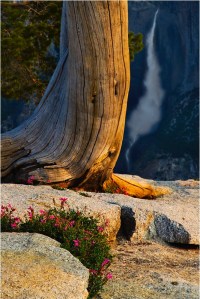
Like so many of my images, this one was a process that would have been much more difficult without a tripod. My objective was to ensure sharpness in the sunlit rocks, wildflowers, and tree in the foreground, and to allow Yosemite Falls to recede into the background. Finding the right combination of subject distance, focal length, framing, focus point, and f-stop/shutter/ISO was a painstaking process that required multiple images before I was satisfied.
Being on a tripod allowed me to review and refine the previous image without completely recreating it each time (as I would have had to do if I’d been hand-holding). Furthermore, because the focus margin was razor thin, even small but unavoidable distance changes introduced by hand-holding would have jeopardized focus success. And finally, using a tripod without a centerpost enabled me to drop all the way down to the flowers’ level.
Links
Making the case for using a tripod
Really Right Stuff
Photo Workshop Schedule
Using my Tripod to Build an Image
(Click, evaluate, refine, click…)
Click any image to scroll through the gallery LARGE


 Eloquent Images by Gary Hart