Eloquent Images by Gary Hart
Insight, information, and inspiration for the inquisitive nature photographer
Dinner Can Wait
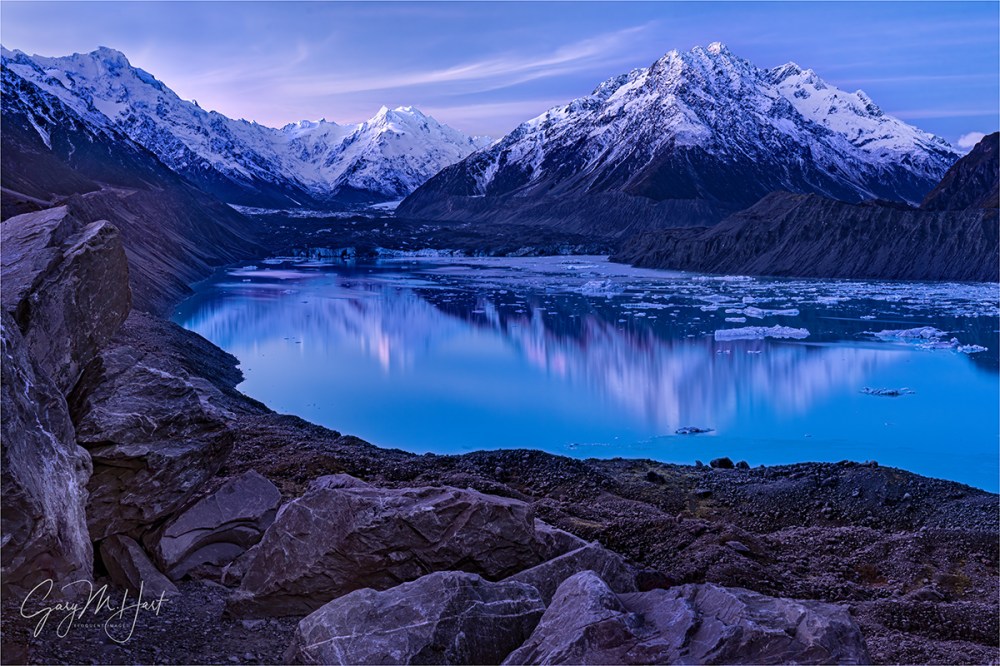
Glacial Twilight, Tasman Lake Reflection, New Zealand
Sony a7R V
Sony 24-105 f/4 G
ISO 100
f/16
13 seconds
Among the (many) highlights of the New Zealand workshop Don Smith and I do each year is the short but steep hike to the Tasman Lake vista. Somehow the people at Aoraki / Mt. Cook National Park have managed to cram the .4 mile trail (I measured) with 334 stairs (I counted), but once you’ve caught your breath at the top of the trail, the reward for your effort is a 270 degree view that includes 12,200 foot Mt. Cook (New Zealand’s tallest peak), Tasman Glacier (covered in black rock in this image), turquoise Tasman Lake dotted with icebergs, the Tasman Valley, and a host of snowcapped Southern Alps peaks.
Because free-soloing this Tasman view climb isn’t for everyone, Don and I have an alternate spot for those who don’t feel like mountain climbers. This year, after dropping me and my Tasman Lake crew at the trailhead, Don and our driver Steve took the (larger) remaining group to a nearby bridge across the Hooker River, where they could photograph many of the same peaks with the river in the foreground. The plan was for both groups to photograph sunset at our respective locations, then reconnect for dinner while waiting for the sky to darken enough for (another) Milky Way shoot.
Normally I’m not crazy about setting rigid meet-up times following a shoot because it’s always impossible predict what conditions we’ll have and exactly when the show will be over. In this case we had enough cell service at both locations to allow us to include a little “We’ll let you know if we need more time,” flexibility in the plans. That turned out to be a good thing.
I’ve probably been up to this view at least a dozen times now, and each time it’s different. And much like approaching Tunnel View in Yosemite, you have no idea what’s in store until the view is upon you. The typical variables are the clouds, the amount snow at lake level, the number of icebergs and their location on the lake, and the color of the lake (always some shade of glacial green/blue).
Also like the Tunnel View experience, the reaction of people seeing this view for the first time is a true personal treat. This year’s experience was no exception, especially since the view this evening was among the best I’ve ever seen here. It checked most variables mentioned above: thin clouds swirled beneath the peaks; there was more ice on the lake than I’ve ever seen, most of it floating in the best part of the scene; and the lake’s color was off the charts. The only thing missing was snow at lake level.
Though sunset was still 45 minutes away, the light on the swirling clouds kicked us into gear instantly. As I worked on compositions ranging from extremely wide to moderate telephoto, it seemed the departing sun was taking the clouds with it—by the time the last sunlight kissed the tips of the peaks, the only clouds remaining were distant cirrus.
At that point it seemed like the show was over and a couple in my group started to pack up their gear and head back down to wait for the van. But I suggested that since we were already up here, and there was potential for some nice post-sunset twilight light, we may as well hang out to see what happens. A couple of minutes later I got a text from the other group saying they were wrapping up, but I responded that we’d need at least 20 more minutes—10 to see what the sky does, and 10 to make it back down to the trailhead.
About that time I took my eyes off the sky to glance at the lake and did an actual double-take. In all the years I’ve come here, I’ve never seen the lake surface still enough for a true reflection, but that’s exactly what was forming. I pointed it out to the others and we all snapped back into action. By this time it was fairly dark—dark enough that while waiting for one exposure to complete I was able to fire off a text to Don and Steve saying that we need more time, to just go to dinner without us.
This composition is a version of one I’d settled on earlier, before the reflection started. I’d quickly realized that biggest problem with this otherwise perfect scene was that a wide shot would require including either too much fairly empty sky, or too much of the jumbled and very bland rock surrounding the lake (which is why I always hope for snow at lake level). It’s difficult to tell from this image, but the slope down to the lake is quite steep—not vertical, but steep enough that it would require a little skill and great care by anyone trying to pick their way down to lake level. But this steepness allowed me to step about 5 feet back from the edge and use nearby (much more interesting) boulders to block most of the ugly lakeside.
Since these foreground rocks were between 5 and 10 feet from my camera, I had to be careful about depth of field. But because nothing in my frame was moving, after stopping down to f/16 I didn’t need to make any ISO compromises to speed my shutter—I just kept my ISO at 100, focused on a spot about 10 feet away, and dialed in the shutter speed that gave me the exposure I wanted. In this case that was 13 seconds (which should give you an idea how dark it had become). This long shutter speed had the added benefit of smoothing very slight motion disturbing lake surface, helping the reflection stand out even better.
Another thing I didn’t fully appreciate until I compared this image to previous images from this view was how much more blue there was in this lake that normally tends toward green. I attribute the color to the fact that by this time there was no direct sunlight anywhere, so the only source of light was the deep blue sky, which was still reflecting from the lake.
We made it back down the hill in near darkness, arriving at the trailhead at about the same time Steve returned from dropping the rest of the group at the restaurant. That night’s buffet was a little pricey but almost as spectacular as the view we’d just photographed and worth every penny, especially given the appetites we’d worked up. We finished the night with a fantastic Milky Way shoot just up the road from where the rest of the group had photographed sunset, then slept quite well back at our hotel in Twizel.
Join Don and Me in New Zealand next year
Workshop Schedule || Purchase Prints || Instagram
Big Reflections


 Eloquent Images by Gary Hart
Gorgeous! Sorry I missed this one, choosing to not do the 300+ stairs was obviously not the right decision on my part!
Thanks, Pat! Tasman Lake is always a tough balancing act for me as a workshop leader because I need to be able to convey its beauty without talking people into something they really shouldn’t attempt. (And you could have chosen to attempt the 334 steps and realized halfway up you’d made a mistake.) 😊
Great story, great image. I always enjoy reading the story behind the shot.
Larry
>
Life is full of choices: This chosen hike was well worth the effort. Lovely photo, Gary.
Pingback: Smart Luck | Eloquent Images by Gary Hart