Eloquent Images by Gary Hart
Insight, information, and inspiration for the inquisitive nature photographer
Sometimes It’s Better To Be Lucky Than Good
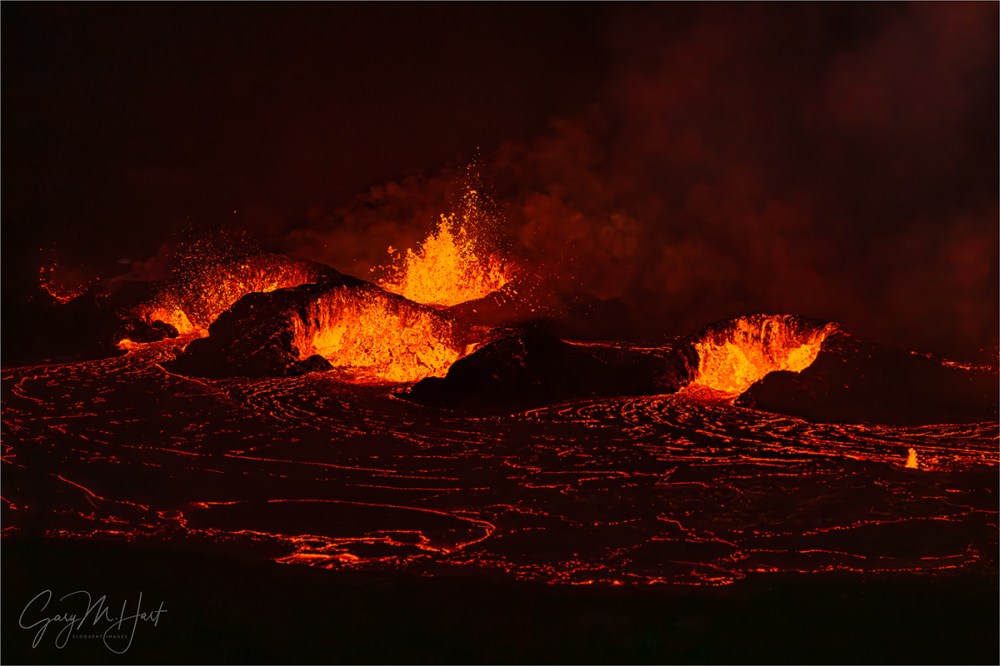 Making Mountains, Kilauea, Hawaii
Sony a7R V
Sony 100-400 GM
ISO 1600
f/5.6
1/500 second
As a rule, landscape photographers resent being told “you’re so lucky to have seen that.” We work very hard to get to our scenes in just the right conditions, and to create the compositions with the exposure settings that portray them at their best. But I have to admit that luck is a factor as well—sometimes more than others.
For example…

Sunrise Mirror, Mono Lake
One time my brother Jay and I spent an afternoon exploring the north shore of Mono Lake, searching for alternatives to the mayhem of heavily-photographed South Tufa. Navigating a maze of barely passable unpaved roads, we found a remote spot that required a half mile walk through sand and shoe-sucking mud to reach, but it looked like it would be worth returning to for sunrise.
Rising a couple of hours before the next morning’s sun, we made our way in that general direction, but in the darkness couldn’t find the exact spot (or even the exact road). Nevertheless we did find a place to park, so we blazed a new trail to the lake, where we waited for sunrise.
Though luck isn’t what got us out of bed that morning, it had everything to do with all that followed. For starters, we were quite fortunate to randomly wind up at the spot we did. But the real luck was the clouds the sky delivered this morning, and the perfectly calm lake surface that mirrored them perfectly.

Rainbow Bridge, Colorado River, Grand Canyon
For good reason, rainbows usually feel like gifts from heaven. Knowing the science behind rainbows can certainly make finding them easier, but that knowledge can’t actually create the conditions necessary to form a rainbow.
Each year I schedule my Grand Canyon Raft Trip for Photographers to maximize the opportunity for dark sky (moonless) Milky Way opportunities, clear (pre-monsoon) water in the Colorado River, and blue in the Little Colorado River. Rainbows are never a consideration when I make these plans.
I’ll take a little bit of credit for seeing the conditions and anticipating the possibility of a rainbow on this rainy May afternoon in 2016, but of course had absolutely nothing to do with the actual manifestation of those conditions. Yet there it was, a vivid double rainbow spanning the Grand Canyon walls, exactly as I’d fantasized for many years. Do you believe in miracles?

Aurora Reflection, Glacier Lagoon, Iceland
If you know anything about the northern (and southern) lights, you know that they’re caused when Earth’s magnetosphere is overwhelmed by electromagnetic radiation from the Sun. You might also know that this solar activity follows an 11 year cycle from one “solar maximum” to the next. And it stands to reason that midway between these electromagnetic peaks is the solar minimum, when the Sun is relatively quiet and auroral activity reaches its nadir.
It just so happened that in 2019 Don Smith and I chose the most recent solar minimum to make our first visit to Iceland, scouting for our Iceland photo workshop scheduled to debut the following year. We chose winter to increase our aurora odds, but given the Sun’s quiescent status really had no right to expect a northern lights show. Of course that didn’t prevent us from spending each night shivering in the cold dark, peering into a frustratingly black sky.
So imagine our surprise when, just as our trip was wrapping up, a confluence of magic conditions graced us. First, on the trip’s final night we just happened to be at Glacier Lagoon, where floating icebergs bob atop a mirror-like lake just downstream from Jökulsárlón Glacier—a made-to-order aurora landscape. Coinciding with this visit was a reprieve from the clouds that so frequently obscure Iceland’s night sky. And even more fortunate, of all possible nights the Sun chose this one to deliver the most breathtaking solar display of that winter.
A Kilauea Eruption


My latest lucky break, so lucky that I actually shake my head and chuckle whenever I think about it, came in my Hawaii Big Island workshop earlier this month. Kilauea hadn’t erupted since June, and since its historic eruption in 2018 had actually spent much more time asleep than awake. The volcano was still sound asleep the Friday Jay and I departed for Hawaii, just three days before the workshop, and remained that way as we went about my annual pre-workshop scouting routine on Saturday and Sunday. (You can read about what happened next in my I Was There blog post.)
On Sunday afternoon we headed down the Puna Coast, a beautiful volcanic coastline that also happens to be off the cellular grid. But in the several hours we were down there, Kilauea came back to life and we instantly jettisoned all plans for the evening and beelined to the caldera. I felt especially lucky to photograph the eruption at its peak, on the night it started, from the closest possible vantage point—that was shut down permanently about 30 minutes after we started.
When I took my group back up to Kilauea a couple of days later, I had no idea where we’d go or even if there would be another spot with a direct view of the eruption. Guiding them into Volcanoes National Park, I just followed the crowds until I encountered a detour that terminated in a parking lot near the rim. There we learned that a one-mile walk would indeed enable us to view the eruption.
So we set out on foot, still not really sure what to expect, finally encountering our first view of churning magma about 1/2 mile down the trail. Everyone was so thrilled by the sight that I had to herd them forward with promises (hopes) of even better views ahead. To my relief, the view soon opened up to provide a full view of the entire caldera floor, complete with fountaining cinder cones and flowing lava—everything a volcano watcher can hope for. More than one person told me that evening had checked a long coveted bucket-list item for them.
We returned a couple of nights later for one more shot at the eruption, and to apply lessons learned from our first visit. On this second visit a dense mist had settled in the caldera, making focus sometimes difficult, but also painting a towering rainbow as the sun set behind Mauna Loa. By the end of the workshop, every single one of us had once in a lifetime memories and the images to savor them by.
When the eruption started, I marveled at my good luck that it happened the day before my workshop started. Little did I know that the eruption would end the day after the workshop wrapped up, and my workshop group couldn’t have thread the eruption needle more perfectly if I’d have planned it that way. Like I said, sometimes it’s better to be lucky than good.
Workshop Schedule || Purchase Prints || Instagram
Fortunate Photography
Click any image to scroll through the gallery LARGE


 Eloquent Images by Gary Hart
Wonderful images and eye candy! thanks Gary.
Another great read, and you read my mind! Here I am in Lee Vining wondering where in the #$&* you took Sunrise Mirror! I visited South Tufa for the first time (in the rain though it did let up for the time I was down by the lake 🍀) this evening scouting for a morning shoot, thinking about that gorgeous shot, and wondering where you were when you took it. Now I know! And the rest of the story of two intrepid photographers who did the work and got rewarded for their efforts!
Hoping for a little of that tomorrow! see you later!
Melanie
Pingback: Fire and Rainbow | Eloquent Images by Gary Hart