Eloquent Images by Gary Hart
Insight, information, and inspiration for the inquisitive nature photographer
Fire and Rainbow
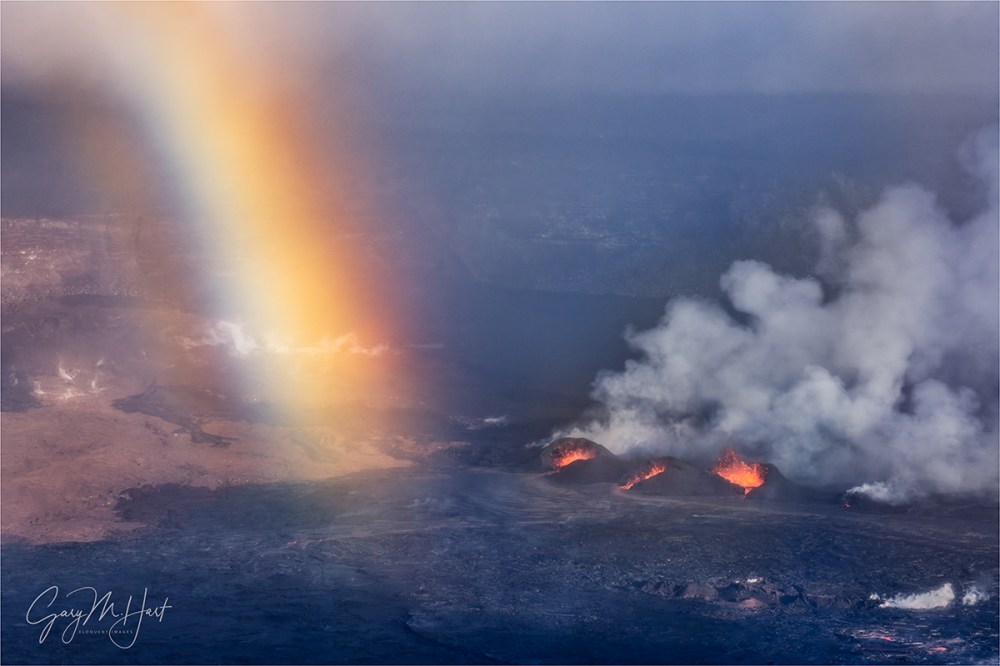
Fire and Rainbow, Kilauea, Hawaii
Sony a7R V
Sony 100-400 GM
ISO 250
f/11
1/200 second
One concern about returning to the same location, at the same time, in the same workshop, is finding something new to photograph. But last month’s Hawaii workshop group was so excited about our first shoot of the Kilauea eruption, going back on the workshop’s final night was a no-brainer. Not only were we looking forward viewing the fountaining lava one more time, we all wanted to apply some of the lessons learned from the Tuesday shoot. And Mother Nature delivered a surprise that guaranteed something new for everyone.
Surprise or not, many in the group returned with plans for different exposure or focal length choices; I want to use the knowledge gained in the first visit to position my group better, because the eruption had been so new on that first visit, I’d arrived at Kilauea with no idea of what we’d encounter and how we’d access it. I knew enough this second time to arrive with an actual strategy.
The first night we had to park in the overflow parking lot and walk about a mile along the caldera rim to reach the best vantage points; this time we arrived nearly 90 minutes earlier and drove directly to Kilauea Overlook, our favorite vantage point from the earlier visit. Even arriving that much earlier, we ended up snagging the last three parking spaces in the lot—one more kiss of good fortune to bless this especially fortunate workshop group.
Though the eruption was still going strong, we found the shooting conditions this second evening much different. The first time it was dry, with a mix of sky and clouds; this time we found ourselves surrounded by low clouds that dampened every surface and filled the caldera with a heavy mist. By the end of the evening I’d labeled this a “stealth” rain—microscopic drops that couldn’t really be felt as they landed, but somehow managed to saturate our clothes and accumulate on our lenses. But at first it just seemed a little damp.
As early as we were, the sun still hadn’t set behind Mauna Loa. As we unloaded our gear from the cars, I noticed blue sky visible above Mauna Loa and pointed out to the group that there may actually be enough moisture in the air to create a rainbow if the sun came out. And it wasn’t long after making our way to the rim that the sun did indeed pop out enough to create a fuzzy rainbow far to the left of the lava.
The rainbow’s location was close enough to the eruption that we could include both in the same frame without going too wide, but I wanted to get it even closer to minimize the (not especially appealing) brown caldera floor separating them. This is where understanding basic rainbow science pays off. A rainbow forms a 42 degree circle around the anti-solar point: the point in the sky at the other end of an imaginary, infinitely long line starting at the sun, passing through the back of the viewer’s head, and exiting between the eyes. Since we each have our own anti-solar point (and therefore our own rainbow), which is entirely a function of our position relative to the sun, we can change the location of any rainbow (relative to the landscape) by simply repositioning. In this case I knew I could move about 300 yards to my right before the trail (and eruption view) curved out of view of the eruption and rainbow.
Since this was the workshop’s final evening, and we’d all photographed the eruption from here before, everyone was pretty comfortable scattering (rather than sticking close to me for guidance)—which is exactly what they’d done. I hailed as many as I could and explained what I was doing and why, encouraged them to join me, then rushed up the trail.
Not knowing how long the rainbow would last, on the way I stopped a couple of times to fire a frame or two. Turns out I needn’t have worried because the rainbow lasted, in one form or another, for at least 30 minutes. Once I reached the vantage point that positioned the rainbow closest to the eruption, I set up and went to work. The rainbow seemed most intense near the lava, but at times I could make out a faint full arc, and once even pulled out my 12-24 lens to capture a few frames of it. But for the most park I was interested in the tighter, brighter compositions.
Finally working in one spot long enough to get settled, I started to fully comprehend how wet it was. I was wearing a thin rain shell, but could tell that it was already soaking through to my flannel. (Flannel in Hawaii? Indeed—here at 4,000 feet conditions were both wet and windy, with temps in the low 50s.) The wind made my umbrella pointless, so the mist/rain also assaulted my front lens element enough that I had to wipe it clear every few frames.
The difficult problem was getting focus. I’ve come to trust the autofocus on my Sony mirrorless cameras so much, the only time I manually focus anymore is when I have a critical focus point requirement—in 100% infinity scenes like this, I just autofocus anywhere in the scene (wherever my focus point happens to be positioned) and call it good. But the mist this evening was so dense, I could rarely get a focus confirmation—and even when I did, I wasn’t completely confident of it. So I scanned my surroundings and spied a couple hundred yards behind me one of the volcano observatory buildings (near the now shuttered Jagger Museum) to auto-focus on.
This worked well, especially since I use back-button focus and didn’t need to switch between auto and manual focus each time I refocused. Of course each time I changed my focal length I had to pop my camera off my tripod and turn around to refocus, but this became second nature soon enough.
We stayed until dark, battling the wetness and chill to add to our already brimming Kilauea eruption collections. Once darkness fell, the eruption didn’t look much different than it had the first time, so as soon everyone felt like they’d had enough success and addressed whatever problems they’d identified in their prior images, we retreated to the cars and headed back down to Hilo.
Who wants to find out what we’ll see in Hawaii next year?
Workshop Schedule || Purchase Prints || Instagram
Lots More Rainbows
Click any image to scroll through the gallery LARGE


Your photography is spectacular! 🌈
Love this article, thanks for sharing Gary!
Jeannie O’Brien
<
div>
Sent from my iPhone
<
div dir=”ltr”>
<
blockquote type=”cite”>