Eloquent Images by Gary Hart
Insight, information, and inspiration for the inquisitive nature photographer
There’s No Whining in Photography
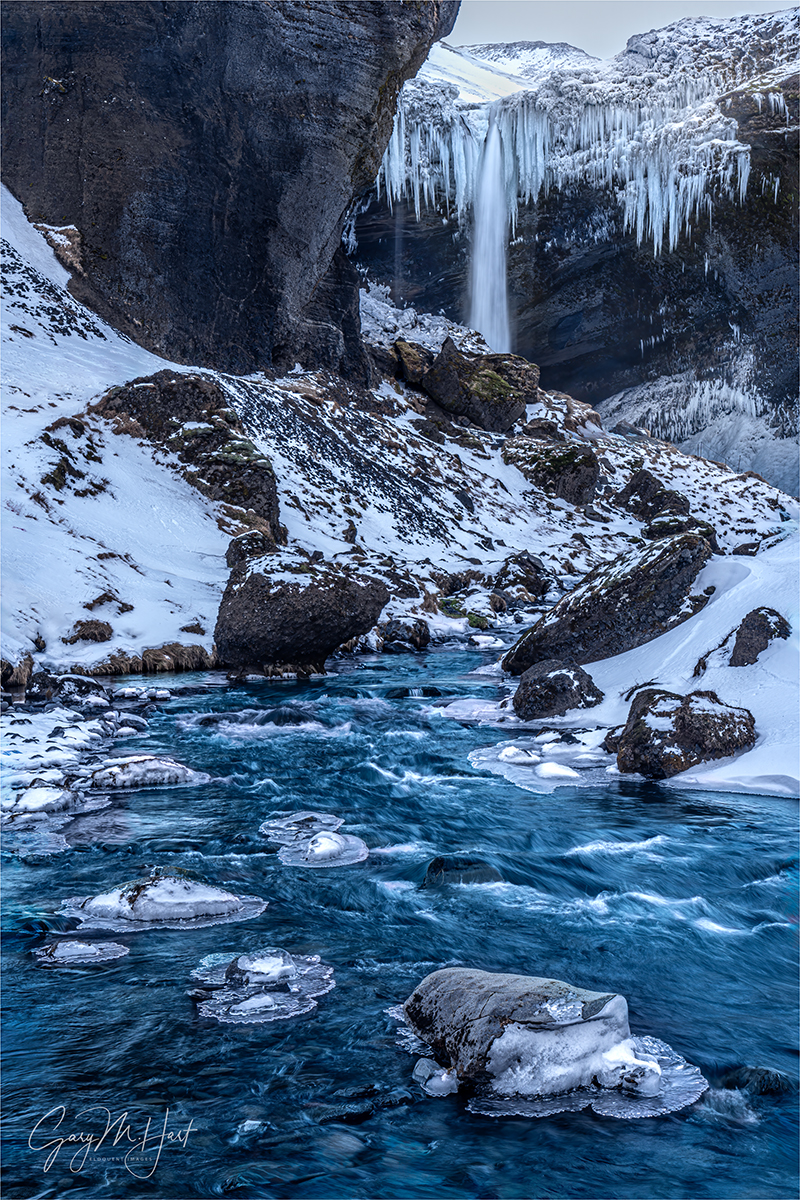
Icewater, Kvernufoss, Iceland
Sony a7R V
Sony 24-105 f/4 G
ISO 50
f/18
1/4 second
Do I need to tell you it was brutally cold this afternoon? Of course not (and I doubt anyone really wants to hear me whine about it anyway).
I also probably don’t need to tell you that this scene was spectacularly beautiful. And unfortunately, these two facts are often inexorably intertwined because the best time for photography is usually the worst time to be outside. As nice as it is to stroll up to a scene in shorts and flip-flops to discover the image of my dreams just waiting for me, the majority of my most memorable images required some degree of suffering.
That suffering can take many forms, but whenever I start feeling sorry for myself, I remind myself that most of my favorite images were earned. I say this less to pat myself on the back than to force me back outside when my resolve starts wavering.
With this in mind, many years ago I created a simple mnemonic that describes the effort-centric mindset that consistently good photography requires that I call, “The 3 P’s of Nature Photography”: Preparation, Persistence, and Pain.
Let’s review
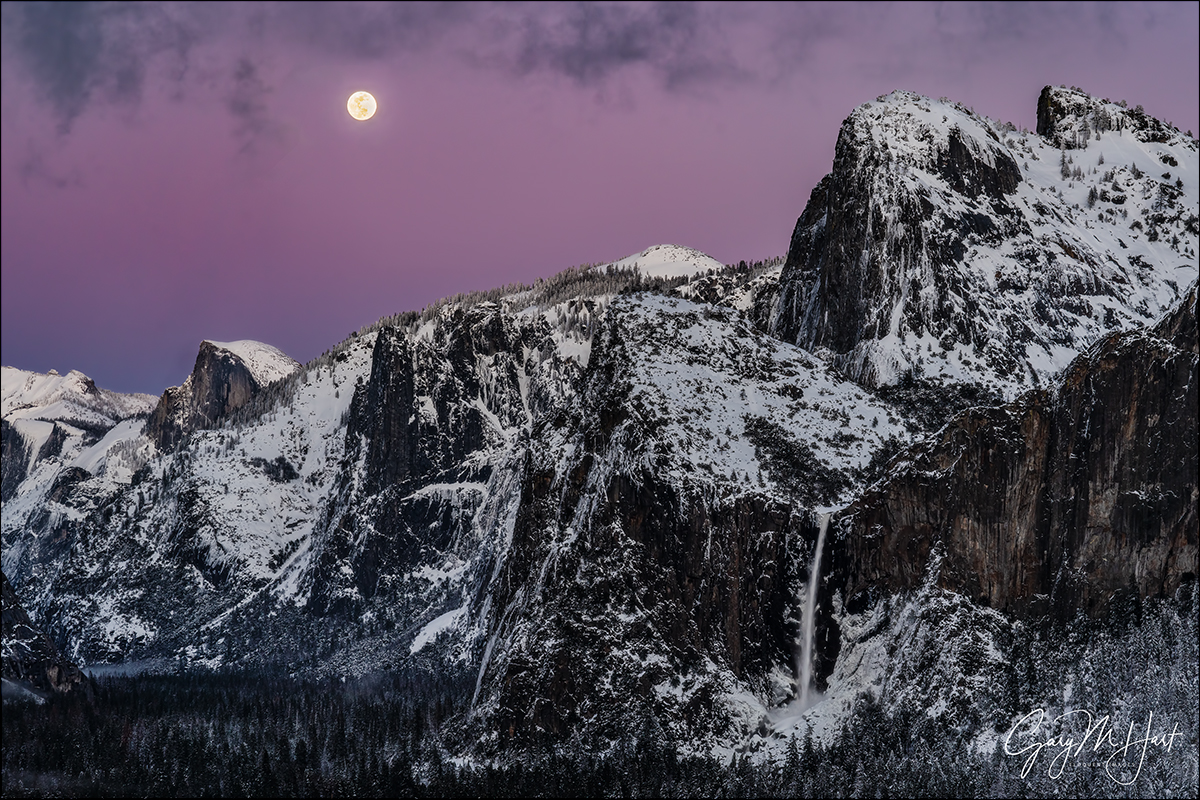
Nightfall, Full Moon and Yosemite Valley, Yosemite
1: Preparation is your foundation, the mastery of your craft combined with the creative vision that allows you to wring the most from every moment in nature. It’s the location experience you’ve earned, the craft you’ve worked hard to perfect, the research that puts you in the right place at the right time, and your ability to see the world the way your camera sees it.
Prepared photographers possess a firm grasp of exposure and hyperfocal focus techniques. They research their subjects to understand when the light will be best, where and when the wildflowers bloom, and the precise time and place of the full moon’s appearance above their favorite landscape. They know at capture how they’ll leverage their processing skill for the best possible result.
The moon’s arrival above Yosemite Valley on this snowy February evening was no fluke—it had been on my radar for over a year, and I’d arranged my schedule to ensure that I wouldn’t miss it. So, while (from all appearances) most of the photography world shivered in Yosemite Valley with their cameras trained on Horsetail Fall, waiting for the fickle sunlight to do its unpredictable thing, my camera and I were set up with a small cohort of similarly prepared photographers at Tunnel View, anticipating the moon’s arrival. As is often the case, the Horsetail Fall crowd was disappointed this evening; the moon chasers were not.
But just being there wasn’t enough, because photographing a daylight bright moon above a landscape washed in diminishing post-sunset shadow is an extremely tricky exposure.
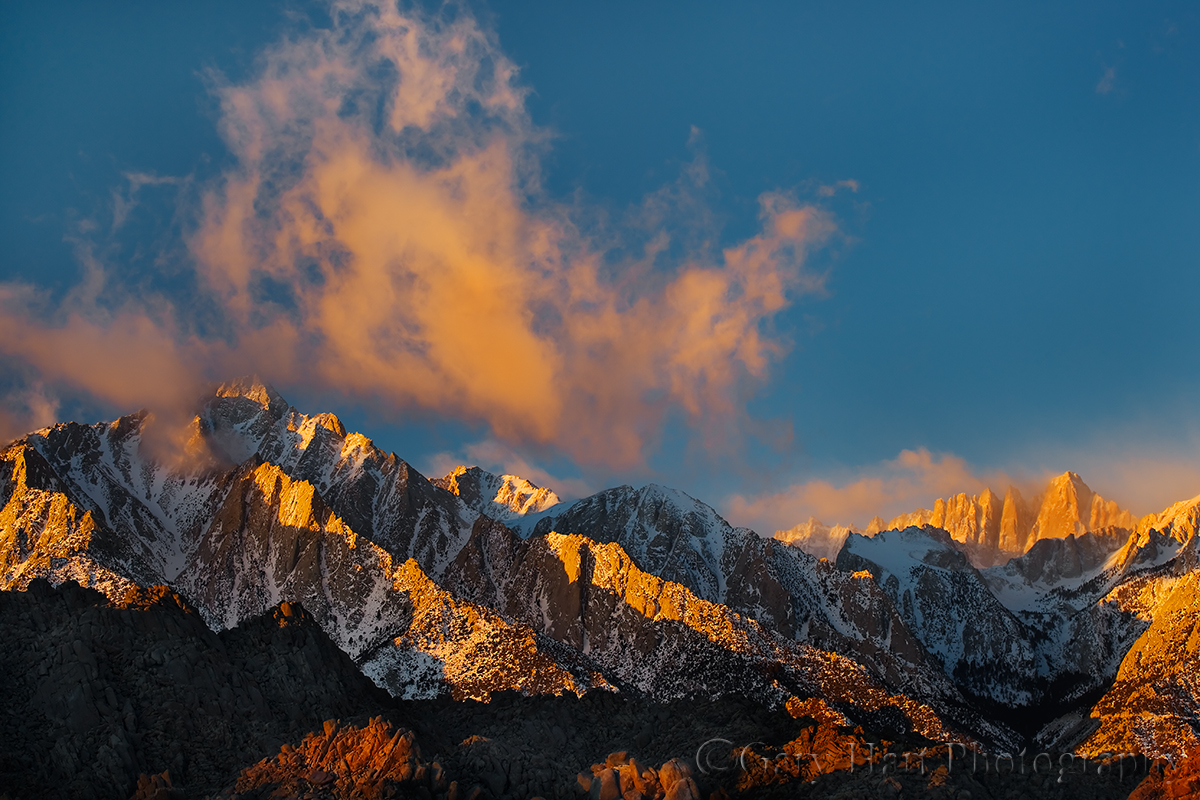
Sunrise, Lone Pine Peak and Mt. Whitney, Eastern Sierra
2: Persistence is patience—with a dash of stubbornness. It’s the determination that keeps you going back when the first, second, or hundredth attempt has been thwarted by unexpected light, weather, or a host of other frustrations. Persistence keeps you out there when the chances look bleak, and sends you over that next rise when there’s no sign of reward.
With virtually no control over our subjects, nature photographers soon learn that persistence is sometimes the only fuel that keeps us going, and we all have stories of rewards that more than compensate for the far greater number of failures.
Many years ago my brother and I holed up for several days beneath a solid gray deck of low clouds above Lone Pine, waiting for the clouds to lift enough for Mt. Whitney to come out to play. Every morning we’d drive up into the Alabama Hills full of hope to wait for a sunrise that never happened. With a weather forecast that promised snow along our route home, we had every reason to forego photography and hit the road early on our final morning. But we drove back up into the Alabama Hills one last time, and were finally rewarded when the clouds broke up just as the rising sun illuminated the Sierra Crest.
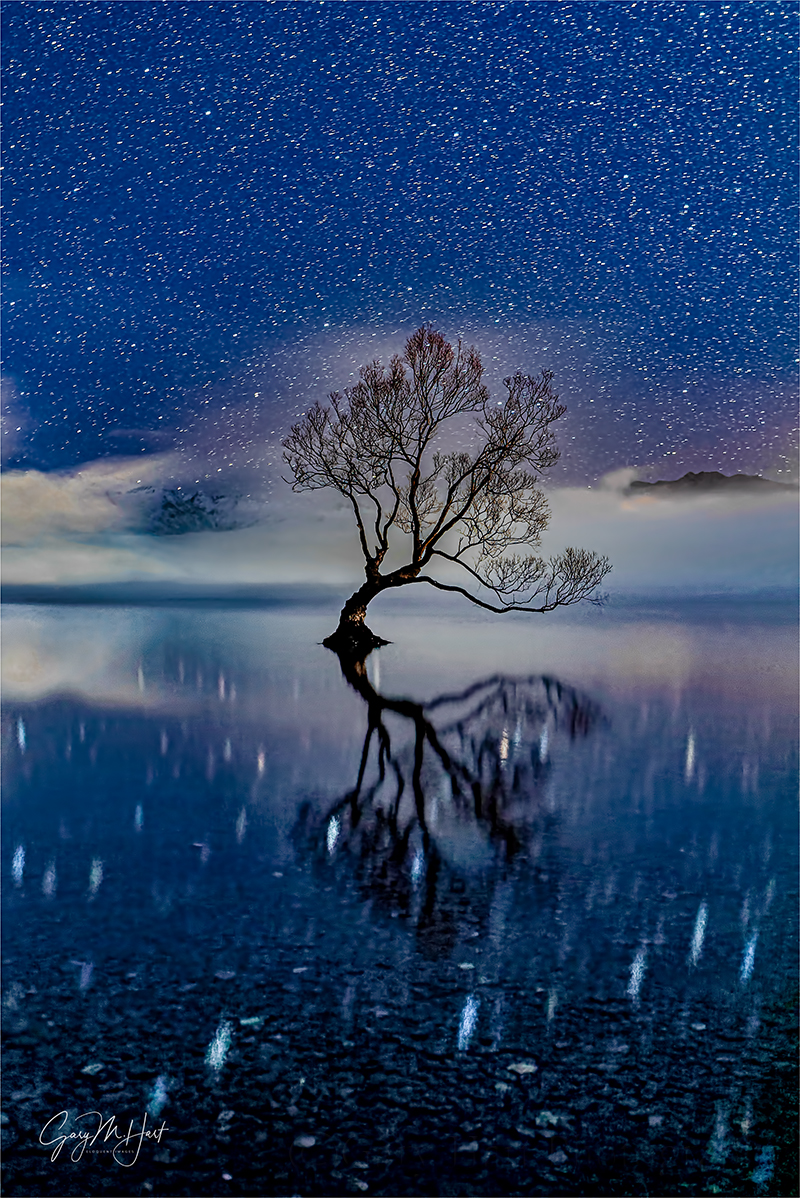
Starry Night, Lake Wanaka, New Zealand
3: Pain is the willingness to suffer for your craft. I’m not suggesting that you risk injury or death for the sake of a coveted capture, but you do need to be able to experience more than a little discomfort, and to ignore the tug of a warm fire, full stomach, sound sleep, and dry clothes, because the unfortunate truth is that the best photographs usually seem to happen when most of the world would rather be inside.
Pain and persistence often go hand-in-hand, and the ability to persist is often a function of your tolerance of the pain it brings—not just physical pain, but the monotony of repetition or just enduring minutes or hours of absolutely nothing happening. For most photographers, there’s a direct correlation between the joy an image brings and the pain experienced pursuing it.
My day at Lake Wanaka in New Zealand had started long before dawn with a walk along the lakeshore to spend sunrise with this truly special tree and its reflection. Sunrise was nice, but we weren’t done, not even close. From there our group drove three hours to Aoraki / Mt. Cook National Park, making several stops along the way for more hikes and beautiful winter photography. We wrapped up the day, or so I believed, waiting for darkness to reveal the Milky Way over Tasman Lake. Following our Milky Way shoot, we walked back to the van in the dark, and made the three-hour drive back to Wanaka to wrap up the longest photography day of my life.
The return drive was made even longer by dense fog that hugged most of our route back. Thoroughly exhausted, at our Wanaka hotel, where warm beds beckoned, I glanced skyward and saw stars. Somehow that sight infused me with a second wind and rather than return to my room, I beelined back to the lake.
It was so dark that at first I couldn’t find the tree—had I hiked too far? Not far enough? After a couple of test images to orient myself, I started working on the scene. I was aware of the cold, but strangely unaffected by it, something that photography seems to do to me. I got in about 30 minutes of joyful photography before the fog expanded and swallowed the scene.
So which of my 3 P’s do I credit for this one?
Icewater, Kvernufoss, Iceland
This image was all about the Pain. I captured it just couple of months ago, on the last full day of the Iceland winter workshop that Don Smith and I do each year.
Having never been to Kvernufoss, we took the word of the two photographers Don and I had hired to guide this year’s group, Albert Dros and Vincenzo Mazza, that it was worth the one mile hike. As you can see, they were right.
My difficulty (pain) this frigid afternoon was exacerbated by the fact that a couple of days earlier the crampons that had enabled me to successfully navigate Iceland’s frequently treacherous icy footing had mysteriously disappeared, making each outdoor step a potential disaster. Not knowing the trail, I had no idea whether I’d make it to the fall without my crampons, but I didn’t want to miss a new waterfall. Most of the hike turned out to have a slight uphill grade that was not too icy and much easier to navigate than I’d feared, but as we crested a rise and got our first look at the fall, I saw that the trail descending to the fall was quite icy.
That first view was quite beautiful—so beautiful that it would have been very easy to just set up there and go no farther. But I really wanted to get closer. Slowed by my banana peal boots, I quickly fell behind the group. As I cautiously descended, I could see that many in the group had actually followed the trail behind the fall, a potentially very cool perspective. But the trail kept getting icier, and after witnessing several people with crampons fall hard and struggle to navigate the trail’s final stretch, I reset my plan about 150 feet from the fall.
Resigned to Plan B, I decided to focus my attention on the ample opportunities nearby: glacial blue-green river punctuated with icy disks, snowy riverbank, and plunging waterfall framed by spear-like icicles. I tried a few frames firmly planted on the main trail, but knew I could better emphasize the river and ice by getting down to river level. Hmmm…
I spied a short, narrow trail curving down to the river and gingerly made my way down, concentrating with each shuffle-step lest I reprise (a winter version of) the Romancing the Stone mudslide scene. Safely down at the river, I planted myself back on solid (-ish) footing and framed up a scene in my viewfinder. With each peek, decided I needed to be closer to river level to make the water and ice as prominent as possible, slightly lowering my tripod each time. When I finally started working the scene from river level, I realized I should have just bypassed all those incremental tripod steps and plopped straight down, but (speaking of “pain”) the older and colder I get, the more difficult the simple act of dropping to ground level becomes (and don’t even get me started on getting back up).
Grateful for my heavy duty, waterproof down parka that goes down to mid-thigh, I plopped my butt down onto the snow to position myself closer to eye level with my viewfinder—and to minimize my chances of ending up in the river. I framed the scene to maximize the nearby ice disks, minimize the flat gray sky, and eliminate distractions along the riverbank. The trickiest part was finding a clean border with minimal subjects cut off or jutting in, but I finally found something I was pretty satisfied with. Because sharpness throughout my frame was essential, and the closest ice was just a few feet away, I stopped down to f/18 and focused on the second ice disk. To add a little blur to the water, I dialed to ISO 50.
While it would have been easy to complain about the cold, or to feel sorry for myself for missing my crampons, I was here by choice. Scenes like this are exactly why I do this photography thing—and a perfect reminder why there really is no whining in photography.
Join Don and me in Iceland
Workshop Schedule || Purchase Prints || Instagram
To the Pain
Click any image to scroll through the gallery LARGE


 Eloquent Images by Gary Hart
Thanks for the gorgeous images and honest reminders Gary. I want to create images like yours, but I’m not committed to making effort in persistence, preparation, and pain.
Hi Gary, I love your Kvernufoss photo! I was there just a year ago last month and it had been warm and rainy so all the falls along the south of Iceland were bare with no snow or ice. The attached photo had some ice on the ground from the splash of the falls so I took the photo inside the cave. The stream is an amazing blue color as your photo show… Dave George
Toutes ces photos sont d’une grande beauté et je les ai toutes savourées avec un gros coup de coeur pour les aurores boréales. J’ai pu en voir en Niorvège mais je n’étais pas assez préparée à la technique qu’il faut maîtriser pour les capturer et je n’ai eu que deux photos acceptables à Tromso sur une cinquantaine de prises. Merci.
Thanks, Marie. Well a least you got a couple of northern lights images—that’s all you need for a successful trip (even if more would have been better). 😊
love this