Eloquent Images by Gary Hart
Insight, information, and inspiration for the inquisitive nature photographer
The Battle of the Brains
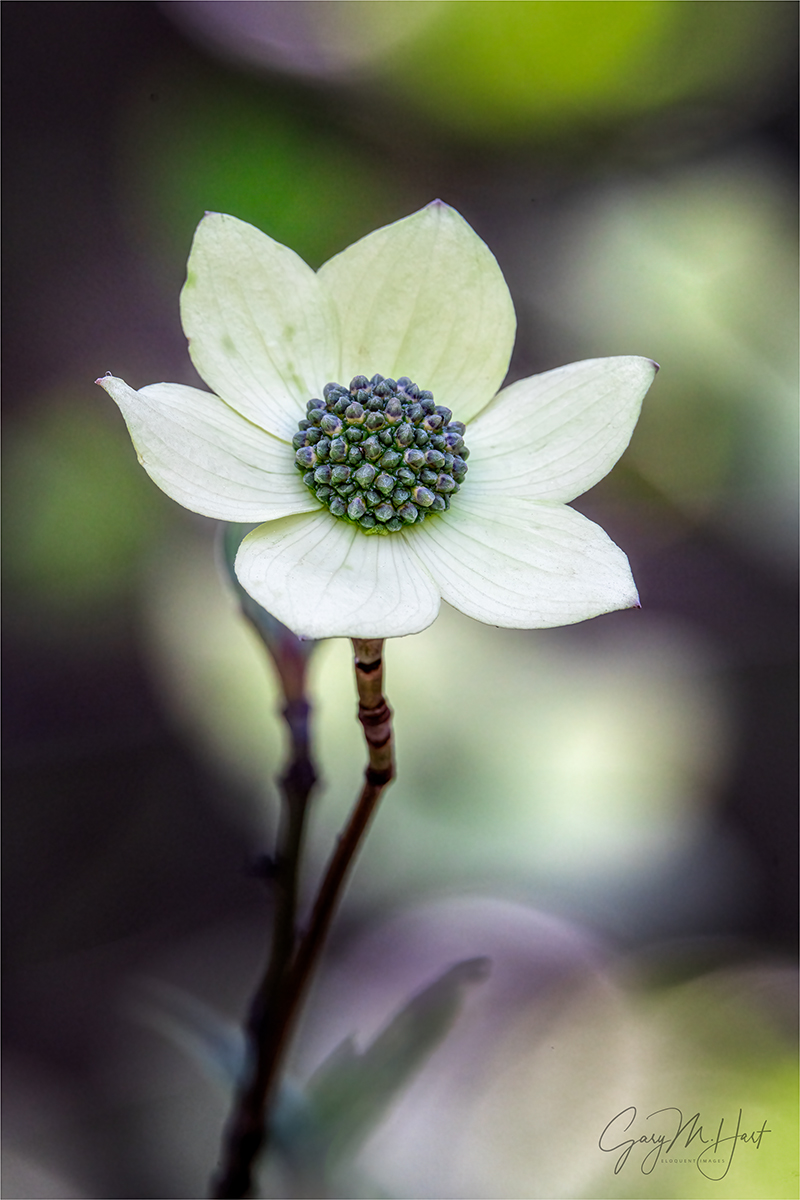
Intimate Dogwood, Yosemite Valley
Sony a7RV
Sony 200-600 G
ISO 1600
f/10
1/125 second
Two photographers approach a dense forest festooned with blooming dogwood: One is drawn to a lovely bloom and can clearly visualize a uniquely beautiful image, but he has no idea how to manage his exposure variables to achieve it; the other photographer is so intent on minimizing diffraction while identifying the shutter speed that will freeze the gently swaying bracts without compromising the ISO, that to her, the scene is nothing more than a disorganized assortment of white splashes.
While most photographers don’t fall at these extremes of the creative/analytical continuum, the vast majority do approach their craft with a dominant intuitive or analytical bias, a right-brain versus left-brain struggle with one side or the other significantly stronger than the other. Compounding the problem, rather than simply getting out of the way and letting the strong side do its work, much like an irritating little brother, the less developed (notice I didn’t say “weaker”) side often seems committed to distracting its dominant counterpart.
But every once in a while I run into a photographer who seems to have negotiated a synergistic truce between her conflicting mental camps. She’s able to efficiently analyze and execute the plan-and-setup stage of a shoot, then check-in with her aesthetic counterpart for creative inspiration. As the time to click the shutter approaches, she seamlessly switches between the two camps: the right brain knows how much to soften the background and blur the water, while her left brain knows exactly how to make this happen. The result is images that consistently amaze with their creative inspiration and technical execution.
My job as a photo workshop leader (among other things) is to identify where each photographer falls on this analytical/intuitive spectrum so I can honor and refine the dominant side, and encourage and nurture the less developed side. And after more than 18 years leading photo workshops, I’ve learned that what most photographers perceive as a terminal shortcoming in their creative or analytical aptitude can usually be resolved once it’s untangled from the dominant side.
When I hear, “I have a good eye for composition…,” I know before the “but” exits the photographer’s lips that I’ll need to prove that he’s smarter than his camera (he is). Our time in the field will be spent working on jettisoning the camera’s automatic modes because as smart as it might seem, your camera is not creative. I try to demystify and simplify metering, exposure, and depth management until they become second nature, comforting allies rather than distracting antagonists. Fortunately, despite the fact that much of the available photography education seems designed to intimidate Einstein, laying a foundation for mastering photography’s technical side is ridiculously simple.
On the other hand, before the sentence that starts, “I know my camera inside and out…,” is finished, I know I’ll need to foster this photographer’s curiosity, encourage experimentation, and help her disengage the rules that constrain her creativity. We’ll think in terms of whether the scene feels right, and work on what-if camera games (“What happens if I do this”) that break rules. Success won’t require a brain transplant, she’ll just learn to value and trust her instincts.
Intuition is the key to breaking the rules that inhibit creativity, while simplification and repetition create technical confidence. Alone, these qualities are incomplete; in conflict, they’re mutually exclusive anchors that prevent movement; in concert, their synergy is the foundation of photographic success.
For example
Coincidentally, just this week I happed to find myself in a dense forest festooned with blooming dogwood. Go figure. A few minutes earlier I’d set my workshop group free just upstream from Valley View, and after making sure everyone was content, I grabbed my camera, tripod, and 200-600 lens and went dogwood hunting.
I started by switching on my creative brain and wandering slowly, scanning the surroundings for a dogwood flower (yes, I know they’re technically not flowers, they’re bracts) to isolate from its surroundings. Eventually I made my way across the road, and soon my eyes landed on a single bloom swaying gently in full shade. Its slightly green tint and pristine center (this is where the actual dogwood flowers reside) told me this specimen was young—exactly what I was looking for.
Instead of framing my subject up and clicking, I scanned the background and found a branch with more young flowers a couple of feet away. Positioning myself to align my target flower with the background flowers, I framed up a vertical composition. Briefly engaging my analytical brain, I opened my aperture wide for the absolute softest background, increased my ISO to mitigate the effects of the breeze, and focused on the dogwood’s center. Then I dial my shutter speed until the histogram looked right, checking to be sure my chosen speed could freeze the flower”s gentle bobbing.
My favorite moment when doing these creative selective focus shots is the instant my subject snaps into focus. Suddenly, the world in my viewfinder is completely different from the one outside my camera. In addition to the pillowy background flowers, I liked the way a few rays of sunlight had penetrated the dense branches overhead to illuminate a couple of green leaves in my frame.
My creative brain really liked the framing I’d found, but thought the background could use just a little more definition. So back to my analytical brain I went, stopping down to f/10—just enough to distinguish individual flowers in the soft background. But stopping down also reduced my exposure—since I couldn’t increase my shutter speed to add light, instead I increased my ISO knowing that whatever noise the higher ISO introduced would easily clean up in processing. Click.
Of course this creative/emotional switching doesn’t really happen consciously anymore, but there was a time when I was far more deliberate about the distinction. Like most things in life, the longer I do this, the more unconscious and seamless this switching becomes, and the better my two sides play together.
Workshop Schedule || Purchase Prints || Instagram
More Dogwood!
Click any image to scroll through the gallery LARGE


 Eloquent Images by Gary Hart
Beautiful
And once again the anonymous above is me, Al Marsh.
You do a great job teaching those things. I am a natural systems/business process analyst; left-brained to the core. I am naturally drawn to analyzing the natural processes happening around the scene and using them in my composition. Out of focus foregrounds drive me nuts, yet I see others who have used it to their advantage and just say wow. Where I am going with this is that I’ve had to embrace my left brain and use its analytic prowess to find the best composition.
Beautiful! This may be my favorite dogwood photo by Gary Hart! I love the soft pastel colors in the background with hints of
lavender.
Beautiful image capture Gary! Love the softness and colors of the background balanced with the sharpness of the dogwood bloom. I know the “Battle of the Brains” well! I was fortunate to have Dr. Betty Edwards (who wrote “Drawing on the Right Side of the Brain”) as my beginning drawing teacher back in my freshman year at Cal State Long Beach. I’ll always remember her teaching us to draw a ficus tree while looking at it AND our drawing pads (the left brain dominates the drawing), then turning right around and having us draw the same tree without ever looking at our drawing pad on the easel. What a difference! So I always let my right brain search, look and compose a scene and let the left brain do that “techy” stuff. Good synergy indeed!