Eloquent Images by Gary Hart
Insight, information, and inspiration for the inquisitive nature photographer
Full Contact Photography

Vivid Dawn, Mono Lake
Sony a7R V
Sony 24-105 f/4 G
ISO 50
f/16
30 seconds
Years ago, my brother Jay and I were photographing an autumn sunrise at Mono Lake’s South Tufa. Among the first to arrive at the lake, we’d set up at the spot I’d chosen the prior evening, but soon South Tufa’s shoreline was jammed with jostling, elbow-to-elbow photographers. Scanning the line of overlapping tripod legs, I was baffled because, unlike many popular photo destinations, South Tufa has many beautiful places to set up, offering ample opportunity to create something unique. But the sole deciding criterion for these photographers seemed to be, Well, someone else is set up here, so this must be the spot. And they kept coming. It got so bad that at one point we witnessed two photographers who, rather than set out in search of something to make their own, almost come to blows over a 3-foot square of choice lakeside real estate. That was when I told myself there must be other locations at this special lake that aren’t saturated with photographers content to settle for barely distinguishable versions of the same scene.
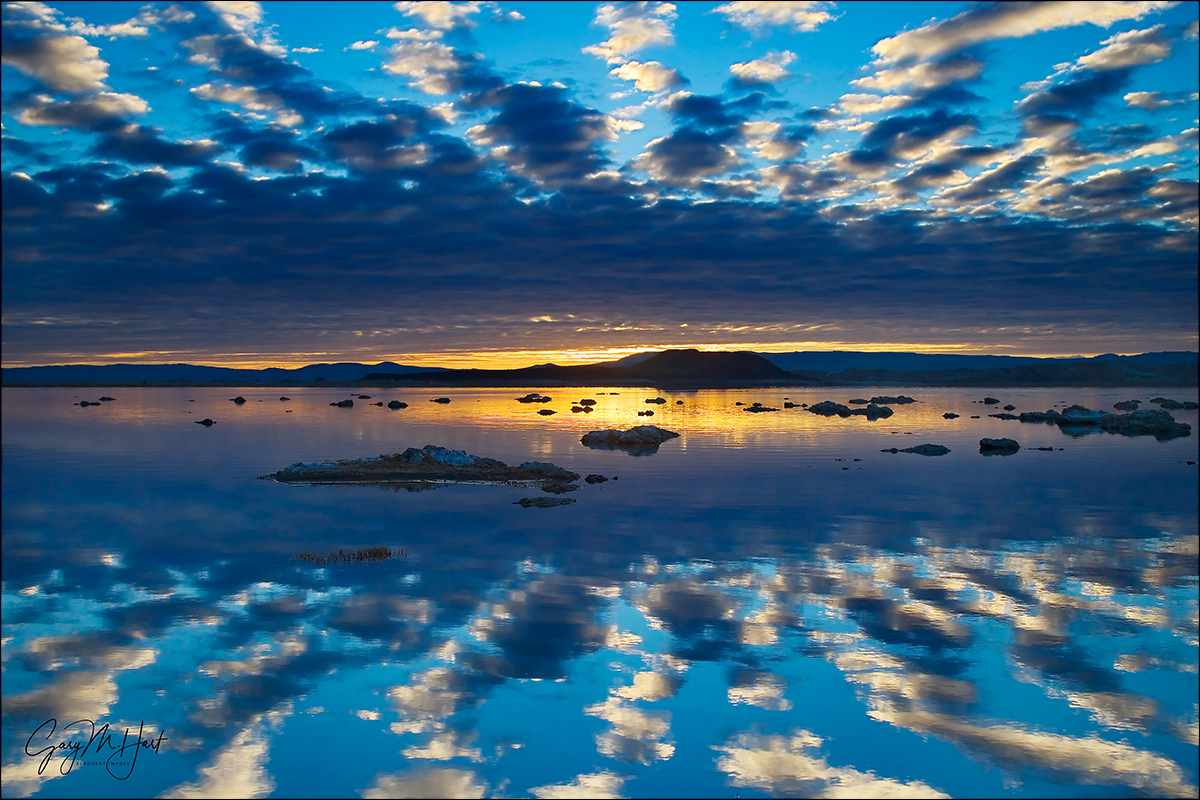
Sunrise Mirror, Mono Lake
That afternoon Jay and I explored the network of rutted, unpaved roads encircling Mono Lake, ending up completely alone for sunset, across the lake at a remote beach dotted with low tufa platforms jutting from mirror reflections. Undeterred by the maze-like drive, and a half-mile or so walk to the lake that started in thick volcanic sand and ended in shoe-sucking mud, we were so pleased with our sunset experience that we vowed to return for sunrise the next morning.
But the story didn’t end there because, despite meticulously logging (in that pre-smart phone and GPS time) each odometer click between turns on the way back, the following morning we still got hopelessly lost trying to reverse-execute the prior night’s exit in the dark. With the eastern horizon starting to brighten, I stopped by the first wide spot that was relatively close to the lake, and we hoofed it cross-country through more sand and mud to beat the sunrise.
The show that morning was one of the most memorable sunrises of my life. The juxtaposition of those two mornings reinforced for me the joy of experiencing Nature in relative peace. And though I didn’t realize it at the time, that realization influences an approach to my subjects that continues to this day: rather than settle for the views most trampled, no matter how spectacular, I started challenging myself to seek less obvious places to plant my tripod.
Honestly, I enjoy sharing Nature’s beauty with kindred spirits almost (even just) as much as I do photographing in complete solitude. But sadly, the hostile display Jay and I witnessed that morning at South Tufa, fueled by the digital renaissance, was only the first in what feels like a growing epidemic of full-contact photography: the inevitable consequence of too many photographers trying to force themselves into spaces too small, simply so they can replicate images already captured many times.
For example, a collapsed riverbank caused the NPS to permanently close Southside Drive to Horsetail Fall aspirants, and the Navajo have justifiably banned tripods in Antelope Canyon. And I’m surprised that (as far as I know) no one has fallen, or been shoved, over the cliff in the Mesa Arch sunrise scrum.
Whether the agitation escalates to fisticuffs, or the governing entity closes the location or imposes Draconian restrictions, no one wins. And the “contact” doesn’t need to be physical—often mere proximity can escalate tension enough to ruin things for everyone.
Here are a few examples of bad photographer behavior, brought on by some photographers’ inability to play well with others, that I’ve witnessed myself:
- During one Grand Canyon sunset, a very well known photographer with a “Do you know who I am?” attitude set up with the railed vista between himself and the scene he wanted to photograph, then started ranting at a pair of European tourists (not even photographers) for walking into “his” scene. They were clearly taken aback—when I saw them timidly start to leave, I rushed over and apologized on behalf of all photographers and Americans, telling them they’d done nothing wrong and have every right to stand there and enjoy the view for as long as they’d like.
- In Iceland last February, a couple of photographers (who should know better!) walked out in front of the bridge where my and Don Smith’s workshop group had set up to photograph a waterfall. Not only did they turn deaf ears to our requests for them exit our scene, they trampled the formerly pristine snow that had made the scene so special. Adding insult to injury, one of them sent up a drone, completely ignoring the many signs forbidding them.
- One morning at North Lake (Eastern Sierra), some guy had his tripod set up far behind, and in direct line with, the section of lakeshore where dozens of photographers had set up. Then he proceeded to aggressively shoo everyone away, essentially claiming the entire North Lake scene for himself. I tried reasoning with him, but when he seemed unwilling to compromise, we all just ignored him. When he came rushing down, looking to punch someone, a photographer who was much larger than him (and pretty much everyone else there) calmly sauntered up and asked him what the problem was—at which point he suddenly remembered someplace else he had to be.
- And probably my personal “favorite” is the guy who, at everyone’s favorite Schwabacher Landing Grand Tetons reflection view, donned waders and walked out into the water in front 50 or so other photographers waiting for sunrise. Despite gentle requests, pleading, and eventually enraged threats, he refused to budge. I think the only thing that spared his life was the fact that low clouds obscured the peaks and sunrise light that morning.
All of these experiences have informed my approach to all my locations, whether I’m on my own or leading a group. Of course as a photo workshop leader, I need to balance that instinct with the understanding that for many of my students, my workshop might be the only time they’ve visited this location, and may very much want their own versions of the most popular scenes. So in a workshop, I always make sure to blend a combination of familiar spots with my own “secret” (few locations in nature photography are truly secret) spots.
But anyway…
Over the last two decades I’ve returned to this relatively untouched side of Mono Lake, both by myself and leading groups. With no trail from the road to the lake, each time I wind up at a slightly different spot, but so far have never been disappointed.
The October morning I captured this image was wonderfully calm, with the reflections only slightly disturbed by gentle undulations. I had to move around a bit to organize the relationships between the foreground tufa mounds, but quickly landed at this spot. With mostly clear skies, I limited the sky in my composition, emphasizing the graduated colors reflecting atop the lake instead.
I wanted to smooth the rolling swells into a flat, gauzy reflection, while underexposing enough to avoid washing out the sky’s pre-sunrise natural color. Still nearly 30 minutes before the sun arrived, the scene was still dark enough to allow a 30-second exposure without an ND filter. With a fairly wide lens and not a lot of close foreground detail, depth of field was pretty easy—it probably didn’t matter, but I focused on the right-most tufa mound.
I photographed until the sun appeared, but took enough time between frames to appreciate the utter solitude of my surroundings, and contrasted them with the mayhem I knew was happening across the lake. The irony of the full contact experience over there driving me to find the isolation here, wasn’t lost on me.
Photograph Mono Lake with me in my Eastern Sierra workshop
Workshop Schedule || Purchase Prints || Instagram
More Mono Magic
Click any image to scroll through the gallery LARGE


 Eloquent Images by Gary Hart
Good stories, Gary. Some people! We had one self-centered woman
And a P.S.Along with meeting several peop