Eloquent Images by Gary Hart
Insight, information, and inspiration for the inquisitive nature photographer
Isolate and Conquer

Autumn On the Rocks, Bridalveil Creek, Yosemite
Sony α1
Sony 100-400 GM
3.2 seconds
f/16
ISO 200
This year marked my second autumn visit since the reopening, and everything still feels gloriously new to me. Arriving at Bridalveil Creek on the final morning of last week’s Yosemite Fall Color photo workshop, I started with a brief orientation, then guided the group along the main trail, pointing out the many photography opportunities here. I wrapped up the introduction by inviting anyone who doesn’t mind a little bush-whacking and rock scrambling to follow me to one more spot.
Off the beaten path and often jammed with fallen trees and branches, the scene here is a little different each time I visit. The amount of water in the creek varies, as does the number of leaves on the ground and in the pools. This year the water was nice, but the leaves hadn’t quite reached peak blanket status. But these annual variations are part of what I love about photographing here.
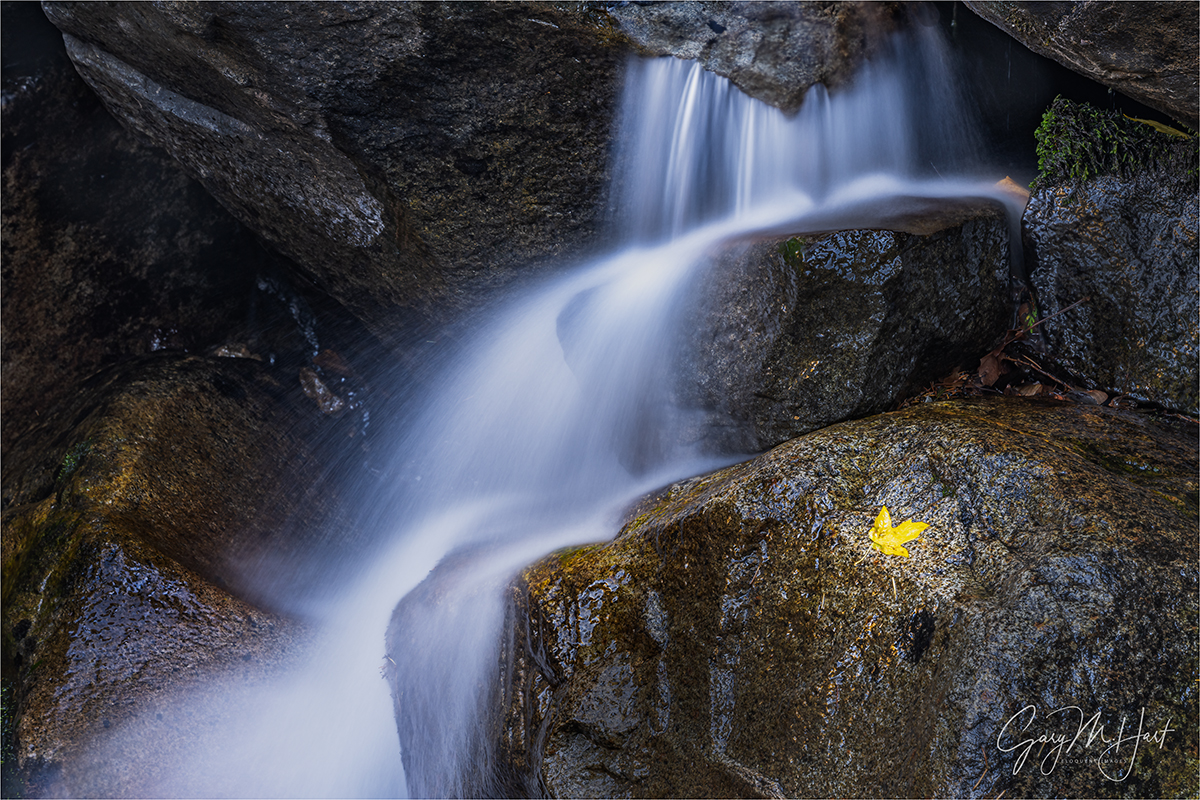
Autumn Leaf and Cascade, Bridalveil Creek, Yosemite
Sony α1
Sony 100-400 GM
8 seconds
f/16
ISO 100
Probably my favorite thing to do at Bridalveil Creek is to find a leaf or leaves swirling in a pool and capture their colorful spiral with a long exposure. But when I couldn’t find any candidates for swirling color on this visit, I went to Plan B and scanned the scene for a leaf I could isolate. Despite lots of beautiful yellow leaves overhead, I only found two candidates on the ground.
Usually I try to get within 10 feet of subjects like this, because the closer I am, the more even a small amount of repositioning affects my foreground/background relationships. But closer access to these leaves was blocked by water, rocks, and downed branches (plus I didn’t want to risk getting in someone else’s frame), so I put away my 24-105 lens in favor of my 100-400, and went to work from an open vantage point about 30 feet back.
As I worked this scene, I couldn’t help remembering that every time I share an autumn image from Bridalveil Creek in Yosemite, I need to brace for the questions: some version of, “Did you place that leaf there?” Usually the tone is friendly curiosity, but sometimes it includes an undercurrent of suspicion bordering on accusation. While these questions are an inevitable part of being a nature photographer, I suspect that I get more than my share because I aggressively seek naturally occurring subjects to isolate and emphasize—and Bridalveil Creek in autumn has them in spades. But regardless of the questioner’s tone, my answer is always a cheerful, unapologetic, and honest, “No.”
I digress
We all know photographers who have no qualms about arranging their scenes to suit their personal aesthetics. The rights and wrongs of that are an endless debate I won’t wade into, other than to say that I have no problem when photographers arrange their subjects openly, without intent to deceive. But photography has to make you happy, and I create my photographic happiness by discovering and revealing Nature, not manufacturing it. I don’t like arranging scenes because I have no illusions that I can improve Nature’s order, and am confident that there’s enough naturally occurring beauty to keep me occupied for the rest of my life.
Order vs. chaos
Nature is inherently ordered. In fact, in the grand scheme, “Nature” and “order” are synonyms. But humans go to such lengths to control, contain, and manage the natural world, we’ve created a label for our failure to control nature: chaos. Despite its negative connotation, what humans perceive as “chaos” is actually just a manifestation of the Universe’s inexorable push toward natural order.
Let’s Take a Trip…
For example, imagine that all humans leave Earth for a scenic tour of the Milky Way. While we’re gone, no lawns are mowed, no buildings maintained, no fires extinguished, no floods controlled, no Starbucks built. Let’s say we return to Earth in 100 years*. While the state of things would no doubt be perceived as chaotic, the reality is that our planet would in fact be closer to its natural state. And the longer we’re away, the more human-imposed “order” would be replaced by natural order.
* Since this is my fantasy, I’ve chartered a spaceship that accommodates all of humankind and travels at 90 percent of the speed of light. While Earth has indeed aged 100 years during our holiday, we travelers return only a year older. (Dubious? Don’t take my word for it, ask Albert Einstein.)
What’s it all about?
Instead of manufacturing false order, I prefer organizing my scenes around naturally occurring relationships in a way that makes the image about something—in other words, finding the natural order and interpreting (translating) it in a way that resonates with humans. To distill this natural order from perceived chaos, nature photographers have a couple of compositional tools in our creative toolbox.
With a wide lens and careful positioning and framing, we can guide viewers’ eye with relationships that start in the close foreground and extend to the distant background, connecting elements to create virtual lines that guide the viewers through the frame. I think most photographers are biased toward these wide landscape images because the wider frame is closer to the way we see the scene with our eyes. But going wide also risks introducing unwanted elements that clutter the frame and pull the viewers’ eyes off their prescribed visual path.
Enter the telephoto lens, an underused landscape tool by most (but not all) photographers. A telephoto lens lets us be more surgical in our subject choice by simplifying the scene to its most essential elements that emphasizes our scene’s most prominent feature or features, and eliminates peripheral distractions. Nevertheless, despite the telephoto’s effectiveness, I often catch myself automatically defaulting to my wide lenses. But I’ve learned that those times when I’m struggling to find a shot, the easiest way to reset my creative instincts in the field is to simply view the scene through a telephoto lens, just to see what might be lost in the visual discord of the wide scene.
Still not convinced? In addition to providing a fresh perspective, telephoto lenses offer undeniable, tangible advantages in landscape photography:
- Bigger subject: Bigger isn’t always better, but there’s often no more effective way to emphasize your subject than to magnify it in your frame.
- Isolate: By zooming closer, you can banish distractions and unwanted objects to the world outside the frame, distilling the scene to its most essential elements.
- Highlight the less obvious: Sometimes a scene’s compelling, but more subtle, qualities are overwhelmed by the cacophony of dramatic qualities that drew you in the first place. By all means, shoot the grand drama that drew you in the first place, but take the time to discover the smaller stuff that’s there as well.
- Selective focus: The longer your focal length, the shallower your depth of field. One of my favorite ways to emphasize a subject that might otherwise be overlooked is to render it as the only sharp object surrounded by a sea of soft color and shape.
If telephoto vision doesn’t come naturally to you in the field, try training your eye in the comfort of your own home by opening any wide angle image in Photoshop (or your photo editor of choice), setting the crop tool to 2/3 aspect ratio (to match what you see in your viewfinder), and see how many new compositions you can find. (I’m not suggesting that you shoot everything wide and crop later—this crop tool suggestion is simply a method to train your eye.) But whether you do it in the field, or later in Photoshop, once your eye gets used to seeing in telephoto, you’ll find virtually every scene you photograph has telephoto possibilities you never imagined existed.
Meanwhile, back at Bridalveil Creek…
On this morning, I shot these leaves—one, the other, and both—horizontal and vertical, from wide to tight (horizontal version shared above). I even experimented with a variety of shutter speeds, but it was so dark back here in the early morning shadow beneath towering granite, darkened further by a canopy of leaves, and with a polarizer essential to mitigate the glare on the wet rocks and leaves, that any reasonable ISO didn’t allow a shutter speed that made a noticeable difference in the water’s blur—the water was moving so fast, 1 second and 10 seconds were virtually identical. So I just went with whatever shutter speed I needed to get the exposure I wanted (the fact that I ended up shooting this frame at ISO 200 instead of ISO 100 was just small oversight, left over from earlier shutter speed experiments).
My starting position was more-or-less at eye level with the cascade, putting the leaves more edge-on. Though they were clearly visible, but their classic maple leaf shape was somewhat obscured by the angle of view. So after exhausting all compositional variations, I scanned my surroundings for a higher vantage point and spotted a rock that would take a little effort to scale (nothing dangerous—mostly navigating a lot of downed trees and branches), but that might work if the view from there was unobstructed.
Turns out shifting those few feet was worth the effort, providing a much better angle that clearly revealed the leaves’ shape. I proceeded to run through another series of compositions similar to what I’d done at the first spot.
I’ve learned to wait until the workshop’s final day to take my groups to Bridalveil Creek. The photography here isn’t as obvious as the rest of Yosemite, so as excited as I am to share it, it takes a while for everyone to refamiliarize themselves with their cameras and warm up their creative muscles. This group was no exception, but when we gathered at the cars after the shoot, I heard the same “I could have stayed here all day!” responses I always get at Bridalveil Creek. Me too!
Join me in Yosemite
Workshop Schedule || Purchase Prints || Instagram
Isolate and Conquer
Click any image to scroll through the gallery LARGE


 Eloquent Images by Gary Hart
One of my very skilled photo friends said that dropping a leaf and its fluttering to a spot that creates excellent compositional opportunities is actually very intelligent use of natures breezes. If it lands in the right place, even on the 2nd or 3rd attempt, it was meant to be. This is nothing but spontaneous manifestation, which essentially mandates the clicking of the shutter. The resulting photo should be appreciated, not challenged.
That sounds like a rationalization to me. Definitely not something that would work for me, but if it makes your friend happy…
These are absolutely stunning images Gary. I share your preference for finding nature’s beauty rather than arranging it. And I’d love to try your travel experiment to leave nature to organize and heal from our obsessive control and plundering.
Thanks, Brad. 🙏
Wonderful moments so brilliantly captured! Thank you for sharing with us! 📸🤩💯
Thanks so much!
beautiful pictures
Thanks!