Eloquent Images by Gary Hart
Insight, information, and inspiration for the inquisitive nature photographer
Comet Dreams Fulfilled
Posted on March 13, 2013

Comet PanSTARRS & New Moon, Haleakala, Maui
(The moon was a thin crescent; because of the extra light my camera took in, it “saw” lunar detail in the shadow.)
Canon EOS 5D Mark III
3 2/3 seconds
F/5.6
ISO 1600
320 mm
I’ve been a huge comet geek since I was ten years old (details here), so when I heard about Comet PanSTARRS almost a year ago, I was pretty excited. I became even more excited when I learned that PanSTARRS would be a little more than three degrees left of a new moon on March 12. Checking my calendar, I discovered I’d be on Maui for a workshop that week. Sweet.
Fast forward to March 12: I’m on Haleakala, the location of the PanSTARRS telescope that discovered the comet, with my Maui workshop group. After a sunset that colored the swirling clouds in all directions, the clouds close in and completely shut down the sky. We stick it out for a while, but when the cold saps the group’s enthusiasm (it’s 35 degrees with 35 mph winds), I reluctantly honor their wishes. Could I really have gotten so close to this event I’ve been anticipating for nearly a year, only to be denied. Descending the mountain with one eye on the sky, I hope for a break.
Less than two miles down the road we suddenly pop into the clear and see a thin slice of moon dangling like a Christmas ornament in the blue/orange band separating day and night. While PanSTARRS isn’t bright enough to be visible the twilight, I know I can use its proximity to the moon to guide my lens. I pull the car over and we yank out our cameras and start firing, wider shots at first, then tighter to zero in on the comet and moon. As a bonus, the amount of light necessary to reveal PanSTARRS also exposed exquisite detail in the moon’s shadow area.
I’ll write more when I have time but I just had to share. Now, off to Hana….
More Comet Images (mostly NEOWISE)


Paradise Found
Posted on March 10, 2013

Waterfall and Pool, Road to Hana, Maui
Each time I visit a location, no matter how many times I’ve been there, I make a point of finding something new. On Maui several days in advance of my workshop (which starts Monday), I took the drive to Hana with the express purpose of exploring some of the unmarked, intriguing, jungle canyons that I’d “rushed” (a relative term on the serpentine Hana Highway) by on previous visits.
The Hana Highway, also known (less ironically) as The Road to Hana, clings to the intersection of Haleakala’s windward slopes and the relentless Pacific surf. Navigating this harrowing track makes me marvel that it was ever built in the first place—it’s easy to understand why the engineers who carved the route opted whenever possible for hacking into the lush jungle over chiseling into the volcano’s precipitous basalt cliffs. The result is long stretches of road tunneling through a dense green canopy, suddenly interrupted by a vertigo inducing explosion of blue sky and sea.
Along the way each bridge encountered marks that stretch of road’s deepest plunge into the jungle before climbing back toward the ocean. These bridges are also where the waterfalls are. Many can be viewed without exiting the car—lower the windows and hear the roar; others are up or down the canyon, accessible with varying degrees of effort.
Somewhere on the midpoint of the trip I squeezed my car into a wide spot next to a bridge crossing a quiet stream. The lack of parking combined with the rush of oblivious cars indicated that this was not a location of note—exactly the kind of thing I was looking for, so I figured I’d at least check it out. Without my camera I scrambled over some rocks and dropped down to the stream bed. The stream flowed past water-rounded rocks that ranged all the way up to refrigerator-size. From my initial vantage point I saw the canyon had promise but it soon bent left and disappeared. I hopped to the far side and scrambled upstream—as soon as I rounded the bend the canyon’s vertical walls squeezed tighter and several times I wasn’t sure I could go on. But each time I encountered barrier it seemed the solution was to cross to the other side and keep moving forward (there’s metaphor there).
As I advanced I started seeing pictures everywhere: little cascades spilling over rocks, graceful ferns arcing from the mossy walls. What had started as quick feasibility study had somehow evolved into an actual exploration and I was starting to regret leaving my camera in the car. But the canyon seemed to be pulling me forward and I continued, hoping for a more open view that would give me more insight into what lay ahead. Fortunately that came soon enough, when I rounded and came face to face with the end of the road: a vertical cliff, at least 100 feet tall, trimmed by a diaphanous veil of water tumbling into a translucent turquoise pool. Paradise found.
It took me exactly ten minutes to hop back to the car (I timed it), and (distracted by the opportunities along way) maybe thirty minutes to make my way back up with my camera. But despite the distractions there was never any doubt about where I was going to spend the bulk of my time—finding a scene like this is more thrilling to me than the most colorful sunrise or vivid rainbow. The persistent overcast was ideal for the intimate photography I love so much, so most of my efforts concentrated on aspects of the scene, balancing the exposed and submerged rocks with the waterfall’s white strand.
I can’t even tell you that this is my favorite image from that shoot—I just grabbed an image that pleased me and processed it quickly because wanted to share something. I have no illusions that I’m the first person at this spot, not even close. But for the two hours I spent, in the middle of primetime on the Hana Highway, I was completely alone in Paradise and that was enough for me.
An unexpected treat (and a good lesson)
Posted on November 7, 2012
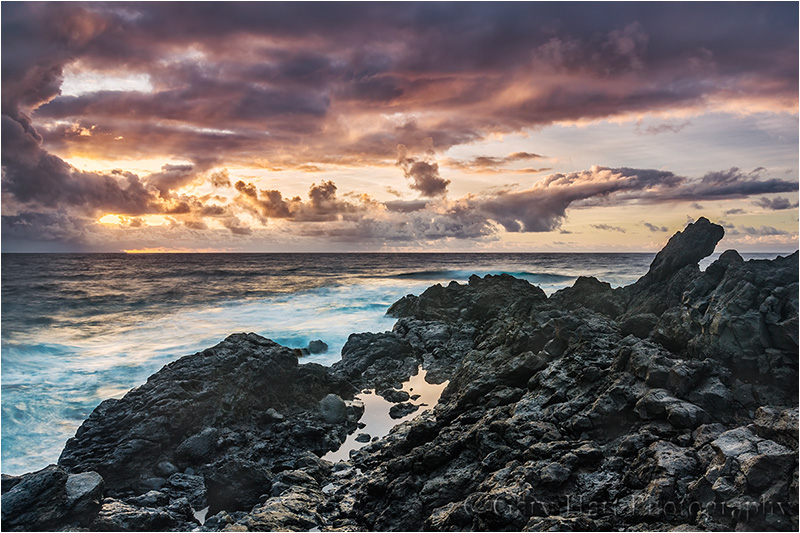
Sunrise, ‘Ohe’o Gulch, Maui
* * * *
The drive to Hana is an adventure of crowded, winding, narrow roads. The drive to the Seven Sacred Pools of ‘Ohe’o Gulch, Maui, about twelve miles beyond Hana, is even more unnerving—the road narrows further and the crowds are replaced by miles of empty road interrupted infrequently and abruptly by careening locals in vehicles just slightly too large for the blacktop.
On my latest Maui visit I rose in the Hana darkness and headed to the Seven Sacred Pools for sunrise. Doing this drive in the pre-dawn dark only adds to the tension, but I arrived unscathed to find the parking lot empty. Perfect! Following my headlamp along the quarter-mile trail, I continued mulling compositions I’d been plotting since my last visit (when light and crowds didn’t permit anything particularly creative). So imagine my surprise to find a padlocked gate blocking the stairs down to the pools. Hmmm. After a few minutes of reconnaissance, I decided they really, really didn’t want me down there and set out in search of other opportunities.
‘Ohe’o Gulch empties into the Pacific, draining rain that falls on the slopes of Haleakala high above. In addition to the main trail along the gulch are a number of smaller, less defined trails that trend out toward the surf. I followed one of these and soon found myself making my own path along broken lava toward the waves. The sky had brightened just enough to render my headlamp unnecessary, but footing was treacherous and I had to step carefully—a fall likely wouldn’t have resulted in death or even severe injury, but the rocks would have sliced me pretty good, not to mention what it would have done to my camera, so my focus was more on the ground at my feet than the larger scene.
When I made it out to where the surf met the rocks (I can’t call it a beach), I was quite pleased to find several reflective pools nestled in the lava, guarded by a prominent lava outcrop. The rising sun had already started to color the sky, so I set up quickly, finding various compositions that balanced the largest pool with the rising sun and outcrop. Working the scene, I was treated to a sunrise palette of magenta, red, and gold punctuated by an explosion of crepuscular rays as the sun crested the horizon. I couldn’t help thinking that I’d probably have missed it all had I concentrated on the shots I’d planned for that morning—a gentle reminder not to get so locked into my agenda that I lose sight of the larger world around me.
On the drive out of the parking lot I encountered the park ranger opening the entrance station. I asked her about the locked gate at the pools and she explained the flash flood risk forces them to restrict access when the weather forecast calls for heavy rain on Haleakala.
Looking a little closer
Posted on April 20, 2012

Surf and Stone, Hana Highway beach, Maui
My print sales tell me that it’s the familiar, dramatic vistas that people are most interested in (not that there’s anything wrong with that), but what I most like photographing is the often overlooked details that make nature special. While I do my share of landscape retreads–because there are reasons these scenes are popular and I’m still a sucker for natural beauty–when left to my own devices, I could (and do) shoot stuff like this intimate Maui beach scene all day.
Because Maui and the Big Island have experienced the most recent volcanic activity (it’s ongoing on the Big Island), scenes like this are much more common than they are on the other major islands. I found these volcanic stones, polished smooth by sand and surf, on a small beach near Hana. I composed to capture the sea/land interaction that’s so easily overlooked in favor of the more dramatic surroundings. Once I found a composition I liked, I clicked twenty frames recording a variety of wave actions at different shutter speeds.
The Road to Hana
Posted on April 1, 2012
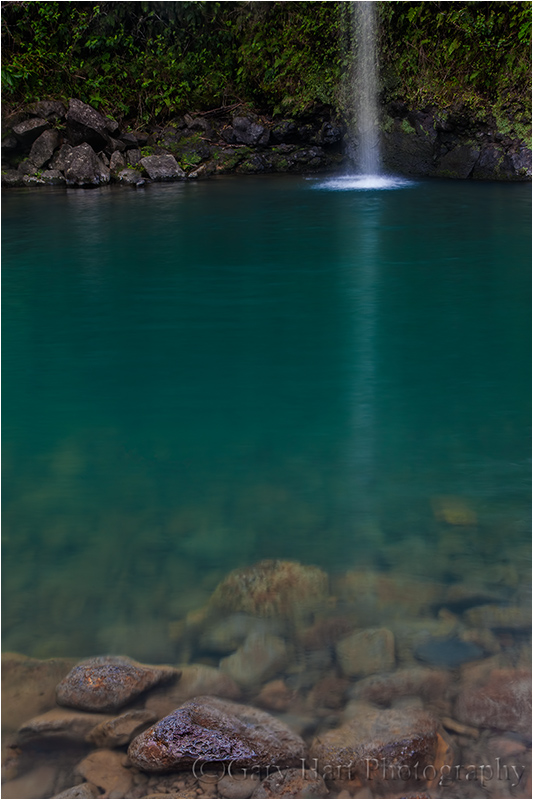
Serenity, Waterfall and Pool, Hana Highway, Maui
Canon EOS-5D Mark III
45 mm
.6 seconds
F/16
ISO 200
In my parents’ day, Maui’s “Road to Hana” was something to be achieved. Negotiating the narrow, undulating, muddy, potholed, serpentine, lonely jungle track was a badge of honor, something akin to scaling Everest or walking on the moon.
Today’s Hana road has been graded, paved, and widened just enough to accommodate a double yellow line that creates the illusion of space for one car in each direction. This sanitized road, now dubbed the “Hana Highway,” hosts a daily bi-directional swarm of tourists whose priorities range from not missing a single leaf, all the way to being the first to cross the finish line in Hana or back in Kapalua. Unfortunately, priorities (among other things) collide at each of the 56 bridges that, due to budget constraints, remain at their original one-lane width. Add to this mix laboring bicyclists, a sky that pinballs between blinding sunshine and windshield-obliterating downpour, an assortment of impatient and sometimes hostile locals (they’re the ones whose music you hear before their pickup rounds the turn), an occasional ten-wheel dump truck large enough to scrape roadside foliage with both mirrors, and random mongooses that pop from the jungle with Wac-A-Mole predictability, and navigating the Road to Hana feels more like a Hope/Crosby movie than a tropical vacation.
But one thing hasn’t changed: The Road to Hana experience remains a living embodiment of the tired axiom, “It’s not the destination, it’s the journey.” Hana itself is a pleasant, Hawaiian town with nice beaches and a small but eclectic assortment of restaurants and lodging. But with every hairpin turn or precipitous drop on the way there, you can’t help feeling that you’ve plopped into Heaven on Earth. The Hana road’s 50-plus miles alternate between dark, jungle tunnels and cliff-hugging ocean panoramas, punctuated by waterfalls (some of which start above you and complete beneath you, on the other side of the car), colorful foliage, and the constant potential for a rainbow. And oh yeah—banana bread. The best banana bread you’ve ever tasted. Still warm.
Sonya and I set out for Hana early Thursday morning—not quite as early as we’d planned, but we hoped early enough. Finding the first few miles beautiful and relatively easy going, we naively congratulated ourselves for our early start. But somewhere around mile-ten, as the curves tightened, the road shrank, and the photography improved, our pace slowed considerably and we found ourselves swept up in the tourist wave. Parking at every scenic turnout was a battle that often resulted in extremely, uh, “creative” solutions. Nevertheless, after a day packed with a year’s worth of scenery, we rolled into Hana at about 5 pm, equal parts exhausted and hungry.
Approaching Hana we’d glanced a sign for a restaurant called “Café Romantica,” offering “Gourmet, organic vegetarian food.” Since Sonya’s a vegetarian, and I don’t eat red meat, meals on the road are sometimes problematic and we were excited about the possibility of rewarding ourselves with a good meal. But the sign offered no specifics and despite our vigilance we found no hint of its existence anywhere.
Once we were comfortably ensconced in our (amazing) room, I pulled out my iPhone and looked up Café Romantica. I found it on Yelp, but no address, website, or phone number anywhere. The Yelp reviews were both amazing (nearly unanimous 5 stars) and intriguing (references to a truck beside the road and bizarre hours) enough that I knew we had to find it. Clicking the “Directions” link on Yelp returned a Google map with a dot on the road about ten miles south of town (in the opposite direction from which we’d arrived)–still no address, but at least solid clue.
In a perfect world we’d have taken an hour or so to clean up, enjoy the setting, and recharge after the drive, but one of the Yelp reviews warned the restaurant closes at 7:00, so we sucked it up and headed right back out. (This might be a good time to mention that the day prior Sonya and I had driven to the top of Haleakala. This is a harrowing drive in its own right, spiraling from sea level to over 10,000 feet in less than thirty miles. On the way down the mountain the brake warning light in our rental blinked on and off intermittently. And on the drive to Hana that morning, our tire pressure warning light had come on a couple of times.)
Twilight was fast approaching, but we felt confident in the Google map on my iPhone, with its bold red dot representing Café Romantica and a blue dot that perfectly pinpointed our location. I mean, even without an address, how hard could it be? Since there’s only one road in and out of town, I figured we’d just drive into the jungle until we found the restaurant where the dots meet.
I watched the road and the dashboard warning lights (so far so good), while Sonya monitored the dots, watching the blue dot inch closer to the red one far slower than we’d expected. It became immediately clear that the road out of Hana is even more challenging than the road into Hana. It’s narrower, shrinking to one lane for long stretches, and much rougher. And while the road into Hana seemed to be about 80-percent fellow gawking (but harmless) tourists, the only vehicles we encountered south of town were clearly locals who seemed to be enforcing their own secret roadway protocol, the prime principle being that, no matter what the hazard or consequence, we are to get out of their way.
About five miles (twenty minutes) into the jungle we rounded a particularly narrow corner to find ourselves headlights-to-headlights with a careening pickup who instantly opted for his horn instead of his brakes. After deftly braking and swerving, I glanced in the mirror and saw that pickup driver had finally discovered his brakes, and in fact had also stumbled upon his reverse gear and gas pedal and as accelerating back in our direction. I boldly applied the gas and disappeared around the next bend, then spent the next two miles with an eye on the mirror. (I’ll probably never understand that little encounter, but fortunately we never saw the guy again.) The road grew more remote with each turn, and we started imagining engine and tire noises–at one point I rolled down the window to see if I could figure out where that tire noise was coming from, but the road noise was drowned out by jungle sounds. My attention alternated between the road in front of us, the rearview mirror, and the dash, while Sonya kept a vigilant eye on the dots and we traded to “Deliverance” jokes to ease the tension.
By the time our dots merged, darkness was almost complete and we were pretty much resigned to the reality that our dinner plan had descended to wild goose chase status. According to Yelp, Café Romantica clings to a remote, vine-covered cliff about two hundred vertical feet above the Pacific—there’s not enough room there for a toaster, let alone an entire restaurant. But at that point we were just happy to find a place wide enough to turn around.
The drive back in the dark was less eventful (and no doubt due to my vigilant scrutiny, the previous day’s warning lights never did return), though at one point we were tailgated by a group of partying teenagers who pushed us along until I found a place wide enough to pull over safely. Needless to say, we were quite hungry by the time we rolled into town at around 7:30. Given Hana’s limited selection of restaurants, its reputation for shutting down early, and our specific culinary needs, we inventoried the food we had in the car and decided rice cakes, graham crackers, and fruit could get us to breakfast without starving.
About two blocks from our hotel a string of lights on the left caught my attention and I slammed on my brakes while my brain struggled to comprehend what I saw. Suspended above a small motorhome on an otherwise vacant lot was an awning with the words, “Café Romantica.” It was so close to our room that the walk there would have been shorter than the walk to our car had been. Besides a man putting away chairs and tables at the back of the property and a woman puttering inside the motorhome, we couldn’t see much activity. Nevertheless, I executed a quick u-turn and parked out front.
The motorhome had an attached awning covering a short counter with three or four stools. Behind a sliding window above the counter puttered the woman. I approached the window, crossed my fingers, and asked if they were still open. She shook her and apologized politely, explaining that she was almost out food. But as I started to summarize our futile hunt of the last hour she must have heard the desperation in my voice, because immediately her face warmed and she reassured us in a most maternal tone that she’d take care of us. She introduced herself as Lori Lee and asked where we were from.
About then another couple walked up, and rather than turn them away, Lori Lee rattled off to the four of us a handful of the most mouth watering, eclectic vegetarian entrées imaginable: rellenos, quiche, curry, …. She qualified each offering with the proviso that she only had one or two servings of each, but since they all sounded so good, the four of us had no problem negotiating who’d get what.
Lori Lee entertained us with friendly conversation as we sipped a wonderful soup (that also gave us great hope for what was to follow) she’d offered to hold us over until dinner was ready. Rather than make you watch me chew, I’ll just say that dinner was so good that we ordered dessert (something we never do), and even added one of her remaining entrees to-go for lunch the next day.
One of my tenets is that things always work out. I have to confess that our drive that evening severely tested my conviction, but without our little misdirection adventure, Sonya and I would have been deprived of probably the most memorable experience of our trip, and a restaurant experience I’ll never forget.
A few words about this picture
This little waterfall is just one of dozens visible along the entire length of the Hana Highway. Many are quite dramatic and stimulating; others, like this one, are more subdued and soothing. I must admit that by the time we pulled up to this fall I was verging waterfall overload. I’d found that my 70-200 lens worked best for most falls because it allowed me to isolate aspects of the scene and also to surgically remove tourists at some of the more popular falls, and I’d started exiting the car without the rest of my gear.
But cresting the small hill that provided a vantage point, I realized I’d left the car with only my 24-105 lens. Rather than walking back to the car (a hike all of maybe 150 feet), I decided to pick my way down to the pool’s edge. And had I not done that, I would have completely missed the beautiful rocks just beneath the water’s surface.
To ensure sharpness throughout the frame, I stopped down to f16, dropped to my knees, and focused on the large rock visible just beneath the surface (behind the protruding rocks). I carefully oriented my polarizer to remove glare on the nearby water and rocks, but not so much that I lost all of the fall’s reflection in the quiet water. I clicked several frames, all vertical. Some included the entire fall, but I like the mystery of this composition, the way it lets you imagine the rest of the fall and the scene surrounding it.
About thirty seconds after I snapped this a teenage girl jumped into the water right in front of me and the shot was gone. Fortunately I had all that I needed and I returned to the car a happy photographer.
Join me in my

 Eloquent Images by Gary Hart