Eloquent Images by Gary Hart
Insight, information, and inspiration for the inquisitive nature photographer
Variations on a Tree

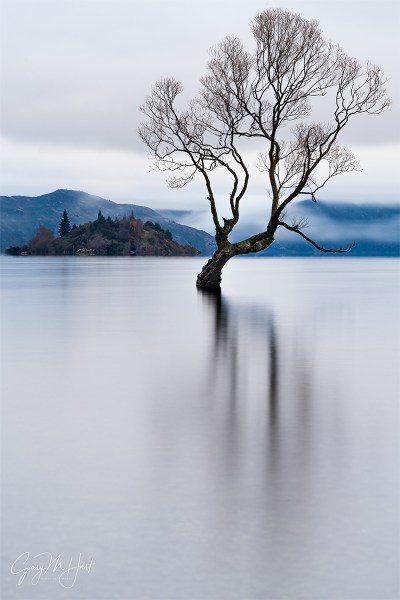
Winter Chill, Lake Wanaka, New Zealand
Sony a7R V
Sony 100 – 400 GM
ISO 100
f/18
30 seconds
I returned from New Zealand Saturday evening, a bit battered and bruised by jet lag and a brief but quite unpleasant battle with food poisoning (or norovirus), but nevertheless already missing this beautiful country that feels more like my home away from home each time I visit. I love everything about New Zealand—its unparalleled scenery, its friendly people, its tasty food, its pristine environment (the air, lakes, rivers, streets, and even the public restrooms), its meticulously maintained hiking trails, and even its (almost but not quite) ubiquitous sheep. Oh wait a minute—not the bacon. I definitely do not love New Zealand’s flaccid bacon (bacon should snap, not tear like soggy tissue).
Because I’m still in recovery mode, as I did last week, this week’s blog will be a new image attached to a revived and (significantly) updated prior post. I hope to forego the self-plagiarism and resume my regular schedule next week. In the meantime…
I’m incredibly blessed to make my living guiding enthusiastic photographers to many of our planet’s most beautiful locations: New Zealand, Iceland, Yosemite, and Grand Canyon, among many. While this makes my life far too rich for complaint, let me say (without complaining) that a particular challenge imposed by frequent return visits to the same locations is finding unique ways to photograph them.
My usual approach at these familiar locations is to identify appealing relationships and framing, then use my camera’s exposure variables to play with the scene’s “creative triad”: motion, light, and depth. Whether it’s blurring or freezing water, emphasizing shape by going dark for a silhouette or bright for a high-key effect, or depth-of-field from narrow to extreme to emphasize depth, I love playing with these variables to create something unique.
One particularly challenging subject is the solitary willow tree near the south shore of Lake Wanaka in New Zealand. This striking tree just stands by itself in a lake (most of the time), with little motion, silhouette, or depth of field opportunities. But each time I visit Wanaka, I challenge myself to find a version of the scene that’s different from anything I’ve captured, a challenge that grows harder with each visit. And just because I don’t have my full arsenal of creativity weapons doesn’t mean I’ve arrived completely disarmed.
With a compromised (but not quite eliminated) creative triad, my creative options at Lake Wanaka rely more heavily on some combination of weather and water conditions, juxtaposition of visual elements, focal length, and framing. And as you can see in the gallery at the bottom of this post, the conditions at the time of my visit play the largest role in the way I approach this scene. The weather conditions for sure, but also the color and light, the quality of the reflection, and whether it’s day or night.
Because a picture is worth a thousand words, I’ll spare you long explanations and share some examples with a few words of explanation
(Click the image for the blog post describing its capture)
First, a little bit about this beautiful tree. It grew from, of all things, a fence post placed near the lake around 1940, at a time when the water was lower than it is in most of these images. Spend much time in New Zealand and it’s not hard to recognize that New Zealanders are especially proud and protective of their indigenous flora and fauna. Which might explain why most New Zealanders view the attention this non-native willow tree receives with emotion that ranges from bewilderment to downright irritation. These feelings seem to intensify with proximity to Wanaka.
In March 2020 (clearly not a great month) the tree was vandalized by person/persons unknown (though I’ve been told that local authorities have a good idea who it is) who sawed off several branches, including the distinctive lowest branch that arced downward and nearly grazed the lake surface. And while this branchectomy (I made that word up) did cost the tree some of its aesthetic appeal, its beautiful spirit persists, and the Wanaka Willow remains a striking feature to view and photograph. (It won’t be difficult for anyone browsing the gallery images below to distinguish the before and after images.)

Wanaka Reflection, New Zealand
New Zealand’s winter clouds are a frequent source of delight. This image was captured late-morning (not usually great light), but the clouds and reflection were so nice that I couldn’t resist shooting. I chose a horizontal composition because it allowed me to include more clouds and reflection, while filling the frame top-to-bottom with the tree and its reflection, than a vertical composition would.

Red Sunset, Lake Wanaka, New Zealand
Juxtaposition is almost always a prime consideration. I especially love the snow-capped Southern Alps across the lake, so all things equal, I’ll usually position myself with the mountains in the background (the other options are trees and shoreline, or the town of Wanaka itself). In this scene the main event was the spectacular tangerine sunset, perhaps the most vivid color I’ve ever witnessed in New Zealand.
With the most intense color in the direction of the peaks, I set up facing that direction, taking care not to merge the tree with tiny Ruby Island. The reflection was slightly disturbed by gentle undulations on the lake’s surface, so I added a 6-stop neutral density filter to smooth the water. The resulting 30-second exposure glazed the lake surface and softened the distant fast-moving clouds just enough.
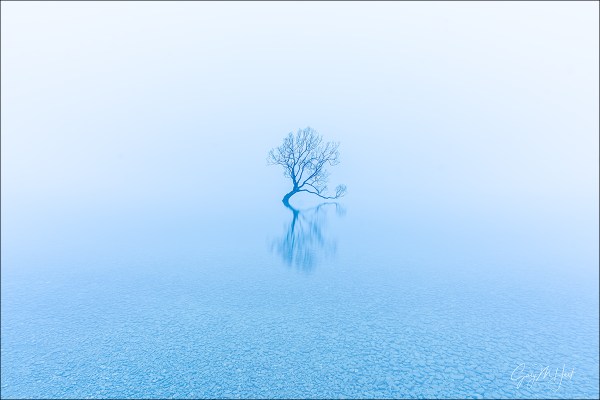
Gray Dawn, Lake Wanaka, New Zealand
But it’s not always about background juxtaposition. For example, on the morning following the sunset image above, the morning fog was so thick it rendered the background completely irrelevant. I chose a spot that best emphasized the tree’s shape, and that allowed me to fill my foreground with a mosaic of barely submerged stones. I played with my polarizer until I found an orientation that revealed the nearby stones while sparing the tree’s reflection. (Hold a gun to my head and ask me to name a favorite Wanaka Tree image and I might just choose this one.)
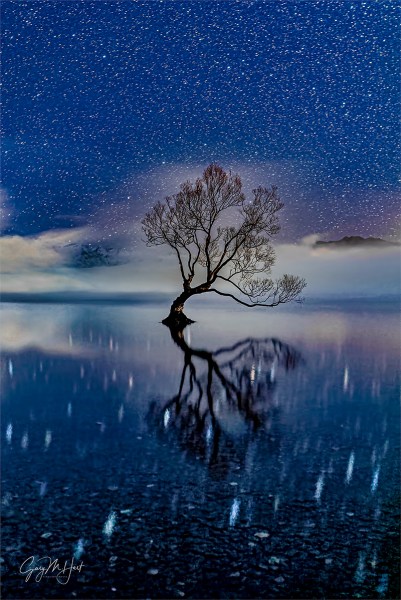
Starry Night, Lake Wanaka, New Zealand
Sky Light,The Milky Way and City Lights, Lake Wanaka, New Zealand
One aspect of the conditions I have some control over is whether it’s day or night. By going out after dark on a clear night, I can include stars—depending on the timing and my position, I can also juxtapose the tree with the Milky Way and a background feature.
In June, when I’m usually in New Zealand, for the first half of the night including the tree with the Milky Way also means including the lights of Wanaka. While that’s not necessarily a bad thing, I generally prefer avoiding city lights. I made an exception on this chilly night when a low fog bank obscured most of the direct artificial light, absorbing and reflecting Wanaka’s glow to paint the lower half of the frame gold.

Milky Way and Reflection, Lake Wanaka, New Zealand
If I wait until the night hours closer to sunrise, the Milky Way has rotated westward, away from the city lights. On the morning I captured the image on the right, the Milky Way was well on its way to setting. Rather than staying up all night for this image, I simply rose a couple of hours before sunrise to make this image (the beauty of having a hotel within walking distance of the tree). Unfortunately, by the time I made it out to the tree, the sky was just starting to brighten and lose contrast, and the Milky Way had rotated so far west that including it with the tree meant also including nearby shoreline and trees too. I have visions of making it out there a couple of hours earlier, but so far haven’t had a clear enough night on any subsequent visit.
For the image at the top of this frame, captured the same night as the image that includes the city glow, I decide to forego the Milky Way entirely and just concentrate on the tree and its reflection. The result was another of my favorite, and most successful, images.
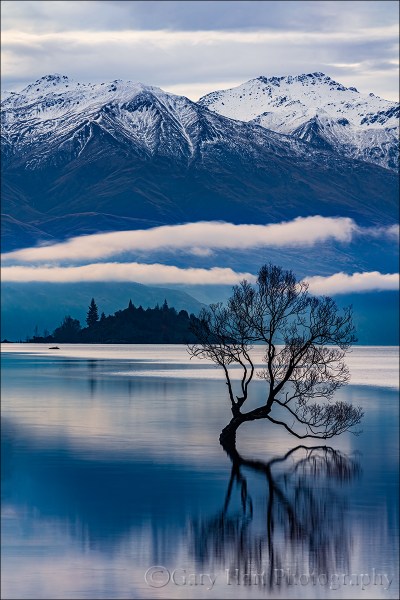
Lone Willow Reflection, Lake Wanaka, New Zealand
I wasn’t really crazy about the sky when I captured this image, but I liked the background peaks and low-hanging clouds. So I retreated down the lakeshore, away from the tree, and then climbed a gentle slope to distance myself even further, then used a telephoto to enlarge the tree and shrink the distance between it and the mountains and clouds. (If I had it to do over again, I’d have moved slightly right to avoid merging the tree with the island.)

Reflection on the Rocks, Wanaka Willow Tree, New Zealand
The beautiful clouds that had started the evening over the Southern Alps had move quickly across the scene were exiting southeast and out of my frame. It wasn’t long before my options were to hold my position and photograph the tree with the mountains and no clouds, or reposition myself to feature the best of the clouds against the town of Wanaka. I went with the clouds.
Because I saw the potential for a beautiful sunset, I went went wide to maximize the sky, choosing my 12 – 24 lens. Instead of filling most of the frame with colorful clouds, I positioned myself so the reflection mirrored the arc caused by the last of the retreating clouds, creating a frame for the tree. I was aware that I was picking up a few structures on the opposite lakeshore, but felt that was justifiable compromise to ensure the best clouds and sunset color potential combined with snowy peaks.
The light was beautiful when I started, but it just kept improving as the color ramped up. Every few minutes I repositioned myself to keep the tree framed beneath the shifting clouds. To feature the flat, multi-toned rocks visible beneath a thin veneer of reflective water, I dropped my tripod and moved it a foot or so into the water. And finally, I shifted just enough for the trunk to split the gap between two distant peaks. Going vertical allowed me to get the full arc of clouds and their reflection above the rocks, with less far lakeshore than a horizontal composition would have.
Winter Chill, Lake Wanaka, New Zealand
This year’s (2023) Wanaka visit featured persistent dense, high fog. Perhaps not the dazzling conditions we’d all hoped for, but the longer I spent with the scene, the more I started to appreciate the opportunities. With fairly bland clouds overhead, my goal this morning was to isolate the tree, its reflection, and distant Ruby Island. To do this, I used my my 100-400 lens, positioned myself as far back as I could, and aligned the tree and island so they were close but not merged.
The reflection this morning was visible but slightly disturbed by gentle waves rolling across the lake surface. With a focal length of 166mm, I was a little concerned about keeping both the tree and the background sharp, so I stopped down to f/18, temporarily removing my camera from the tripod to focus on trees behind me that were slightly farther away the the willow (read about hyperfocal focusing). To create a more ethereal effect in the reflection, I returned the pre-focused camera to the tripod and added my Breakthrough 6-stop Dark Polarizer for a 30-second exposure that gave the lake a beautiful gauzy sheen.
Workshop Schedule || Purchase Prints || Instagram
Variations on a Tree
Click any image to scroll through the gallery LARGE


 Eloquent Images by Gary Hart
Beautiful. Thankyou.
These are gorgeous images Gary. Clearly, you have a gift for photography and teaching.
Much appreciated, Brad. Thanks for looking (and reading).
My pleasure Gary.
great example of taking the primary subject matter and using so many variations based on light and reflection.
Exceptional !
Thanks, Charlie!
wow, I love your creativity!
Thanks so much, Vicki!
Pingback: Variations on a Tree | Eloquent Images by Gary Hart - Photography
Pingback: A (Big) Mistake, and a (Small) Rant | Eloquent Images by Gary Hart
Pingback: New Zealand Rocks | Eloquent Images by Gary Hart
I absolutely love this!
Thanks!