Eloquent Images by Gary Hart
Insight, information, and inspiration for the inquisitive nature photographer
Storm Chasing Diary: Safety, Schmafety
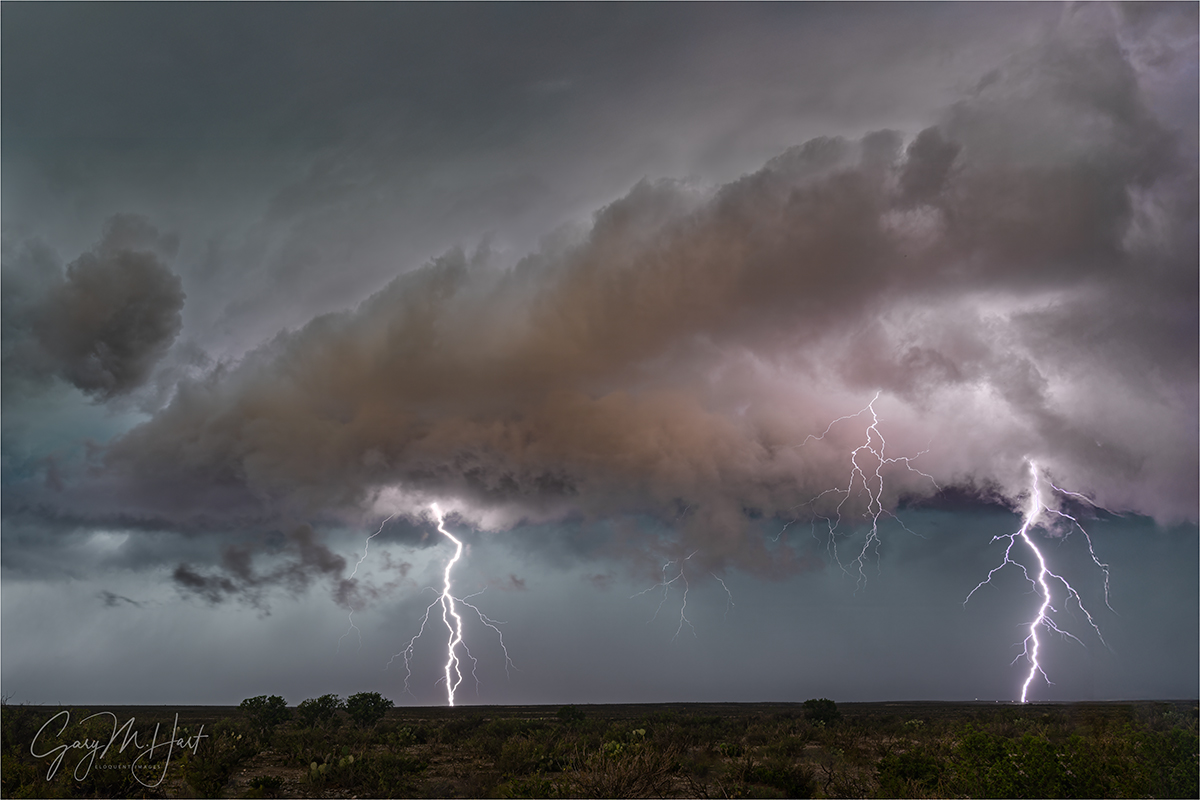
Too Close, Somewhere in West Texas
Sony a7R V
Sony 24-105 f/4 G
ISO 100
f/10
1/2 second
It feels pretty weird writing about sweltering Texas June afternoons while, only a couple of weeks later, shivering through frigid New Zealand June mornings, but welcome to my world. We’ve had some gorgeous photography Down Under again this year, and while I’d love to be able to capture, process, and blog in something closer to real time, my workshop priorities just don’t permit that. So here I am in extraordinarily beautiful New Zealand, still thinking about storm chasing in the Midwest. (But I’m definitely not complaining about this life I’ve chosen.)
So anyway…
It seems like every time I post a lightning image, I get admonished by someone who insists that I’m too close, too foolish, or that I must have a death wish. And while I appreciate the concern about my wellbeing, (tongue in cheek title of this post notwithstanding) I really am not a careless person.
These unsolicited lectures seem to have been exacerbated by this year’s decision to chase storms in the Midwest. After fielding enough (ostensibly) well-intended scoldings, I’ve decided that some people just don’t understand the research and planning that goes into storm chasing, and the care taken to ensure the safety of all—safety really is a non-negotiable priority. And then there those people who, no matter how careful my planning and execution, simply can’t comprehend why someone else would do something they themselves wouldn’t dream of doing.
To the latter group, let me point out that risk management is part of virtually every human activity, from a trip to the store, to free-soloing El Capitan (I’ve actually done one of these things), and pretty much every other activity in between.
Before any act, on some level, conscious or unconscious, we decide whether the benefit justifies the risk. And as you might imagine, the individual calculus behind those choices is all over the map, because one person’s thrill is another person’s terror. Which is why I’m always amused when someone scolds me for doing something simply because they’d never do it.
Yes, pursuing a subject that might kill you—suddenly, violently, and in multiple ways—on the surface sounds pretty nuts. But people every day most of us get behind the wheel fully cognizant of the potential that some random event completely beyond our control, from a sudden mechanical failure to a clueless fellow driver, could injure or kill us without warning. And what about that steak you had for dinner last night? Did you know that more than 5000 American die from choking each year?
Alex Honnold, everyone’s poster-child for risk taking, talks about the difficulty people have distinguishing difference between risk and consequence. He asserts that most people focus too much on the consequence of failure (almost certain death for someone free-soloing), and not enough on its risk. He believes, and so far has proven, that his preparation, physical abilities, and experience, make free-soloing a very low risk endeavor.
Far-be-it from me to compare myself to Alex Honnold, but I will say that majority of people who storm chase (myself included) don’t just race willy-nilly into a violent storm—we do an immense amount of research, arm (or surround) ourselves with the necessary expertise and tools, and make informed decisions on where to be, when to be there, and how we’ll retreat when things don’t go exactly as expected. As a nature photographer, this kind knowledge and preparation enables me to satiate my passion for natural drama and beauty while minimizing the non-zero chance I’ll die doing it. But your results may vary.
Is throwing caution to the wind how I live every aspect of my life? Absolutely not—not even close. For example, living vicariously through climbers, I think free-soloing El Capitan sounds like a blast—but all the preparation, knowledge, and ropes in the world are nowhere near enough to compel me to try rock climbing, in any form. In fact, even the knowledge that simply standing still is enough to keep me completely safe on the rim of Horseshoe Bend (near Page, Arizona—all who have been there know what I’m talking about), couldn’t get me within three feet of that edge. But, as I said, your results may vary.
Back to storm chasing
The big three storm-chasing weather phenomena that can kill you are tornadoes, hail, and lightning. (Despite words to the contrary from self-appointed lightning experts) I have enough general understanding and firsthand experience with lightning to possess a pretty good sense for what’s safe and what’s too close. But a charging tornado? Not so much. Before the trip, all I knew about tornado safety was that the ever popular grizzly attack strategy—just be faster than the person you’re standing next to—doesn’t work for tornadoes. And hail? Just looking at pictures of cars and buildings pummeled by large hail was enough to give me pause, and to seriously wonder whether storm chasers need to don helmets.
Given these concerns, it didn’t take long to appreciate the advantage of a trip leader who is a meteorologist with more than 20 years’ experience chasing storms. Specifically, our leader Chris’s ability to read the storms well enough to not only identify the best burgeoning supercell to target, but also to put us in the safest place to photograph whatever our chosen storm delivered, and when it’s time to exit, paid off time and time again.
From Chris, I learned (and later confirmed through my own observation) that tornadoes tend to form in very a specific region of a supercell, and only after tipping their hand with visible tells. Before dispensing a tornado, supercell starts visibly rotating, then drops a “wall cloud” down to ground level. On the day we saw a half-dozen or so tornadoes, Chris called each in advance, actually pointing out just where they’d drop.
And once on the ground, tornadoes tend to follow a predictable (to those who can read supercells) path. So even though we were within a mile of several tornadoes that day, we were able to safely observe them moving across our line of sight, and never felt the slightest anxiety.
Large hail was another danger novelty for this California boy. After seeing photos and hearing stories graphically depicting an assault by baseball-sized (and larger) frozen projectiles, I had no desire to experience large hail firsthand. But, since (as I know now) large hail tends to fall in certain regions of a storm that can be seen from a great distance, and you can actually hear hail coming, we were always able to avoid dangerous hail.
Lightning, on the other hand, still made me nervous. Turns out our experienced, storm-chasing meteorologist was perfectly comfortable defying all the lightning rules I’ve applied during my Grand Canyon monsoon storm chasing trips (where lightning is our prime target). Wide open spaces? Sure, whatever provides the best view. Nearly simultaneous lightning/thunder? Keep shooting!
I eventually asked Chris if he has some kind of secret lightning-whisperer insight that enables him to get so close to lightning. And though his answer wasn’t exactly comforting (“No.”), he did share that his lightning strategy is founded on more than 20 years of consequence-free exposure to supercell lightning.
Too close for comfort (but I’d do it again)
By the time we were on our tenth day of chasing, I’d come to terms with our cozy relationship with lightning, and certainly couldn’t argue with the results: lots of great lightning captures, and no storm chasers lost. Win/win.
But we weren’t out of the woods yet. Day 10 day found us motoring from the Texas Panhandle into eastern New Mexico, and finally down to southwest Texas, not far (as the crow flies) from Big Bend National Park. The day’s highlight was chasing a beautiful supercell across the Texas badlands in typical (by now) stop/start fashion, tracking the blue hail core, monitoring visible rotation for a possible tornado, and grabbing occasional lightning strikes.
At one point, the limited road network out there forced us to “punch through” the core of the storm, where we endured about 30 minutes of torrential downpour, drifting small (-ish) hail that deposited up to two inches of white, grape-size pellets on the road, and a barrage of frequently close lightning. After reaching the other side, several times we found ourselves far enough out front to stop and photograph the storm’s advance for a few minutes before retreating.
At our final stop, we had enough time to break out the tripods—a real luxury. The closest lightning was no more than a mile or two away as I took up position along a fence and set up my tripod, camera, and Lightning Trigger. Though the foreground here wasn’t great (understatement), the blue of the hail core was clearly visible, and a howling wind continuously pushed spectacular clouds rapidly across the scene, each one armed with an arsenal of ground-stabbing lightning.
After composing and metering, I just stood back and let my Lightning Trigger do all the work, and enjoyed the show. Occasionally, I’d adjust my framing as I became more aware of where the most lightning was firing. As the intensifying blue of the hail core signaled the storm’s approach, I could that the lightning was advancing with it. About the time I started getting a little nervous, Chris called us all back to the vans, but just as I reached for my camera to pack it up, the most spectacular, and closest, strike fired and the thunder exploded almost immediate my camera’s final click of the day.
I made it to the van before the next bolt landed, and we were soon down the road safely ahead of the hail. Had we been too close? Possibly. But as much as we’d grown to trust Chris, who had been right every time leading up to this shoot, we all hung in there. Seasoned storm chasing veterans by now, every single one of us was well aware of the risks, and each made the conscious choice to stay out and keep shooting rather than return retreat to safety as the lightning approached.
I always wear a seatbelt in a car, a helmet when I bike, and wait for the WALK sign. And you’ll never find me clinging to the side of El Capitan, or even standing on the edge at Horseshoe Bend (my Horseshoe bend pictures require a tall tripod and 3-foot remote cable to keep me a comfortable distance from the edge). But I’d do this storm chasing thing again in a heartbeat—even if that heartbeat might be my last.
Workshop Schedule || Purchase Prints || Instagram
Worth the Risk
Click any image to scroll through the gallery LARGE


 Eloquent Images by Gary Hart
Stunning images and interesting backstory of storm chasing with relative safety.
Wow! Love your storms.
What a fascinating experience you had! The photos are phenomenal! It almost makes me want to try storm chasing! (key word: almost)
Thanks for sharing your storm chasing travels. I’ve enjoyed them!
Pingback: Looking Back at 2025: I Was There | Eloquent Images by Gary Hart