Eloquent Images by Gary Hart
Insight, information, and inspiration for the inquisitive nature photographer
Send in the Clouds
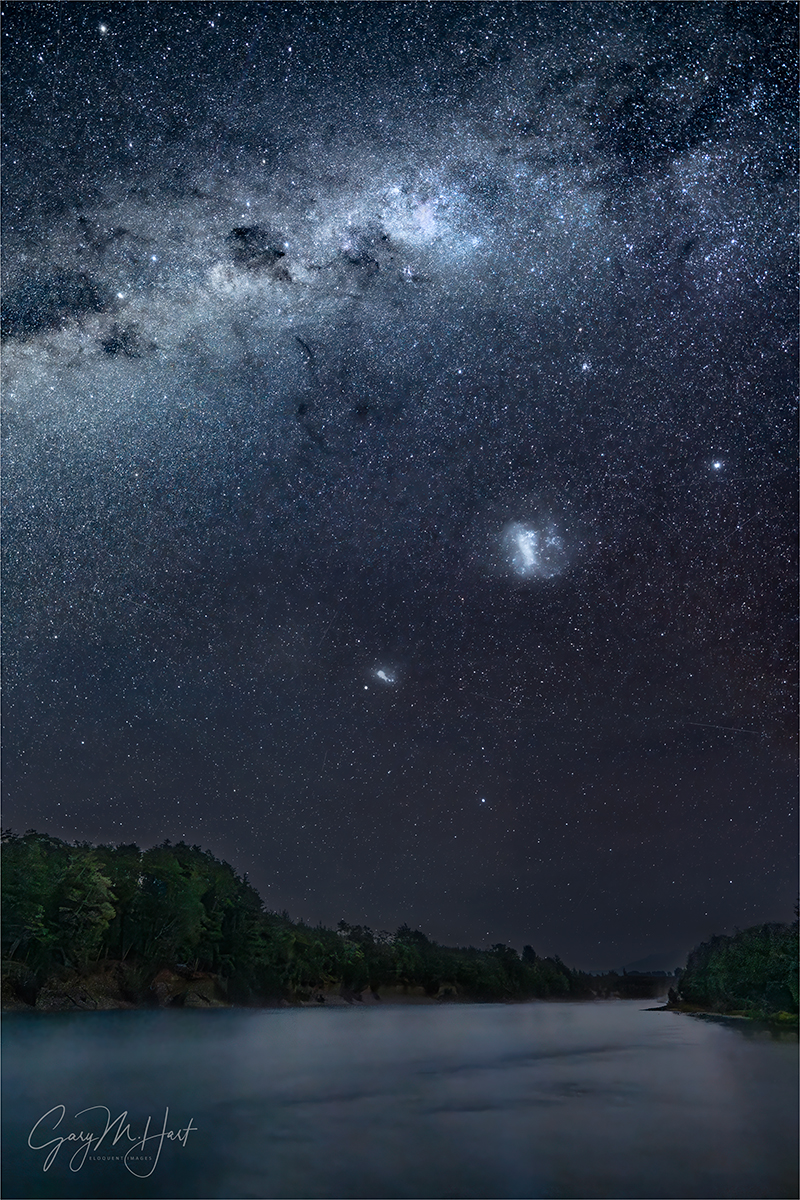
Milky Way and Magellanic Clouds, Waiau River, New Zealand
Sony α1
Sony 14mm f/1.8 GM
ISO 5000
f/1.8
20 seconds
Greetings from New Zealand.
It doesn’t take a genius to figure out that New Zealand is my favorite place to photograph the Milky Way. So, because I only get down here once a year, I always choose June, when the Milky Way is up all night and New Zealand nights are longest.
The New Zealand workshop Don Smith and I do follows pretty much the same itinerary each year, laid out in large part to match the spectacular scenery with the Milky Way. Since our first New Zealand visit in 2017, I’ve identified many great spots to photograph the Milky Way—at least one at most of our workshop’s overnight destinations. Lake Wakatipu: check. Wanaka: check. Aoraki / Mt. Cook: check. But Te Anau—where we spend three nights and visit both Doubtful and Milford Sounds—has always frustrated me.
The problem in Te Anau is two-fold. First, the town’s position on the shore of Lake Te Anau doesn’t offer any correctly oriented, easily accessible lake views in the hours immediately following sunset (we rely on a driver who must follow strict government safety rules that don’t permit him to drive all day, then go out again in the wee hours of the morning). And second, in winter, lake-hugging fog usually obscures the Te Anau night sky.
But this year was different. After losing (our usually reliable) first night Lake Wakatipu Milky Way shoot to clouds, when we saw clear sky in the forecast for the following night in Te Anau, Don and I reached out to friend and Te Anau-based photographer Douglas Thorne, who generously suggested his favorite nearby Milky Way location. Turns out, this spot isn’t actually on the lake, it’s on the Waiau River that connects Lake Te Anau and nearby Lake Manapouri.
Normally Don and I try to get our eyes on a new location before guiding a group there, but we arrived in Te Anau too late that evening to do any scouting. Having lost one Milky Way shoot already, and with clouds forecast for the next two nights (and maybe beyond), we decided go all-in on Douglas’s site.
Foremost on my mind as we arrived was whether it would check all of our Milky Way boxes—boxes that are different for a workshop group than they are for a solo photographer or small group of comparably adventuresome shooters (because a group can only do what it’s most limited participant can to do). To work for a workshop group, we require: 1) a photogenic foreground beneath a clear view of the Milky Way; 2) easy and safe access (a relatively short walk that’s easily headlamp navigable by all in moonless darkness); 3) (because we usually have several Milky Way first-timers) plenty of room for the entire group to photograph in close proximity, enabling Don and me to get everyone set-up, and to be easily available when someone needs help.
Hopping out of the van in the evening’s rapidly darkening twilight, the first thing I did was orient myself and scan the landscape in the direction the Milky Way would soon materialize. Seeing nothing but a lovely tree-lined river beneath wide open skies, I breathed a small sigh of relief and mentally checked Milky Way Box 1. Our driver Steve and I donned headlamps and followed a wide dirt track up a little rise for no more than 200 feet, before descending to a broad, open stretch of riverbank with more than enough room for our entire group: Boxes 2 and 3 checked.
It only took about 10 minutes to get the group over there and set up. At first the Milky Way was only visible to our cameras, so I had to point out where to aim until the sky darkened enough (love those dark New Zealand skies!) to be easily seen by all. I started as I usually do when photographing the Milky Way: wide and vertical. Since the Milky Way is higher in New Zealand than most of the northern hemisphere locations where I usually photograph it, I used nothing but my 14mm f/1.8 prime lens, which gives me the best combination of wide field of view and light gathering capability.
With darkness complete, I pointed out the Large and Small Magellanic Clouds to the group, explaining to anyone listening that they are satellite galaxies gravitationally bound to the Milky Way and visible only in the Southern Hemisphere. Because the only time I get to see and photograph the Magellanic Clouds is on my New Zealand trip, I always look for ways to include them in my images. Unfortunately, the two Magellanic Clouds are separated from the Milky Way just enough to make it difficult to include all three in the same frame—it can be done in a wide horizontal composition, but the MCs and the Milky Way usually end up being too close to their respective sides of the frame to be compositionally palatable to me.
The other problem I’ve encountered when trying to include all three in one frame is that composing that wide at any of other my New Zealand Milky Way locations ends up requiring me to include less photogenic parts of the landscape. But from here, I was pretty thrilled to see that a 14mm horizontal frame that included all three worked really well.
Instead of being satisfied with the horizontal solution, I got the (uncharacteristically) brilliant idea to try a vertical frame aimed straight upstream, directly at the two Magellanic Clouds (which were conveniently situated over the river). Low and behold, not only was a 14mm vertical able to capture both Magellanic Clouds and the river, it was wide enough to include a segment of the Milky Way was close enough to the galactic core to rival its brightness.
This turned out to be a successful night in many ways. In addition to my Magellanic Clouds / Milky Way triumph, everyone in our group got Milky Way images that made them happy (a point of emphasis—and stress—for Don and me until it happens), and we found a new Milky Way spot to share with future groups.
Join Don and me as we run it back in New Zealand again next year
Workshop Schedule || Purchase Prints || Instagram
New Zealand Milky Way
Click any image to scroll through the gallery LARGE


I had a photo of the Milky Way taken in Switzerland but it was stolen from my room where I am living now. I had a certificate of authenticity for it also.
Exquisite image Gary. I really need to join you and Don down there one day.Sent from my iPadOn Jun 15, 2026,