Eloquent Images by Gary Hart
Insight, information, and inspiration for the inquisitive nature photographer
Taking One for the Team…
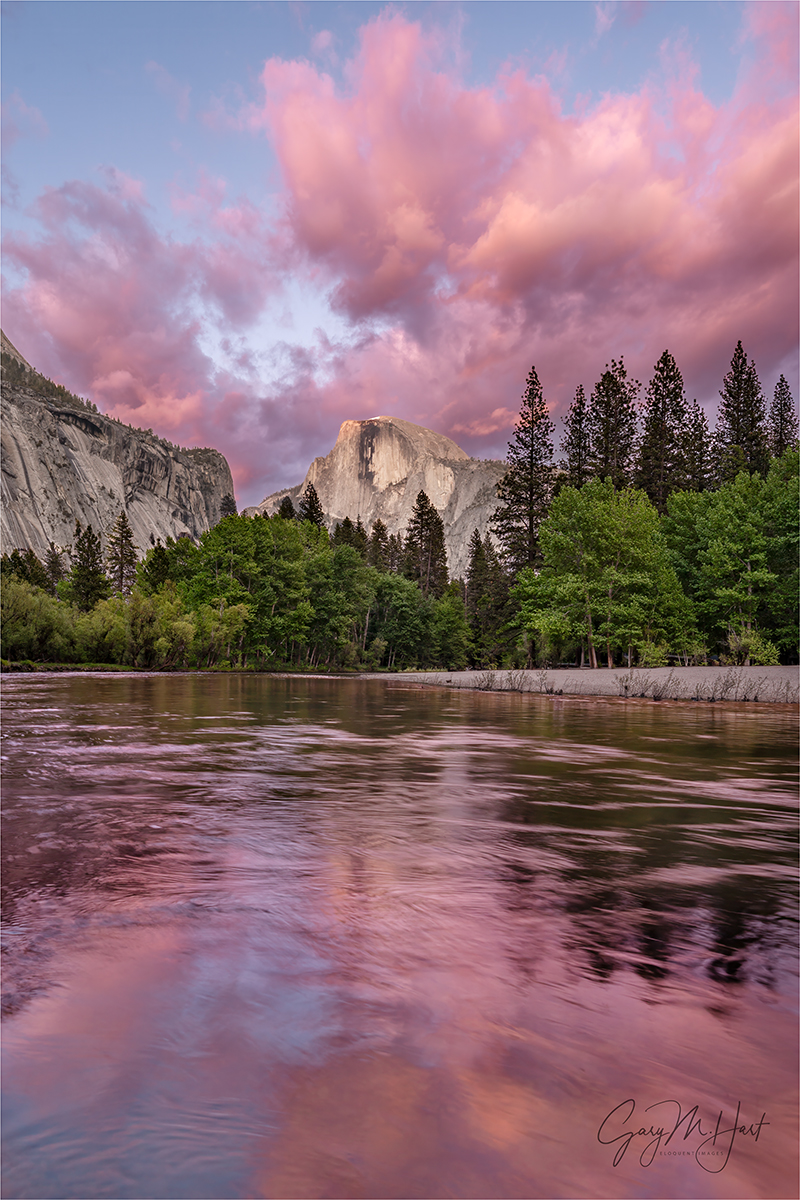
Color and Clouds, Half Dome and Merced River, Yosemite
Sony a7R V
Sony 12-24 GM
1/5 second
F/11
ISO 100
If there’s one thing every nature photographer agrees on, it’s this: Before the really good stuff can happen, someone needs to take one for the team. In other words, the truly spectacular (sunset, aurora, rainbow, lightning, and so on.) display everyone hopes for will not happen unless, 1) someone who could have been there opts out, or 2) at least one person gives up and leaves.
Over the years this truth has been proven time and again: Kilauea eruptions, Horsetail Fall color, and Grand Canyon lightning shows, to name three, but today I’m thinking about my most recent experience.
By the time our final sunset rolled around, my April Yosemite spring workshop had already been memorable for several reasons, from the road conditions uncertainty that threatened the start of the workshop, to an assortment of waterfall rainbows, to the welcome return of the Yosemite Falls moonbow. In fact, coming into the workshop’s final shoot, this group had already enjoyed so much beautiful Yosemite springtime photography, I figured whatever happened for that evening would just be the cherry on top. And when I saw that the weather forecast called for blank skies, I lowered my expectations further. Until…
For absolutely valid reasons, earlier that final day three people had decided to cut and run before the workshop ended. Two participants wanted to get a head start on their long journeys home (one had driven out from Tennessee), while my brother Jay, who was assisting the workshop and sharing my hotel room, decided to call in sick. That’s when I started having flashbacks to the last day of my spring workshop two years ago, when Jay thought he was having a heart attack and ended up getting an ambulance ride to the hospital in Mariposa—followed by four months (that’s not a typo) in UC Med Center in San Francisco with what turned out to be acute necrotising pancreatitis. (Talk about taking one for the team.) This time it was either food poisoning or norovirus, a distinction that made little difference to the sufferer, but a great difference to his roommate. So Jay got no argument from me when he opted out of that final day and went home.
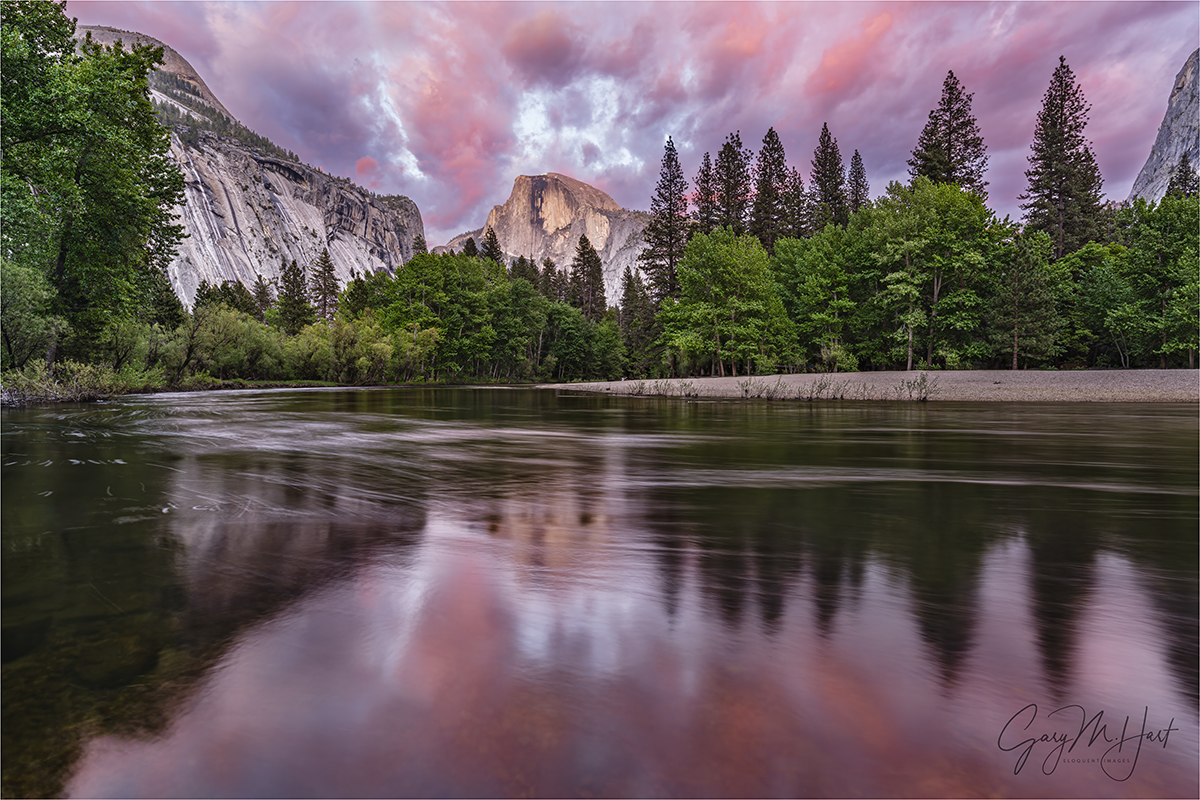
Majesty, Half Dome Sunset Reflection, Yosemite
The rest of the group enjoyed a pleasant afternoon that included an image review and moonbow processing talk, more nice photography, and a visit to the Ansel Adams gallery. We wrapped up about an hour before sunset, taking thea short walk to a favorite riverside view of Half Dome and its reflection, that I often save for the workshop’s final shoot.
Because I’ve photographed this spot so many times, when the conditions don’t look especially promising I’ve been known to taunt the photography gods by leaving my camera gear in the car. But this time I inexplicably decided to don my backpack before leading everyone into the woods. Never have I been happier with a decision that was in all honesty pretty-much a coin-flip. Whether or not it would have happened if the group had been at full strength, but it’s fun to imagine.
I already wrote about this sunset a couple of weeks ago, but let me emphasize the importance of composing your images to fit the conditions, rather than forcing them into a preconceived bias of how the scene should look. This bias can be the product of prior visits, viewing the images of others, or just noticing what others around you are doing—whatever the reason, don’t let your bias blind you to what’s happening right now, because you might be pretty amazed to discover the variety of ways a single scene can be photographed.
I frequently time my visits here to coincide with a moonrise I can use to accent a wide shot, or as a scene partner to pair with Half Dome in a tight frame. In low-flow months, the main event at this spot is the Merced River’s mirror-like reflection, while in spring, the Merced’s volume and speed turns the surface into a swirling abstract that looks very cool in a multi-second exposure. Either way, I often compose wide enough to include the reflection with whatever is happening on and behind Half Dome. And when there are no clouds, assuming I take any pictures at all, they tend to be tighter portraits of Half Dome, or of nothing but Half Dome’s reflection.
This evening, with the clouds catching late sunlight and clearly hanging around longer than usual, I soon switched to my 12-24 lens—something I rarely do here. But since the warming clouds were so exquisite, and the reflection doubled the size of the scene, I wanted the option to include as much of this beauty as possible, even if that meant shrinking Half Dome. When the sky and reflection turned about as red as a sunset can get in Yosemite, I was ready to catch the whole thing. I also made a point of composing both horizontal and vertical versions of the scene.
Even though I was using focal lengths in the 12mm – 16mm range, note how straight the trees are. Though many photographers blame flaws in their ultra-wide lenses for the perspective distortion that skews trees and other vertical lines, it’s simply what every lens does when angled up or down—the wider the focal length, the greater the effect. Point the lens straight ahead and everything magically straightens.
So what about the people who took it for the team so the rest of the group could enjoy this beautiful sunset? Everyone made it home safely and (eventually) healthy, and focused more on what they saw than what they missed. As it should be.
Yosemite Photo Workshops
Variations on a Scene (same place, different conditions)
Click any image to scroll through the gallery LARGE


Beautiful shot!
Thanks, Diana!
Gary! What a lifetime image! AND “Thank You!” for adding all the variations. I relate in an odd, but in a similar sort of way! Many a year ago at 19 and now 86, I hit Emeric Lake at darkening light on the way out from a month soloing in the Yo-South. The lake was boiling–it had been a LONG day, the upper trail from Triple Creek including the mile up Lyle Fork of the Merced for the incredible view of Mt AA. I did not know at the time it was Ansel’s favorite of all, but ultimatrly requiring a return accomplished as Yo-Family 2012 with Jeff NIXON, his and my last Hurrah! That evening I had climbed the outlet to the bottom end of the lake to make camp. I didn’t have time to think, BUT knew if I didn’t break out my tackle I would regret it for the rest of my life. I put on a Black Ant and cast about thirty feet down the shore line and immediately hooked into a twenty inch Rainbow. I well learned no matter the tired, break out the tackle! (Today they are Brookies of the same size (’09), a Queen of the Yo-Sierra lakes! I didn’t take my SLR–only a Poloroid by Tiny the Cook of the TrailCrew who hosted me!?) Carry On, Gary! Yo-Paul on FBK (ADAMS’ ART, 175 pg MA Thesis,1983–draft read’n’critiqued by AA)
Thanks so much, Paul. And thanks for sharing your story—I too have many wonderful memories of the High Sierra in my younger years!
WOW
Thanks!
Love your photos!!!
Thanks, Gwen!
Welcome!!!
A delightful read and a gorgeous photograph, Gary. Adapting to what nature offers rather than a preconceived notion of an image is great advice. Your brother is a lucky man to have survived necrotizing pancreatitis. Every day is special in a new way after that ordeal. I’m glad he is recovered.
Chuck
Thanks, Chuck. Yes, he feels quite fortunate, especially to have been treated at UC Med Center in San Francisco, which I think had much to do with his recovery.
I love the details in your story and of course, your photos. Best wishes to your brother.
Thanks for sharing.. Sarah from the West of Ireland
Thanks so much, Sarah. I’ve never been to Ireland, but it’s very high on my list. (I actually have some roots there–my great-grandparents emigrated from County Roscommon to the US in the late 19th Century.)