Eloquent Images by Gary Hart
Insight, information, and inspiration for the inquisitive nature photographer
That Time Elon Musk Photobombed My Workshop…
Posted on August 15, 2023
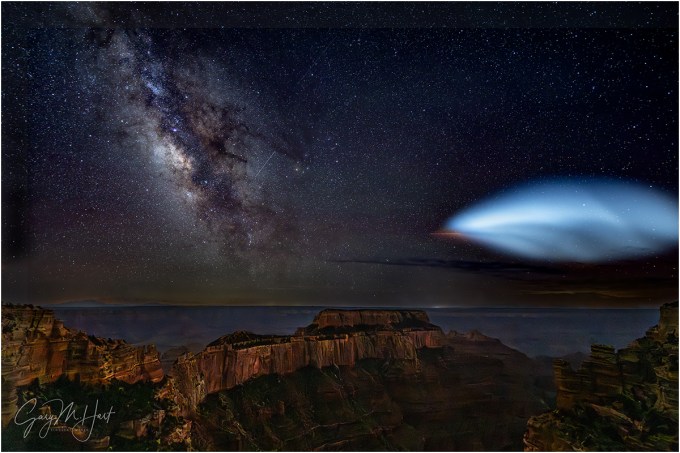
Milky Way and SpaceX Falcon 9, Wotan’s Throne, Grand Canyon
Sony a7R V
Sony 14mm f/1.8 GM
ISO 4000
f/1.8
25 seconds
Last week’s Grand Canyon Milky Way shoot almost didn’t happen, but by the time all was said and done, we ended up with far more than we’d bargained for.
My Grand Canyon monsoon workshops are ostensibly about photographing all of Grand Canyon’s unrivaled beauty, but ask anyone who signs up and they’ll tell you their number one goal is lightning. About 70 percent of my monsoon groups have what I consider lightning success: everyone in the group gets at least one nice lightning image. Of course that also means in 30 percent of my groups, not everyone gets lightning—I can prepare them, monitor the activity, and put us in the locations that maximizes our chances, if the lightning isn’t happening, there’s not much I can do. On the other hand, the clouds that bring lightning often wipe out the night sky, so the (generous) consolation prize for the clear-sky groups is the opportunity to photograph the Milky Way in the dark Grand Canyon sky.
After spending the first two days of this year’s second Grand Canyon workshop beneath wall-to-wall blue skies, all of us were excited about photographing the Milky Way on that second night. Though I was a little concerned about the wind during the Cape Royal sunset shoot, it wasn’t until walking over to my nearby Milky Way location in the darkening twilight (for a less obstructed view and better angle to our foreground subject, Wotan’s Throne), that I really started to fear our Milky Way shoot might not happen. I’d hoped that the more sheltered location would help, but the wind there was just as intense, blowing so hard that I wasn’t sure we’d be able to keep our cameras stable throughout the long exposures a Milky Way shoot requires.
Not only that, the views this spot offers are very exposed, with no railings above a precipitous vertical drop (there’s also room back from the edge for all who aren’t comfortable with heights, so no one is forced to stand on the edge). That meant, given the wind gusting to 40 MPH, in addition to camera stability concerns, I was more than a little concerned about someone straying too close to the edge and getting knocked off balance by a sudden gust. Yikes.
After pondering all this, I decided that we’d hang out a safe distance from the edge at least long enough for the darkening sky to reveal the Milky Way. Best case, the wind would die enough for us to photograph; worst case, we’d at least get to see the Milky Way, always a treat. (Okay, the real worst case would be someone stumbling over the cliff in the dark, but there was really no need for anyone to vacate their safe vantage point once we were established.)
As we waited, I realized that the gusty wind often slowed long enough that we might be able to time our captures between gusts and decided we may as well give the Milky Way a shot—when darkness was complete, we were open for business. With each person’s camera safely affixed to their tripod, Curt (the photographer assisting me) and I moved around to ensure that all had achieved reasonable focus, the right exposure settings, and a good composition. Thanks to our optional practice shoot at Grand Canyon Lodge (where the South Rim lights make for less than ideal Milky Way conditions) the prior night, the group got up to speed quickly.
With exposures in the 10 to 30 second range (double that if long exposure noise reduction is turned on), we had lots of time while waiting for each exposure to complete to simply appreciate skies darker than any of us get at home—for some, darker than they’d ever seen.
It truly is a joy to watch the stars pop out in a darkening sky. There’s Spica in Virgo, Arcturus in Bootes, Antares in Scorpius, plus a host of less prominent stars. Splitting the dark like sugar spilled in ink was our Milky Way galaxy’s luminous core. Two or three times a meteor flashed through the scene, perhaps a stray Perseid streaking from behind us, but most likely just a random piece of space dust.
But wait a minute… What’s that? As I mentally checked through all the familiar skymarks (I just made-up that word), something new caught my eye. Expanding in the southwest sky was a large diaphanous disk. We all saw it at about the same time, which told me that it had just appeared. My first thought, which I uttered out loud only half joking, was, “I hope it’s one of ours.”
Living in California my entire life means I’ve seen a few rocket launches—none that looked exactly like this, but similar enough that I was pretty confident that’s what we were seeing. I did a quick Google search and the first thing that popped up was a SpaceX Falcon 9 Starlink mission launching from Vandenberg Air Force Base on California’s Central Coast, nearly 500 miles away, at 8:57 that night. I checked my watch: 9:04 p.m.—mystery solved.
SpaceX was founded in 2002 by Elon Musk to further his dreams of space dominance. Propelled by reusable Falcon and (soon) Starship rockets, SpaceX crafts deliver both human and electronic payloads to space. Today the human payloads are primarily mega-rich tourists, but the eventual goal is to put humans on the Moon, Mars, and perhaps beyond.
A more practical current SpaceX implementation is the Starlink satellite system that blankets Earth and is capable of providing Internet service anywhere on the planet. I’ve used Starlink at a location where I’d previously had no Internet (the Grand Canyon North Rim, actually) and was absolutely blown away by the speed and reliability—not as fast as home, but certainly fast enough for reasonable use (I didn’t stream any movies, but I did stream shorter videos without problem). On the other hand, this year we tried Starlink on the North Rim and didn’t have a clear enough view through the trees to get a reliable signal—sometimes it worked, but mostly it didn’t.
Which is why SpaceX is still adding satellites. As of August 2023 4,500 Starlink satellites orbit roughly 200 – 350 miles above Earth’s surface. The launch we witnessed last Monday added another 15, with the ultimate goal being as many as 42,000!
I found a video of the launch and learned that 7 1/2 minutes after liftoff, a few seconds before I captured this image, the rocket propelling the satellites toward orbit was 175 miles above Earth’s surface, traveling over 10,000 MPH. But the the Falcon 9 rocket achieves this altitude and speed by using two stages—when the first one has exhausted its fuel, it steps aside and defers to stage two. After doing a little research I’m pretty sure what we witnessed was the beginning of the stage-1 rocket’s return to Earth—the second stage and its satellite payload were out of sight.
Five minutes earlier (2 1/2 minutes into the flight), it’s job done, stage 1 had shut down and separated from the moneymaking section of the rocket, turning control of the payload delivery to stage 2. At that point the rocket was about 50 miles above Earth, traveling about 4,700 MPH. As stage 2 took over, accelerating its payload of satellites even further heavenward, it rapidly outpaced the jettisoned first stage.
With nothing propelling stage 1 forward, Earth’s gravity became the only force acting on it, causing immediate deceleration. But with so much momentum and virtually no atmosphere to slow it further, the depleted stage 1 continued climbing for about 2 1/2 more minutes.
Without further intervention, stage 1 would have plummeted far out in the Pacific. But SpaceX wants to reuse it, so about 7 1/2 minutes into the flight, when it was about 42 miles above the ocean and traveling more than 4,800 MPH, stage one threw on the brakes with a 20-second entry burn timed to deliver it into the waiting “arms” (landing pad) of a SpaceX ship positioned in the east Pacific, west of Baja California. Bullseye (watch the video and be amazed).
I believe the glowing cloud my group and I witnessed was the exhaust from this entry burn, illuminated by the sun. The red streak is the rocket burn itself.
The opportunity to view this phenomenon is relatively rare. Because the exhaust cloud has no inherent luminance, it’s visible only when illuminated by sunlight. That means Earth-bound viewers must be beneath dark skies, and the exhaust plume must be high enough to still have a direct line of sight to the sun—in other words, night below, daylight above. Too far east and the plume would get no sunlight; too far west and it wouldn’t have been visible to anyone beneath a night sky. This convergence requires a twilight launch, cloudless skies, and a viewing position within a relatively small terrestrial zone just into the dark side of night’s advancing shadow.
I virtually never photograph anything manmade, but this was too cool to lose to silly personal rules. At this point, still completely ignorant of all I detailed above, I quickly adjusted my composition to include more of the glowing exhaust plume without losing the Milky Way and Wotan’s Throne. I just stuck with the exposure values I’d already been using. I got exactly one frame before the rocket and its cloud faded noticeably—I just hoped the image was sharp.
I come from the generation where space flight was celebrated, a time when the world stopped to watch every launch, splashdown, and space milestone. Teachers would wheel televisions into classrooms so we could all view together, and I still have vivid memories of watching Neil Armstrong’s first steps on the moon. But as amazing as this SpaceX launch was to view and photograph, and no matter how beneficial this technology is, I can’t help being more than a little concerned about what all this hardware in space is doing to our once pristine night sky.
When I was a kid gazing up at the night sky, spotting a satellite was a rare and thrilling event. But in this 25-second exposure I count at least 9 satellites of varying degrees of brightness—what’s our night sky experience going to be like when Starlink’s count reaches its 42,000 goal, and SpaceX’s inevitable competitors try to match them?
And if scientific exploration is important to you, consider that satellites have become the bane of optical astronomers’ existence. SpaceX has started applying a less reflective surface to its Starlink satellites, reducing their visibility by about 50% (better than nothing but still not great), but also increasing their surface temperatures, making them more problematic for infrared astronomy.
I don’t really have a solution for this conundrum, I just hope that moderation is applied to these technological advances, and that factors beyond the bottom line are considered as we dig deeper into space.
(And I still love this image.)
Join me at the Grand Canyon
To Infinity and Beyond
Click any image to scroll through the gallery LARGE


 Eloquent Images by Gary Hart