Eloquent Images by Gary Hart
Insight, information, and inspiration for the inquisitive nature photographer
Waterfall with a twist
Posted on February 26, 2011
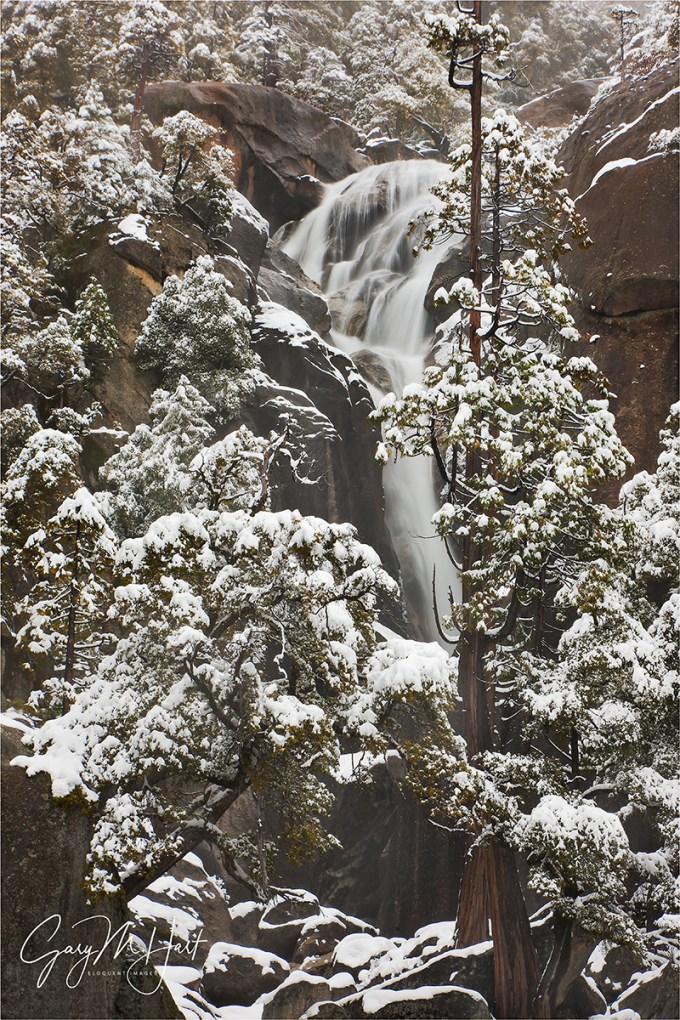
Winter Cascade, Cascade Creek, Yosemite
Canon EOS-1Ds Mark III
2/3 second
F/11.0
ISO 200
85 mm
When is a waterfall not a waterfall? The next time you’re in Yosemite, stop at the turnout where Cascade Creek meets Big Oak Flat Road and see if you can figure out why this impressive cataract doesn’t merit an official “waterfall” designation. It certainly isn’t for lack of verticality. Or drama. From the bridge on Big Oak Flat Road, Cascade Creek appears to spring full-speed from the heavens before taking a little twist and exploding into a network of violent, staircase cascades and disappearing beneath the bridge. You can cross the road and continue following the whitewater to its convergence with Tamarack Creek and its disappearance around a bend. I guess a waterfall by any other name looks just as sweet.

Get to Horsetail Fall at the right time and it is indeed breathtaking.
On the other hand, after again experiencing the annual circus that is Horsetail Fall in February, keeping the Cascade Creek waterfall/cascade relatively anonymous may just be a good thing for those of us who already appreciate it. I find it kind of amusing to compare the always photogenic, in-your-face Cascade Whatever to Horsetail Fall, which usually requires binoculars to locate, even if you know exactly where to look. When I get my groups on location at one of the Horsetail Fall viewing locations (including the picnic area directly beneath the fall), I typically spend at least five minutes helping everyone locate the fall: “See that tall tree at the edge of the parking lot? Follow it all the way to the rock outcrop at the top of El Capitan. Okay, now follow the top of El Capitan to the left until you get to a tree–Horsetail Fall comes straight down from there. See it?” By the time they find it I’m exhausted and they’re puzzled: “Is that what all the excitement’s about? Really?”
Of course when the light’s right, Horsetail Fall doesn’t need much water to become a breathtaking spectacle, and I’ll never tire of showing others the Horsetail “Firefall” effect for the first time. But honestly, given the shear drama and variety of compositions possible, I have a lot more fun photographing Cascade Creek. But let’s just keep it our secret.
Read more about the Horsetail Fall phenomenon
A gallery of waterfalls
Click an image for a closer look, and a slide show. Refresh the screen to reorder the display.


The recipe for fresh snow in Yosemite Valley
Posted on February 21, 2011

Half Dome and Fresh Snow, Cook’s Meadow, Yosemite
Canon EOS-1Ds Mark III
32 mm
1/8 second
F/16
ISO 100
In any season Yosemite offers something that makes it special, but the most beautiful place on Earth is never more spectacular than when it’s blanketed with fresh snow. For a brief time immediately after a cold storm, every exposed surface for as far as the eye can see is brand new and pristine.
Capturing this magic is all about timing. At just 4,000 feet, Yosemite Valley gets significant snow only during the coldest storms, usually just a handful of times each winter. And when the snow stops, the relatively mild temperatures (usually in the 30s), brilliant sunshine, and even the slightest breeze, conspire to clear the trees in a matter of hours. Meanwhile, park visitors driven inside by the weather, swarm outdoors to gape, quickly adding footprints and spreading mud with their boots, bikes, and cars.
The key to photographing Yosemite with pristine snow is to be in the park while its snowing—if you delay your Yosemite departure until you hear that it snowed, you’re too late. It’s fun sharing this visual treat with my workshops, but because I must schedule these trips over a year in advance, there’s no telling what weather we’ll encounter. So imagine my delight when, after six weeks of dry weather and blue skies, Mother Nature cranked up Yosemite’s snow machine just in time for my 2011 Yosemite Horsetail Fall winter workshop. Each morning greeted us with scenes that seemed designed to outdo what we’d found the day before.
Among my many snowy-Yosemite go-to spots is Cook’s Meadow. On this trip, until the snow arrived, the meadow was a field of lumpy brown grass, its sentinel elm a bare skeleton in the shadow of Half Dome. But six inches of overnight snow transformed this once bland meadow into an undulating sea of frozen white waves. Attempting to emphasize the snow, I dropped to my knees and found a vertical composition that leads the eye across the snowfield to the elm and ultimately to Half Dome. I minimized the brooding sky because, while interesting, it lacked the power to compete with the foreground.
I should add that many in the group had signed up to photograph Horsetail Fall, but since Horsetail Fall requires clear sky for its fiery show, at the beginning of the workshop I advised everyone that Horsetail Fall wasn’t likely in our future. Some were disappointed at first, and a few were puzzled by my enthusiasm for what was in store, but by the time we finished, I don’t think anyone would have traded our experience in the snow for even the most spectacular Horsetail Fall shot.
Workshop Schedule || Purchase Prints
A snowy Yosemite gallery
Click an image for a closer look and slide show. Refresh the window to reorder the display.


Are you insane?: A control freak’s prescription for photographic success*
Posted on February 11, 2011

Fall Into Winter, Valley View, Yosemite
Canon EOS 1DS Mark III
60 mm
1/15 seconds
F/16
ISO 200
* This message isn’t for everybody. If your photographic pleasure derives from simply breathing fresh air and admiring the view, or if your camera is just an accessory that helps you share and relive those outdoor experiences later, you’re already a successful photographer. But if you aren’t achieving the results you long for, either in the quality of your images or the attention they attract, please read on.
Are you insane?
Albert Einstein defined insanity as doing the same thing over and over again but expecting different results. Hmmm. For some reason this reminds me of the thousands of good landscape photographers with hundreds of truly beautiful images they can’t sell. These photographers have a good eye for composition, own all the best equipment, know when to be at the great locations, and are virtual gurus with state-of-the-art processing software. Yet they haven’t achieved (their definition of) success.
Conducting photo workshops gives me pretty good insight into the mindset of the most serious amateur photographers (the photographers serious enough to spend lots of money and vacation time for several days of sunrise-to-sunset photography). I’m frequently struck by the number of amateur photographers with serious aspirations who are so mesmerized by today’s technology that they’ve turned over control of the most important aspects of their craft to their camera. Their solution to photographic failure is to buy more equipment, visit more locations, and master more software. The tool they overlook is the one on top of their shoulders.
Knowledge vs. understanding
Just as a new camera won’t make you a better photographer, simply upgrading your photography knowledge won’t do it either—knowledge is nothing more than ingested and regurgitated information. Understanding, on the other hand, (among other things) gives you the ability to use information to create new knowledge—solve problems.
Many photographers invest far too much energy acquiring knowledge, and far too little energy understanding what they just learned. For example, it’s not enough to know that a longer shutter speed or bigger aperture means more light if that knowledge doesn’t translate into an understanding of how to manage light, motion, and depth with your camera.
Take control
Automatic modes in most cameras handle static, midday light beautifully, yet struggle in the limited light, extreme dynamic range, and harsh conditions that artistic photographers seek. I see many serious amateur photographers with so much faith in technology that they possess a critical deficiency of two fundamental photographic principles:
- How a light meter determines the exposure information it gives you. This seems so basic, but auto-exposure and histograms have fooled many into thinking they understand metering and exposure.
- How to use the reciprocal relationship between aperture, shutter speed, and ISO to manage photography’s three variables: light, depth, and motion. This is the universal tool that enables photographers to handle the limiting factors of every scene.
Books and internet resources are a great place to start acquiring these principles, but the knowledge you gain there won’t turn to understanding until you get out with your camera and apply them. When these principles become second nature, you’ll be amazed at what you’ll be able to accomplish with your photography.
For example
The image at the top of the post is from a visit to Yosemite’s Valley View last November. I chose it because it demonstrate how I applied the essential photographic principles above to accomplish my goal.
I arrived at Valley View that afternoon to find it blanketed with fresh snow—had I opted for the obvious composition, I’d have captured a gorgeous version of something that’s already been captured thousands of times. But I wanted something different, so I headed upriver a hundred feet or so to this dogwood I remembered from previous visits. (In fact, it’s the same dogwood featured in one of my favorite images.) I found that the sudden snow had caught the dogwood’s colorful leaves off-guard, leaving many still dangling from the snowy branches like frozen Christmas ornaments.
I wanted to emphasize the collision of seasons, and once I had my composition, I started working on how to deal with the factors limiting my objective for the scene:
- With the foreground leaves so close, and Bridalveil Fall in the background, sufficient depth of field was my prime concern
- The light was limited in the dense overcast
- A slight breeze swayed the branches
The light in this scene was low but easy, with a very narrow dynamic range that fit easily within my camera’s range of capture. Because I was on a tripod, camera-shake wasn’t a concern; in the low light I only needed to worry about finding a shutter speed that would stop the breeze. Wanting lots of depth of field, but concerned about diffraction (from a too-small aperture), I decided f16 would give me complete sharpness in the leaves (essential), with just a little softness in the background and minimal diffraction. But f16 at my preferred ISO 100 resulted in a 1/8 second exposure that I feared wouldn’t be enough to freeze the swaying branches. So I bumped my ISO to 200, confident that I could make 1/15 work if I timed my exposure for a lull in the breeze (I was not at all concerned about the minimal noise introduced by the higher ISO). I clicked several frames just to be sure the breeze hadn’t introduced motion blur too small to detect on my LCD.
Insanity is in the mind of the beholder
If landscape photography gives you what you want, then by all means, continue doing what you’re doing. But if you’re having a hard time achieving a photographic goal, I suggest that the solution is likely not doing more of what you’re already doing. Instead, reevaluate your comprehension of fundamental photographic principles that you might not have thought about for years. You’ll know you’re there when you have complete control of the light, motion, and depth for every scene you encounter, know how to get the result you want or that it’s simply not possible.
Do I really think you’re insane for doing otherwise? Of course not. But I do think you’ll feel a little more sane if you learn to take more control of your camera.
Workshop Schedule || Purchase Prints || Instagram
When Seasons Collide
Click an image for a closer look, and to view a slide show.


Simple
Posted on February 8, 2011

Champagne Glass Poppies, Merced River Canyon
Canon EOS 10D
1/1000 second
F/2.8
ISO 100
100 mm
Yesterday NPR and Jazz24.org released their Jazz 100, “the 100 quintessential jazz songs of all time.” Topping the list was one of my jazz favorites, the Dave Brubeck Quartet’s “Take Five.” Listening to “Take Five” this morning I was particularly struck by the simplicity of its sound, and it occurred to me that simplicity is an essential and often overlooked element in photography.
Spend a little time on photography websites and it’s easy to come away feeling visually assaulted. Saturated sunsets, crashing waterfalls, and swirling clouds can make wonderful photographs, but some of nature’s most divine beauty is best revealed by subtracting elements we’ve been brainwashed into thinking are necessary. Just as many of the pieces on the Jazz 100 are quite complex, simplicity is certainly not necessary for a successful image. But it seems many photographers have forgotten how effective a simple image can be. As my parents used to advise (shout), louder is not necessarily better. And neither is a lot of activity in a frame. To be effective, a scene’s elements (shape, color, lines, texture) need to work together; if they can’t, it’s better to isolate the most compelling aspect and remove distractions, no matter how beautiful they are.
Case in point: A poppy-covered hillside is a beautiful thing, but so are the graceful curves and translucent gold of a single poppy. The poppy in the foreground of this image was just one of thousands blanketing a hidden hillside in the Merced River Canyon just west of Yosemite Valley. After photographing the entire scene I gradually moved closer until I found myself sprawled on my stomach beneath this one poppy. Conveying its simple elegance was all about removing distractions: rocks, weeds, and yes, even the thousands of other beautiful poppies in the background. In this case I used selective focus, attaching an extension tube and dialing up a wide aperture to limit the depth of field. Focusing on the poppy’s leading edge turned everything else in the frame to a smear of color.
Did I achieve Brubeck’s mastery of my world? I think not—but it’s nice to have something to aspire to.

 Eloquent Images by Gary Hart