Eloquent Images by Gary Hart
Insight, information, and inspiration for the inquisitive nature photographer
Roll over Ansel
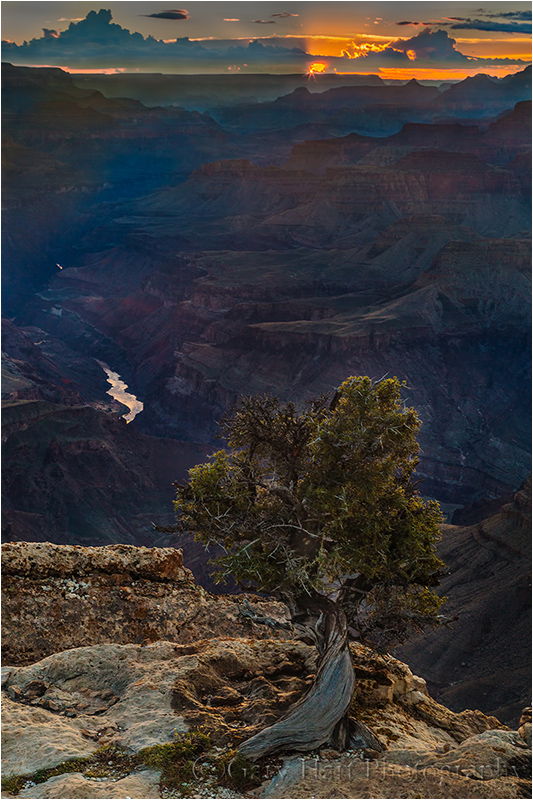
Solitude at Sunset, Lipan Point, Grand Canyon
Canon EOS-5D Mark III
65mm
1.3 seconds
F/20
ISO 100
A few days ago I was thumbing through an old issue of “Outdoor Photographer” magazine and came across an article on Lightroom processing. It started with the words:
“Being able to affect one part of the image compared to another, such as balancing the brightness of a photograph so the scene looks more like the way we saw it rather than being restricted by the artificial limitations of the camera and film is the major reason why photographers like Ansel Adams and LIFE photographer W. Eugene Smith spent so much time in the darkroom.” (The underscores are mine.) Wow, this statement is so far off base that I hardly know where to begin. But because I imagine the perpetuation of this myth must send Ansel Adams rolling over in his grave, I’ll start by quoting the Master himself:
- “When I’m ready to make a photograph, I think I quite obviously see in my minds eye something that is not literally there in the true meaning of the word.”
- “Photography is more than a medium for factual communication of ideas. It is a creative art.”
- “Dodging and burning are steps to take care of mistakes God made in establishing tonal relationships!”
Do those sound like the thoughts of someone lamenting the camera’s “artificial limitations” and its inability to duplicate the world the “way we saw it”? Take a look at just a few of Ansel Adams’ images and ask yourself how many duplicate the world as we see it: nearly black skies, exaggerated shadows and/or highlights, and skewed perspectives. And no color! (Not to mention the fact that an image is a two-dimensional approximation of a three-dimensional world.) Ansel Adams wasn’t trying to replicate scenes more like he saw them, he was trying to use his camera’s unique (not “artificial”) vision to show us aspects of the world we miss or fail to appreciate.
You’ve heard me say this before
The rest of the OP article contained solid, practical information for anyone wanting to come closer to replicating Ansel Adams’ traditional darkroom techniques in the contemporary digital darkroom. But it’s the perpetuation of the idea that photographers are obligated to photograph the world like they saw it that continues to baffle me.
The camera’s vision isn’t artificial, it’s different. To try to force images to be more human-like is to deny the camera’s ability to expand viewers’ perception of the world. Limited dynamic range allows us to emphasize shapes that get lost in the clutter of human vision; a narrow range of focus can guide the eye and draw attention to particular elements of interest and away from distractions; the ability to accumulate light in a single frame exposes color and detail hidden by darkness, and conveys motion in a static medium.
No, this isn’t the way it looked when I was there
While this sunset scene from Lipan Point at the Grand Canyon is more literal than many of my images, it’s not what my eyes saw. To emphasize the solitude of the lone tree, I allowed the shaded canyon to go darker than my eyes saw it. This was possible because a camera couldn’t capture enough light to reveal the shadows without completely obliterating the bright sky (rather than blending multiple images, I stacked Singh-Ray three- and two-stop hard transition graduated neutral density filters to subdue the bright sky).
To convey a mood more consistent with the feeling of precarious isolation of this weather-worn tree, I exposed the scene a little darker than my experience of the moment. The sunstar, which isn’t seen by the human eye but was indeed my camera/lens’ “reality” (given the settings I chose), was another creative choice. Not only does it introduce a ray of hope to an otherwise brooding scene, without the sunstar the top half of the scene would have been too bland for me to include as much of the shadowed canyon as I wanted to.
I’m not trying to pass this image off as a masterpiece (nor am I comparing myself to Ansel Adams), I’m simply trying to illustrate the importance of deviating from human reality when the goal is an evocative, artistic image. Much as music sets the mood in a movie without being an actual part of the scene, a photographer’s handling of light, focus, and other qualities that deviate from human vision play a significant role in the image’s impact.
A Gallery of My Camera’s World
(Stuff my camera saw that I didn’t)


 Eloquent Images by Gary Hart
It matters greatly on the OP authors meaning of “seeing.” It can be a literal or figurative meaning. As you mention in the first Adams bullet, he tended to see with his minds eye vs. just through his eyes alone.
That’s a valid point, Mark, but it shouldn’t be up to the reader to solve the writer’s intent. In this case it may very well just be poor writing conveying the wrong message, but it doesn’t really matter how the reader comes away with the wrong idea.
Less reading and more doing…
There are so many amazing photos in this gallery and on your blog. All absolutely breathtaking!!! 🙂
Thank you, Norma.