Eloquent Images by Gary Hart
Insight, information, and inspiration for the inquisitive nature photographer
A Different Kind of Cat Herding
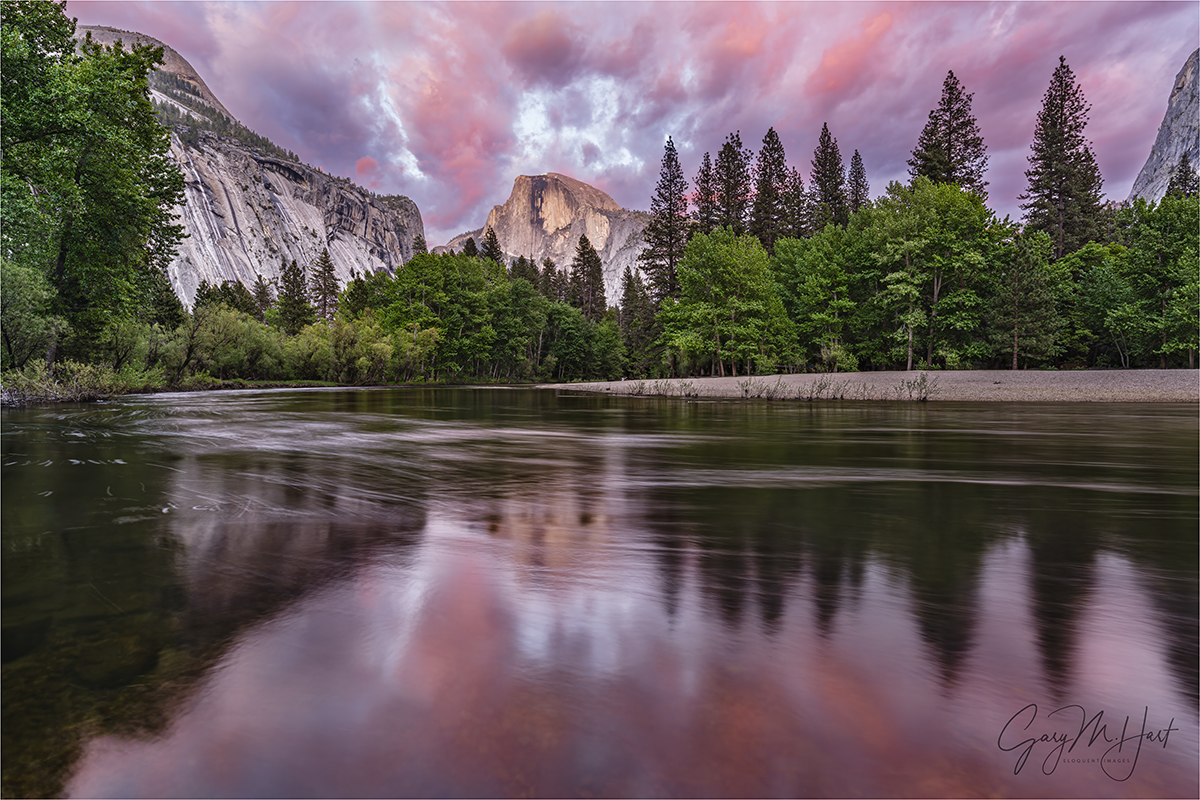
Majesty, Half Dome Sunset Reflection, Yosemite
Sony a7R V
Sony 12-24 GM
2 seconds
F/16
ISO 50
With my April Yosemite workshop starting in less than three hours, I was experiencing more than my normal (mild) pre-workshop anxiety. But after 20 years of photo workshops, I’ve accepted that I will always be a little stressed about the unknown until we start: how will this group of strangers connect, and what kind of photography conditions will we have?
Guiding a diverse group of photographers, each with their own priorities and pace, always has a cat-herding component, but this was the first time I’ve felt like I was herding cats before the workshop even started. In this case, rather than anxiety over connections and conditions, I was stressing about whether everyone (or anyone) would even make it to the workshop at all.
My concern was the snow forecast threatening to close two of the three routes to Yosemite Valley, combined the weeks-long now-it’s-open/now-it’s-closed status of the third route, thanks to a new rockslide. It didn’t help that, as the workshop approached, I’d already heard from several participants who were experiencing a variety transportation troubles that ranged from a cancelled bus ticket to concern about potential chain requirements. Reminding myself that these kind of inconveniences usually temporary, and almost always end up making great stories that help bond the group later, was little comfort in that moment.
Most years, the go-to stress for my Yosemite spring workshop is whether there would be enough water in Yosemite Falls for us to get a nice moonbow. But that concern had been resolved when a series of unusually robust April storms had turned the historically low Sierra snowpack into something that at least approached average.
Ironically, my current concerns—the snow forecast and persistent rockslide—were a direct result of those ongoing storms that had solved the not-enough-water-in-the-fall problem.
Highway 140 is my preferred, and strongly recommended, route to Yosemite for several reasons: it’s an easier drive, the scenery is better, and (especially) it gets much less snow and ice. Slides on 140 happen several times a year, but the closures are usually measured in hours. Not only did this slide lead to multiple closures, the duration each was measured in days. And each reopening was only one lane, a sign that they were still working on it.
Sure enough, the Caltrans engineers who make these closure decisions determined that 140 still wasn’t quite ready for prime time. When, less than a week before the workshop, 140 closed again so they could address the troubling areas, I started sending my April group updates offering alternate routes: from the north, Highway 120 through the Big Oak Flat entrance; from the south, Highway 41 through the Wawona entrance. These alternatives, adding more curves and mountainous terrain to the drive, are still good roads that don’t increase the drive time. But because they climb 3000 feet higher than Highway 140, Highways 120 and 41 are particularly problematic in stormy weather: when it’s raining on 140 and Yosemite Valley, 41 and 120 are usually experiencing snow and ice (and chain requirements).
With the next in a series of late-season storm forecast to arrive the day before the workshop, the (literally) chilling prospect of sending Yosemite virgins—some from regions of the country that never see snow, have no mountainous terrain, or both—into a Sierra storm that may bring snow, ice, limited visibility, and chain requirements, seemed very possible. If 140 stayed open, everyone’s drive to Yosemite should be a piece of cake; but if it closes…
So imagine my relief Friday night, less than three days before our Monday afternoon start, when I learned that 140 reopened. I updated my group with the good news, but also shared a link to the Caltrans website where they could find reliable and up-to-date road conditions (closures, roadwork, chain requirements, etc.). Because another closure was not impossible, I encouraged everyone to monitor their chosen route’s status before starting their drive into the park—given the forecast, I encouraged them to default to 140 if at all possible to avoid the inevitable snow and ice on the higher roads.
With 140 now open, I started to feel more confident that most or all of my group would make it to our workshop hotel without trouble. The biggest unknown at that point was Jim, a photographer from California’s Central Coast, who couldn’t drive and was at the mercy of a combination of trains and buses. About a week before the workshop, Jim had been notified by Amtrak, which contracts with YARTS (the Yosemite bus service) for the non-rail portion of its Yosemite route, that due to the 140 closure, his trip had been cancelled. With no reasonable alternative, he told me he had to cancel. But a few days later, Jim e-mailed that he was still going to try to make the workshop, though he might be a day or two late (depending on when 140 opened and the buses resumed). Then he went dark.
On Sunday evening (the day before the workshop), I’d heard from one of the workshop’s snow- and mountain-driving rookies (from the Gulf Coast), Barbara, that she had attempted 120 earlier that evening, but returned to Groveland for the night after encountering snow, poor visibility, lost cellular (and the GPS map service that requires it), and highway signs threatening chain requirements. I told her that since my Outback and I were planning to enter on 120 (so I could check out the higher elevation dogwood bloom), if the 120 conditions hadn’t improved by morning, I would meet her in Groveland and she could follow me all the way down to Yosemite Valley.
Waking at home early Monday morning, I immediately checked the road conditions and saw that 120 was only R1 (chains not required as long as you have snow tires), and 140 was still open. Yay. While on the road a couple of hours later, I received a text from Barbara saying that rather than attempt 120, she’d backtracked to 140 and no longer needed my assistance. It seemed things were starting to fit into place.
But one immutable photography truth, pounded into a nature photographer’s brain at every opportunity, is to take nothing for granted. Which is why I shouldn’t have been surprised when word soon reached me that 140 had just closed again. Sigh. I quickly called and texted Barbara, but she was out of cell range; soon I was off the grid too, so I just had to hope that she’d get my messages in time turn around before driving all the way to the closure.
I stopped in Groveland, a small cell signal island in a gridless sea, to catch up on the latest conditions and wait for Barbara as long as possible, in case she needed my help navigating 120. While waiting there, though I didn’t hear from Barbara, I did learn that the snow had stopped and all chain requirements on 120 had been lifted. A few minutes later, just as I started to get back on the road, my phone rang: not Barbara—this was Jim.
With everything else going on, I hadn’t really thought about Jim since he’d told me he’d be late, if he made it at all. He told me that shortly after 140 had opened Friday night, Amtrak had notified him that his bus trip had been reinstated. So, leaving his home on California’s Central Coast early Sunday, he’d actually made it all the way to Yosemite Valley by Sunday evening. Once in the valley he’d booked a room; his plan had been to take that night to recover from his travels, then catch a bus down to the workshop hotel Monday morning. Easy-peasy.
Not so fast. While walking back to his room after dinner Sunday night, he’d tripped on a rock in the dark, landing hard enough to eject a hearing aid and bang himself up so much that the hotel staff called an ambulance to rush him to the closest hospital, more than an hour away in Mariposa (which he’d already been through once that day).
The good news was, the hospital found no serious injuries. The not-so-good news was, after patching him up and releasing him in the wee hours of Monday morning, he had no way to get back to his hotel room (which contained his suitcase and camera gear) in Yosemite Valley. Eventually he found a generous soul to give him a ride to a nearby hotel. He’d checked in (his second hotel room that night) and managed to get few hours of sleep, then waited for the day’s first bus that would return him to Yosemite and all his stuff. Not ideal, but no damage beyond a few cuts and bruises, and the lost hearing aid—and at least he’d make it the workshop in time for our 1:30 p.m. Monday start.
A truly great plan—until 140 re-closed Monday morning, just a couple of hours before he was to catch his bus. Suddenly, Jim found himself stranded in Mariposa with no car, no public transportation, no local taxi service, and a rock slide between him and all of his stuff in Yosemite.
Which is how I found myself sitting in my car, less than three hours until my workshop, stressing about whether or not I’d even have a group to lead: I had Barbara and ten other workshop participants careening about the Sierra foothills in stormy weather, quite possibly following my directions into a dead-end or a snowstorm (take your pick), plus one person completely marooned in Mariposa. What could be worse?
Right about then my phone rang again—a new number—and I feared I was about to find out. But (spoiler alert) this is where my story takes an about-face. I inhaled and answered, bracing for the next crisis. But this was just Stan and Bonnie from Wisconsin, two of the missing ten (at least they know how to drive in snow), making sure I was aware of the latest 140 closure, and letting me know it had forced them to detour and that they’d probably be late for the orientation.
As I told them that wouldn’t be a problem, I was struck by an uncharacteristic flash of brilliance and asked how far they are from Mariposa. Ten minutes? I quickly summarized Jim’s plight and asked if they’d mind returning to Mariposa to pick him up. When they graciously agreed, I had them sit tight while I called Jim to see if he could be ready in 10 minutes. Jim was thrilled, so I quickly called Stan and Bonnie back, gave them Jim’s number, and told them to negotiate the rendezvous directly with him. A few minutes later I motored out of cellular range and could only hope that all the pieces would fall into place.
I’m happy to report that everyone made it to the workshop—most (including Barbara) before orientation, with Stan, Bonnie, and Jim rolling in shortly before I wrapped up. Many in the group had stories of their own adventures getting to the workshop, and it was clear that having shared travel experiences enabled the group to connect even faster than most groups connect.
It didn’t hurt that the unsettled weather that caused me so much stress hung around for the workshop’s first couple of days, treating the group to beautiful clouds and turbo-charging the falls. The clouds departed just in time for our moonbow shoot on the workshop’s penultimate night, then returned the next afternoon to color the sky for our final sunset.
Oh yeah—it seems that someone found Jim’s lost hearing aid and returned it to the hotel’s lost-and-found. And when we picked it up, the hotel staff was genuinely concerned about his wellbeing, and let him know that they’re reversed the charges for his room on the night he spent in Mariposa.
About this image
Yosemite isn’t known for its colorful sunsets, but they do happen. Nevertheless, and despite beautiful cumulous clouds assembled behind Half Dome all afternoon, I couldn’t help being a bit pessimistic about them hanging around until the workshop’s final sunset. Usually clouds like this dissipate as the sun drops toward the horizon, which switches off the convection mechanism that drives them upward. But watching from the bank of the Merced River that afternoon, it soon became clear that these clouds weren’t going away.
Since there were so many clouds, each catching the rapidly warming light of the setting sun, I told my group if the light stays on the clouds all the way until sunset, we’d be in store for a real treat. For the next 30 minutes I held my breath as we watched the clouds slowly shift from amber to peach to a rich magenta. But what made the scene special for me, and the thing I usually love most about this location, was the reflection.
In any landscape scene the photographer needs to decide how much sky the image merits. That decision becomes especially important when there’s a reflection. I tell all my workshop students (and anyone else who will listen) to base this sky versus landscape decision on the relative beauty of the two. In this case, both the vivid sky and its reflection in the Merced River merit maximum attention, I quickly switched to my 12-24 lens and gave them both equal billing.
This turned out to be one of the most memorable sunsets I’ve ever experienced in Yosemite, and truly fitting conclusion to (what turned out to be) a fantastic workshop. To quote Tom Petty: Most things I worry about, never happen anyway. Truth.
Workshop Schedule || Purchase Prints || Instagram
Yosemite Sunsets
Click any image to scroll through the gallery LARGE


If I hadn’t lived through all that chaos personally, I would swear you were making it all up!! Even though I returned home a day early and missed the beautiful sunset, I came away from the workshop with many incredible shots that I am quite proud of. As I’ve told you before, you have helped me become a decent photographer in spite of myself. And I got with my moonbow image after three years of trying. After a chaotic week that you made to appear seamless for you participants, I had a wonderful experience. Thank you!
Previous comment from Kent Spaulding – not sure why it marked me Anonymous unless Gary is trying to tell me something.
Simply breathtaking. I enjoyed the color inclusions especially but there is a lot to be said, with great enjoyment, of the Emergence, Half Dome, photo. So moody and intriguing. I marvel at your talent and dedication. Thank you for sharing it all with so many others.
Pingback: Taking One for the Team… | Eloquent Images by Gary Hart