Eloquent Images by Gary Hart
Insight, information, and inspiration for the inquisitive nature photographer
An Old Friend Returns
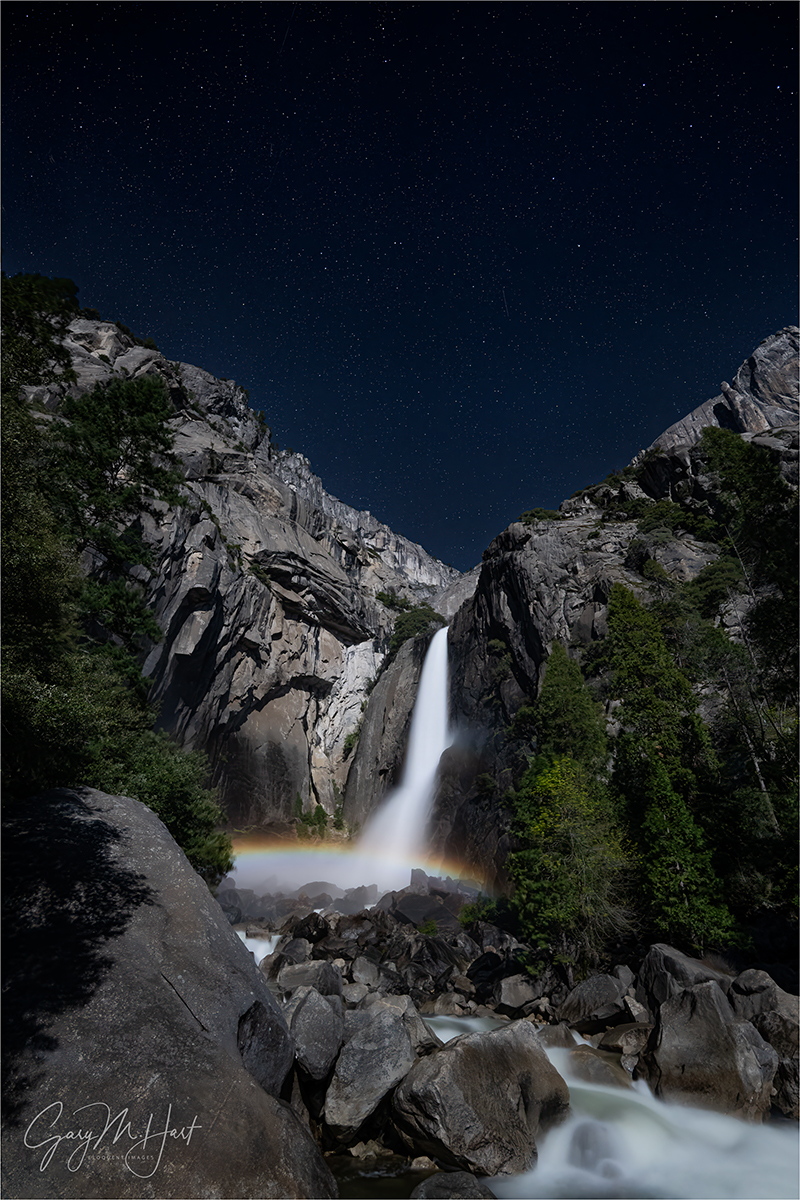
Moonlight Prism, Lower Yosemite Fall Moonbow, Yosemite
Sony α1
Sony 14mm f/1.8 GM
ISO 1600
f/1.8
4 seconds
Has anyone noticed that Yosemite becomes a completely different park with each season? I feel quite fortunate to live close enough that I’m able to enjoy each Yosemite season, and to offer Yosemite workshops in three of four seasons. (Actually, you can probably infer that I live close enough to offer workshops in all four seasons, but I leave summer to the tourists.)
Each Yosemite season offers its own distinguishing qualities. In autumn, though the falls are nearly dry (Bridalveil still trickles), red and gold leaves fill the trees, carpet the ground, and reflect gloriously in the low and slow Merced River. Winter is when the waterfalls return to life, and also the best time to find Yosemite draped in powdery white—but since snow is never guaranteed, I always schedule a workshop around the natural firefall light on Horsetail Fall (while still crossing my fingers for snow). Spring is the Yosemite of postcards and calendars, when waterfalls peak, dogwood blooms abound, low-lying meadows host (reflective) vernal pools, and rainbows color the waterfalls.
Each of these Yosemite workshops has a potential bonus lunar event that I try to include when it corresponds with the season’s primary distinguishing quality. Many autumns and winters I can align a rising full moon with Half Dome at sunset, and spring is when the light of a full moon paints a rainbow at the base of Lower Yosemite Fall.
For years I scheduled two workshops around this moonbow, but finally decided that the window for the absolute best moonbow experience is open only during a four week span from early April into early May. Though a moonbow also happens with the full moon from late March and into June, in late March and early April the moonbow appears in the mist billowing too far left of the fall; later in May and into June, the crowds swarming Yosemite Valley make an unpleasant experience for everyone.
Despite the remarkably predictable moon/landscape geometry that creates a moonbow, its appearance is never certain. Clouds are the biggest nemesis, but low water can also diminish the experience. Coming into this year, limiting my moonbow workshops to a single full moon in that four-week window, combined with factors beyond my control (in addition to clouds, you can add a sudden park closure and global pandemic), has meant that my previous successful moonbow sighting was in 2019. And for a while, it appeared 2026 would continue that streak of futility.
There was a time when I didn’t believe it possible for Yosemite’s spring runoff to be so low that the moonbow would essentially be erased. But as California’s wet season progressed and the Sierra Nevada range found itself on the way to an historically poor snowpack year, I couldn’t help flashing back to 2015. That’s the year PBS Newshour arranged for a film crew to follow me and my Yosemite spring workshop group as we photographed Yosemite’s spring splendor, with a particular emphasis on the moonbow. But 2015 also happened to be the year an unprecedented drought shrunk Yosemite’s normally booming spring waterfalls to mere trickles. Rather than cancel the Newshour segment and keep the film crew home, they adroitly pivoted to a piece on California’s drought and its impact on Yosemite. Check it out. (FYI, I haven’t aged a bit since then.)
Would history repeat this year? As April approached, the answer appeared to be yes. Then a series of unseasonably cold storms arrived, filling our rivers and bolstering the Sierra snowpack just in the nick of time. A couple of days before the workshop (scheduled for the last four days of April), another storm landed, further recharging the falls and even lingering through the workshop’s first couple of days—just enough rain and clouds to provide excellent photography, but not enough to wash us out. Suddenly, my concern wasn’t that there would be enough water, it was whether the clouds would depart in time for my planned Wednesday night moonbow shoot.
Even with all this last-minute moisture, spring 2026 was not especially wet in Yosemite. Though still flowing beautifully, all the falls were noticeably on the low side of average for this time of year (peak runoff is usually around May 1). Nevertheless, there was more than enough water exploding on the rocks beneath the falls to form the billowing mist Yosemite’s signature waterfall rainbows require.
Throughout the workshop my group enjoyed an assortment of daylight rainbows, from various vantage points (I have the timing down to the minute for each location, creating the illusion that I’m much smart than I am), but it was the moonbow everyone was crossing their fingers for. I had one person in the group who had already taken this workshop twice, each time with the expressed desire to photograph the moonbow. With Kent was returning for a third attempt, the pressure was on and I was pretty committed to making it happen for him if at all possible.
Since the moonlight timing and angle would be best on Wednesday, the workshop’s penultimate night, I tried to get everyone up to speed on moonlight and moonbow photography during that afternoon’s training session. The evening’s sunset shoot featured the full moon rising over Bridalveil Fall, photographed from an elevated turnout on Big Oak Flat Road. As soon as we finished there, I zipped the group back down to the Yosemite Valley Lodge parking lot, where we grabbed our gear and made the short walk, in the gathering dark, up to the bridge at the base of Lower Yosemite Fall.
The below average flow in the fall meant that this year’s moonbow wouldn’t be as big, or last as long, as it does in the wettest years. That’s because less water means a smaller cloud of mist for the bow to form in, not only shrinking the moonbow’s breadth, but also terminating the show sooner, as the rising moon shifts the necessary 42 degree rainbow angle downward and eventually out of the mist. (Rainbows drop as the sun or moon rises—read more about the geometry of rainbows on my blog) But this year’s moonbow was plenty big enough to thrill everyone, providing about 40 minutes of quality photography between the time the sky was dark enough for the moonbow to appear, and when it dropped out of the mist.
Even with less water than usual, the moonbow was obvious to the unaided eye as a shimmering silver band. And the rainbow colors were clearly visible in our mirrorless viewfinders or live-view LCD screens, even before a picture was captured.
The diminished flow in Yosemite Fall had one major advantage: at no point did we feel like we were photographing in a rainstorm. Every once in a while we’d get sprinkled with a small amount of mist, but I’ve photographed the moonbow from here when everyone had to don rain gear, and even a single 5-second exposure—that started with a dry lens—would finish with the front lens element completely misted over. When it gets like this, the only way to do it is with an umbrella in one hand and a towel in the other.
There were quite a few people the bridge this evening, but I’ve seen far more here. We’d become a little scattered on the walk up to the fall, so it took me a little while in the darkness to ensure everyone in my group had found a suitable spot to set up. Once I was confident my group was positioned satisfactorily, I tried to get around to everyone to make sure they were doing okay.
Exposure for the moonbow is pretty easy, and I’d given them settings to use before we started. Composition is a little tougher given the limited light, but I’d very strongly encouraged everyone to put their lens at its widest focal length and leave it there—this simplifies things, and today’s digital cameras have more than enough resolution to allow ample cropping later.
Not only does shooting wide streamline composition in the dark, it simplifies the most challenging aspect of night photography: focus. Since changing focal length requires refocusing, and finding focus in the dark is not easy, once you’ve achieved sharpness you don’t want to do it again. Most of my time this evening was spent moving around between the members of my group, helping them get focused, or checking their focus to make sure it was good. I started with Kent, but eventually made it around to nearly everyone (and even helped one or two people who weren’t in my group).
Eventually I found a few minutes for some frames of my own, squeezing in between a member of my group and another person who was okay with me and my tripod up in his space (I checked). I take both horizontal and vertical versions of virtually every scene I photograph, but I always photograph the moonbow vertically because I just haven’t found a horizontal composition that pleases me. For starters, I want to include as much sky as possible, and I think Yosemite Creek churning through granite boulders is a far more interesting than the trees on the left and right. This evening, I used my 14mm prime lens, enabling me to include a lot of starry sky above the fall (including 5/7 of the Big Dipper), while still getting plenty of moonlit creek and granite beneath it.
You can tell that I captured this toward the of the moonbow window by how low the moonbow is. When we arrived, it hovered above the visible mist, just below the top of the lower section (where the fall starts to spread). So even though my moonbow is not quite as broad as the earlier ones, it is brighter, thanks to all that water.
I should probably add a few words about my exposure. I started doing moonlight photography about 20 years ago, and established my full moonlight exposure values very early on. Back then, then ISO 400 was about as high as I could go without noticeable noise; since my fastest lens at the beginning of my digital years was f/4, so my exposure settings were usually in the ballpark of ISO 400, f/4, 30 seconds.
The problem with 30 seconds is you get a little star movement—not a deal-breaker, but enough to be visible if you look closely. So as sensor technology improved, and I acquired faster lenses, my ISOs went up and my shutter speeds dropped, while my exposure values (amount of light captured) remained constant. For this one, I used f/1.8, ISO 1600, and 5 seconds.
With limited time, and even more limited ability to move around, I still managed to get a handful of frames this night. But that was fine because my photography is never the priority in a workshop (and I certainly don’t lack for moonbow images from past years). Even though this year’s version may not be my best moonbow shot ever, I’m still pretty pleased with my results.
In the image review the next day, I invited everyone to share a moonbow image in addition to their review image—it was wonderful to see that everyone had a success! That includes Kent, who had to leave the workshop early, but who reported to me that his moonbow image is beautiful and he’ll no longer need to repeat the course.
Workshop Schedule || Purchase Prints || Instagram
Yosemite Falls, Day and Night


Pingback: Taking One for the Team… | Eloquent Images by Gary Hart