Eloquent Images by Gary Hart
Insight, information, and inspiration for the inquisitive nature photographer
Honor, Legacy, and Joy
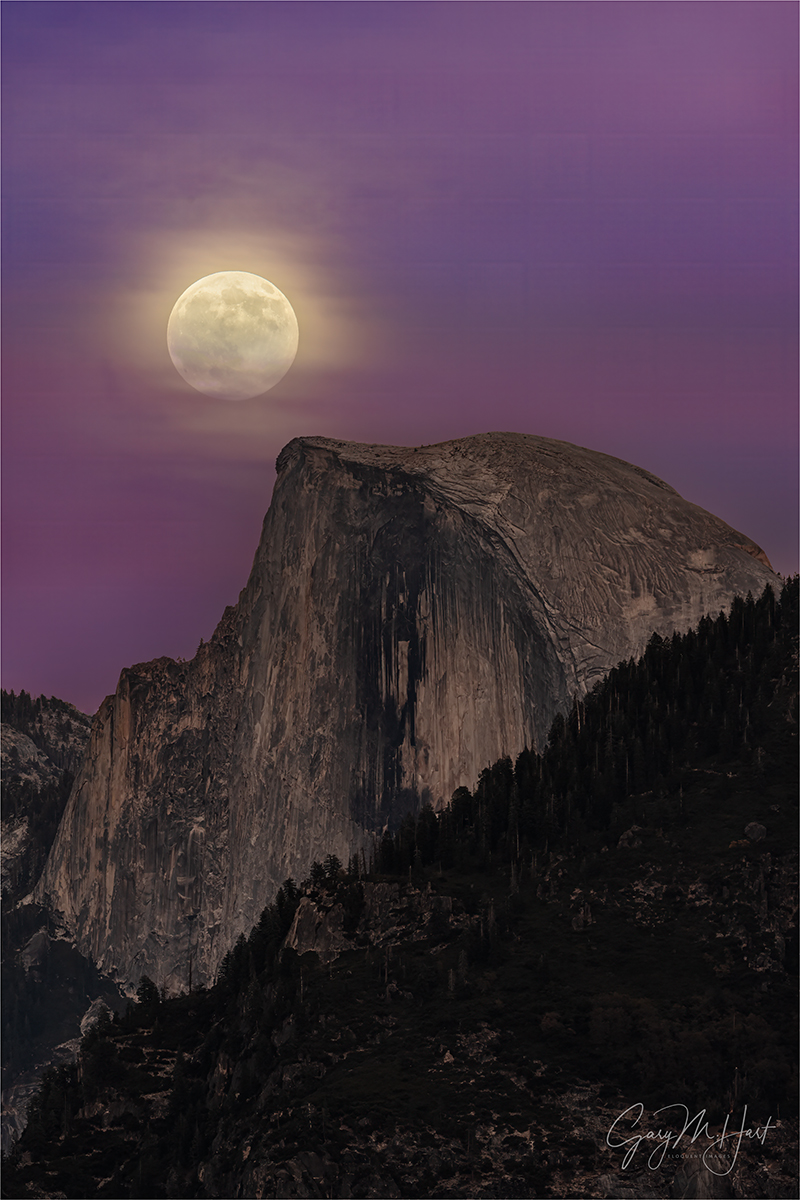
Moonrise Through the Clouds, Half Dome, Yosemite
Sony a7R VI
Sony 100-400 GM
ISO 100
f/16
1/5 second
First, the honor and legacy part
Not long ago I received an e-mail with some exciting and unexpected news. Unbeknownst to me, I’d been nominated for the North American Photography Association‘s Kinne Legacy Award, “Recognizing a NANPA Member whose selfless sharing of professional expertise benefits NANPA Members and the nature photography community.” It’s an honor just to have been nominated, and an even greater honor to actually have been selected.
For those who don’t know, NANPA is an organization that represents, educates, advocates for, and connects all who love to photograph our natural world—landscape and wildlife, professional and amateur. NANPA was founded more than 30 years ago when, shortly before his death, Roger Tory Peterson assembled a cadre of like-minded nature photographers who were similarly committed to shepherding their passion into the 21st century. The list of founding members reads like a who’s-who of nature photography royalty: Galen Rowell, Tom Mangelsen, Franz Lanting, John Shaw, and Art Wolfe, to name just a few.
Also among those founding members were Jane and Russ Kinne, tireless and unselfish advocates for both nature photography and nature photographers. Jane was NANPA’s second president. And it was from the Kinne’s spirit of selfless guidance that this award was born.
My surprise at being selected for the Kinne Legacy Award was due partly to the many other equally worthy photographers I know, and partly because throughout my photography career, (thanks to a lifelong aversion to the spotlight) I’ve been pretty content to toil in relative obscurity. The loyal following I’ve amassed here on my blog, on my social media pages, and among my photo workshop alumni, while not small, pales in comparison to the numbers many other nature photographers claim.
Lucky for me, success isn’t just about numbers. And while (pro tip) anonymity is never a great business strategy, it turns out that what I lack in quantity of followers is more than made up for by their quality. I take great pride in the positive feedback I receive here on my blog, and the fact that more than 20 years into this photography life, more than 70% of my workshop participants are returnees.
That return rate I attribute as much to my workshop students themselves as I do to anything I do: I can’t tell you the number of times a workshop participant has told me some version of, “I’ve attended a lot of photo workshops, but your workshops have the nicest people of any of them.”
That said, I will take some credit for the positive, inclusive environment I foster in my workshops. Which I guess makes sense, because I feel like I’m a naturally positive and inclusive person. I also have always taken a no-secrets approach to photography knowledge, and never discriminate based on skill and experience—in fact, I’ve found that having a mix of skill levels in my workshops, from beginner to expert and even pro, creates a genuine synergy that benefits everyone.
My philosophy, whether in my workshops or my own photography, starts with the belief that photography, not matter how you choose to approach it, should make you happy. That seems like kind of a no-brainer, but one look at the arguments, insults, and oneupmanship peppering online photography forums and social media photography groups is enough to realize that there must be many unhappy photographers out there. Fortunately, I seem to encounter mostly happy photographers: in my workshops, on location, and online. And the longer I do this, the clearer it becomes to me that the thing that sustains me, that keeps photography fresh and stimulating, is the people I get to work with.
This makes me think of the ironic oft-repeated joke, “I’d love my job if it wasn’t for the customers.” Given that my own photography takes backseat to the demands of running my business and leading workshops, it would be easy to say the same thing. But even though my own photography tends to happen at the same places, year after year, interacting with my workshop students elevates me. And nothing is more rewarding than watching a student witness a location or phenomenon for the first time, or teaching a skill that will help someone capture many more successful pictures long after the workshop is over.
I’m not trying to portray myself as an unselfish altruist—I need to earn a living (I don’t do it for free!), I’m just a person fortunate enough to have found a profession that makes me happy. So, doubling back to the “Legacy” part of this award (I can’t believe I’ve reached the point in my life where I’m focused more on my legacy than I am on my future), more than the thousands of images I’ll leave behind (eventually—I’m not going anywhere soon), more than the hundreds of blog posts and photo tips articles I’ve written, I’d love to be remembered as someone who gave photographers, and photography, a sustainable infusion of positive.
Speaking of Joy
If you know anything about me, you know 1) I love photographing the moon, especially as it rises above Yosemite Valley, and 2) I have hundreds of images of the moon (especially as it rises above Yosemite Valley). You’d think by now I’d be tired of it, but guess what: I’m not.
This most recent version of a Yosemite moonrise happened Sunday last evening, and was no less thrilling than the first time I did it (and the dozens of times since). Thrilling not just for one more opportunity to witness the most beautiful thing happening on Earth at that moment (how do you top a full moon rising above Yosemite Valley), but also to be able to share it with a workshop group. But for a while there, thanks to a bank of rogue clouds drifting through at the worst possible time, it appeared we might not get to see it at all.
As always when a workshop approaches, I started monitoring the weather at least a week in advance. I’m not a fan of clear (boring) skies, but for this workshop I found consolation that the clear sky forecast would at least enable a view of the full moon rising over Half Dome on our first night. I’d been especially excited about this moonrise because it would align so perfectly with Half Dome, appearing just to the left of the face about 4 minutes before sunrise, and climbing to directly above the iconic monolith just a few minutes after sunset.
But I woke the morning of the workshop’s first day to see that my friends at the National Weather Service had added “mostly cloudy” to the evening’s forecast. What? (The Yosemite forecast read something like, “Sunny, becoming mostly cloudy by evening,” whatever that means.) Sure enough, the day started clear, but by the time of our early afternoon orientation, a layer of thin clouds had started to drift in from the west, with more queued up behind them. Sigh.
In Yosemite you should never try to predict the weather in an hour based on the weather right now, so there was no way I was going to alter our moonrise plans based on the forecast and some clouds. Since photographing a full moon isn’t as easy as people imagine (the goal is detail in the landscape and the moon—unassisted, most beginners end up with a stark white lunar disk), a few weeks before the workshop I shared some of my moon photography photo tips articles. Then I spent about 20 minutes going over the technique for exposure success.
We departed for Tunnel View earlier than I normally would because I thought it would give my group the best opportunity to find a spot and set up before the inevitable rush. I guided some of my group onto a granite slab above the parking lot and set up my tripod there; my brother Jay set up at the conventional Tunnel View vantage point with the group members who chose not to scale the granite. They were eventually joined by dozens of other photographers and gawkers who had assembled to await the show, while I spent my time bouncing back and forth between the two locations to ensure everyone was doing okay. Arriving early also gave us a front-row view of the clouds unflagging march toward our target.
By the time the moonrise approached, I was back on the granite, eyes affixed on the horizon behind Half Dome and the clouds now resolutely ensconced there. It was difficult to tell how thick the clouds were, but I found hope in the possibility that maybe they’d be thin enough for the moon to shine through. I also found hope in a couple of (narrow) clearer bands that might give us at least a minute or two of moon.
The first hint of the moon’s arrival was an expanding glow in the clouds on the ridge just left of Half Dome. A few seconds later, audible cheers erupted when the moon’s leading edge peeked into view and everyone simultaneously realized we were in business.
The clicking started immediately. The moon rose into and out of thicker bands of clouds, but never disappeared completely on its ascent. For the duration of the event we never lost sight of the lunar disk, and usually could see at least some lunar detail. This was all pretty great, but the bonus came when the clouds I’d stressed about so much started pinking up, turning this moonrise into something truly special.
I’ve been working on this post for a few weeks, but I hadn’t decided which image to share with it until this week’s Yosemite moonrise. As excited as I was to witness and photograph it, the real joy came from watching how excited everyone in my group was (and then finding out that every single person in my group ended up with a successful image that made them happy).
Workshop Schedule || Purchase Prints || Instagram
(Many) More Yosemite Moonrises
Click any image to scroll through the gallery LARGE


Congratulations on your nomination! All your workshop participants know what a great teacher you are.