Eloquent Images by Gary Hart
Insight, information, and inspiration for the inquisitive nature photographer
A Shot in the Dark
Posted on December 19, 2023

Nature’s Light Show, Aurora Over Dyrhólaey Coast, Iceland
Sony α1
Sony 12-24 GM
6 seconds
F/2.8
ISO 6400
At its best, still photography reveals aspects of the world invisible to, or overlooked by, human vision. In nature photography, we create these visual revelations when we use an extremely fast exposure to freeze the intricate detail of a lightning bolt that’s a memory before our brain registers it. Or when we dial up a long exposure to turn pinpoint stars into symmetrical arcs that reveal Earth’s rotation.
As a lifelong admirer of the night sky, I’m a huge fan of the camera’s ability to see in the dark far better than I can, extracting stars and celestial color too faint for my eyes. This is possible because cameras can accumulate light over an extended period, and because the camera’s ability to “see” color is less dependent on the amount of light it captures than the human eye is.
No subject more clearly demonstrates the camera’s light gathering ability better than the Milky Way. A relatively faint ribbon of light in even the darkest sky, a high ISO (extremely light sensitive), large aperture, multi-second exposure (30 seconds or less to minimize star streaking) brings to life the exquisite color and detail of starlight infused with interstellar dust and gas.
This ability to accumulate light also helps the camera extract color from apparent darkness. But just as important to the camera’s light gathering advantage over the human eye is the way it does it. The human eye uses a collaboration of rods and cones to collect light, with the rods doing the heavy lifting in low light, pulling enough monochrome information for us to discern shapes, while providing little help with color and depth. The cones that complete the scene with color and depth information require much more light to do their job. But a digital sensor, though blind to depth, captures photons using tiny photosites specifically designed to discern color.
With the first DSLRs, way back in the early 2000s, successful night photography required help from external light, like light painting with artificial light (which I never do) or moonlight (which I did all the time). But sensor technology has improved steadily over the years, not just the sensors’ resolution, but their light capturing ability too. Today I don’t hesitate photographing dark sky, the darker the better. Nevertheless, despite many years photographing the night sky, it wasn’t until 5 years ago that I got to photograph an aurora.
In January of 2019 Don Smith and I had traveled to Iceland to scout for a future photo workshop. We chose winter to ensure the longest, darkest nights for the best chance to view an aurora. Having seen thousand of pictures of the northern (and southern) lights, I believed I had an idea of what to expect, but I had no idea. No. Idea.
Before I start raving about the camera’s ability to photograph an aurora’s unseen color, let me just say that no picture can do justice to the experience of witnessing an aurora in person. I’m not talking about the green, horizon-hugging glow that lucky high-latitude Lower-48 residents enjoy from time to time (that’s still worth staying up and freezing for, BTW), but an actual sky-spanning dance of light beams, waves, and swirls. Rivaled only (in my book) by a total solar eclipse and a brilliant comet, a brilliant aurora display might possibly be the most beautiful thing you’ll ever witness in Nature.
But, despite lacking the dynamics of personal aurora experience, a camera does do better than the eye in one important aurora aspect: color. That’s because to the naked eye, many aurora displays aren’t bright enough to engage the cones and appear monochrome to our eyes. A camera, on the other hand, reveals auroras in all their kaleidoscopic glory. And though color in an extremely strong aurora is indeed plainly visible to the unaided eye, no matter how strong the aurora, the camera will always “see” more color than we will.
Since that first visit, I’ve returned to Iceland most winters, and have viewed many beautiful northern lights shows. Each was unique and beautiful in its own way, but hold a gun to my head and ask me to pick a favorite, and I think it would be a tie between back-to-back nights early this year (January)—first at Kirkjufell, then at Dyrhólaey on the South Coast. The Kirkjufell night was special because it featured a spectacular display above an Iceland icon. The Dyrhólaey show, while lacking the instantly recognizable foreground of the previous night, was even brighter and more expansive, at times spanning the entire sky.


I blogged about both nights earlier this year:
- Kirkjufell: It’s All About the People
- Dyrhólaey 1: Lights, Camera, Action!
- Dyrhólaey 2: Blessings
The image I’m sharing today is another one from the Dyrhólaey night. With our eyes we could actually see a little of the green, but not the red. And as beautiful as this image is, even with my 12 – 24 lens at its widest, it didn’t come close to capturing the entire horizon-spanning display.
One more thing
When there’s not enough light for visible color, colors in the night sky become the photographer’s processing choice. For my Milky Way images, that’s mostly a matter of adjusting my white balance in Lightroom until sky color feels right. I find a lot of other photographers’ night images too cyan for my taste, and if you look at my older night images, you’ll see that I used to skew them fairly blue. But in my recent night images, I’ve gone for something closer to black with just a hint of blue/violet, which is what I’ve done with the background sky in this image.
The color of the northern lights is similarly subjective, and starts with the color temperature my camera’s auto white balance chooses. Since I don’t have as much experience photographing auroras as I do the Milky Way, I’ve started identifying northern lights images that I like, taken by other photographers, then try to adjust my own images’ white balance in Lightroom to something that comes close to that. But looking at the gallery below, with greens that skew toward yellow (warmer), and some that skew toward blue (cooler), it’s clear that this is still a work in progress. But it does appear that I’m moving a toward cooler aurora images. And believe it or not, none of my northern lights images have any saturation added because they don’t need it—just giving the scene a little more light than my eyes see is all that’s necessary to bring out this eye-popping color.
The Lights Fantastic
Click any image to scroll through the gallery LARGE


Image Building (the old fashioned way)
Posted on May 1, 2023
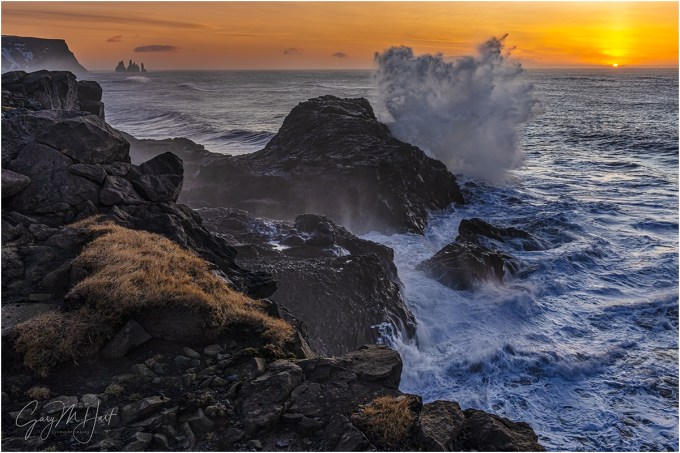
Sun and Surf, Dyrhólaey, Iceland
Sony a7R V
Sony 24-105 f/4 G
ISO 100
f/20
1/20 second
Today it’s possible to open an app on your computer, type in a few descriptive terms, and faster than you can take a sip of coffee your very own beautiful image will appear. No frozen extremities, missed meals, or sleep deprivation required. What could possibly be better than that?
I’ll tell you what’s better: the frozen extremities, missed meals, and sleep deprivation necessary to witness Nature at its best, and to remind me that the best things in life are even better when a little sacrifice is involved. There’s simply no substitute for the multi-sensory opportunity to worship with nature—coming away with a beautiful image is just icing on the cake of the experience of simply being there.
Icing this winter morning’s cake involved more than a little effort, as well as a good degree of physical discomfort. Dyrhólaey, on Iceland’s South Coast, has a network of short but steep trails leading to broad vistas of rugged lava cliffs, a long black sand beach, several sea stacks (including distant Reynisdrangar), and lots of open sea. (It’s also the location of a truly epic aurora show about 10 days earlier, but that’s a different story.)
Since this was a week or so into a workshop (the second of two Iceland workshops Don Smith and I did this past January), and Dyrhólaey is so spread out, after the brief location orientation everyone had scattered quickly to search out their own scene, leaving me to my own devices. Iceland’s interminable gray winter twilight was already underway when we arrived, but actual sunrise was still an hour away, so there was no real rush.
This morning’s temperature (F) and wind (MPH) were both in the teens, but I was bolstered by multiple layers covering virtually every square inch of delicate California skin. Not immediately drawn to any one scene, I was quite content to wander the trails, taking in the view. On my travels I connected with as many in the group as possible, keeping my eyes open for potential images along the way. Eventually I found myself atop the highest point, enjoying a bird’s eye view of the violent surf’s relentless pounding. I stood there at least 15 minutes, completely mesmerized by waves arriving from all possible directions, each one reacting to the rocks a little differently than the waves preceding it.
This surf was on a different scale than anything I’d seen in California or Hawaii—more violent, and clearly more determined to punish anything in its path. Each wave exploded impressively onto the rocks, but occasionally just the right combination of size and direction resulted in a nuclear explosion that mushroomed far enough skyward to obscure some of the sky.
While the sky lacked clouds to add visual interest and catch sunrise color, I recognized the potential for a sunstar when the sun finally crested the horizon. With this thought in mind, I managed to pull myself away from my perch and move along the cliff’s edge, identifying and organizing the various elements for a possible composition.
I knew the sun would be the strongest background element, and decided that putting it on the right of my frame would provide the best foreground. Widening my frame to 27mm allowed me to balance the sun with Reynisdrangar (the 3 sea stacks in the distance). With that framework in place, I moved around looking for the best combination of close foreground that would also allow me to include the large rock with the greatest potential for a big wave. Since the sky wasn’t especially compelling, and I really liked the surf and rocks below me, I minimized the sky in favor of the much more interesting foreground.
Hoping for a sunstar, I stopped down to f/20, which had the added benefit of extra depth of field cushion. I focused on the large grassy patch. With my composition in place, I just stood back and waited for big waves, clicking each time one reached its apex. The biggest waves were few and far between, but I crossed my fingers for one to land while the sun was still on the horizon.
Turns out I got one really big wave—not the biggest I’d seen, but big enough. And as you can see, haze on the horizon meant the sunstar never materialized, but it also kept the sun from washing out the sky’s rich gold sunrise hues. (I actually think I like it better without the sunstar, which might have overpowered the rest of the scene.)
This is probably not a picture that will make me rich, but I like it not only for whatever aesthetic value it might possess, but also for the reminder of this beautiful Iceland morning, the sacrifices we nature photographers make in pursuit of our passion, and for the way my effort to assemble the scene’s disparate elements into a coherent scene actually came together (never a sure thing).
Assembly Required
Click any image to scroll through the gallery LARGE


Blessings
Posted on February 20, 2023

Aurora Ribbons, Dyrhólaey Coastline, Iceland
Sony α1
Sony 12-24 GM
10 seconds
F/2.8
ISO 3200
I just wrapped up what was no doubt the most intense work/travel stretch of my 17 years leading photo workshops. It started the second week of January with 3 weeks in Iceland leading 2 workshops with Don Smith (with no break in between). After the long flight home (that’s a story for different day), I had just one day to recover before driving nine hours to Death Valley (still very much jet lagged) for another workshop that started the next day. Returning from Death Valley, I actually had a few days to lick my wounds before heading off to Yosemite for my Horsetail Fall workshop (with crowds that make it pretty intense by itself).
I have no one to blame but myself for this schedule (it seemed like such a good idea at the time). And I won’t say that I’m not looking forward to a few weeks off before my next workshop. But honestly, I’d do it all again in a heartbeat. And I should also say that despite appearances to the contrary, I’m actually home far more than I’m on the road, and when I’m home, I’m really home (unless I’m at Starbucks, without a lot of places I’m expected to be. So don’t feel too sorry for me.
The people I get to share my workshops with are constant source of energy and joy that sustains me through these difficult stretches. But today I’m (selfishly) thinking about the bucket-list worthy sights and locations my frequently nomadic life has afforded me. It’s an exercise I try to go through regularly to avoid taking my many blessings for granted.
I’m thinking about this right now because I returned just a few days ago from another Horsetail Fall workshop, where I could be at serious risk of taking for granted a truly beautiful and unique spectacle that I’ve seen literally dozens of times, but that is a genuine bucket list experience for so many others.
One way I try to avoid taking my blessing for granted is to revisit my annual Highlights galleries: 2016, 2017, 2018, 2019, 2020, 2021, 2022. I love creating these galleries not only because the process reminds me of the sights I’ve seen over the past year, but also because it gets me excited for the still unknown sights in the upcoming year. And each time I revisit them, I’m reminded of how lucky I was to have been witness to such beauty. Invariably, after opening a gallery, I’ll find myself thinking, oh wow, surely this was my best year (not necessarily my best photographs—just my best year for the things I got to see), then I go on to another year and have exactly the same thought.
Another thing this exercise makes pretty clear is the things in Nature that excite me most. I’ve always believed that we each make our best pictures when we follow our heart to the subjects we love most. For me that’s locations to which I feel a personal connection, like Yosemite and Grand Canyon, and natural phenomena like weather and all things celestial. Not so coincidently, these are also the subjects I most love studying and understanding.
For the longest time I would say the most beautiful sight I’d ever witnessed was a comet—I just couldn’t imagine anything matching it. Then in 2017 I witnessed a total solar eclipse and that list became two. Then (I bet you know where I’m going here) I saw the northern lights. So now my most-beautiful list is three.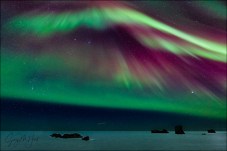
I’ve seen the northern lights many times since that first experience, but that first one always stood out as the best. But Nature always seems to be trying to top itself, and this year it finally managed. The first Iceland workshop group got two consecutive nights with spectacular northern lights shows—the first night at least matching my previous “best,” the second night topping it.
Because I blogged about that night a few weeks ago, I won’t go into all the details. The image I shared in that earlier post was more of a spontaneous capture away from the best scene, simply because the display was so spectacular. The image I’m sharing today is the scene I spent most of the night pointing at because it had the best combination of foreground and aurora display. The dancing lights changed so much from one minute to the next that I could pluck any one of dozens of images from this scene, label it “best,” and get no argument.
Workshop Schedule || Purchase Prints || Instagram
A Few of My Many Blessings


 Eloquent Images by Gary Hart