Eloquent Images by Gary Hart
Insight, information, and inspiration for the inquisitive nature photographer
The secret world before the sun
Posted on February 24, 2013
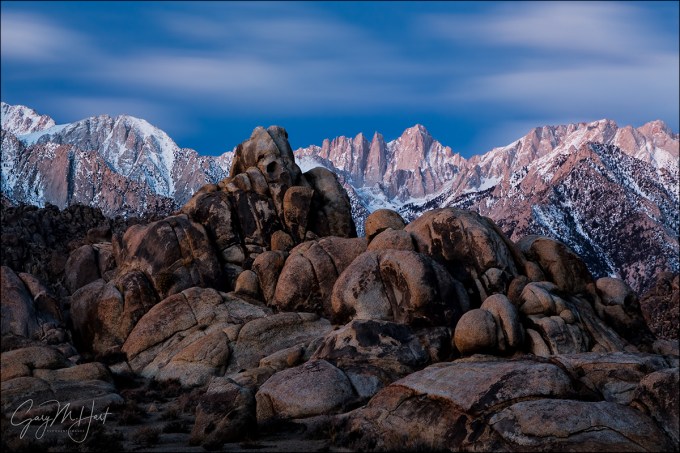
Before Sunrise, Mt. Whitney and the Alabama Hills, California
Canon EOS 5D Mark III
30 seconds
F/16
ISO 400
70 mm
Compared to the human eye, the camera’s vision has many shortcomings (as photographers are quick to lament). At the top of photographers’ list is the very narrow gap separating the brightest and darkest tones a camera can capture: dynamic range.
But while the camera taketh away, it also giveth. Experienced photographers understand that what we perceive as complete darkness is really just our eyes’ relatively limited ability to gather light, combined with the brain’s insistence on processing this limited input instantaneously. But a camera’s sensor (or a rectangle of unexposed film) can accumulate all the light striking it for whatever duration we prescribe, thereby stretching its “instant” of perception indefinitely. Advantage camera.
For example, the camera’s narrow dynamic range is (exquisitely) mitigated in the barely perceptible light preceding sunrise and following sunset. Unlike night photography, when the light in the sky is so faint that extremely long exposures are required to register any foreground detail, and daylight/moonlight photography, when unidirectional light casts high contrast shadows that exceed a camera’s dynamic range, pre-sunrise/post-sunset twilight light is spread so evenly overhead that most shadows disappear.
About this image
Horizon-to-horizon skylight made dynamic range a non-factor in the above Alabama Hills pre-sunrise scene, while my camera’s instant-stretching ability revealed beauty present in a landscape that was nearly invisible to my eyes.
I arrived at this scene about 45 minutes before sunrise, but knew from experience I wasn’t too early to get to work. White with snow and towering 10,000 vertical feet above my location in the Alabama Hills, Mt. Whitney jutted in dramatic contrast to the dark sky. As my eyes adjusted to the limited light, the jumbled rocks of the Alabama Hills became vague, colorless shapes. Anyone relying on their eyes on this January morning would likely conclude that there’s not yet enough light for photography. But I knew better.
I started by juxtaposing a nearby fortress of boulders against Whitney’s serrated outline. While the mountains were the dominant feature to my eyes, I knew a long exposure would make the nearby rocks equally prominent, making their sharpness essential. Limited light made autofocus out of the question, so I stopped down to f16 to increase my margin for error and focused manually.
As expected, a thirty-second exposure at ISO 400 uncovered volumes of invisible detail and color my eyes missed. (It took two or three exposures to get the focus, exposure, and composition right, as I felt like I was working blind, and my meter was of little value in the darkness.) Though I was photographing in a fairly stiff (and frigid!) breeze at 4,500 feet, it was nothing like the hurricane wind that smeared the clouds above Whitney into an ethereal glaze. Another revelation of the long exposure was the sky’s exquisite, natural (not processing-enhanced) blue-hour hue.
Workshop Schedule || Purchase Prints
A twilight gallery
Click and image for a closer look, and to enjoy the slide show


From one extreme to another
Posted on August 1, 2012

Bristlecone at Sunset, Schulman Grove, White Mountains, California
* * * *
In my previous post I wrote about California’s extremes. I used Badwater in Death Valley to illustrate, but of course there are many more examples. Case in point: the bristlecone pines of the White Mountains, just east of Bishop, across the Owens Valley from the Sierra Nevada.
The more heralded, heavily traveled Sierra gets most of the rain and snow from the Pacific, rendering the White Mountains a high elevation desert. With very little water to sustain foliage, fierce winds scour the White’s rocky surface unchecked. Water (and foliage) also moderates temperatures (lower highs, higher lows)–without water’s moderating effect, high temperatures in the White Mountains are higher and low temperatures are lower than corresponding elevations in the nearby Sierra.
Enter the bristlecone pine, a hardy conifer that has evolved to not only survive in these extremes, it thrives. Thrives to the point that it is generally acknowledged as the oldest living thing on earth (older, even, than Larry King). Some bristlecones approach 5,000 years old; the tree in this image is around 4,000 years old, give or take a millennium (due to, believe it or not, concerns about vandalism, individual bristlecone ages aren’t revealed).
The Schulman Grove Discovery Trail is a one mile loop with great access to some magnificent trees. It’s a very well-marked, heavily used trail, but it’s quite steep. And at over 10,000 feet elevation, it will definitely test your lung capacity. At just about the halfway point of the trail, you’ll find a magnificent bristlecone pair, well worth the effort to get out there. The trail here loops around these trees, providing 270 degrees of perspective.
The most popular view here, the view that seems to attract the most photographers, is close and looking up at the trees against the sky. But this evening I liked that the (often obscurred by haze) Sierra crest was clearly visible, and saw that the sky had potential for color, so I picked a more distant vantage point up the trail a bit. From there I could isolate the tree against the mountains and compress the distance somewhat with a moderate telephoto.
Using some scruffy yellow shrubs to anchor my foreground, I decided a vertical composition allowed me to compose the tree a little tighter. It was about 75 feet away, which meant at f16 and 75mm, focusing just a little in front of the tree gave me sharpness from 25 feet to infinity (as reported by the hyperfocal app in my iPhone). The color came late, after many photographers had packed up and headed back to the visitor center. While the sunset didn’t paint the entire sky, it very conveniently peaked in direct line with my composition. I love it when everything comes together.
Photographers are stupid (and I have proof)
Posted on July 10, 2012

Saturated Sunset, Rush Creek, Eastern Sierra
When I was nine or ten my dad took me to the top of a towering granite dome in Yosemite and asked me to hold his umbrella while he tried to photograph lightning. My dad was not a stupid man, nor was he an unloving or irresponsible father. But it was the first example in my life of how the behavior of an otherwise rational adult can be altered by the simple act of holding a camera. I used to shake my head at some of the things I observed photographers do, and the get-the-shot-at-all-costs photographer stories I heard. That is, until….
October, 2006
An incoming storm had set up the sky for one of those electric sunsets that photographers come to Mono Lake for: towering clouds, shafting light, glassy water—all that was missing was me and my camera. You see, I’d gotten so caught up in the fabulous fall color in nearby Lundy Canyon that I’d lost track of time and was now rushing to beat the sunset to Mono Lake’s South Tufa. I’d chosen South Tufa because its familiarity meant I could pretty much roll out of my truck and find a shot without a hunt. Plus, I knew a shortcut that would save at least five minutes (and what self-respecting photographer passes an opportunity to take a shortcut?). Unfortunately, I’d become so focused on the goings-on in the sky (photographers rarely watch the road) that I’d missed my shortcut, which was why I was barreling down Highway 395 pondering two options: Continue to 120, or turn around and locate the dirt road shortcut? Neither would ensure a timely arrival at South Tufa.
Then, like a gift from Heaven, an unpaved road veering in the general direction of the lake materialized on my left and I swerved without conscious thought across all four lanes of highway, abruptly enough to send all my gear crashing to the floor behind me. This improvised route, all sagebrush and stone, was new to me, but it soon became clear that not only did the road head in the right direction, its washboard surface smoothed out quite nicely at a fairly brisk 40 mph. Congratulating myself on my truly excellent judgement, I nudged the speedometer even higher and started visualizing the sunset possibilities. Barely slowing for a sharp bend, my foot was already back on the accelerator as I exited the curve, which, it turns out, channeled me like a boat ramp toward the heretofore overlooked (and aptly named) Rush Creek, swift and swollen by recent rain. Traveling at more than 40 miles per hour allowed no more than a fraction of a second for deliberation: Hit the brakes and accept defeat, or accelerate and hope?
There must be a mutation polluting photographers’ gene pool, a “get the shot at all costs” mindset that causes paparazzi to pursue princesses with no regard for life, acclaimed photographic masters to clone full moons and zebras into already lovely images, and hungry landscape photographers to believe that really, really wanting a shot is enough to turn a two-wheel drive Toyota Tacoma into a flying machine.
So. It turns out that Toyotas don’t fly. Nor do they float. Of this I have empirical proof. At 40 miles per hour they do, however, have significant inertia. In this case enough inertia to deliver me to the center of a rushing creek before turning me over to another, more inconvenient, force of nature: gravity. Thus, in water swift enough to nudge a one-and-a-half ton truck several feet downstream, my Tacoma sank like a stone. To the doors. Had it been equipped with four-wheel drive, or even front-wheel drive, I might have been able to gain enough purchase to extricate myself, but rear-wheel drive on a submerged pickup is about as useful as wheels on a boat.
Once I came to a rest I turned off the ignition and sat, feeling quite stupid and thinking, maybe if I just sit here, nobody will ever find out. I’m not sure how long I entertained this fantasy, but frigid creek water tickling my toes finally spurred me to action–if my feet were getting wet, what about all the camera gear on the floor in the back? With (selfless) disregard for my own safety, I dove into the back of the cab and rescued my camera bag from the incoming torrent. After stuffing my cell phone in a pocket, I rolled down my window, scrambled onto the hood, stepped gingerly across to the front fender, and leapt to shore.
Out of harm’s way, I surveyed my surroundings. I was actually on a small island, though the channel in front of me wasn’t nearly as deep and swift as the one that had swallowed my truck. Unlike my truck, the road emerged from the creek and disappeared into the inhospitable landscape. With no cell signal and snow promised for later, I knew rescue would require a hike, perhaps as far as South Tufa (a couple of miles away). For some reason it occurred to me that most carnivorous predators are nocturnal. I eyed the darkening sky and with renewed focus charged forward, traipsing through the rest of the creek without bothering to remove my sandals and socks or roll up my pants.
Fortunately, I only had to trek about a half mile before finding a cell signal. Because this was in the days preceding ubiquitous GPS devices, I had to muster all my descriptive skills before the CHP dispatcher could assure me help was on the way. Somewhat assuaged, and having overdosed on urgency for more than hour, on the walk back I finally allowed myself to slow and appreciate the sunset (which had manifested as advertised), though my enthusiasm for photography had dampened considerably. (And when I heard the coyotes planning dinner, the urgency returned.)
Back at my truck, I sat on a rock and watched the wedge of daylight shrink behind the Sierra. After what seemed much longer than it probably was, a tow truck appeared (I never imagined a tow truck could be so beautiful), parking pretty much where I should have stopped in the first place. The driver got out and surveyed the scene, finally hand-signaling (the roar of the creek drowned his shouts) that he’d need to drive around to the other side to pull me out. I was less than enthusiastic about letting him leave, but there was clearly no way he was going to extricate my truck from way over there, and he seemed to know where he was going.
Relieved that I probably wasn’t going to be left to the coyotes, I decided it might be a good idea to snap a picture of my misfortune. Since I was reluctant to venture back onto the Toytanic to retrieve my tripod and remote-release, I switched to the fastest lens in my bag (f2.8), dialed my camera to ISO 3200, turned on the two-second timer, and plopped my butt onto the sand in front of the truck. With a flashlight clamped between my teeth and the camera firmly pressed to my chest (and one eye out for the tripod police), I fired a couple of frames, hoping one would be sharp enough. (If you look closely, you can see the concentric circles of the flashlight on the hood, as well as footprint.)
The darkness was nearly complete when the tow truck reappeared on my side of the creek, and within five minutes my truck was winched out and draining on dry land. I’d envisioned a long, shame-filled tow truck ride back into Lee Vining, but the tow truck driver suggested I try starting my truck—imagine my surprise when the engine turned over and fired right up. Not only that, when the driver found out I’m a AAA member, he told me there’d be no charge. When I sheepishly suggested that I might just be the stupidest person he’d ever helped, he told that in the spring he’d rescued another driver in a high clearance 4×4 who had tried crossing at the same spot (a photographer no doubt) when the water was high enough to actually turn his truck around. That made me feel marginally better.
Epilogue
I hadn’t driven far when my check-engine light came on, but everything continued to run fine. And anyway, I think three hundred dollars damage to my exhaust system, a saturated carpet, and a few soggy books and magazines is small price to pay for an education and a story.
Oh yeah–the snow started falling before I was done with dinner.

 Eloquent Images by Gary Hart