Eloquent Images by Gary Hart
Insight, information, and inspiration for the inquisitive nature photographer
Next Year Finally Came
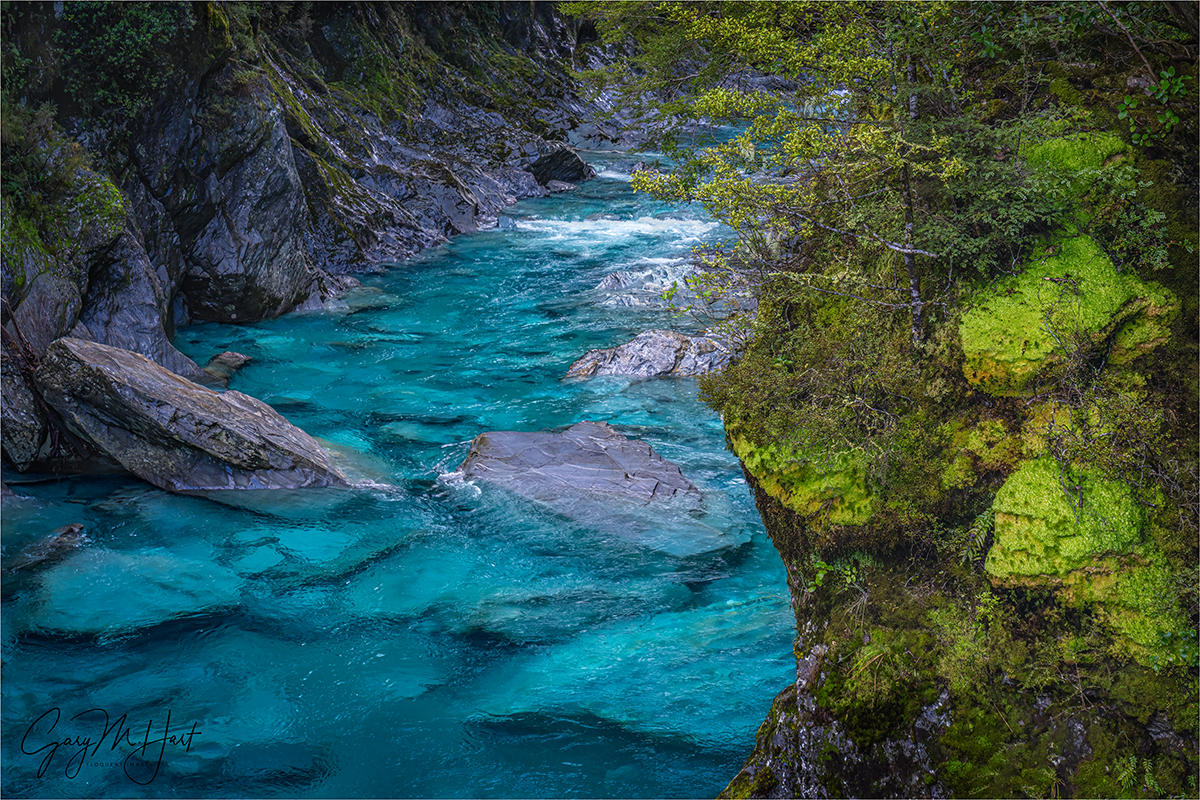
Blue Pools, Blue River and Makarora River Confluence, New Zealand
Sony a7R V
Sony 24-105 G
1/25 seconds
F/10
ISO 800
The rallying cry of the early ’50s Brooklyn Dodgers, “Wait ’til next year!”, was spawned by years of disappointment served up by crosstown rivals: mostly the New York Yankees, plus a lethal dose of 1951 New York Giants. Entering this year, the “wait ’til next year” nemesis for Don Smith, me, and our New Zealand workshops had become the Blue Pools of Haast Pass.
The Blue Pools are the visual reward for making a short but sweet rainforest hike that ends on a footbridge overlooking a narrow, blue or (sometimes) greenish-blue (or brown if you’re unlucky) river. It’s is a true highlight location, a spot Don and I love returning to and sharing with our groups each year. But recently, we were starting to feel like we’d never make it back there.
The first few years we did this workshop, the Blue Pools delivered so reliably that it’s difficult to distinguish in my memory one visit from another. Then the COVID pandemic intervened, and when we returned to New Zealand in 2022 following a two-year hiatus, we discovered that the trail to the Blue Pools had been rerouted and lengthened. The formerly half-mile downhill trek that had originated at a small roadside turnout, had been replaced by a one-mile gently undulating route that started at a new parking lot that was better able to handle the growing crowds.
I was a little concerned about taking a group on a trail I’d never been on, but despite doubling the distance, Don and I quickly deemed this change a net improvement to the overall Blue Pools experience: more parking, a toilet at the trailhead, plus a broader and less steep trail. And the payoff remained unchanged: a soothing walk through a lush rainforest to view a narrow canyon carved by a spectacularly clear and ridiculously blue river.
So imagine our disappointment in 2023, to learn that this new trail had been closed to overhaul its (essential) swinging suspension bridges. Oh well, we rationalized, closures can happen anywhere and anytime (as any photo workshop leader can confirm), and we were confident that we’d return the next year. But shortly before the 2024 workshop, our driver told us that the bridge repairs still weren’t complete and the trail remained closed. Bummer—but surely next year….
When the 2025 New Zealand trip came around, Don and I were quite pleased to learn a few weeks before starting that the Blue Pools bridge repairs had finally wrapped up and the trail was open for business. Yay, finally—nothing can stop us now….
On the morning we were scheduled to navigate Haast Pass and visit the Blue Pools on our drive to Fox Glacier, we were notified that an overnight rockslide had closed Haast Pass “indefinitely.” Suddenly the Blue Pools was the least of our concerns—with two workshop nights in Fox Glacier to replace, we scrambled to rearrange our itinerary, completely removing Haast Pass and Fox Glacier from that year’s trip.
Last year’s adjusted on-the-fly itinerary added two more nights in Te Anau, allowing us spend more time at Milford Sound and on the Milford road. We liked this change so much that we decided to permanently drop our two Fox Glacier nights and add one more night in Te Anau. And because we didn’t want to miss Haast Pass and the Blue Pools, the new (and improved!) itinerary replaced the other Fox Glacier night with a second night in Wanaka, allowing us to dedicate a full day to the Blue Pools and waterfalls of Haast Pass.
As you can see from this image, “next year” finally arrived!
Every time I guide a group here, I make a point of being among the first to arrive at the bridge so I can enjoy everyone’s reaction to their first view of this vivid blue water. Not only does this give me great pleasure, it always gives me flashbacks to the first time I laid eyes on the Little Colorado River.
The color here is a product of the Blue River’s glacial origin. As a glacier advances and retreats, it grinds the underlying rock to an extremely fine powder, called glacial flour—nearly microscopic particles so fine, they remain suspended in the moving water rather than drifting to the bottom. These suspended particles absorb the shortest—indigo and violet—wavelengths of the visible spectrum, while the water itself absorbs the longer—yellow, orange, and red—wavelengths. All that remains to get bounced back to our eyes is a very narrow band of wavelengths in the blue and green range. The variation in color from visit to visit is a function of the temperature of the sunlight illuminating the water, and the amount and size of the suspended particles on that day. And if runoff from recent rainfall has sent mud and organic debris into the water, you might see nothing but brown (fortunately, this has never happened to us).
Honestly, standing there and taking in the view up the canyon this afternoon, I realized that despite the vibrant blue that grabs you instantly, after spending a few minutes appreciating the jumbled assortment of submerged car-size boulders, you begin to realize how deep the water is, and suddenly it’s difficult to decide what’s more impressive about the Blue Pools, its color or its clarity.
A polarizer essential to remove the glossy sheen from the surface of the water, rocks, and foliage (the improvement is not subtle). But since we always try to get here in overcast or late afternoon shade, and a polarizer subtracts a couple of stops, light limited. Since the best vantage point is a suspension bridge that sways with each footstep, photographing here when others are around can be a challenge.
When it’s just other photographers, it’s not hard to negotiate and agree on the times to move and the times to expose. But when sharing the bridge with tourists (almost always), it’s mostly just a matter of trying to time the clicks and crossing your fingers. For this shoot, I bumped my ISO to 800, and even though I was on a tripod, put my camera in Continuous mode and for each shutter press held my finger down for three or four frames.
It’s pretty hard to take a bad picture here, but I was still pretty deliberate about my framing. For this one I positioned myself a little to the right of the bridge’s center so the river moved diagonally across my frame. I was careful to avoid cutting off the most prominent submerged boulders, and used the bright green moss patches on the steep, rocky slope on the right to balance the blue river.
I already can’t wait for next year…
Join Don and me in New Zealand
Glacial Influence
Click any image to scroll through the gallery LARGE


I absolutely loved all of your photo gallery. The Iceland images are especially magical. Great work!