Eloquent Images by Gary Hart
Insight, information, and inspiration for the inquisitive nature photographer
A Different Kind of Thrilling
Posted on September 6, 2025
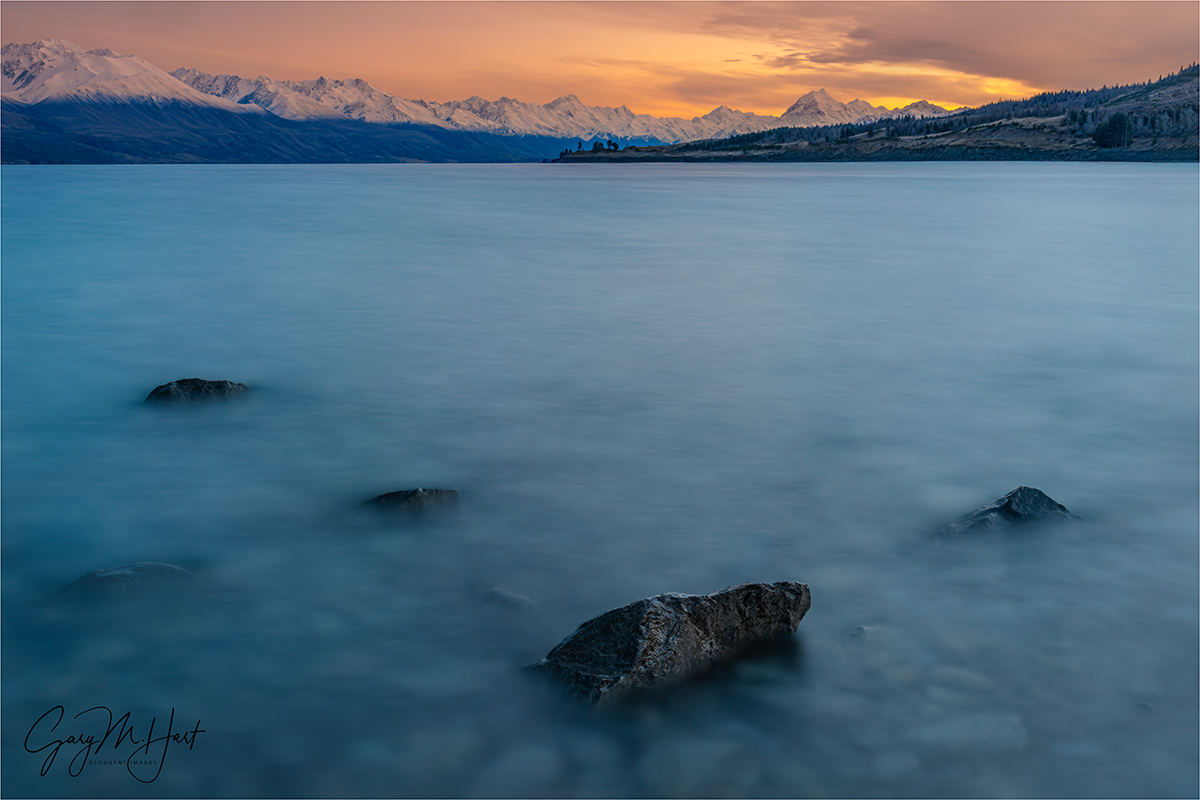
Quiet Dawn, Aoraki and Lake Pukaki, New Zealand
Sony a7R V
Sony 24-105 G
30 second
F/18
ISO 50
Chasing tornadoes is undeniably thrilling, but photographers don’t live by thrills alone. Or maybe a better way to put that would be, thrills don’t necessarily need to set your heart racing. Because after nearly 2 weeks chasing supercells and their (thrilling) progeny, I was only home for a couple of days before jetting off to New Zealand for a completely different kind of thrills. Instead of action-packed targets like lightning, tornadoes, and the supercells themselves, our New Zealand thrills skew more toward soothing.
On any photo trip, whether it’s a workshop or personal, I like to balance the essential popular photo spots with a variety of less known, personal-discovery sites. For our New Zealand workshops, over the years Don Smith and I have assembled a nice variety of these spots to mix in with the Wanaka willows, Doubtful Sounds, and Tasman Lakes that justifiably attract the beauty-loving masses.
In New Zealand, and elsewhere, Don and I have learned that popularity doesn’t necessarily mean superiority, and some of our off the beaten path photo spots can be at least as beautiful as their more popular counterparts. With the added bonus of complete solitude.
When we scout workshop locations, we always get our eyes on the popular spots for a better understanding of things like light, foreground options, light, and so on. But we spend much more time poking around the perimeter of these known locations, venturing off-road (or at least off main and paved roads), studying maps, querying locals, and simply exploring the terrain for potential vantage points that are easily overlooked. (This doesn’t make us special—most good photographers take a similar approach.)
Which is how we came across this sweet location on the shore of Lake Pukaki in New Zealand. Many years ago, Don and I were just driving along the lakeshore, scouting possible photo locations in the Aoraki/Cook area. And while this spot is off the main highway, I’d hardly label it “hidden.” But we’ve never seen another photographer there. When we first saw it, we instantly realized that it checked every box on our list that day: mountains, lake, and foreground features (plus access that won’t kill anyone in the group).
From the get-go, Don and I made this a regular workshop sunrise location. And over the years we’ve learned that, like many spots, it’s a little different with each visit: the lake level goes up and down (and with it the rocks that are visible), the snow line on the surrounding peaks changes, amount of churn on the water varies, and of course the sky is always doing something different. Not only that, making our way from the van to the water in the pre-sunrise dark, it’s easy to end up a couple hundred feet one direction or the other from where we were the previous year. But one thing remains unchanged: we’re always alone.


One of the most important features of this spot is the prominence of Aoraki (Mt. Cook). At over 12,000 feet, it’s New Zealand’s highest peak. Sometimes clouds obscure its summit, but this year’s group got to watch Aoraki’s striking outline slowly materialize against the brightening sky.
With the group settled in and happily clicking away, I set about searching for this year’s foreground rocks. One of the things that makes this such a great location is the shallowness of the water near the shore here, which allows a few rocks to jut above the surface, with many more clearly visible just below the surface. For my foreground, I always look for the protruding rocks, but also stay very aware of the surrounding submerged rocks. This year, with Aoraki so visible, I hunted until I found a V-shaped collection of nearby rocks that complemented the distant peak.
Because the lake was fairly choppy, I decided on a long exposure to smooth the water, which provided the added bonus of better revealing the submerged rocks. We were still about 20 minutes out from sunrise, so achieving a 30-second exposure without a neutral density filter was a simple matter of dropping to ISO 50 and stopping down to f/18. To compose, I positioned myself so the nearby rocks framed Aoraki. Then I dropped my tripod a little to shrink the gap between the rocks and the peak, but didn’t drop as low as I might otherwise have because the lake’s glacial turquoise is such a beautiful feature itself.
One unsung perk of these pre-sunrise long exposures is the waiting. Nothing is more soothing, and dare I say thrilling, than simply standing and basking in morning’s quiet calm while my camera collects the faint light. Sublime.
Join Don and Me in New Zealand
Workshop Schedule || Purchase Prints || Instagram
Roads Less Traveled
Click any image to scroll through the gallery LARGE


Peak Color
Posted on January 9, 2024

Twin Peaks, Mt. Tasman and Aoraki / Mt. Cook, New Zealand
Sony α1
Sony 24 – 104 f/4 G
ISO 100
f/11
.6 seconds
The first time I visited New Zealand (way back in 1995), I was surprised not just by the number of mountains, but also by their size. New Zealand’s mountains reminded me very much of the Eastern Sierra peaks I visit every year for the way their serrated profiles tower above the surrounding landscape. And while the east-side view of the Sierra Crest is truly spectacular, the New Zealand mountain experience also includes glaciers, rainforests, and an assortment of massive, glacier-carved turquoise lakes that are so pristine, locals drink straight from them.
It’s no coincidence that Don Smith and I concentrate our annual New Zealand winter workshop in the Southern Alps, the backbone of the South Island and home to all 20 of New Zealand’s 10,000+ foot peaks and all of its glacial lakes. We choose winter not just for the Milky Way’s prominence in the night sky, but also to maximize the snow on the Southern Alps.
Fox Glacier on the South Island’s West Coast is the farthest north our groups get. Our stated reason for being here is our heli-hike on Fox Glacier (we helicopter onto the glacier for a guided hike and an intimate view of its crevasses, caves, pools, and seracs), we’ve come to appreciate many other features of this segment of our workshop—specifically, the (aptly named) Blue Pools as well as the various waterfalls of Haast Pass, and the spectacular views of New Zealand’s two tallest peaks, Mt. Tasman (on the left in this image; 11,473 feet) and Aoraki / Mt. Cook (12,218 feet).

Dark Sky Dreams, Lake Matheson, New Zealand
Our Lake Matheson hike during our stay in Fox Glacier (also the name of the town where we stay) is a particular highlight because of its mirror reflection of Tasman and Aoraki/Cook. But on our last morning in Fox Glacier, we photograph sunrise on the two peaks from Fox Glacier Vista, an underrated vantage point that’s a great way to wrap up our stay.
Given all the sights we see throughout the 10 days of this workshop, it’s easy to overlook this brief stop before our long drive to Aoraki / Mt. Cook National Park on the other side of the Southern Alps (less than 30 miles as the crow flies, but nearly 300 (breathtaking) miles as the Mercedes Sprinter Van drives). But the view here is nice, even during an ordinary sunrise, and always worth the stop.
The sunrise on our Fox Glacier departure morning in 2022 was anything but ordinary. We always depart for this shoot expecting a nice shoot, but usually my mind is more on the long drive ahead and I’m content to stand back an drink in the view. But this morning we could tell from the instant we arrived that the ingredients were in place for something truly special: Right at our feet, a frosty glaze covered the meadow and spread all the way to the trees, and in the distance, layers of broken clouds hovered above the peaks, which in the crystal clear air appeared etched against the horizon.
Read about the science behind sunrise/sunset color
Though it was still fairly dark, hints of color were already seeping into the clouds behind the Southern Alps. This was Don’s and my first visit following two years lost to COVID, and I immediately saw that the vista we knew so well had been expanded and upgraded, something I initially found disorienting. While the rest of the group rushed to set up at the most obvious vantage point, I took a couple of minutes to explore along the short trail to make sure we weren’t missing something new, before returning confident that we were indeed in the best place. (I was so focused on the view during this little jaunt that I failed to notice a small piece of jutting root that aggressively reached out to send me sprawling in the dirt—my skinned knees and bruised ego were only slightly comforted by the knowledge that no one actually witnessed my face-plant.)
In these situations, when spectacular conditions rival the scene I came to photograph, I try not to get too cute with my compositions. If there’s an obvious complex option that doesn’t distract from the natural beauty of the moment, I’ll take it, but generally I prefer to let the scene speak for itself by keeping my composition as simple as possible.
But that doesn’t mean I don’t pay attention to the entire scene. In this case we were limited by a fence between us and the meadow, and since I already knew the view, I concentrated on simple framing. With the combination of matching snow-capped Tasman and Aoraki bookending the closer Craig Peak, and parallel horizontal layers throughout the scene, it didn’t take a rocket scientist to identify an opportunity for what I call “aggressive symmetry.” The pair of larger foreground trees, while not perfectly in balance with the rest of the frame, were close enough to symmetrically arranged that I was pleased with their (unavoidable) inclusion.
Given the way the color was progressing as the sun brightened behind the mountains, I worked out my composition long before it peaked, clicking every few seconds while saying to myself each time, surely this must be maximum color. But it just kept intensifying—the thrill of witnessing it was matched only by the thrill of listening to the rest of the group react to what we were seeing.
As I clicked, I couldn’t help think that this was turning out to one of those sunrises (or sunsets) with color so vivid that I know people viewing the images won’t believe they’re real. Fortunately, from sunrises/sunsets to wildflowers to auroras, photographers know that there’s nothing subtle about color in Nature, and that when Mother Nature wants to, she really can dial the vivid up past the point of credibility. The best way to describe these moments is that to me it feels like the atmosphere possesses a physical component that penetrates my skin and pretty much everything else it touches until I feel like the entire world is actually humming with color.
You never know when Nature’s little (or big) surprises will happen, but their possibility is the thing gets me out of bed in winter darkness, keeps me out well past dinnertime, and makes all the cold, rain, snow, or whatever other hardships Mother Nature wants to throw my way, tolerable.
Join Don and me in New Zealand
Workshop Schedule || Purchase Prints || Instagram
Sunrise / Sunset Color
Click any image to scroll through the gallery LARGE


New Zealand on Ice
Posted on October 28, 2018

Glacial Flow, Tasman River, New Zealand
Sony 24-105 f/4 G
1 1/3 second
F/16
ISO 50
One summer when I was a kid my family took a camping vacation to the Canadian Rockies. Bits and pieces of that trip return to me as vague memories, but one memory permanently etched in my brain is the color of Lake Louise and Moraine Lake. My dad, a very passionate amateur photographer, was frothing with excitement and must have gone through half his film budget (remember those days?) at Moraine Lake alone. Nevertheless, and despite my dad’s pictures, I couldn’t fully process a world where water could be that color and for many years after that doubted my memory.
Long before visiting New Zealand I accepted that water really can be that color, but still had few opportunities to view it. Then I started visiting New Zealand, where photographing the lakes and rivers gives me a little déjà vu—it’s just plain disorienting to see water this color.
So what’s going on?
In areas of persistent cold, snow can accumulate faster than it melts. Over many years of accumulating, the snow’s weight compresses it into ice and a glacier is born. A glacier is incredibly heavy; since pressure decreases the freezing point of ice, at the interface between the glacier and the underlying rock (where the pressure of the ice’s weight is greatest), melting ice lubricates the glacier and allows it to move downhill. The glacier’s extreme weight combined with this forward motion breaks up the rock. Embedded with these rock fragments, the glacier behaves like sandpaper, grinding the rock on which it slides into finer and finer particles. The finest of these particles is called “glacial flour.”
Meltwater from the glacier flows downhill, carrying scoured rock with it. While the larger rock particles simply sink, the glacial flour remains suspended in the runoff. While most of the sunlight striking water infused with glacial flour is absorbed by the suspended particles, the green and blue wavelengths aren’t absorbed; instead they scatter back to our eyes and we are treated to turquoise water. The water’s exact hue (whether it appears more green or blue) is determined by the size of the suspended particles, which dictates the relative amount of green and blue wavelengths they scatter.
About this image
The Hooker Valley track is a spectacular 3-mile hike beneath Mt. Cook to Hooker Lake. This gradually sloped trail follows the Hooker River’s twisting turquoise ribbon, snaking back and forth across the water on three swinging suspension bridges. It doesn’t take too much time on the trail to understand why this is one of the most popular hikes in New Zealand.
This year’s workshop group didn’t have time to do the entire 6-mile roundtrip, but since the beauty starts pretty much in the first 100 yards and doesn’t let up, we guided them up the track with instructions to take their time and photograph without concern for how far they got. It turns out most only made it to the first bridge, initially stopped by the view of the river and mountains, and then by the sunset that colored the clouds above the peaks.
This image came from fairly early in our bridge shoot, when clouds capped the scene and I took advantage of the soft light to stretch my exposure and smooth the water. Here I was a few yards up the trail from the bridge, which allowed me to make the river a diagonal stripe across the frame. Less than thrilled with the fairly boring foreground shrubs, I moved around a bit until I found a large rock to occupy the that part of the frame.
New Zealand Photography Workshop
The Best of New Zealand
Click an image for a closer look and a slide show


 Eloquent Images by Gary Hart