Eloquent Images by Gary Hart
Insight, information, and inspiration for the inquisitive nature photographer
Watch Your Back
Posted on August 21, 2023
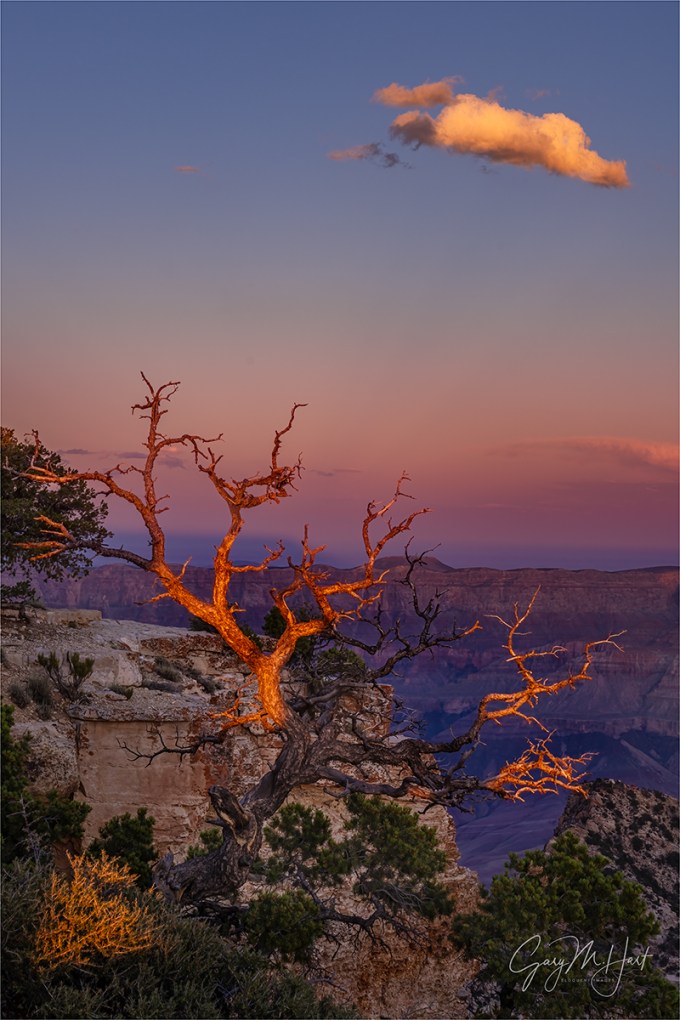
Day’s End, Cape Royal, Grand Canyon
Sony a7R V
Sony 24-105 f/4 G
ISO 100
f/13
1/13 seconds
Landscape images can be divided into two categories: the right place at the right time images, and the “Hey, look at this!” images (that creatively reveal something easily overlooked). While I do everything I can to get myself and my workshop groups in the right place at the right time for something special, it’s the HLAT! images that I find most satisfying.
Right-place/right-time can be an anticipated event that we mark on a calendar and make an effort to be present for (or schedule a photo workshop for)—things like a Yosemite moonrise, Iceland’s northern lights in January, or the lightning of the summer monsoon at Grand Canyon. Or they can be one of those surprises that sometimes just seem to fall into our laps—for example, a SpaceX rocket launch photobombing a workshop Milky Way shoot. As thrilling as these moments can be, photographing them is mostly just a matter of combining a decent eye for composition with an understanding of your camera and mastery of photographic craft (like exposure and depth of field).
The HLAT! images start with those basic skills, but also require creative vision and an uncommon attention to detail. It’s a mindset that knows there’s something better here, and a determination to find it.
Rather than settling for the obvious, I strive for that mindset and approach. And while I think I have decent success with it, in pretty much every workshop image review I’m reminded by my students’ images that I still miss things. My students’ images are a great reminder to everyone present, myself included, of the creative possibilities at every location.
I do find it ironic that those spectacular right-place/right-time moments we covet so much can so easily blind us to all the subtle, but no less beautiful, opportunities nearby. And while a few fortunate photographers seem naturally predisposed to recognize Nature’s subtleties and convey them in unique ways, most of us need to actively cultivate that vision. For me that means having the discipline to regularly check my surroundings—look behind me, look closer, and just plain slow down—no matter what else is going on.
Most times I start by identifying the best light and finding a composition that uses it, regardless of the scene’s primary subject. Something else that helps is switching to a different lens—for example, using an ultra-wide when the more obvious composition calls for something longer, then getting right up in a close foreground subject. Or I’ll add telephoto lens when my first inclination is to shoot wide, then remove my camera from the tripod and slowly scan the scene to see what stops me.
I had a good opportunity to apply all this at Grand Canyon earlier this month. Anyone who has photographed sunset at Cape Royal on the North Rim of the Grand Canyon knows that “the shot” there is facing west and southwest. Not only is west the direction of the setting sun, it’s also where you’ll find the North Rim’s most impressive canyon view. And starting with that view, going wider and angling your camera just a little to the left (southwest) allows you to include all of massive Wotan’s Throne, arguably the Grand Canyon rim’s most iconic feature, jutting front-and-center.
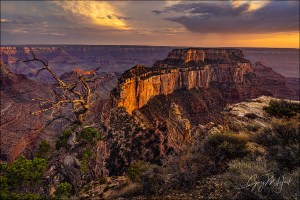
Last Light, Wotan’s Throne, Cape Royal, Grand Canyon
Though Wotan’s Throne is a prominent feature at most of the South Rim vistas, Cape Royal on the North Rim is the closest vantage point, and the absolutely best place to catch it throbbing with the warm light of the sun’s last rays. Less heralded Cape Royal views to south and east include Vishnu Temple and more canyon, but they’re not nearly as expansive as the view west and southwest.
My workshop groups always do a sunset shoot here, and when conditions permit, we top it off with a Milky Way shoot. As you might imagine, no matter which way their cameras were pointed, no one leaves Cape Royal disappointed.
First time photographers here can be forgiven for giving all of their sunset attention to these west/southwest views. This evening it seemed everyone in my group had found some version of the obvious sunset- and Wotans-facing view. Some had visions of capturing a sunstar or red rubber ball sun, while others set up to include Wotan’s Throne’s last light (a wide shot will get both). But as you’ll hear from any quarterback who has fixed his gaze on the primary receiver while the (unguarded) tight end frantically waves his arms in the end zone, the first choice isn’t always the best choice.
In a workshop I generally don’t shoot unless I think I can get something new, but no matter how “ordinary” I think the sunset might be, I’ve learned never to walk out to Cape Royal without my camera bag. This time, as expected, my gear had spent the entire evening resting on a rock, undisturbed.
One of my roles during a shoot with a group is to be the eyes in the back of everyone’s head—not only does this benefit them, foregoing my camera keeps me from being so locked in on what’s in my viewfinder that I miss other good stuff. So while the group concentrated on the primary scene, I kept my head on a swivel, scanning for less obvious opportunities.
Long aware of the aesthetic appeal of the dead tree clinging to the cliff at Cape Royal, I’ve attempted to photograph it (with varying degrees of success) on previous visits. Usually it’s been as an accent to the primary subject (as in the Wotan’s Throne image above), and I’ve never really emphasized it. But this time, after seeing its gnarled branches bathed in golden sunset light and accented by a single lit cloud, I sounded the alarm.
Of course this was also the moment when the sun had just balanced in the horizon, so most of the Wotan’s light, sunstar, red ball crowd were otherwise engaged. But a couple in the group saw what I saw and pulled themselves away, and when I raced to my bag to pull out my own camera and tripod and set up facing the opposite direction of everyone else (Tip: when you see a pro photographer point his or her camera in the opposite direction, take a second to figure out what the attraction is), one or two more joined the fun.
With only a couple of minutes before the sun disappeared, I worked fast, starting with vertical compositions, but making sure to include horizontal options as well. The cloud was a fortuitous addition, just enough to carry the sky. And while I try to avoid cutting subjects with the horizon line, I didn’t have much choice and was grateful that the lit part of the tree was almost entirely below the horizon.
As the sun dropped, the light on the tree just kept getting warmer, but also the amount of the tree actually receiving light shrunk. At some point I realized that the tree was actually catching some of my shadow (duh), so every time I clicked my shutter (using a 2-second timer because I hate the Sony remote), I ducked to hide my shadow.
Turns out, this is one of those images that’s equal parts right place, right time, and “Hey, look at this.” I happened to be at the right place at the right time for this light and cloud, but I’d have completely missed it if I’d been too focused on the more obvious scene. In this case I was especially pleased because not only did I get an image that’s a little different than the conventional scene, I was actually able to encourage a few others in the group into photographing something they otherwise would have missed—and in the process remind them to always watch their back.
Epilogue
Less than 2 hours after this we were photographing Wotan’s Throne beneath the Milky Way, when Elon Musk’s SpaceX Falcon 9 rocket crashed the party. And at this point in the workshop it still looked like we’d be lucky to get lightning, but that changed quite suddenly two nights later. Stay tuned…
Join me at the Grand Canyon
Workshop Schedule || Purchase Prints || Instagram
The Less Obvious Shot
Click any image to scroll through the gallery LARGE


Grand Canyon: North vs. South
Posted on August 29, 2021

Last Light, Wotan’s Throne, Cape Royal, Grand Canyon
Sony a7RIV
Sony 12-24 f/2.8 GM
1/30 second
F/10
ISO 100
North vs. South
When people decide to cross the Grand Canyon off their bucket list, they usually look at a map and see that the South Rim is an easy one hour detour off Interstate 40, or just a little more than three (mostly interstate) hours from Sky Harbor Airport in Phoenix. The North Rim, on the other hand, is nearly five hours from the closest major airport, and isn’t really on the way to anywhere. Not only that, most of the Grand Canyon pictures we see came from the South Rim. Great views, minimal effort? The South Rim is the clear winner, right?
If you prefer experiencing your national parks in wham-bam-thank-you-ma’am visits to jaw dropping, expansive vistas, the South Rim is definitely for you. But here’s a little secret: If your outdoor tastes lean toward an actual relationship with nature, the North Rim is better, and it’s not even close.
I realize that “better” is subjective, and you’re welcome to disagree. But for each of the last 9 years (not including 2020), I’ve led at least two Grand Canyon photo workshops that split time evenly between the Grand Canyon’s North and South Rims—if the votes of hundreds workshop participants who spent equal time on both sides mean anything, the North Rim wins in a landslide.
So what gives?
For both workshop participants and myself, an oft-cited North Rim benefit is just plain peace and quiet. Its relative remoteness, limited accommodations and dining, combined with a dearth of luxury amenities that today’s travelers take for granted (like wifi and reliable cellular), work better than a border wall to keep the masses away. But these “hardships” are actually a feature for those of us who prefer communing with nature, rather than simply gawking at it.
Another bonus: As a photo workshop leader, it’s wonderful not having to stress over parking strategies for every shoot, or having to negotiate prime photography real estate with selfie-obsessed tourists (does a tripod possess some kind of cloaking magic that makes a photographer invisible to tourists?). When I’m with a group on the South Rim, I can’t wait to get over to the North Rim to recharge my psyche.
I do love the South Rim’s views—a lot—but I literally cannot think of a single thing on the South Rim that I’d consider scenic that isn’t a canyon view. On the other hand, the North Rim’s canyon views are surrounded by thousands of acres of dense evergreen forest that’s marbled with aspen, and green meadows sprinkled liberally with wildflowers. You could spend an entire North Rim visit surrounded by peaceful beauty without getting a single glimpse of the canyon. (And if you’re lucky, you might even enjoy a view of the bison herd that hangs out near the entrance station.)
And the North Rim’s views, while not as plentiful or expansive as those on the South Rim, are still world class. For lightning photography, there’s no better spot than Grand Canyon Lodge. Protected by an array of lightning rods, with the fully enclosed lodge Sun Room right there for immediate retreat, the Grand Canyon Lodge view faces south, across the canyon, in the direction from which most thunderstorms approach. Rather than chasing the lightning, we can just wait for it to come to us.
But for beautiful views, my two favorite North Rim vistas are Point Imperial and Cape Royal. At nearly 9000 feet above sea level, Point Imperial is the Grand Canyon’s highest scenic view point. It also provides the park’s best view of the Vermillion Cliffs and Grand Canyon’s Marble Canyon. And picturesque Mt. Hayden, a prominent spire that stands front and center against a host of ridges and towers that recede in the distance, makes a perfect visual anchor for Point Imperial scenes.
Cape Royal has the North Rim’s most expansive view, and is probably the best spot on the North Rim to photograph the setting sun. It also offers the closest view of Vishnu Temple, one of the Grand Canyon’s most recognized landmarks. But what really sets Cape Royal apart for me is that it is hands down the Grand Canyon’s best view of Wotan’s Throne, a massive sedimentary monolith rising nearly 3000 feet above the Colorado River.
Even though it stands out as a large, flat-top structure that’s clearly visible from most of the Grand Canyon’s South Rim vistas, when viewed from the South Rim Wotan’s Throne isn’t nearly as interesting as its neighbor, Vishnu Temple. Which probably explains why Wotan’s Throne doesn’t get the love I’ve always felt it deserves. But at Cape Royal, Wotan’s Throne looms just a mile away, and the close view from this side reveals it to be so much more than it appears to be from the South Rim.
About this image
Maybe the best thing about the Cape Royal Wotan’s Throne view is the way it seems positioned, as if by Devine hand, to catch the warm light of the setting sun. Which is exactly what I was thinking about when my third workshop group arrived for the final North Rim sunset shoot of this year’s trip.
The cloudy vestiges of the afternoon’s thunderstorms were scattered across the sky, broken by just a few blue patches. The clouds were beautiful, but what excited me most was the lack of clouds on the western horizon, which would (fingers crossed) provide a perfect path for the sun’s last rays to slip through to color the sky and canyon.
After making sure everyone else was settled, I set about trying to find something for myself. It was pretty clear that the scene both west and south was going to be spectacular at sunset, but I decided that finding a single composition in one direction and would allow me to park my tripod and move around and help people between shots.
I chose the view to the south, for the potential sunset light on Wotan’s Throne, over the view of the actual setting sun in the west. I was drawn to a dead tree precariously perched near a vertical drop of undetermined height (I wasn’t super motivated to find out), and worked hard to safely position myself to balance the tree between Vishnu Temple and Wotan’s Throne, and to get my camera high enough to prevent the tree from intersecting the horizon. While I ended up having to dig my shoes into a steep slope a few feet from the edge, I felt safe.
Being so close to the tree, I chose my Sony 12-24 GM lens. This would allow me to include lots of sky and canyon. Normally I try to avoid too much sky in my Grand Canyon images, but there was potential this night = for some very special color that would demand a lot of sky.
Waiting for the show to start, I just started composing and clicking to familiarize myself with all the composition possibilities. When the sun finally dropped beneath the clouds to light up Wotan’s Throne, I was ready. Many of my shots were wider, including Vishnu Temple and more sky, but for the few minutes the tree got beautiful light, I tightened my composition a little to better emphasize it.
Even though the tree was just a few feet away, I knew that at 20mm I could comfortably use f/10 (to avoid diffraction) if I focused just a little beyond the tree. Since there was nothing beyond the tree to focus on, I used one of the shrubs on the right that I estimated to be just a little farther away than the tree. Dynamic range was extreme, but well within the bounds of my Sony a7RIV. With my focal length, f-stop, and focus point set, I dialed my shutter speed with my eye on the histogram. Click.
This was probably the nicest sunset I’ve ever seen at Cape Royal. I have more colorful images from this evening, and many that include more clouds, and Vishnu Temple, but I chose this one because it’s the best example I’ve ever captured of the spectacular Wotan’s Throne sunset light I love so much.
Grand Canyon Workshops
Workshop Schedule || Purchase Prints || Instagram
A North Rim Gallery


 Eloquent Images by Gary Hart