Eloquent Images by Gary Hart
Insight, information, and inspiration for the inquisitive nature photographer
When in Iceland…
Posted on August 29, 2026
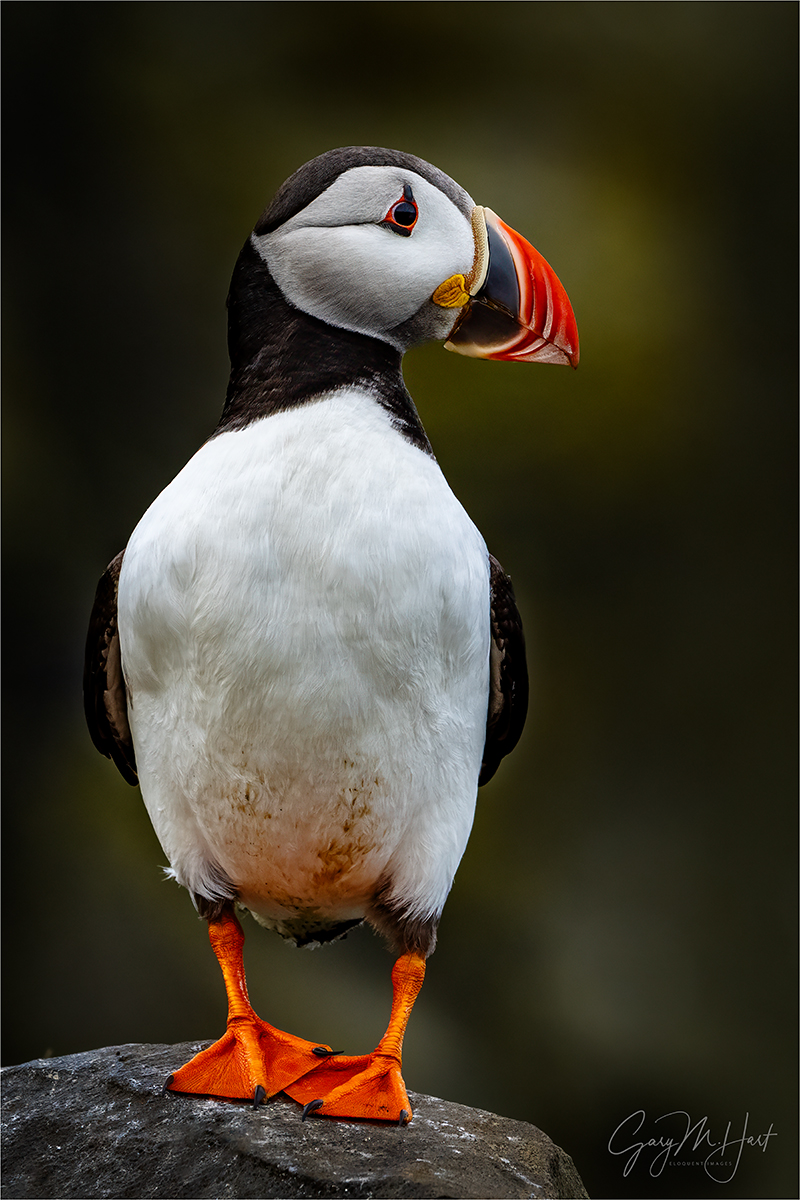 Puffin Profile, Dyrhólaey, Iceland
Sony a7R VI
Sony 100-400 GM
ISO 800
f/8
1/800 second
I’ve never been to Rome and have no idea what Romans do, but I have been to Iceland enough to know that when in Iceland, you photograph puffins. So, despite years of proclaiming that I never photograph anything that moves, in Iceland earlier this month I was able to (temporarily) soften my rigid stance.
We were in Iceland to photograph the total solar eclipse. Traveling to Iceland to witness an event that requires clear skies is an act of faith, and though Don Smith and I did our best to remind our workshop students that the eclipse we’re most likely to witness was the actual eclipse eclipsed by clouds, we all remained optimistic about our eclipse chances right up until the bitter, overcast end.
But that eclipse disappointment happened on the workshop’s first day—we still had a week and a half to wring the best from Iceland’s rugged landscape. Our itinerary included geothermal features (geysers, steam vents), sea stacks, the glaciers and volcanic craters of the rugged Highlands region, and waterfalls—lots of waterfalls.
While puffins were never part of our itinerary, I couldn’t help notice during the workshop orientation how many workshop students inquired about the opportunity to see them. But when our guide explained that there were no puffin locations near our route, and we were almost to the end of the puffin viewing window anyway, everyone understood and the thought faded to the background.
Despite the fact that no one held Don, Kaspars (our guide), or me responsible for missing the eclipse (despite a valiant effort that took us all the way into Westfjords, it turns out virtually no one in Iceland got to see it), we three guides felt a strong desire to make up for everyone’s disappointment. So when Kaspars mentioned that we could spend our second planned Iceland Highlands day on the South Coast instead, where, among other things, puffins might be found, he had our attention.
Kaspars qualified his suggestion with the warning that there was no guarantee of puffins because Iceland had reached the point in their season where puffins are no longer reliably at any location, but given the other South Coast opportunities this detour added, and our desire to make up for the lost eclipse, we decided to go for it.
After our daily waterfall fix (let me go on record as saying that there can’t be any place on Earth with a greater quantity, and variety, of waterfalls than Iceland), we pulled into Dyrhólaey a little before 5 p.m. Unlike many of the locations so far, Dyrhólaey was quite familiar. In fact, it’s the home of one of the most unforgettable northern lights extravaganzas I’ve seen in my many Iceland visits.
 Wings of Angels, Aurora Above Dyrhólaey, Iceland
Before starting the short walk out to the cliffs where the puffins frequently hang out, I held my breath and hoped for at least one puffin for the group to photograph. Because I’d been here a million times and never photograph wildlife (right?), I almost left my camera bag in our Sprinter. I’m so glad I came to my senses and didn’t fall victim to my stubborn adherence to arbitrary rules.
I didn’t have to hold my breath long, because just a short distance down the trail we encountered a pair of smiling tourists who exclaimed that we’ll have no problem finding puffins, describing exactly where to find the best viewing.
Old habits die hard. When we reached the cliffs and found them teeming with puffins as promised, my first inclination was to approach the scene like the landscape photographer I am. I set up my tripod and hunted for a position that would allow me to photograph one or more nearby puffins with the Reynisdrangar sea stacks this area is known for in the background. Each frame carefully framed and focused, it only took about 10 minutes to jettison the tripod, put my camera on fast-continuous, and just start firing.
One hour, and 1400 pictures, later, the puffins started to thin and everyone agreed that we had more than enough puffin images to occupy us for months. Since I had no real frame of reference, I relied on the reaction of the people in my group, and other photographers nearby, to determine that what we’d experienced was truly special. Not only were there hundreds of puffins surrounding us on the cliffs, many were within 10 feet, and frequently even closer than that. At one point I overheard a photographer exclaim to his buddy, “This is the easiest wildlife shoot I’ve ever done in my life!” Me too.
Of course this was also the most difficult wildlife shoot I’d ever done in my life. But whatever—it was a genuine blast. I surprised myself with how quickly I started to feel comfortable sans tripod, and despite working at 20+ frames per second, it wasn’t long before I keyed in on certain subjects, behaviors, and framing enough to spend most of my time following an actual plan.
In hindsight, I realize that I’ve just scratched the surface of bird photography’s many challenges—these beautiful little creatures were literally, uhhhh, sitting ducks. Yes, they did move around far more than my landscape subjects, but I also fully appreciate that photographing birds in flight is an order of magnitude harder. (And I have a few soft images to prove it.)
Are puffins destined to become my gateway bird, opening the door to my future as a bird photographer? Unlikely. But if nothing else, this experience was a great reminder to never let myself be bound by rules, and that the most insidious rules of all are the ones we impose on ourselves.
Workshop Schedule || Purchase Prints || Instagram
My Complete, Unabridged, Puffin Gallery
(Yes, these are two crops of the same frame)


