Eloquent Images by Gary Hart
Insight, information, and inspiration for the inquisitive nature photographer
The Other AI
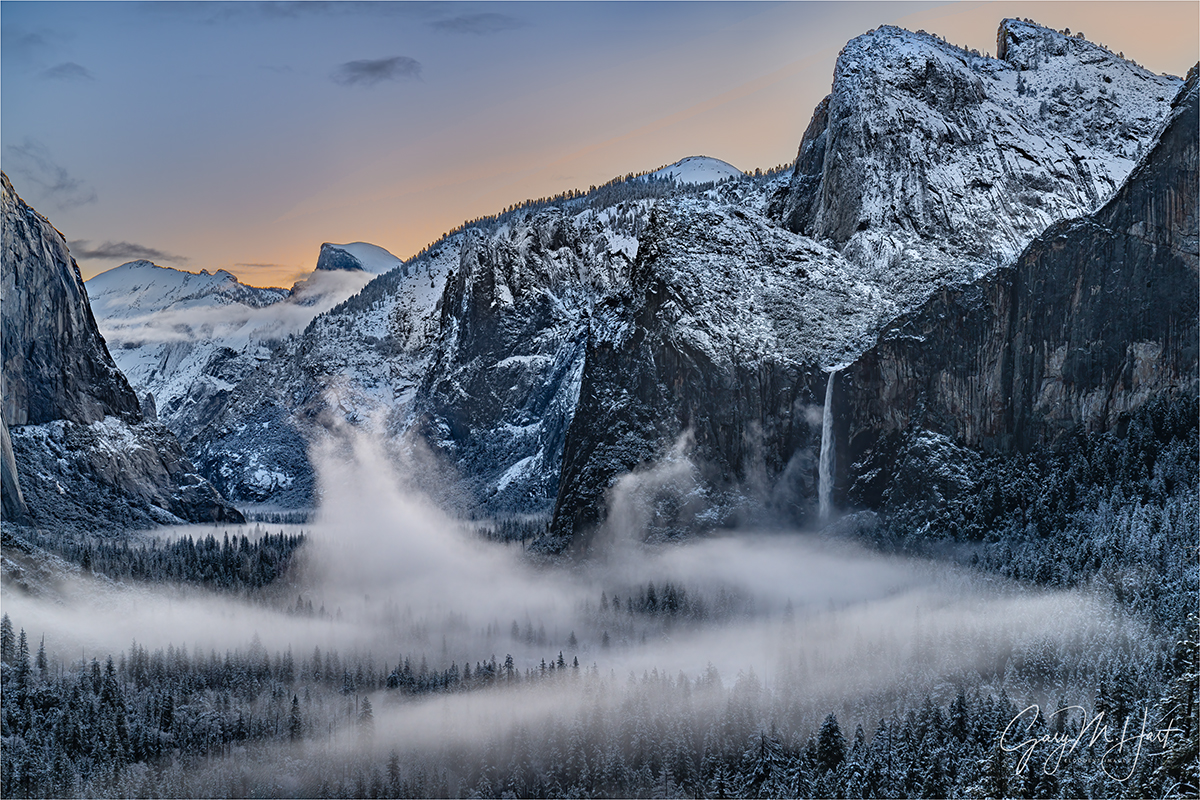
Dance of the Veils, Tunnel View, Yosemite
Sony a7R V
Sony 24-105 f/4 G
ISO 100
f/10
1/10 second
What’s wrong with ACTUAL intelligence (the other AI)?
I love all the genuine eclipse photos popping up on social media—almost as much as I DESPISE all the fake eclipse photos. Though we’ve had to deal with a glut of fabricated photos since the introduction of computers and digital capture to photography (all the way back before the turn of the 21st Century), the advent of artificial intelligence, combined with insatiable social media consumption, has put the bogus image problem on steroids. Despite being downright laughable, these AI frauds seem to fool a disturbing number of viewers. More concerning, many who claim they’re not fooled claim they don’t care because they still find these AI-generated fakes “beautiful.”
Acknowledging that beauty is in the eye of the beholder, all I can do is shrug and offer that my own definition of beauty is founded on truth. Not necessarily a perfect reproduction, or repetition of literal fact, but an overarching connection to some essential reality.
Whether it’s a painting, a work of fiction, a photograph, or any other artistic creation, I need to feel that essential truth connecting the scene, the artist, and me. The reality in a work of art—visual, musical, written, or whatever—doesn’t need to be, in fact usually isn’t, a literal reproduction of the world as I know it. Rather, I prefer artistic creations that reveal a previously unseen (by me) truth about the world. In other words, while paintings are rarely literal interpretations of the world (and in fact can be quite abstract), and novels by definition aren’t factual, the artistic creations I’m drawn to tap the creator’s unique take on reality to expand my own.
Even photographs, once relied on as flawless reproductions of reality, can’t possibly duplicate our 3-dimensional, unbounded, dynamic, multi-sensory reality. But they can, in the right hands, leverage the camera’s reality to expose hidden truths about the world. No matter how “stunning” an AI-generated or dishonest composite (two or more unassociated scenes in one image) image might be at first glance, they lack the artist’s perspective, or any connection to reality, sometimes both. Even worse, counterfeit images pretend to represent a reality that doesn’t exist. While it may be possible for an AI creation to require genuine human insight and creativity, so far all I see is people using AI as a shortcut around actual intelligence.
Of course photographic deception started long before digital capture, but like so many other things computers simplified, digital capture made it easy for people more interested in attention than connection to attract the strokes they covet. At least in the film days, manipulating a photo still required a bit of skill and effort—back then, when it was done honestly, you could at least admire the perpetrator’s skill.
Full disclosure (I digress)
I have to confess that I was actually party to blatant image manipulation at the age of 11, when my best friend Rob and I did a sixth grade Science Fair project on UFOs. In Rob’s backyard (and with help from Rob’s dad), we first photographed a homemade styrofoam “flying saucer” suspended on a wire against a plain tarp. Next, without advancing the film, we photographed our school, then sent the film off to be processed (who remembers those days?).
A few days later, we had a pretty convincing black-and-white print of our school beneath a hovering UFO. But, since our sole goal was to prove how easy it is to fake a UFO sighting, we did reveal the sleight-of-camera trick in our presentation (so no harm, no foul).
The digital dilemma
The introduction of computers to the world of photography, even before digital camera’s were anything more than a promising novelty, created an almost irresistible temptation for photographers who lacked the ethic or inspiration to create their own images. At the time, with no consensus on where to draw the line on digital manipulation, some photographers innocently stepped over the spot where most of us would draw it today.
For example, in the mid-90s, when Art Wolfe cloned extra zebras into his (already memorable) zebra herd image, many cried “Foul!” Wolfe, who had no intent to deceive, was taken aback by the intensity of the blowback, arguing that the resulting image was a work of art (no pun intended), not journalism.
In the long run, the discussion precipitated by Wolfe’s act probably brought more clarity to the broader digital manipulation issue by forcing photographers to consider the power and potential ramifications of the nascent technology, and to decide where they stood on the matter. Expressing his disapproval in a letter to his friend Wolfe, renowned landscape photographer Galen Rowell probably said it best: “Don’t do anything you wouldn’t feel comfortable having fully revealed in a caption.” Great advice that still applies.
Nevertheless, left up to each photographer, the “how much manipulation is too much” line remains rather fuzzy, but I think most credible photographers today agree that it excludes any form of deception. Which brings me back to the absolutely ridiculous eclipse fakes we’ve all been subjected to. I honestly don’t know what upsets me more—the fact that “photographers” are trying to pass these fakes off as real, or the number of people who they fool. (And I won’t even get into the fact that every image and word I’ve shared online has almost certainly been mined to perpetrate AI fabrication—that’s a blog for a different day.)
One risk of that mass gullibility, and people’s apathy about the distinction between real and artificial, is the dilution of photography’s perception in the public eye. As beautiful as Nature is without help, it’s pretty hard to compete with cartoonish captures when a connection to reality isn’t a criterion. I’m already seeing the effects—the volume of enthusiastic praise for obvious fakes is disturbing enough, but even more disturbing to me is the number of people responding to legitimate, creative, hard-earned images with skepticism.
So what can we do?
I’m not sure there is a complete solution to the AI problem, but I hope that enough people crying “Foul!,” on social media and elsewhere, will open eyes and force discussions that might help the public draw a line—just as the zebra debate did three decades ago. If the blowback is strong enough, perhaps even the potential stigma will be enough to discourage AI purveyors and consumers alike.
As much as I appreciate people calling out AI perpetrators in the comments of obviously fake social media posts—I’ll do this occasionally myself when I think I can contribute actual insight that might help some understand why an image is fake—I’m afraid these well-intended comments get so buried (by the “Stunning!” and “Breathtaking!” genuflections) that very few people actually see them. So one step I’ve started taking with every single fake image that soils my social media feeds is to permanently hide all future posts from that page/profile/poster. I’m probably fighting a losing battle, but at least this unforgiving, one-strike-and-you’re-out policy gives me a little satisfaction each time I do it.
About this image
Dance of the Veils, Tunnel View, Yosemite
One thing a still photo can do better than any other visual medium, better even than human vision, is freeze a moment in time. From explosive lightning, to crashing surf, to a crimson sunset, to swirling clouds, Nature’s most beautiful moments are also often its most ephemeral. No matter how much we believe at the time that we’ll never forget one of these special events, sadly, the memory does fade with time. But a camera and capable photographer, in addition to revealing hidden aspects of the natural world, records the actual photons illuminating those transient moments so they can be revisited and shared in perpetuity.
Which was the very last thing on my mind as this year’s February workshop group and I pulled into the Tunnel View parking lot in the predawn gloaming of this chilly morning. Instead, we were abuzz with excitement about the unexpected overnight snow that had glazed every tree and rock in Yosemite Valley with a thin veneer of white.
Our excitement compounded when we saw the scene unfolding in Yosemite Valley below. One of my most frequent Yosemite workshop questions is some version of, “Will we get some of that low fog in the valley when we’re at Tunnel View?” My standard answer is, “That’s only in the Deluxe Workshop,” but they rarely accept that. The real answer is, while this valley fog does happen from time-to-time, it’s impossible to predict the rare combination of temperature, atmospheric moisture, and still air it requires. (It’s much easier to predict the mornings when it absolutely won’t happen, which is most of them.)
But here it was, almost as if I’d ordered it up special for my group. (I tried to take credit but don’t think they were buying it.) Since I’ve seen this fog disappear as suddenly as it appears, or rise up from the valley floor to engulf the entire view in just a matter of seconds, as soon as we were parked I told the group to grab their gear and hustle to the vista as fast as they can. Then I did something I rarely do at Tunnel View anymore: I grabbed my gear and hustled to the vista as fast as I could.
While Tunnel View is one of the most beautiful views I’ve ever photographed, I’ve been here so many times that I usually don’t get my gear out here anymore—not because I no longer find it beautiful, but because it’s a rare visit that I get to see something I’ve not seen before. But since the view this morning, while not unprecedented, was truly special, I just couldn’t help myself. Another factor in my decision to photograph was that here we can all line up together, allowing me to check on and assist anyone who needs help, and still swing by my camera to click an occasional frame. This morning everyone seemed to be doing fine, so I was actually able to capture a couple of dozen frames as the fog danced below.
There were a lot of oohs and ahhs when a finger of fog rose from the valley floor and pirouetted toward Half Dome. There were many ways to photograph it, but I chose to frame it as tightly as possible, ending up with a series of a half-dozen of this particular fog feature before it morphed into something completely different. I included minimal sky because the sky above El Capitan, Half Dome, and Cathedral Rocks was relatively (compared to the rest of the scene) empty and uninteresting.
With the fog continuously shifting, to avoid cutting off any of the zigzag beneath Bridalveil Fall, I had to be extremely conscious of its spread. Depth of field wasn’t a concern because everything in my frame was at infinity. The most challenging aspect was exposure of the bright sky with the fully shaded valley. To get it all, I underexposed the foreground enough to spare the warmth of the approaching sun. The result was a virtually black foreground and colorless sky on my camera’s LCD, but I took special care to monitor my histogram and ensure that I’d be able to recover the shadows in Lightroom/Photoshop.
So, as you can see from my description, I did indeed leverage digital “manipulation” to create the finished product I share here. But my processing steps were designed to brighten the nearly black foreground my camera captured, because exposing it brighter would have resulted in a completely white sky. Since neither a white sky or a black foreground were anything close to our experience this morning, I applied actual intelligence to expose the scene and create an image that more closely reflects this actual (and unrepeatable) event in Nature.
My group rose in the frigid dark and stood bundled against the icy cold to witness this scene and capture permanent, shareable memories of our glorious morning. I imagine it might have be possible for us to have stayed in our cozy hotel rooms, open our computers, and input a few prompts in an AI image generator to come up with something similar (and why not throw in a rainbow, lightning bolts, and rising moon while we’re at it?). But where’s the joy in that?
Ephemeral Nature
Click any image to scroll through the gallery LARGE


 Eloquent Images by Gary Hart
Gary
Wonderful image and a very nice commentary on “intelligence”. Be well, Mark
Mark D. Leibowitz (858) 204-5929 (cell) mark.d.leibowitz@gmail.com
>
I photographed a parent Great Blue Heron arriving at a nest with three chicks looking up at the parent. The chicks were sitting on a next on the bottom of the frame and I wanted to raise them. So AI just created a quarter-inch of sticks. I next added a quarter inch of sky and shoreline along the left border to push the parent right of dead center. A nature photo judge said I was still guilty of AI crime. Had I used content-aware fill, I could have continued to live without a felony record of AI abuse. However, the contest is “aware” somehow, and I think it is close to the AI process.
And once again, Anonymous above is Al Marsh. Haven’t figured out how to add my name. Beautiful shot. I think that is from Feb. I went vertical but now wish I had done both vertical and horizontal.
Hi Gary. Thanks for another stunning collection of photos. I appreciate your talents and lament the rise of AI with you. It’s surprising (and disappointing) how much fake crap is being circulated on social media, content and images.
I always enjoy your writing and your rants. I have only used AI once to remove some brush next to a flower for image review at one of your workshops. I could have kept quiet but stated what I had done. Matt K. says AI can be used just like healing brush in PS and that was my intent. You made a pretty harsh comment half in jest and half meaning it. I haven’t used AI since. Just like I don’t use HDR, I have taken AI out of my tool box also.
Awesome!
Overall, I agree with you. But I probably disagree as to where the line should be drawn. Your philosophy is to show what the camera sees. I try my best to get an excellent digital negative, but I will tweak it to make it look more like what I saw. Adjusting lighting and saturation, etc. is acceptable. So is noise reduction. HDR is OK when the dynamic range of what I saw is beyond the camera’s range. To the extent AI can help, I’m all for using it.
Pingback: Happy Earth Day | Eloquent Images by Gary Hart
It’s a beautiful photo along with an insightful blog, Gary. Presenting AI images as photography to garner likes and comments violates my sense of what is truthful. Your advice to block obvious unlabeled AI creators is sound. The view of the world through your camera takes me to very real places under special conditions and light. Keep it up!
I love your writing, and I completely agree with you on the AI intrusion of photography as I had always appreciated it. I see that it is increasingly hard for lots of people to discern reality from AI, and some people have become so piqued about calling out AI now that they are crying “fake” and “AI” on legit photos though too! Thanks for writing and sharing this great article that helps me feel less alone in these changing times of the art of photography.
This is Theresa, by the way; sorry I didn’t log in first to be able to have it reflect my name when posting!
Thanks so much, Theresa. I love writing as much as I love photography, so it’s always nice to hear when others appreciate it. 😊 I am always thrilled to see your beautiful pictures. Hope you’re well.
We hit the water this morning for this year’s raft trip. Can’t wait!
Oh my gosh!! Have a blast and be safe! Secure your flip-flops!! I’m still so grateful to you for that trip and the wonderful photos and memories!
Pingback: ‘Tis the Season… | Eloquent Images by Gary Hart