Eloquent Images by Gary Hart
Insight, information, and inspiration for the inquisitive nature photographer
Spring in Yosemite
Posted on April 30, 2013

Dogwood Branch, Pohono Bridge, Yosemite
Canon EOS 5D Mark III
1/200 second
F/5.0
ISO 400
150 mm
People ask all the time for my favorite season in Yosemite, and I really can’t give them an answer that doesn’t sound like a press conference by a waffling politician—there are things I love about each season in Yosemite, so asking me to choose is like asking me to pick a favorite child.
But what I can do is tell you what I like about each season, and I’ve always felt that spring in Yosemite is the most consistently photographable—it doesn’t really matter what the conditions are, I can always find something to photograph. In my workshop last week we had lots and lots of blue sky, nice for tourists but usually death to photographers, but we didn’t skip a beat.
Spring is when Yosemite’s waterfalls peak, and Yosemite Valley starts to green up. Many of the meadows are home to ephemeral pools that reflect Yosemite’s iconic monoliths, soaring cliffs, and plunging waterfalls. And with all the water in the falls, spring sunshine means rainbow opportunities from many spots if you know when to be there.
Maybe my favorite spring sunshine treat is the dogwood, which is great in full sun—just put the sunlit blooms against a dark background, expose for the flower, and go to town. And the translucence of backlit dogwood give them a luminosity that appears to originate from within. Either way you shoot it, front or back, dogwood in full sunlight allows shutter speeds that can largely mitigate frequent spring breezes.
My general approach to photographing dogwood is to start with a bloom, group of blooms, or entire branch, that I can isolate from surrounding distractions. Once I identify a likely candidate, I maneuver myself until I can get the subject against a complementary background—other dogwood, water, shaded (dark) evergreens. I usually opt for a shallow depth of field to eliminate or smooth distractions.
This branch of dogwood blooms was just one of many waving above the Merced River at the Pohono Bridge. I was able to isolate it against another similarly festooned branch in the background, and used a fairly large aperture to soften the background branch just enough to keep it recognizable (without making it a distraction). Exposing for the sunlit blooms darkened the Merced River in the distant background, allowing the brighter dogwood to stand out even more.
The biggest problem I had working this image was the gusting breeze, which blew quite strongly most of the time, often waving the branch completely out of my frame. But I found that by setting up my composition (on a tripod!) and exercising a little patience, the wind would eventually subside for a few seconds, allowing me to fire off a couple frames, sometimes even with enough time for quick adjustments in between.
Bracketing digital style
Posted on June 29, 2012

Dogwood, Merced River, Yosemite
Film shooters used to bracket high dynamic range scenes because there was no way to know if they’d nailed the tricky exposure until the film was processed. For some reason this bracketing approach has carried over to digital photography, when it’s a complete waste of storage and shutter clicks (not to mention all the unnecessary images to wade through at home) that shortens the life of media cards and cameras alike (the shutter is usually the first thing to wear out on a DSLR).
The histogram gives digital shooters instant, accurate exposure feedback with each capture. Today the only reason to exposure bracket is if you plan to blend images later, yet the practice persists. I suspect the persistence of exposure bracketing can be attributed to a subtle but significant paradigm shift introduced by digital capture: With film, each shutter click cost money; with digital, each shutter click increases the return on your investment.
Film shooters use exposure bracketing sparingly, as a last resort for important shots with a small margin for exposure error, but digital photographers get lulled into complacency by the (apparent) free ride digital capture offers. While the invisible per-click cost creates great opportunities, it has also engendered bad habits in digital photographers who either don’t trust their histogram, don’t know how to read it, or simply are too lazy to take the (simple) steps get the right exposure. (I’m not saying you shouldn’t adjust and reshoot when the exposure is off, I’m saying you should try to get the exposure with the first click and only reshoot when you miss.) And I suspect these photographers leave many shots on the table.
On the other hand, I’m a huge advocate of thoughtful application of digital’s “free” click paradigm. In my workshops I encourage students to take lots of pictures, with one proviso: Always have an objective. The objective doesn’t even need to be a good image; sometimes it can just be a “what if” game to educate yourself. But for me the greatest benefit is the ability to work a scene and capture composition, depth, and motion variations that can be selected later with the aid of time and a large monitor.
I apply this approach in virtually everything I shoot. When I find a scene that works (near, far, or in between), I work it obsessively. Compositions wide to tight, orientation horizontal and vertical, depths shallow to broad. And when there’s motion in the scene also vary its effect. Sometimes that means using a variety of shutter speeds; sometimes it means timing the motion differently with a variety of clicks. Ocean waves are a perfect example of this, as is the dogwood image above.
For example
My general approach in the field is to find a subject to isolate and juxtapose it against a complementary background. This is pretty straightforward when everything’s stationary, but when things are in motion I don’t always know what I have until I click and check my LCD. And when things are moving fast, I don’t have enough control over the result to get it with a single click. In May, while photographing dogwood around Yosemite Valley, I found this dogwood branch with two perfect blooms jutting away from other nearby branches. Positioning myself on the Pohono Bridge with my 70-200 lens all the way out to 200mm, I was able to isolate the blooms against the dark green of the Merced River.
With a slight breeze waving the branch, I increased the ISO to 400. To limit depth of field (and help the blooms stand out more) I selected f4, then spot-metered a bloom and dialed my shutter speed until the meter indicated +1 (above a middle tone). I composed so the branch cut diagonally across the scene, clicked, and checked my LCD. The exposure was dead-on (dogwood perfectly exposed against an underexposed river), but what caught my eye was the glistening bubbles whizzing by in the background. They flew by so quickly that I hadn’t really registered their compositional potential, but as soon as I saw them on my LCD I knew I had the potential for something cool.
With the exposure dialed in and my composition still sitting there on my tripod (don’t get me started on my whole tripod rant again), I didn’t need to change a thing, I just needed to time each click for the bubbles. I quickly realized that I could anticipate their arrival by looking upstream, so that’s what I did, timing my exposure and checking the result. After the first few clicks I started to recognize and anticipate patterns.
For the next ten minutes I just stood there on the bridge watching bubbles, timing my click for when they entered the frame. I must have at least twenty versions of this composition, exposed exactly the same, but each with a completely different background. (I also just had a blast.)
Photographic reality: Your camera’s vision
Posted on May 12, 2012

Floating Dogwood, Yosemite
1/160 second
F/4
ISO 400
176 mm
“Photography’s gift isn’t the ability to reproduce your reality, it’s the ability to expand it.”
(The first installment of my series on photographic reality.)
When I hear a photographer say “That’s exactly what I saw when I was there,” I cringe. Not only is capturing human reality in a photograph impossible (really), attempting to do so is so limiting. I’m a strong advocate of “honest” photography, photography that depicts a natural truth without digital deception, but photographic truth isn’t the same as human truth, a fact photographers should celebrate, not deny. Embracing your camera’s reality opens the door to revealing nature in ways humans can’t.
Leveraging your camera’s reality starts with understanding that “reality” is in fact a moving target defined by the medium experiencing it. The human eye’s version of reality is experienced within its narrow confines on the electromagnetic spectrum, limited to only those wavelengths between (about) 400 and 750 nanometers (a nanometer is one billionth of a meter—i.e., really, really small). An x-ray machine’s reality is .01 to 10 nanometers. But if you’ve ever seen an infrared image, you saw another version of reality, this time in the 3,000-14,000 nanometer range. Even your smartphone and microwave oven stake out their own reality turf on the very same electromagnetic spectrum.
My point isn’t to overwhelm you with scientific minutia (this won’t be on the test), it’s to jar you from your human-centric view of the universe. While a camera records light (more or less) within the same range of the electromagnetic spectrum registered by your eyes, a camera’s sensor responds to those wavelength’s a little differently, and it doesn’t benefit from the stereoscopic vision and cerebral processor that conveys depth and motion and adjusts in real time as light and focus needs dictate. And a camera’s sensor can’t handle the same range of light our eyes can, In other words, it’s impossible for a camera to record the world exactly like being there. Thank goodness.
Understanding and controlling the way your camera “sees” allows you to tap its unique vision and emphasize overlooked, unappreciated aspects of the natural world. On the other hand, photographers who see the world only with their own eyes, who use Photoshop or other digital tools to bludgeon their images into something closer to their own reality (or worse, into a manufactured digital reality), rarely add to their viewers’ perception of nature.
Get focused
The camera’s vision differs from yours in many ways. In upcoming posts I’ll cover confining borders, dynamic range, motion, time, and depth. But because I need to start somewhere, I thought I’d begin with an often unappreciated difference: focus. Not only do your eyes have a very wide focus range, they adjust focus (virtually) instantly, responding to a command from your brain in ways your not even conscious of to give you the impression that your entire scene is in crisp focus throughout. The camera, on the other hand, captures the current focus in a static instant. And the reciprocity of shutter speed and aperture make for sometimes impossible choices when trying maximize depth of field in limited light.
Photographers jump through lots of hoops to overcome limited depth of field and more closely approximate their own experience of world. Tiny apertures, tilt-shift lenses, and blended images will do it, albeit with trade-offs. And when all else fails, we’ll bump our ISO into the noisy stratosphere. All that is well and good, but let’s not forget that there’s no rule that says your capture must mimic your experience. Sometimes we can use our camera’s ability to severely limit depth of field to our advantage by eliminating distractions and turning uninteresting backgrounds into a complementary canvas of color and shape.
For example
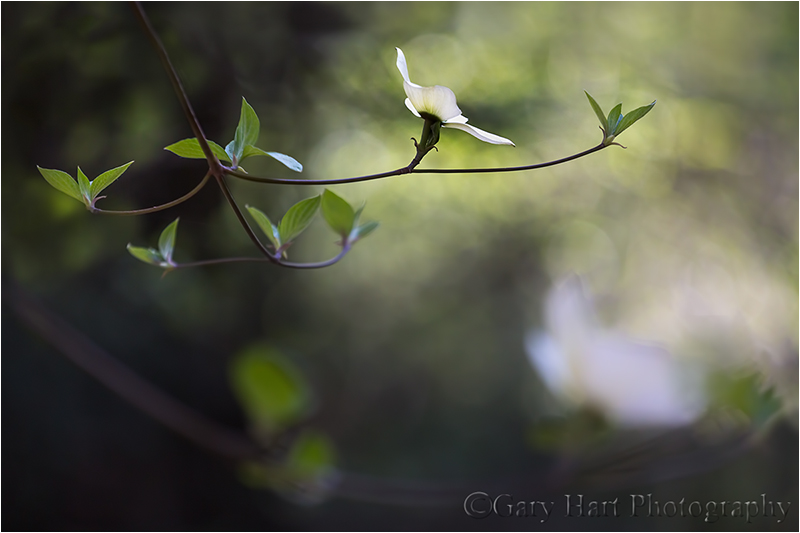
Floating Dogwood, Yosemite
Photographing near the Pohono Bridge in Yosemite, my eyes were treated to an overwhelming variety of input: countless dogwood blooms floating in dappled light; the swollen Merced River, deep and green or fast and frothing; oblivious cars and focused photographers; all this beneath a boring, pale blue sky. (Not to mention the sounds and smells of outdoors.) All of this input demanded attention, but I just wanted to convey the dogwood’s elegant grace in the context of its simple, verdant setting—everything else was superfluous.
While my human senses took in everything with razor sharpness, focusing close with a telephoto lens and large aperture allowed me isolate a single flower, reducing the rest of the visual world to a soft canvas of variegated green. Careful positioning and framing juxtaposed other blurred, complementary elements to provide location context. And using my camera’s inability to capture the range of light my eyes saw, I exposed for the brightly lit dogwood, turning everything in shade into a background ranging from dark green to nearly black.
This is image nothing like what my eyes saw, but it is what my camera saw (minimal Lightroom/Photoshop processing). Using my camera’s vision, I was able to eliminate distractions and isolate only the aspects of the scene I wanted to share. In my next few blog posts I’ll write more about leveraging your camera’s vision to reveal nature’s beauty in ways that are different, but no less real, than being there.
Up next, Framing infinity.
Returning to the scene of the crime
Posted on May 7, 2012
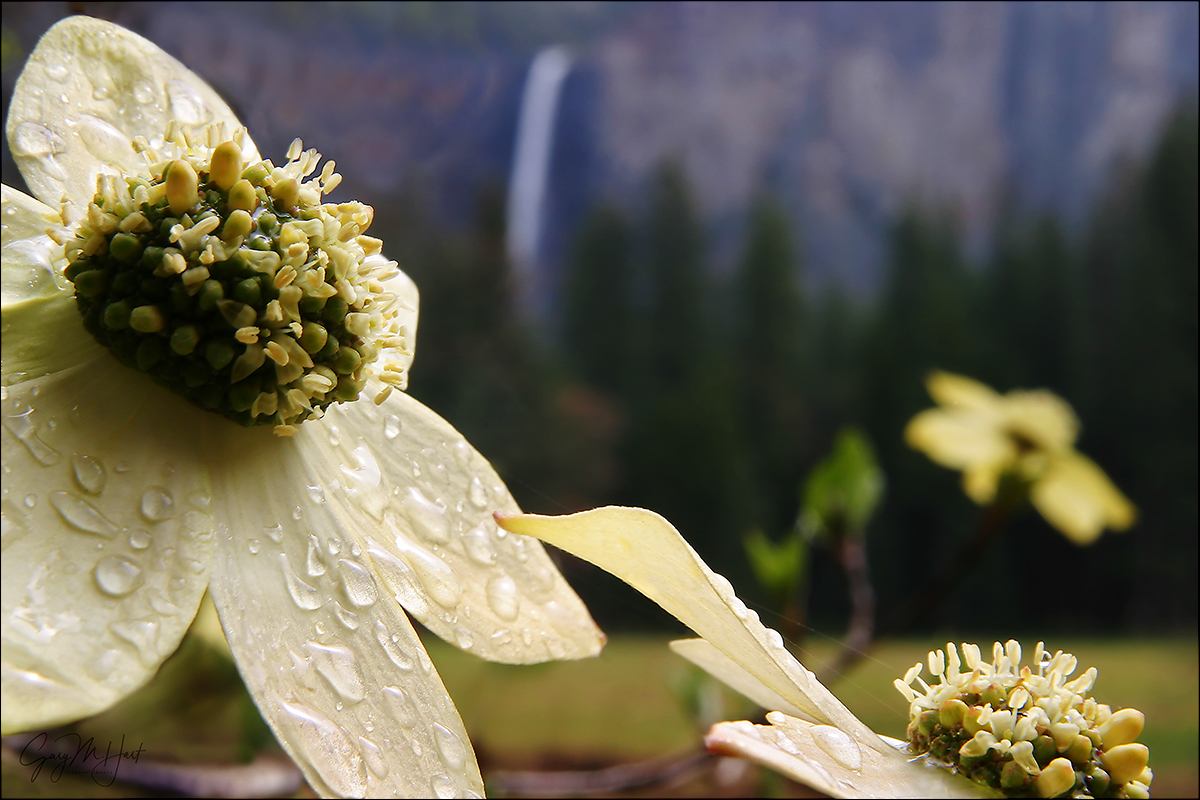
Bridalveil Dogwood, Yosemite
Canon EOS 10D
1/15 second
F22
ISO 100
48 mm
My Bridalveil Dogwood image is eight years old now. It remains one of my most popular images, and is still a personal favorite because it represents so many of my personal goals for each image:
- Use camera’s unique vision to reveal nature’s frequently overlooked details
- Manage the front-to-back plane to create the illusion of depth
- Guide the eye and create location context with selective focus
- Render the world in ways that allow others to imagine a world without human influence
My goal that morning, crystalized on the drive to Yosemite, was to juxtapose a sharply focused, foreground dogwood flower against a Yosemite icon softly focused in the background. I wandered Yosemite Valley in a light rain for a couple of hours before stumbling upon this blooming dogwood tree with Bridalveil Fall in the background. To frame Bridalveil with this pair of flowers I had to drag a log over to stand on, and extend my tripod’s center post much farther than I’m comfortable with (the center post is not terribly stable). An extension tube enabled a close focus that exaggerated the dogwood and softened Bridalveil Fall. Focused that close, getting Bridalveil sharp enough to be recognizable required me to stop down to f22. Fortunately there was no trace of wind.
Someone recently told me they overheard a couple of photographers stalking this tree, talking about my dogwood image, hoping they could duplicate it. While I was flattered, this need to replicate images makes me scratch my head. It’s what creates tripod traffic jams in Antelope Canyon on sunny days, at Mesa Arch every sunrise, and beneath Horsetail Fall each February, to name a few. I’m not saying I don’t have my share of derivative images, but they just don’t give me the satisfaction I get from creating something that I feel is uniquely my own. I tell my workshop students that images that move them to action are great, but they should be the starting point and never the goal. In other words, take an image that excites you and find put your own creative twist to it.
For example, while I have no desire to duplicate any image (my own or anyone else’s), I do return to “my” dogwood tree because I love the way it aligns so perfectly with Bridalveil Fall. A couple of years ago I was in Yosemite during an early snow storm. Many (shocked) colorful fall leaves remained on the trees, suddenly fringed with snow. Wanting to create something that showed the collision of fall and winter and still said Yosemite, I thought of this dogwood. Sure enough, I found a host of colorful leaves clinging like Christmas ornaments and composed something that achieved my goal.
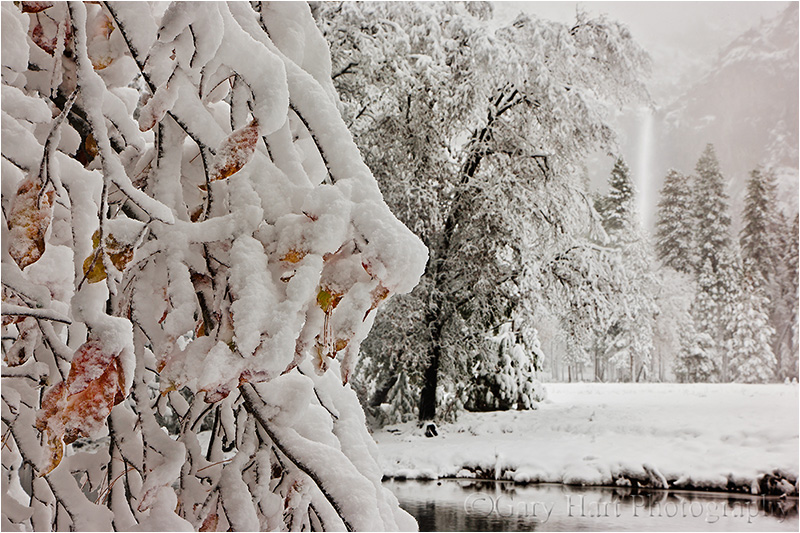
Fall in to Winter, Yosemite
The dogwood were blooming beautifully during my Yosemite workshop that ended Saturday, so one morning I took my group to the Bridalveil dogwood tree. Of course the conditions were entirely different, but from what I saw on several LCDs and during the workshop image review, lots of new images were created. I even tried my own hand at something different, breaking out my 100-400 lens and isolating a sunlit branch wide open at extreme telephoto. I haven’t had a chance to see whether I captured anything worthwhile, but I’ll let you know….
Every picture has a story
Posted on January 7, 2011

Bridalveil Dogwood, Yosemite National Park
Canon EOS 10D
1/15 second
F/22.0
ISO 100
48 mm
Every picture has a story. (And as Rod Stewart reminded us, every picture tells a story as well, but it’s not necessarily the same story and that isn’t really what I want to talk about anyway.) The story of a compelling nature photograph can include every bit of the good stuff that makes for gripping narrative in a book or movie: adventure, peril, suffering, and yes, sometimes even romance, humor, and foolish mishaps.
The story of this image goes back to the beginning of the story of my path as a nature photographer, all the way back to an afternoon when the ten-year-old me joined my father, a serious amateur photographer, on a hike to the top of Sentinel Dome in Yosemite. For those unfamiliar with the most beautiful place on Earth, Yosemite’s Sentinel Dome is a towering, rounded knob of granite that does indeed appear to stand sentinel above the surrounding terrain. At 8,000 feet, its summit provides a 360-degree highlight reel of Yosemite’s most dramatic features: Cathedral Rocks, El Capitan, Yosemite Falls, and Half Dome, among others, are all on prominent display here. With the exception of a single gnarled jeffrey pine, exquisitely captured by Ansel Adams and many other photographers (and now dead and lying on its side), Sentinel Dome’s summit is also as bald as a bowling ball.
On the day of our hike thunderstorms had been firing all afternoon, stabbing the granite near El Capitan and Yosemite Falls just across the valley. Dad’s goal was to photograph lightning, and what vantage point better than Sentinel Dome with its panoramic view, not to mention a photogenic tree for the foreground. My dad wasn’t a stupid man, but personal experience has since helped me understand how his desire to “get the shot” can temporarily overwhelm good sense. So, when the storm crept closer and rain started to fall on our location, rather than descend to safety, Dad handed me an umbrella and asked me to extend it high above his treasured Leica.
So there I stood, proudly and without question, perched atop an elevated and completely exposed peak, extending heavenward a metal rod. I have no memory of fear or even of being aware of the foolishness of our efforts—I just remember sensing Dad’s intense desire to get his shot, and wishing with all my heart for the lightning bolt that would make it happen.
We didn’t get our lightning that day, and more importantly, the lightning didn’t get us. But later that afternoon, as the whole family enjoyed the view in a light rain just down the road at Glacier Point, the storm broke and delivered without warning a brilliant rainbow that arced magnificently across the face of Half Dome. My father, despite being transformed by family priorities from photographer to tourist, still dangled his Leica from his neck—he simply had to lift the camera, meter the scene, and click to get the shot of his lifetime.

Here’s my dad’s Half Dome Rainbow, captured on a summer afternoon in the mid-sixties.
I’ll never forget the contrast of Dad’s emotions that afternoon, which ranged from frustration and disappointment atop Sentinel Dome, to shear euphoria at Glacier Point. I experienced them as strongly as if they were my own, and while photography dropped from my radar as I spent the remainder of my youth occupied with the typical distractions of adolescence, few childhood memories are more permanent than that one. In hindsight it’s clear that Dad’s emotions were a microcosm of the reasons I became a nature photographer. For every success there are ten disappointments, but every once in a while you’re gifted with a surprise that makes all the frustration worthwhile.
Fast-forward to 2004. A gentle spring rain falls as I wander the banks of the Merced River in Yosemite Valley. I have image in mind. Like that afternoon on Sentinel Dome, I have no guarantee of getting the shot I want: a dogwood bloom with one of Yosemite’s landmarks in the background. I make several stops, and as I search I’m only vaguely aware of the steady but light rain (fortunately, there’s no lightning).
I can’t remember how much my thoughts this wet morning drifted to the afternoon on Sentinel Dome with my dad all those years ago, but I have no doubt that it was prime catalyst in my path from enthusiastic assistant, to serious amateur, and ultimately to full-time professional photographer. I now completely understand that need to get the shot with little concern for the consequences, and how easy it can be to mentally eliminate distractions, discomfort, and physical obstacles (and sometimes good sense).
I got my shot that day, a raindrop-festooned dogwood blossom, large and sharp in the foreground, with a roaring Bridalveil Fall soft in the distance. On my drive home I was cold, wet, and happy. Photography’s funny that way. Thanks, Dad.
A sampling of personal favorites
Click an image for a closer look, and a slide show. Refresh the screen to reorder the display.


 Eloquent Images by Gary Hart