Eloquent Images by Gary Hart
Insight, information, and inspiration for the inquisitive nature photographer
Too close for comfort
Posted on August 22, 2013
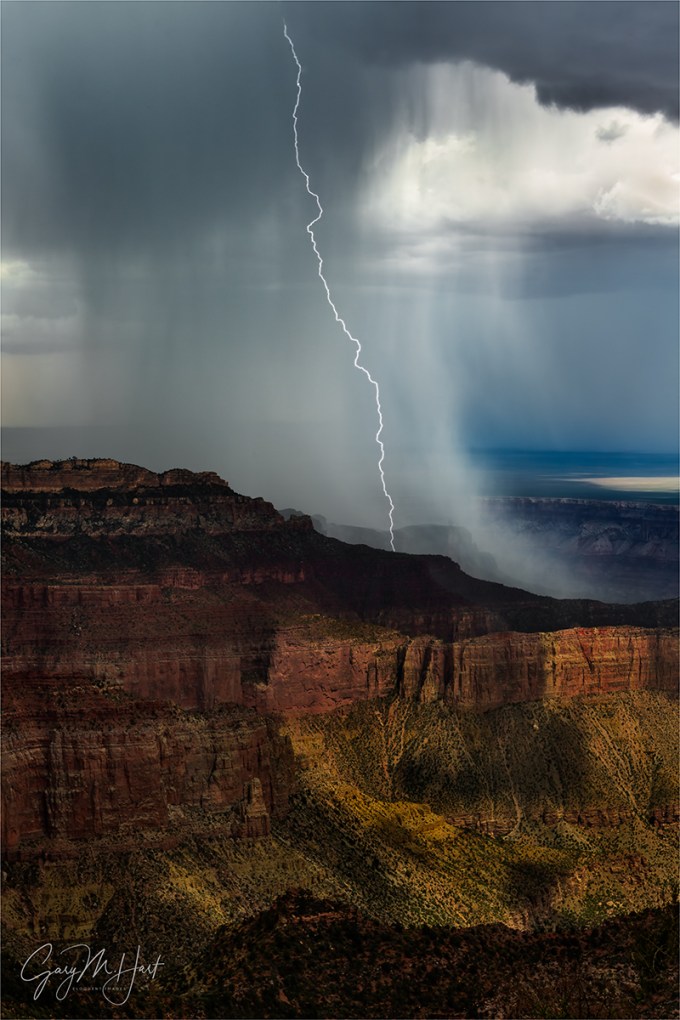
Electric Downpour, Point Imperial, North Rim, Grand Canyon
Canon EOS 5D Mark III
Canon 16-35 f/2.8L
1/8 second
F/16
ISO 50
After wrapping up our first Grand Canyon Monsoon workshop, Don Smith and I stayed a couple of extra nights on the North Rim to check-out potential locations for the second workshop. Saturday morning Don and I left our cabin with every intention of scouting (I swear) some remote, west-facing vista points, but black clouds and rolling thunder in the east (which we already knew quite well) gave us pause. The farther we drove, the blacker the clouds became, and the weaker our resolve to go scouting. A jagged bolt on the ridge north and east of the highway (a sign?) was more than enough to convince us to scuttle the scouting plan and beeline to Point Imperial.
With a 200 degree-plus east-facing panorama that includes the Vermillion Cliffs, the Painted Desert, the sheer walls of the Mosaic Canyon, and many named and unnamed red ridges and monuments, Point Imperial is one of my favorite North Rim vistas. By the time we arrived, the lightning was firing every thirty seconds north of us, well beyond the closest ridge. Gear in hand, I scrambled quickly down onto the rocks beneath the designated vista point for a better view—nobody moves faster than a photographer who feels like he’s missing the show (or so I thought). Don, a month out from knee replacement surgery, stayed up above, near the railed vista area.
Soon my Lightning Trigger had my camera firing away, usually at unseen bolts (it detects flashes obscured by clouds, or too distant for the eye), but occasionally at photogenic strikes too distant for the thunder to reach me. For the first thirty minutes the sky overhead was mostly blue and I watched with very little anxiety as the rain curtain with the most activity drifted slowly eastward. But when a thunder clap rolled across my exposed vantage point I glanced upward and saw nothing but angry clouds. So caught up in the awe of the moment, I’d failed to realize that the lightning frequency had intensified, and now some of the ridges I’d been photographing had disappeared behind an advancing downpour that looked that someone had opened a drain in the sky and released all the water in Heaven. Somewhat uncertain of my safety, I found comfort in the knowledge that the vista point above me still teamed with gaping tourists who surely knew better than this life-long California resident.
My comfort turned to concern when a rapid series of pulses drilled all the way down to the canyon floor just off to my right: One-thousand-one, one-thou… Boom! Hmmm. Maybe just a couple more frames…. Then I got the idea that, since it wasn’t raining on the point, I would leave my camera out to capture the action while waited in the car for the lightning to pass. About two steps into my controlled retreat the sky exploded. While I was pretty sure I’d broken land speed records descending the rocks when I arrived, that feat didn’t come close to the speed with which I flew back up to the car. Phew. Then the rain arrived, and suddenly my idea of leaving the camera out didn’t seem quite so brilliant. So, with rain (mixed with marble-size hail) falling, for the second year in a row, I performed a heroic rescue. Once again, with no regard for my personal safety, I dodged raindrops, hailstones, and lightning bolts (well, two out of three) to liberate my camera from the jaws of death.
Shortly thereafter the advancing column of water marched over us and set up camp. We eventually decided to move on to other locations, and while we saw lots of lightning, some of it too close to even start counting the seconds, we weren’t able to find a vantage point far enough removed from the action for photography. But for nearly an hour on Point Imperial, we had it as good as I could have imagined.
Join me in a Grand Canyon workshop
Workshop Schedule || Purchase Prints
Lightning
Click an image for a closer look, and to view a slide show.


More Grand Canyon lightning (no photographers were harmed in the making of this image)
Posted on August 20, 2012
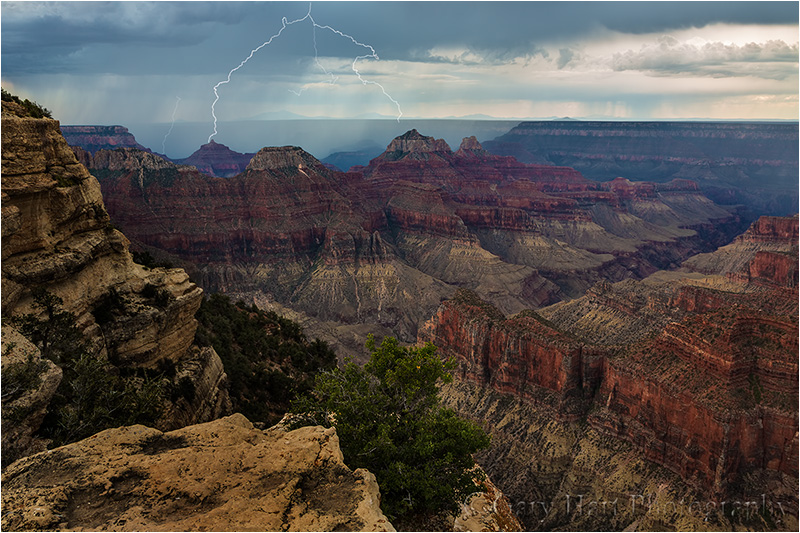
Lightning Strikes Angel’s Gate, Bright Angel Point, Grand Canyon North Rim
* * * *
The bolt was so close that I saw its jagged collision in my rearview mirror, its deafening crack shaking the car less than a second later—three hundred yards, max. “Holy crap!” was our simultaneous (eloquent) response.
Don Smith and I had just negotiated fifteen minutes of natural pyrotechnics unprecedented in our benign, California-sky lifetimes. Obliterating our windshield, flooding the highway, firing warning shots on both sides of the car, Mother Nature was clearly angry at our trespass. This parting shot came just after the rain had eased from opaque sheets to large, individual pellets and we’d started to relax. To these two Californians, rain is a background phenomenon, faint static on the roof and hissing tires on wet blacktop. Earthquakes, which announce their arrival with a rumble and roll that builds slowly enough to allow quick retreat beneath a desk or door jam, are bland compared to the these random explosions that have done their damage and vanished before your brain can register what just happened.
We were in the final miles of a morning’s journey from the Grand Canyon’s popular South Rim to its more isolated North Rim. Safely stashed in the back of the car was the week’s bounty: memory cards, laptops, and backup drives brimming with the Grand Canyon monsoon images we’d come to photograph, including our holy grail, a dozen or so daylight lightning frames apiece. This four-hour detour to the North Rim was a last minute decision with no expectations—whatever we got here would be gravy.
A few minutes later we rolled into the North Rim parking area still buzzing with adrenaline. The thunderstorm we’d just survived had given way to blue skies, so we decided to leave the camera gear in the car and explore. While the lightning was gone, the storm’s rumbling vestiges reminded us not to get too comfortable.
After a quick peek into the Visitor Center to orient ourselves, we headed down to the Grand Canyon Lodge. The cornerstone feature of the lodge, which is perched precariously on the canyon’s north rim, is a large picture window overlooking an expansive deck with an IMAX view across the canyon to the South Rim, ten miles away.
Descending the stairs to the viewing area, we saw people lined up at the window, and stacked two-deep on the deck beyond, all gazing toward the South Rim. It didn’t take long to realize that what had everyone’s attention was a light show dancing across the rim’s entire length. While Don and I had spent the week photographing isolated lightning bolts separated by at least ten minutes, this storm was firing several times per minute. Time to get back to work.
In the short time since our arrival more clouds had organized overhead and Don and I found ourselves dodging juicy raindrops as we hustled back to the car. In less than ten minutes we were tiptoeing back out onto the rim, cameras and tripods in hand. Is this safe? Not only was the storm we were trying to photograph no more than eight miles distant, it was clearly advancing. And there seemed to be other strikes landing much closer somewhere behind us.
Atop a particularly exposed outcrop (with an awesome view!) just below the lodge, I tried to rationalize away all the lightning admonitions I’d read: “Avoid exposed, elevated areas”; “The next bolt can strike ten miles from its last strike”; “If you hear thunder, you’re too close”; “If you see it, flee it”; “If you hear it, clear it”; and so on. At first we set up our cameras as quickly as possible and rushed to (assumed) relative safety beneath a more sheltered ridge while our lightning triggers did the work. But soon, emboldened by the observation that other (presumably lightning-savvy) gawkers were unfazed by the storm’s proximity, we decided to remain with the cameras.
The show lasted about ninety minutes, though the lightning frequency dropped a bit after an hour or so. For variety we’d stay fifteen or twenty minutes at one spot, then move on to a different perspective, eventually making our way all the way out to Bright Angel Point, an elevated knife of limestone sediment protruding a hundred yards or so into the canyon. (In case Bright Angel Point’s elevation and isolation get didn’t get Mother Nature’s attention, the National Park Service has rimmed it with with an iron railing.) And there I stood, as happy as if I had a brain, until the show wrapped up and we went off in search of a sunset location before starting the long drive home.
The above image, taken from the trail to Bright Angel Point, came about twenty minutes into the shoot. The primary bolt is striking Angel’s Gate, about 7 1/2 miles from where I stood. That sounds like a pretty safe distance until you realize that the second fork of this bolt is striking the South Rim near Grandview, also about 7 1/2 miles from Angel’s Gate. The closest strike I recorded that afternoon was about 2 1/2 miles away. I’m sure those with more lightning experience than I will scoff at my hand wringing, and can no doubt share many harrowing tales of far closer encounters, but you gotta walk before you run (and I reserve the right to chuckle as I unpeel them from beneath their desk when that 5.0 tremor strikes.)
For those keeping score at home, here’s the final tally: Gary 51 (bolts), Lightning 0 (photographers).

 Eloquent Images by Gary Hart