Eloquent Images by Gary Hart
Insight, information, and inspiration for the inquisitive nature photographer
If you can’t beat ’em…
Posted on March 1, 2012

Fresh Snow, Half Dome View, Yosemite
If it weren’t for Tunnel View on the Wawona Road, no doubt one of the most photographed vistas in the world, this view from Big Oak Flat Road, across the Merced River Canyon from Tunnel View, would probably be the Yosemite shot we all see. Visitors arriving from Highway 120 round a bend and are greeted with this view, their first inkling of Yosemite’s grandeur.
I’ve stopped here many times, but rarely photograph this view because it seems I always struggle with what to do with the foreground rocks and tree–composing wide enough to include them makes El Capitan, Half Dome, and Sentinel Dome quite small, and I just don’t think they’re interesting enough to occupy so much of the frame. But a couple of weeks ago, while guiding a private workshop student on a snowy morning, I found the entire scene etched in white and immediately saw the possibilities. Like magic, when adorned with a snowy veneer these foreground distractions became a worthy subject.
I moved as far back as the terrain would permit so I could increase my focal length and compress the distance separating the foreground and background. Even so, I was only able to go to 50mm, hardly a telephoto shot. Nevertheless, 50mm with subjects in my close foreground and distant background created depth of field problems. Whipping out my trusty iPhone hyperfocal app, I determined that I could make the scene work at 50mm and f16 if I was very careful with my focus point–focusing a little less than twenty feet away would give me sharpness from about eight feet to infinity. Because I had no way to measure the distance exactly (pacing it off would have ruined the pristine snow) and was more concerned about keeping the foreground sharp than I was about minor softness in El Capitan and Half Dome, I biased my estimate on the close side of twenty feet (making sure I focused between fifteen and twenty feet rather than between twenty and twenty-five feet).
All my previous images from this location have been telephoto shots the emphasize the strength of Half Dome, El Capitan, and Sentinel Dome. In fact, last May a rising crescent moon from this location gave me two of my favorite Yosemite images. But this time I was really happy for the opportunity to go wide and use these foreground features that had bothered me in the past, to come up with a fairly unique capture of Yosemite’s most frequently photographed monoliths.

Crescent Moon, El Capitan and Half Dome, Yosemite

Sunrise Trio, El Capitan and Half Dome, Yosemite
Watch your step
Posted on February 24, 2012
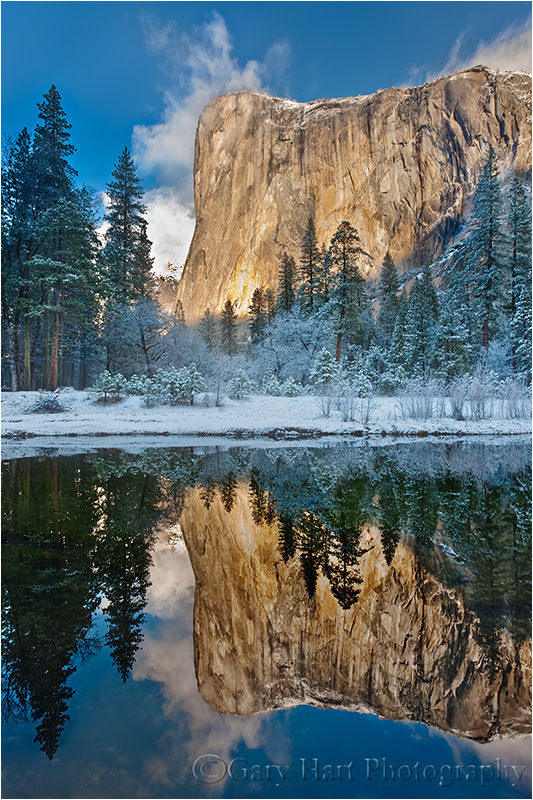
Reflection, El Capitan winter morning, Yosemite
Trouble brewing
I have many “favorite” photo locations in Yosemite Valley–some, like Tunnel View, are known to all; others, like this location along the Merced River, aren’t exactly secrets, but they’re far enough off the beaten path to be overlooked by the vacationing masses. While I used to count on being alone here, as often as not lately I share this shoreline with other photographers. While it’s nice to have a location to myself (so far I can still find a few of those spots in Yosemite Valley), I’m usually happy to share prime photographic real estate with a kindred spirit.
But. In recent years I’ve noticed more photographers abusing nature in ways that at best betrays their ignorance, and at worst reveals their indifference to the fragility of the very subjects that inspire them to click their shutters in the first place. Of course it’s impossible to have zero impact on the natural world: Starting from the time we leave home we consume energy that directly or indirectly pollutes the atmosphere and contributes greenhouse gases. Once we arrive at our destination, every footfall alters the world in ways ranging from subtle to dramatic–not only do our shoes crush rocks, plants, and small creatures, our noise clashes with the natural sounds that comfort humans and communicate to animals, and our vehicles and clothing scatter microscopic, non-indiginous flora and fauna.
For example
A certain amount of damage is an unavoidable consequence of keeping the natural world accessible to all who would like to appreciate it, a tightrope our National Park Service does an excellent job navigating. It’s even easy to believe that we’re not the problem–I mean, who’d have thought merely walking on “dirt” could impact the ecosystem for tens or hundreds of years? But before straying off the trail for that unique perspective of Delicate Arch, check out this admonition from Arches National Park.
Hawaii’s black sand beaches may appear unique and enduring, but the next time you consider scooping a sample to share with friends back on the mainland, know that Hawaii’s black sand is a finite, ephemeral phenomenon that will be replaced with “conventional” white sand as soon as its volcanic source is tapped–as evidenced by the direct correlation between the islands with the most black sands beaches and the islands with the most recent volcanic activity.
While Yosemite’s durable granite may lull photographers into environmental complacency, its meadows and wetlands are quite fragile, hosting many plants and insects that are an integral part of the natural balance that makes Yosemite unique. Not only that, they’re also home to, and nesting places of, native mammals, birds, and reptiles that so many enjoy photographing. Despite all this, I can’t tell you how often I see people in Yosemite (photographers in particular) unnecessarily trampling meadows, either to get in position for a shot or as a shortcut.
Don’t be this person
Still not convinced? If I can’t appeal to your environmental conscience, consider that simply wandering about with a camera and/or tripod labels you, “Photographer.” In that role you represent the entire photography community: when you do harm as Photographer, most observers (the general public and decision makers) go no farther than applying the Photographer label and lumping all of us into the same offending group.
Like it or not, one photographer’s indiscretion affects the way every photographer is perceived, and potentially brings about restrictions that directly or indirectly impact all of us. If you like fences, permits, and rules, just keep going wherever you want to go, whenever you want to go there.
It’s not that difficult
Environmental responsibility doesn’t require joining Greenpeace or dropping off the grid (not that there’s anything wrong with that). Simply taking a few minutes to understand natural concerns specific to whatever area you visit is a good place to start. Most public lands have websites with information they’d love you to read before visiting. And most park officials are more than happy to share literature on the topic (you might in fact find useful information right there in that stack of papers you jammed into the center console as you drove away from the entrance station).
When you’re in the field, think before advancing. Train yourself to anticipate each future step with the understanding of its impact–believe it or not, this isn’t a particularly difficult habit to form. Whenever you see trash, please pick it up even if it isn’t yours. And don’t be shy about reminding other photographers whose actions risk soiling the reputation for all of us.
DEVELOP A “LEAVE NO TRACE” MINDSET
A few years ago, as a condition of my Death Valley workshop permit, I was guided to The Center for Outdoor Ethics and their “Leave No Trace” initiative. There’s great information here–much of it is just plain common sense, but I guarantee you’ll learn things too.
Now go out and enjoy nature–and please save it for the rest of us.
======================================
A few words about this image
I captured this image while guiding a customer on a private workshop the day before last week’s Yosemite winter workshop. After months of clear skies, the sun rose on two inches of fresh snow in Yosemite Valley. As I did two days later when my workshop group was greeted with another dose of overnight snow, I shifted into hurry-up mode to get to as many spots as possible in the couple of hours we had before the snow would be gone–once the sun hits the trees, the snow disappears like magic.
After watching the storm clear from Tunnel View, we arrived here just in time to watch the day’s first light descend the surrounding granite walls. Our timing was ideal, as reflections are never better than when the reflective subject is in sun and the reflective surface in shade.
Shooting on a tripod (always!) enabled me to be at my camera’s ideal ISO 100 and select the f-stop the scene called for, without worrying about the resulting shutter speed. In this case I opted for a wide composition to include all of El Capitan and its reflection, which gave me lots of depth of field. Since the focus point for a reflection is the focus point of the reflective subject, not the reflective surface (that doesn’t mean that you shouldn’t focus on the reflection, it just means you should take care not to focus on something floating on or resting beneath the reflection), at 20mm everything in my frame was at infinity. With depth of field not a concern, I dialed in f11, my lens’s sharpest f-stop (lenses tend to be sharper in their middle f-stops). F11 brought the added benefit of reducing image-softening diffraction that happens at smaller f-stops–I’ll go smaller than f11 only when the composition calls for it (or if I forget to change it from a previous shot).
The dynamic range (the range of light from darkest shadow to brightest highlight) was too much for my camera to handle, but a two-stop hard-transition graduated neutral density filter subdued the brilliant sunlight, enabling enough exposure to reveal detail in the foreground shadows. Hiding the GND transition in the linear band of shoreline trees was easy, and simple dodging and burning in Photoshop brought out shadow detail and ensured that the sunlit El Capitan was brighter than its reflection (as it should be). Also in Photoshop I applied a light touch with Topaz noise reduction, desaturated the sky slightly to prevent it from overpowering the scene, and did selective sharpening (selecting only the areas containing detail).
(While I do take my groups to this quiet spot beside the Merced River, the fragile riverside setting that requires crossing a small meadow makes me reluctant to share it with the general public.)
Waterfall with a twist
Posted on February 26, 2011
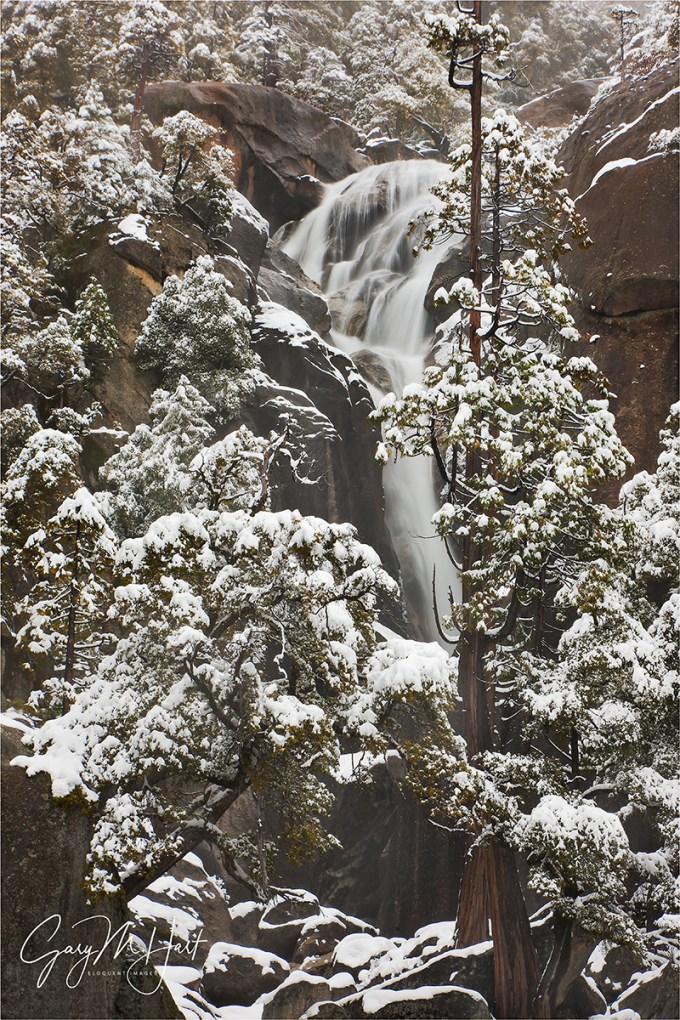
Winter Cascade, Cascade Creek, Yosemite
Canon EOS-1Ds Mark III
2/3 second
F/11.0
ISO 200
85 mm
When is a waterfall not a waterfall? The next time you’re in Yosemite, stop at the turnout where Cascade Creek meets Big Oak Flat Road and see if you can figure out why this impressive cataract doesn’t merit an official “waterfall” designation. It certainly isn’t for lack of verticality. Or drama. From the bridge on Big Oak Flat Road, Cascade Creek appears to spring full-speed from the heavens before taking a little twist and exploding into a network of violent, staircase cascades and disappearing beneath the bridge. You can cross the road and continue following the whitewater to its convergence with Tamarack Creek and its disappearance around a bend. I guess a waterfall by any other name looks just as sweet.

Get to Horsetail Fall at the right time and it is indeed breathtaking.
On the other hand, after again experiencing the annual circus that is Horsetail Fall in February, keeping the Cascade Creek waterfall/cascade relatively anonymous may just be a good thing for those of us who already appreciate it. I find it kind of amusing to compare the always photogenic, in-your-face Cascade Whatever to Horsetail Fall, which usually requires binoculars to locate, even if you know exactly where to look. When I get my groups on location at one of the Horsetail Fall viewing locations (including the picnic area directly beneath the fall), I typically spend at least five minutes helping everyone locate the fall: “See that tall tree at the edge of the parking lot? Follow it all the way to the rock outcrop at the top of El Capitan. Okay, now follow the top of El Capitan to the left until you get to a tree–Horsetail Fall comes straight down from there. See it?” By the time they find it I’m exhausted and they’re puzzled: “Is that what all the excitement’s about? Really?”
Of course when the light’s right, Horsetail Fall doesn’t need much water to become a breathtaking spectacle, and I’ll never tire of showing others the Horsetail “Firefall” effect for the first time. But honestly, given the shear drama and variety of compositions possible, I have a lot more fun photographing Cascade Creek. But let’s just keep it our secret.
Read more about the Horsetail Fall phenomenon
A gallery of waterfalls
Click an image for a closer look, and a slide show. Refresh the screen to reorder the display.


The recipe for fresh snow in Yosemite Valley
Posted on February 21, 2011

Half Dome and Fresh Snow, Cook’s Meadow, Yosemite
Canon EOS-1Ds Mark III
32 mm
1/8 second
F/16
ISO 100
In any season Yosemite offers something that makes it special, but the most beautiful place on Earth is never more spectacular than when it’s blanketed with fresh snow. For a brief time immediately after a cold storm, every exposed surface for as far as the eye can see is brand new and pristine.
Capturing this magic is all about timing. At just 4,000 feet, Yosemite Valley gets significant snow only during the coldest storms, usually just a handful of times each winter. And when the snow stops, the relatively mild temperatures (usually in the 30s), brilliant sunshine, and even the slightest breeze, conspire to clear the trees in a matter of hours. Meanwhile, park visitors driven inside by the weather, swarm outdoors to gape, quickly adding footprints and spreading mud with their boots, bikes, and cars.
The key to photographing Yosemite with pristine snow is to be in the park while its snowing—if you delay your Yosemite departure until you hear that it snowed, you’re too late. It’s fun sharing this visual treat with my workshops, but because I must schedule these trips over a year in advance, there’s no telling what weather we’ll encounter. So imagine my delight when, after six weeks of dry weather and blue skies, Mother Nature cranked up Yosemite’s snow machine just in time for my 2011 Yosemite Horsetail Fall winter workshop. Each morning greeted us with scenes that seemed designed to outdo what we’d found the day before.
Among my many snowy-Yosemite go-to spots is Cook’s Meadow. On this trip, until the snow arrived, the meadow was a field of lumpy brown grass, its sentinel elm a bare skeleton in the shadow of Half Dome. But six inches of overnight snow transformed this once bland meadow into an undulating sea of frozen white waves. Attempting to emphasize the snow, I dropped to my knees and found a vertical composition that leads the eye across the snowfield to the elm and ultimately to Half Dome. I minimized the brooding sky because, while interesting, it lacked the power to compete with the foreground.
I should add that many in the group had signed up to photograph Horsetail Fall, but since Horsetail Fall requires clear sky for its fiery show, at the beginning of the workshop I advised everyone that Horsetail Fall wasn’t likely in our future. Some were disappointed at first, and a few were puzzled by my enthusiasm for what was in store, but by the time we finished, I don’t think anyone would have traded our experience in the snow for even the most spectacular Horsetail Fall shot.
Workshop Schedule || Purchase Prints
A snowy Yosemite gallery
Click an image for a closer look and slide show. Refresh the window to reorder the display.


Are you insane?: A control freak’s prescription for photographic success*
Posted on February 11, 2011

Fall Into Winter, Valley View, Yosemite
Canon EOS 1DS Mark III
60 mm
1/15 seconds
F/16
ISO 200
* This message isn’t for everybody. If your photographic pleasure derives from simply breathing fresh air and admiring the view, or if your camera is just an accessory that helps you share and relive those outdoor experiences later, you’re already a successful photographer. But if you aren’t achieving the results you long for, either in the quality of your images or the attention they attract, please read on.
Are you insane?
Albert Einstein defined insanity as doing the same thing over and over again but expecting different results. Hmmm. For some reason this reminds me of the thousands of good landscape photographers with hundreds of truly beautiful images they can’t sell. These photographers have a good eye for composition, own all the best equipment, know when to be at the great locations, and are virtual gurus with state-of-the-art processing software. Yet they haven’t achieved (their definition of) success.
Conducting photo workshops gives me pretty good insight into the mindset of the most serious amateur photographers (the photographers serious enough to spend lots of money and vacation time for several days of sunrise-to-sunset photography). I’m frequently struck by the number of amateur photographers with serious aspirations who are so mesmerized by today’s technology that they’ve turned over control of the most important aspects of their craft to their camera. Their solution to photographic failure is to buy more equipment, visit more locations, and master more software. The tool they overlook is the one on top of their shoulders.
Knowledge vs. understanding
Just as a new camera won’t make you a better photographer, simply upgrading your photography knowledge won’t do it either—knowledge is nothing more than ingested and regurgitated information. Understanding, on the other hand, (among other things) gives you the ability to use information to create new knowledge—solve problems.
Many photographers invest far too much energy acquiring knowledge, and far too little energy understanding what they just learned. For example, it’s not enough to know that a longer shutter speed or bigger aperture means more light if that knowledge doesn’t translate into an understanding of how to manage light, motion, and depth with your camera.
Take control
Automatic modes in most cameras handle static, midday light beautifully, yet struggle in the limited light, extreme dynamic range, and harsh conditions that artistic photographers seek. I see many serious amateur photographers with so much faith in technology that they possess a critical deficiency of two fundamental photographic principles:
- How a light meter determines the exposure information it gives you. This seems so basic, but auto-exposure and histograms have fooled many into thinking they understand metering and exposure.
- How to use the reciprocal relationship between aperture, shutter speed, and ISO to manage photography’s three variables: light, depth, and motion. This is the universal tool that enables photographers to handle the limiting factors of every scene.
Books and internet resources are a great place to start acquiring these principles, but the knowledge you gain there won’t turn to understanding until you get out with your camera and apply them. When these principles become second nature, you’ll be amazed at what you’ll be able to accomplish with your photography.
For example
The image at the top of the post is from a visit to Yosemite’s Valley View last November. I chose it because it demonstrate how I applied the essential photographic principles above to accomplish my goal.
I arrived at Valley View that afternoon to find it blanketed with fresh snow—had I opted for the obvious composition, I’d have captured a gorgeous version of something that’s already been captured thousands of times. But I wanted something different, so I headed upriver a hundred feet or so to this dogwood I remembered from previous visits. (In fact, it’s the same dogwood featured in one of my favorite images.) I found that the sudden snow had caught the dogwood’s colorful leaves off-guard, leaving many still dangling from the snowy branches like frozen Christmas ornaments.
I wanted to emphasize the collision of seasons, and once I had my composition, I started working on how to deal with the factors limiting my objective for the scene:
- With the foreground leaves so close, and Bridalveil Fall in the background, sufficient depth of field was my prime concern
- The light was limited in the dense overcast
- A slight breeze swayed the branches
The light in this scene was low but easy, with a very narrow dynamic range that fit easily within my camera’s range of capture. Because I was on a tripod, camera-shake wasn’t a concern; in the low light I only needed to worry about finding a shutter speed that would stop the breeze. Wanting lots of depth of field, but concerned about diffraction (from a too-small aperture), I decided f16 would give me complete sharpness in the leaves (essential), with just a little softness in the background and minimal diffraction. But f16 at my preferred ISO 100 resulted in a 1/8 second exposure that I feared wouldn’t be enough to freeze the swaying branches. So I bumped my ISO to 200, confident that I could make 1/15 work if I timed my exposure for a lull in the breeze (I was not at all concerned about the minimal noise introduced by the higher ISO). I clicked several frames just to be sure the breeze hadn’t introduced motion blur too small to detect on my LCD.
Insanity is in the mind of the beholder
If landscape photography gives you what you want, then by all means, continue doing what you’re doing. But if you’re having a hard time achieving a photographic goal, I suggest that the solution is likely not doing more of what you’re already doing. Instead, reevaluate your comprehension of fundamental photographic principles that you might not have thought about for years. You’ll know you’re there when you have complete control of the light, motion, and depth for every scene you encounter, know how to get the result you want or that it’s simply not possible.
Do I really think you’re insane for doing otherwise? Of course not. But I do think you’ll feel a little more sane if you learn to take more control of your camera.
Workshop Schedule || Purchase Prints || Instagram
When Seasons Collide
Click an image for a closer look, and to view a slide show.


 Eloquent Images by Gary Hart