Eloquent Images by Gary Hart
Insight, information, and inspiration for the inquisitive nature photographer
Doing the Math…
Posted on September 30, 2026
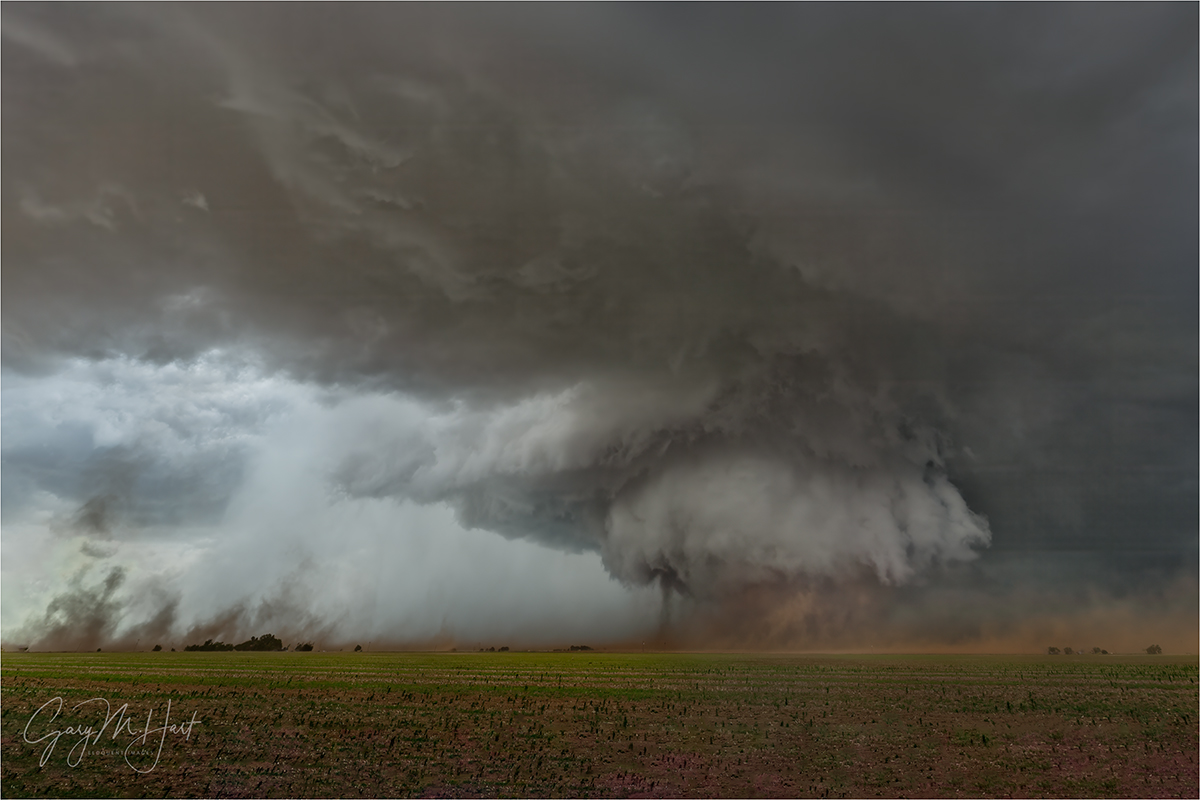
Morton EF2 Tornado and Satellite Vortex, Morton, Texas (2025)
Sony a7R V
Sony 24-105 f/4 G
ISO 200
f/16
1/40 second
Like most decisions in life, choosing to chase tornadoes requires making a personal risk/reward calculation. The risks are real, but for me the potential reward was worth giving storm chasing one try. But a funny thing happened to my math on that first trip: the answer changed.
I think I’ve made it pretty clear in prior posts that the reward side of the storm chasing risk/reward equation far exceeded my (already quite high) expectations; what I haven’t fully expressed is how the risk factor decreased in my mind as well. Suddenly, I’ve become a storm chasing evangelist and have made storm chasing a featured part of my annual workshop portfolio.
My fascination with tornadoes dates back to the first time I saw the lurching vortex bearing down on the Gale homestead in “The Wizard of Oz.” That childhood fascination soon grew into a general passion to witness and understand Nature’s power in any form, and to boggle my mind pondering the incomprehensible vastness of our Universe.
Throughout my life I’ve pursued opportunities to observe (and photograph) examples of Nature’s power and majesty. I’ve chased brilliant comets, basked beneath the northern lights, gawked at a total solar eclipse, and stood awestruck on the rim of an erupting volcano. So it should be no surprise, after checking off all those other items on my must-see natural phenomenon list, that I set my sights on pursuing tornadoes and the storms that generate them. Since I’m no adrenaline junkie, when I dreamed about seeing a tornado, I never visualize one of those massive EF4 and EF5 monsters that ravage entire communities, it’s always been something like that ropey twister in “The Wizard of Oz.”
No responsible storm chaser draws pleasure from the suffering of others—fortunately, the vast majority of tornadoes strike wide-open spaces and do little to no damage. I can’t speak for all chasers, but the ones with whom I associate consciously avoid metropolitan areas, even when they offer the best chance of viewing success, because: 1) they’d only be in the way of people with much higher priorities; 2) no matter how great the photography, there’s no pleasure photographing the source of others’ suffering; and 3) it’s simply much harder to chase in a city.
Like most people, prior to the 2025 trip my closest approach to a tornado experience had come from the “Twister” movies. So after rewatching those movies to mentally prepare for that first storm chasing trip, my anxiety level started ratcheting up. And it sure didn’t help when people started looking at me like I was crazy for doing it. Had I miscalculated?
All of my tornado dreams and fears came into focus one afternoon in June 2025, when my chasing group saw six (I think—I actually lost track) tornadoes. That experience, along with several others we had on that 12-day adventure, revealed to me how naive I’d been about storm chasing risks, and most important, the (experience-based) caution taken by storm chasers to ensure the safety of all involved. (Spoiler alert: Storm chasing safety is not an accident.)
Obviously, no one can say there’s no risk to chasing extreme weather. But after doing it myself, I believe that most people don’t have an accurate perception of those risks. The big three are:
- Lightning: Anytime you’re outside when lightning is about, there’s danger.
- Hail: Large hail can damage buildings, vehicles, crops, and humans without discrimination.
- Tornadoes: And of course a tornado devastates everything in its path.
But storm chasing isn’t “Twister”—I don’t know a single storm chaser who has had to duck a flying cow, or anchor themselves to a pipe with a leather belt to avoid being sucked heavenward. And unlike the way chasing is portrayed in the movies and reality TV, the last place most photographers (and certainly all the chasing photographers I associate with) want to be, is close to the storm they’re photographing. Too close not only puts us at greater risk, the closer we get, the worse the photography.
Like most anxiety-inducing experiences, the more I learned about storm chasing’s risks and the steps taken to minimize them, the safer I felt. I learned that mesocyclones, and the supercells they spawn, are extremely organized, with recognizable features like an anvil (the cap), inflow and outflow fed by updrafts and downdrafts, wall clouds, rotation, and even color-coded areas of hail. Returning to the risks I listed above, here’s the rest of the risk/safety story:
- Lightning: Amazingly, an experienced storm chaser has a pretty good idea of where in a storm the lighting is likely to occur and avoids those areas—something I’ve witnessed first hand enough times to know it’s not a fluke. The safest place to be when lightning is about is inside a fully enclosed structure or vehicle. When a chasing group is outside photographing lightning, it’s always within a few feet of the van (or vans), so when the storm chaser in charge senses a risk, safety is just seconds away. And regardless of the lead chaser’s guidance, the proximity of the van always gives anyone in the group a safe place to retreat to whenever they feel unsafe. All this is probably why there have been no recorded storm chasing lightning deaths.
- Hail: Hail forms in recognizable areas of a supercell, visible as a distinctly blue or green band or patch in the clouds. Additionally, (I learned firsthand that) approaching hail makes an audible roar that serves as a warning that it’s time to retreat to the shelter of the vans. Of course, while people can quickly retreat to their vehicles, the vehicles themselves aren’t quite so lucky—I’ve seen the dents to prove it—and the chasers are highly motivated to keep their vehicles intact and unscarred. One night last year, our storm chasing group was racing to outrun a storm that was about to move across our path. Even though it was completely dark, our chaser somehow knew where the hail would be and got our vans safely beneath a gas station canopy just in the nick of time. (Apparently that’s a thing in hail country, as we were soon joined at the station by a dozen or so other vehicles seeking shelter until the storm passed.)
- Tornadoes: The atmospheric physics that form a tornado are readable to the people who chase storms for a living: the overall direction of the cell, the location in the cell where the tornado is likely to form, and more specifically, the dropping of the storm’s base, paired with its rotation, that signals a tornado is imminent.

Supercell and Lightning, Northeast Colorado
My first storm chasing lesson, learned on Day-1 of that first trip, is that the storm-chasing objective is to find a distant vantage point that provides: 1) safety; 2) the best chance to see any tornado that drops; and 3) a view of the entire supercell (FYI, one of the most jaw dropping sights on Earth).
All this is why responsible storm chasing photographers always partner with actual storm chasers. Not only do experienced chasers know how to use the technical atmospheric data, published daily by NOAA and the NWS, to determine where we should chase today, tomorrow, and the day after (West Texas? Oklahoma? Texas Panhandle?), they know how to read a supercell to identify its direction of motion, and the likely location of any tornado, hail, and lightning that might occur.
They also pay special attention to the roads that can get us in position, all possible escape routes, and whether the roads are paved or might just turn to tire-sucking mud in a downpour. (And just in case, we always back into every parking space, pointing our vans in the direction of escape.)
Supercell structure provides a (general) predictability of behavior that might explain why, with one notable exception, every storm chasing death has been traffic related. The exception? The 2 1/2-mile-wide El Reno tornado in 2013 that unexpectedly changed direction and accelerated, catching four experienced storm chasers off-guard.
But even that incident requires qualification. Three of those fatalities were experienced, respected meteorology scientists trying to navigate their vehicle close enough to the tornado to get their equipment inside the vortex (i.e., as close to it as possible). The fourth death in that storm was a solo local chaser who just got too close. Which of course is not to discount the risk of storm chasing. Rather, the El Reno tragedy is a cautionary tale that reminds all chasers since that Nature truly is in charge, and to never take a storm’s behavior for granted—an approach modeled for my groups multiple times when our leader Chris hustled us back into the vans when no danger was evident to my untrained eyes.
Morton EF2 Tornado and Satellite Vortex, Morton, Texas (2025)
Last year’s group received no better validation of our safety than we did on our tornado day. It started with the continuation of Chris’s savant-like foreknowledge that drove us two hours beneath blue skies, to get us set up at perfect place to view a burgeoning supercell that grew before our eyes. He then anticipated the when and where of the first tornado’s imminent formation, so we were all ready when it appeared. Finally, he knew when it was time to leave that supercell in favor of the one that eventually delivered the majority of that day’s twisters—including the EF2 Morton tornado in this image.
With one tornado already in our pockets, we turned onto a (usually) remote country road near Morton, Texas—and right into the most “Twister”-like scene of our trip: dozens of cars lining both sides of the road, many double-parked, their occupants sprinting this way and that to get in position for a supercell that was about to go off.
After somehow managing to find spots to stuff both of our vans among all the other haphazardly parked vehicles, we all grabbed our gear and raced to join the throngs at a fence across the road. Within minutes the first tornado formed, moving left to right across our view, maybe a half mile away. For more than an hour we photographed a series of mostly EF1 tornadoes dropping from the base of the wall cloud, spinning up a lot of dust from unplanted fields, each staying on the ground for several minutes before retreating to the sky.
By far the biggest tornado we saw was what is now known as the Morton Tornado, which eventually grew to more than a mile wide, traversed about ten miles across unpopulated farmland, with peak winds of 125 MPH. Looking at this image now, I realize this may have been the moment my math shifted. We were all so relaxed—brand new and experienced chasers alike—watching it. Not relaxed like we weren’t beside ourselves with excitement at the sight we were witnessing, but relaxed like there was absolutely nothing to fear.
Join me on a storm chasing trip
The Joys (and Thrills) of Storm Chasing
Click any image to scroll through the gallery LARGE


Storm Chasing Diary: My First Tornado
Posted on June 9, 2025

First Tornado, Lingo, New Mexico
Sony a7R V
Sony 24-105 f/4 G
ISO 200
f/16
1/40 second
Everyone remembers their first time. For me, the experience was as thrilling as I’d imagined, but only lasted about a minute. (I’m talking about my first tornado—what did you think I meant?)
For as long as I can remember, I’ve wanted to see a tornado. Over the years this desire has intensified to the point where a tornado is quite probably my most frequent dream subject. When the NWS suggests just the slightest possibility of rotating thunderstorms in Northern California, I scan the skies and sometimes have even been known to hop in my car to go tornado hunting. (California averages one tornado per year.)
Gary’s Bucket List:
- See a tornado
Raft Grand CanyonRainbow over Yosemite ValleyNaked-eye cometNorthern Lights
Even though a tornado sighting has been number one on my list as all the items below it have fallen away, the opportunity has always eluded me. I suspect it has something to do with an approach based on simply waiting for the tornado to come to me—probably not a winning strategy in California. This year, I decided to change that.
On the recommendation of one of my frequent workshop students, I connected with Jeremy Woodhouse, a fellow photographer and photo workshop leader, who for the last several years has assembled storm chasing tours for photographers. Partnering with Tempest Tours out of Arlington, Texas, Jeremy has put his groups on the scene of some of the Midwest’s most extreme weather. I reached out to Jeremy and told him, if he assembled a storm chasing trip, I’d fill it, and a storm chasing collaboration was born.
In my previous post, I wrote about our first day and the incredible supercell we witnessed. No tornado, but no complaints. But still…
Day-two was quiet—a welcome respite after the initial day’s intensity and miles. We drove from Kansas, through Oklahoma, before finally settling down in Amarillo—without changing plans once. The highlight of that day was dinner at The Big Texan (home of the “free” 72 ounce steak)—trust me, you have to experience this place firsthand to appreciate it. Though there wasn’t much weather happening on day-two, the decision to be in Amarillo wasn’t random—it was to position ourselves for the next day’s chase, which looked far more promising.
In our day-three morning weather briefing (we start each day with a detailed discussion of the day’s weather from our tour-leader/meteorologist, Chris), we learned that the atmosphere was setting up beautifully for supercell development, not just that day, but also over the next three days (at least). We spent most of that afternoon bouncing around New Mexico and West Texas, where we saw lots of rain, hail, beautiful clouds, and (spectacular) lightning, but no tornado. We spent that night back in Amarillo.
Each day Chris identifies a general region to target, based on the morning’s forecast—not the general weather forecast we all get from our weather apps, websites, and TV weatherman, this is extremely detailed atmospheric data from NOAA, with technical analysis that can only be evaluated and subjectively interpreted by an expert. In the day-four briefing, Chris told us conditions were even better than the prior day’s. But despite the promising prospects, the rest of the morning unfolded with little sense of urgency. That’s because the big storms develop from mid-afternoon into the evening, so we generally don’t need to head out on a chase until late morning or early afternoon.
Once we do get on the road, there’s usually a lot of driving around, looping, and backtracking. While Jeremy drives the lead van, Chris rides shotgun and keeps a constant eye on his computer, phone, and ceiling-mounted real-time radar monitor. With every weather update, he further refines our target zone. I ride shotgun in the trailing van; in addition to answering whatever photo question might come up in our van, I provide an essential DJ service (classic rock, anyone?). Our two vans use CBs to stay in touch, and Chris frequently updates Tom, the driver of the trailing van and an experienced storm chaser himself, on all weather changes and other pertinent information.
Words cannot express how fast these supercells explode from a run-of-the-mill thunderstorm into a violent, roiling tower. So, in addition to interpreting weather data, experienced storm chasers must read, on the fly, dynamic features in these building cells (rotation, outflow and inflow, updrafts and downdrafts, to name a few) to determine the supercell’s next move. Once the cell’s direction of motion, speed, growth is established, Chris positions the group as close as possible to the action without subjecting everyone to the inevitable lightning and large hail, not to mention any tornado that might form. No small feat by itself, but factor in the swarm of other chasers seeking similar advantages, and it’s no wonder mayhem ensues whenever a supercell develops.
Once you establish which cell has the best potential to develop into a supercell, merely getting close is not enough. Each supercell has a mind of its own, a unique personality that seems to relish defying expectations. Some have the potential to drop tornadoes, while others might be better lightning producers, or possess spectacular (photogenic) structure (don’t forget your 12mm). Which of these traits you want to go for will determine where to set up to view and photograph.
Ideally we can get out in front of the storm and let it come to us, or better still, watch it move laterally across our view. But a couple of times we’ve had to “punch through the core,” an absolutely thrilling E-ticket ride that includes buckets of rain, punishing hail (and potentially car damaging or even life threatening), and a barrage of simultaneous lightning and thunder.
As you might imagine, the trip leader’s navigation skills are key (the rest of us just follow blindly), as is his ability to think quickly and decisively, and an ability to change plans mid-execution. Terrain is relatively flat in the rural areas we’ve concentrated on so far, with few trees, and lots of agriculture. The network of roads is pretty good, though many are rough and narrow, and often transition to dirt with little notice. Agriculture rules out here, but we also see a lot of livestock (no flying cows so far), and pass numerous oil rigs and wind turbines, vestiges of energy’s past and harbingers of energy’s future, often in very close proximity.
Despite possessing all the elements necessary to spark malevolent competition (crowds, passion, and urgency), the storm chasing community seems to be quite collegial. And despite the challenging roads, everyone seems work well together (creative parking skills help).
Even though the sky was completely overcast as we motored south from Amarillo toward Lubbock—not a good sign, as you need sun to kick-off the all important convection—this was apparently expected, and Chris seemed pretty excited by the atmospheric data he was seeing.
After a few feints and dodges, we ended up tracking south and east toward the most promising region near the Texas, New Mexico border. Apparently we weren’t the only ones who could interpret this cryptic atmospheric data, because it wasn’t long before we started encountering other chasers. Soon it felt like a storm chasing convention—they just kept coming.
By the time we reached ground-zero in eastern New Mexico, our target cell was well into adolescence and on its way to adulthood. We poked around its perimeter a bit, and at one point tried to get closer, then executed a hasty retreat when Chris (somehow) sensed the potential for damaging hail just down the road.
We were no longer on a casual drive, we were in full-on chase mode. We pivoted back the way we came and, looking for anything to put in the foreground of our images, returned to a field of hay bales we’d passed ten minutes earlier.
This gave us a great view of the developing wall cloud (lowering cumulus base from which a tornado usually forms) from a relatively safe distance (maybe a mile or so?). We were close enough to see that it was rotating, and Chris started shouting that a tornado could be imminent.
And then, there it was—a black funnel descending from the cloud base, stretching Earthward. Someone shouted, “It’s on the ground!”, and we were in business.
My first tornado. I just clicked like crazy, and even managed to catch a brief video with my iPhone. Within a minute or so, the funnel was already ascending back where it came from; it vanished shortly thereafter. This was not the last tornado we saw this day, nor was it the most impressive—not even close. But it was my first, and I’ll never forget it.
Gary’s Revised Bucket List:
See a tornadoRaft Grand CanyonRainbow over Yosemite ValleyNaked-eye cometNorthern Lights
Workshop Schedule || Purchase Prints || Instagram
More Wild Weather


Storm Chasing Diary: Hit the Ground Running
Posted on June 6, 2025
Supercell and Lightning, Northeast ColoradoSony α1
Sony 12-24 GM
.4 seconds
F/14
ISO 50
What would you think if I told you that, on my 12-day storm chasing trip in the Midwest, we drove from Colorado, to Wyoming, to Nebraska, back to Colorado, back to Nebraska, and finally to Kansas? Pretty nuts, right?
Please don’t judge me when I tell you all that was just our first day. But when crazy weather is your subject, lots of miles and crazy hours are not negotiable. Fortunately, our storm chasing leaders did give us a small break on day-two, when we started in Kansas and finished the day in Texas, via Oklahoma. As I write this, it’s day-three and I’m sitting in one of our two vans in Vaughn, New Mexico, waiting with my group for our trip-leader/meteorologist to decide whether to stay put with the current storm, head northwest toward an active storm near Albuquerque, or motor east to Fort Sumner to take advantage of increasingly favorable conditions there. (Note: We ended up with, “None of the above.”)
Day-one (Monday) was my first-ever storm chasing experience, and saying we hit the ground running would be an understatement. After a morning orientation at our Denver hotel that included introductions and a lecture that seemed designed specifically to satisfy my inner weather geek, all 16 of us (me, our tour-guide/meteorologist, my co-leader and driver Jeremy Woodhouse, our other driver, and the 12 photographers/chasers comprising the workshop group) piled into our two 12-passenger vans and pointed northeast. Within a couple of hours we were on a storm in southeastern Wyoming, where I got to photograph my first-ever supercell. But spectacular as that was, we didn’t stay long, because (apparently) a better storm was blooming back in Colorado.
After leaving Wyoming, the rest of our day was filled with so much, I don’t have the memory or time to provide blow-by-blow specifics. We’d be racing to get in position for a brewing storm, then see something too good to pass and make an unscheduled brake-slam/hop-out/click/retreat stop, before continuing on our way. Plan changes were routine and came faster than I could keep up.
The weather only intensified as the afternoon progressed. Near Merino, Colorado, we finally got out in front of a storm, enabling us to settle down long enough for the tripods to come out. I set up up with my Sony a1 and 12-24 f/2.8 lens—the only lens wide enough to capture the entire cell as it bore down on us. When I realized how much lightning was firing (mostly to the right of the cell), I quickly attached my Lightning Trigger and went all the way out to 12mm to maximize my lightning chances.
The plan to follow my standard compose/click/evaluate/refine/click workflow went right out the window when I saw how quickly the storm was moving (right-to-left and approaching). Since I needed to be at 12mm, horizontal, with the supercell centered to include all of it, there wasn’t much opportunity to add variety to my compositions. My Lightning Trigger was clicking my camera so rapidly, at bolts seen and unseen, I adopted a new strategy: just let the Lightning Trigger handle the clicking, while I stood back and absorbed the spectacle. My only job was to monitor my exposure and occasionally reframe to account for the storm’s movement. I even had time to capture some video with my iPhone while my grown-up camera did the real work.
This storm actually displayed enough rotation that we thought it might dispense a tornado, and at one point we even heard a tornado siren, but no such luck. Most of its lightning was intra-cloud and out of my frame, but rather than recompose for lightning shots, I kept my composition on the star of the show: the supercell. Though the scene that afternoon was really about this truly magnificent storm, I was thrilled to find a few frames accented with squiggles of lightning.
That night we finished shooting in Nebraska (I think) with a different cell that generated several tornado alerts on our phones (picture a van with 8 people receiving slightly out of synch tornado warnings), but we never saw one. We finally rolled into our hotel in Goodland, Kansas at around 11 p.m., too late for dinner—a not uncommon experience, I’ve learned.
It’s now day-5 and soooooo much has happened since then. And we still have a week to go. No guarantees, but I’ll try to post occasional updates as time permits. Stay tuned….
Join Me On An Upcoming Storm Chasing Adventure
Workshop Schedule || Purchase Prints || Instagram
Cloud Collection
Click any image to scroll through the gallery LARGE


