Eloquent Images by Gary Hart
Insight, information, and inspiration for the inquisitive nature photographer
The secret world before the sun
Posted on February 24, 2013
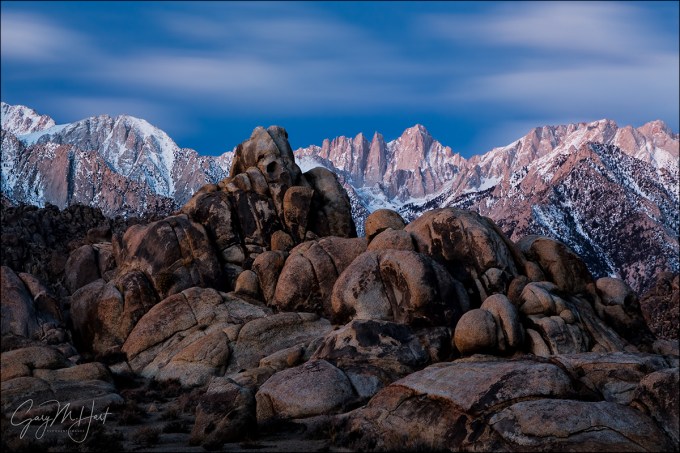
Before Sunrise, Mt. Whitney and the Alabama Hills, California
Canon EOS 5D Mark III
30 seconds
F/16
ISO 400
70 mm
Compared to the human eye, the camera’s vision has many shortcomings (as photographers are quick to lament). At the top of photographers’ list is the very narrow gap separating the brightest and darkest tones a camera can capture: dynamic range.
But while the camera taketh away, it also giveth. Experienced photographers understand that what we perceive as complete darkness is really just our eyes’ relatively limited ability to gather light, combined with the brain’s insistence on processing this limited input instantaneously. But a camera’s sensor (or a rectangle of unexposed film) can accumulate all the light striking it for whatever duration we prescribe, thereby stretching its “instant” of perception indefinitely. Advantage camera.
For example, the camera’s narrow dynamic range is (exquisitely) mitigated in the barely perceptible light preceding sunrise and following sunset. Unlike night photography, when the light in the sky is so faint that extremely long exposures are required to register any foreground detail, and daylight/moonlight photography, when unidirectional light casts high contrast shadows that exceed a camera’s dynamic range, pre-sunrise/post-sunset twilight light is spread so evenly overhead that most shadows disappear.
About this image
Horizon-to-horizon skylight made dynamic range a non-factor in the above Alabama Hills pre-sunrise scene, while my camera’s instant-stretching ability revealed beauty present in a landscape that was nearly invisible to my eyes.
I arrived at this scene about 45 minutes before sunrise, but knew from experience I wasn’t too early to get to work. White with snow and towering 10,000 vertical feet above my location in the Alabama Hills, Mt. Whitney jutted in dramatic contrast to the dark sky. As my eyes adjusted to the limited light, the jumbled rocks of the Alabama Hills became vague, colorless shapes. Anyone relying on their eyes on this January morning would likely conclude that there’s not yet enough light for photography. But I knew better.
I started by juxtaposing a nearby fortress of boulders against Whitney’s serrated outline. While the mountains were the dominant feature to my eyes, I knew a long exposure would make the nearby rocks equally prominent, making their sharpness essential. Limited light made autofocus out of the question, so I stopped down to f16 to increase my margin for error and focused manually.
As expected, a thirty-second exposure at ISO 400 uncovered volumes of invisible detail and color my eyes missed. (It took two or three exposures to get the focus, exposure, and composition right, as I felt like I was working blind, and my meter was of little value in the darkness.) Though I was photographing in a fairly stiff (and frigid!) breeze at 4,500 feet, it was nothing like the hurricane wind that smeared the clouds above Whitney into an ethereal glaze. Another revelation of the long exposure was the sky’s exquisite, natural (not processing-enhanced) blue-hour hue.
Workshop Schedule || Purchase Prints
A twilight gallery
Click and image for a closer look, and to enjoy the slide show


Sandstorm
Posted on February 19, 2013
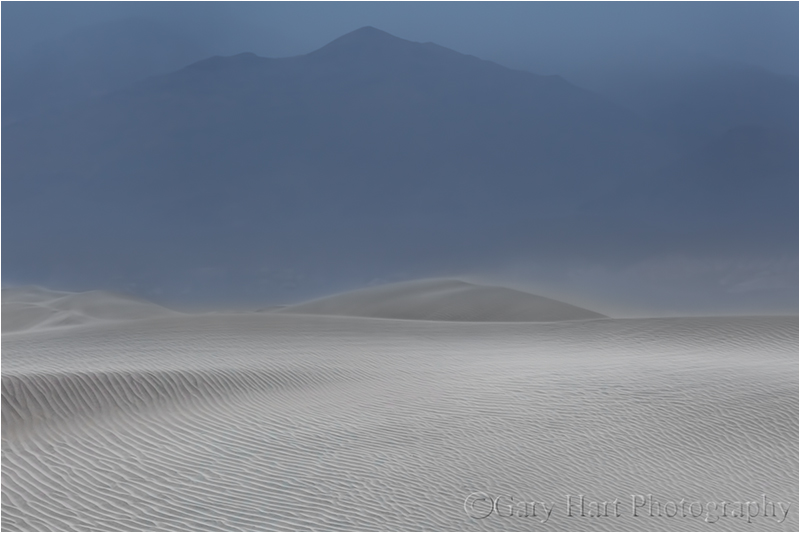
Sandstorm, Mesquite Flat Dunes, Death Valley
* * * *
Read my February 9 blog for more about this amazing evening on the dunes.
____________________
For nearly an hour my workshop group played in relative peace on the dunes, but about fifteen minutes before sunset the clouds dropped and our window of calm slammed shut. Just like that sand was everywhere, invading every camera, clothing, and exposed body orifice. After a few minutes of extreme photography packed up and started traipsing in the diminishing light in the general direction of the highway. Not only was the visibility limited, the tracks we’d just left and that might have guided us back to the cars had already been all but erased. But despite the difficulty it was impossible to ignore the photo opportunities brought by these new conditions and most in the group continued shooting until we were off the sand.
Looking east I saw the crest of Red Top, the tallest of the Death Valley Buttes, poking through the blowing sand, hovering like a spaceship above the dunes. I moved around a bit until I found a complementary foreground of aligned ripples and curved ridges. Wanting to ensure that the exquisite sand at my feet was sharp I closed down to f16; to capture the steady stream of sand blowing parallel to the dunes I experimented with ISO/shutter combinations before finding the effect that worked. (And said a prayer of thanks to Gitzo and Really Right Stuff for keeping everything stable.)
Contrast the color of the sand between this image and the image in my February 9 blog. The earlier image was partially warmed by rays of unfiltered sunlight breaking through gaps in the clouds; today’s image is entirely illuminated by cool, diffused light spread by the thick clouds overhead. It’s a good reminder that color isn’t simply an inherent quality of an object, but rather is a function of the object and the light illuminating it. While white balancing a scene to ensure a fixed color cast might be great for a wedding (God forbid you get Aunt Mabel’s dress wrong), it can rob landscapes of the very qualities that make them special.
Join my next Death Valley photo workshop
Greetings from Squirrel Rock
Posted on February 14, 2013

Sunset Reflection, El Capitan and Horsetail Fall, Yosemite
* * * *
Every workshop has its inside jokes, some comment or reference that gets everyone laughing and somehow seems to find its way into every location or mealtime conversation. So today I offer this beautiful reflection of Yosemite’s Squirrel Rock. Often mistakenly referred to as “El Capitan,” this frequently photographed granite monolith…. Okay, okay, I know, I know, this really is El Capitan, but for the duration of my just completed Yosemite Winter workshop our group affectionately referred to this Yosemite icon as “Squirrel Rock.”
Huh? It seems that my friend Don Smith, who was assisting me in this workshop (I’ll return the favor by assisting Don’s Northern Arizona workshop next month), was photographing at Tunnel View the day before the workshop when a man approached and introduced himself as a fellow pro photographer, then proceeded to position himself as a Yosemite-expert extraordinaire. As if to make his point, he went on to tell Don and all who would listen that the rocks above Bridalveil Fall that we all know as Cathedral Rocks are in fact the “Three Graces.”
In all fairness, the Tunnel View perspective of Cathedral Rocks was once upon a time called the Three Graces (I haven’t heard this reference in years); if he’d have stopped at that all would have been fine and his audience might have learned something. Our amusement was fuel by his adamant insistence, delivered with professorial authority (picture Cliff Clavin), that this ancient Three Graces label (and ignoring National Park and USGS topo maps to the contrary) means the rock formation above Bridalveil Fall cant’ be Cathedral Rocks. That his proclamation was uttered almost literally in the shadow of a National Parks Service sign labeling said icon Cathedral Rocks seemed no deterrent.
Fast forward to workshop Day-1: Don shared his story with the group at Tunnel View, finishing with a grand wave in the direction of El Capitan and telling us all in Clavinesque fashion that its true name is Squirrel Rock. It wasn’t long before Yosemite Falls became Kangaroo Falls, and with these new monikers grew Native American legends of their origins and…, well let’s just say that a workshop’s worth of laughter ensued.
If all this sounds a little silly, please understand that the workshop’s prime objective was Horsetail Fall, a February phenomenon with far more photographers than room to photograph. To ensure a front row seat at the best spot, for two nights in a row we queued up at my favorite vantage point beside the Merced River two hours before sunset. That’s a lot of waiting (and story swapping, and joking, and embellishing, and just plain frivolity).
Our time passed quickly, and while (if the goal is the classic Horsetail blood red sunset stripe) neither night will go down in the annals of Horsetail Fall photo moments, we were nevertheless rewarded with some magnificent photography. On Monday billowing cumulus clouds decorated Squirrel Ro…, uhhh, El Capitan and reflected in the Merced River. Tuesday night we almost hit a home run, but as we rounded third, thin clouds unseen on the western horizon dulled the setting sun and we had to settle for a stand-up triple. Very nice nevertheless.
Both evenings were a blast, well worth the waiting, both for the photography and the good time. Because I already have my tight Horsetail Fall shot from this spot, and the highlight of the first evening was the clouds and reflection, I opted for the wide composition you see above. This location has far more compositional options than the popular El Capitan picnic area spot (which has more room). In fact, even though Horsetail didn’t perform to perfection, both evenings we had things to photograph for the duration of our wait. At one point the tree on the shore at the right of the frame lit up like it had been hit by a spotlight, and Sentinel Rock, directly behind and above us, spent much of the afternoon bathed in warm light.
It seems every workshop has something memorable to set it apart from all the others. In this case it was night after night of warm light and crisp reflections, plus a large dose of laughter. Long live Squirrel Rock.
Pure as the driven sand
Posted on February 9, 2013

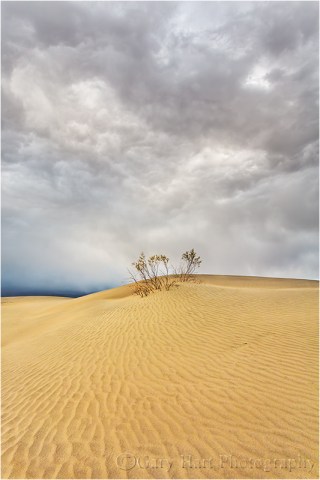
Storm Brewing, Mesquite Flat Dunes, Death Valley
Canon EOS-5D Mark III
21 mm
1/6 second
F/22
ISO 400
February 2013
Sand dunes’ graceful curves and intricate textures move and intrigue the eye, and few things better convey nature’s purity than a windswept dune. Ironically, it’s the dunes’ aesthetic magnetism that hastens their demise as photographic subjects—their fragile sand, so easily sculpted by Mother Nature’s fickle winds, is hopelessly marred by any contact with the humans drawn by their beauty.
While Death Valley has several sets of dunes, by virtue of their ease of access, the most popular by far are the Mesquite Flat Dunes near Stovepipe Wells. Every day hundreds (thousands?) of gawkers seeking a closer look trudge up and down the undulating sand—with each footstep a small amount of purity is lost. Fortunately, it’s rarely long before Mother Natures has had enough and sends in scouring winds that erase the scars like a shaken Etch-A-Sketch.
This year’s Death Valley workshops landed in the middle of an extended static without significant wind, so I knew pristine sand would be hard to find. To minimize the footprints I take my groups to a spot that’s away from the tourist foot traffic, but this time I knew that wouldn’t be enough. Nevertheless we gave it a shot and managed to find enough patches of untouched sand to isolate with a telephoto and everyone was satisfied. Except me.
So when a stiff wind kicked up the afternoon of our final full day in Death Valley I took them back out to the dunes with fingers crossed. On our drive from Furnace Creek the cars were buffeted by gusts and the entire northern horizon was obscured by dark clouds that I soon realized were in part blowing sand—a very good sign indeed. I pulled up to a spot I’d scouted a few days earlier, far removed from the paved parking area and tall dunes that draw people, and surveyed the conditions. The wind whipped anything not buttoned down and pewter clouds were rapidly overtaking the late afternoon light skimming the Cottonwood Mountains.
The group prepared for strong wind and blowing sand similar to the way we’d prepare to photograph in the rain, but in the five minutes it took to get onto the dunes the wind had mysteriously diminished to an eery calm. Before us spread pure, rippled sand for as far as the eye could see. And except for one distant photographer who quickly passed out of sight, we were the only people out there.
Fearing a shotgun approach to setting the group free would result in inadvertent footprints marring the scenes of others, I gathered everyone and suggested that we move together and agree to stay behind a predetermined imaginary line. The problem, I explained, wasn’t just staying out of everyone’s frame, it was that each step in the sand would ruin all shots in that direction. So they all followed me until I found a nice scene with a good amount variety, which we all photographed for a few minutes before I guided them to another scene. After two or three of these cycles, it seemed everyone had become comfortable enough with the environment and the ground rules that we could scatter without interfering.
I have to say that there is no kind of photography that makes me happier than what we did that evening. With virgin, textured sand and a dramatic, rapidly changing sky, the creative possibilities were off the charts. Surveying the group, it was clear that everyone was as thrilled as I was, each fully engaged in their own photographic zone. I kept telling them that they had no idea how lucky they were to be photographing these dunes without a single footprint, but I’m not sure anyone was listening at that point.
About this image
Most successful images provide a clear path for the eye to follow, or an obvious place for the eye to rest—often both. With sand dunes, so much visual motion (curves and lines) and activity (texture) makes a visual resting point particularly important. The first place I stopped the group was in front of this solitary shrub atop a low, curving ridge of sand. The scene had all the compositional elements you could ask for: elegantly arcing sand, rich texture, a dramatic sky, and a potential focal point. After pointing all this out and encouraging the group to assemble the key elements into a composition that resonates with them, I was pleased to see lenses of all focal lengths, horizontal and vertical compositions, and lots of repositioning to arrange foreground and background relationships.
Surveying the scene for myself, I noticed clouds moving in from the north painted a texture overhead that complemented the ridged sand at my feet. The filtered sunlight on the western horizon, while waning, was still sufficient to warm the scene. Finding the sand and sky equally appealing, and the shrub more interesting for its lofty perch than its inherent beauty, I tried to identify a composition that incorporated these elements.
To emphasize the foreground and sky, and to shrink the shrub, I twisted on my widest lens and dropped to about a foot above the sand. A vertical composition allied the dune’s parallel ridges with the frame’s long side to move the eye from front to back and created the impression that the entire world is converging on my little shrub. The vertical composition also narrowed the frame enough to eliminate incongruous clouds lowering on my left and right. I stopped-down to f22 and focused about three feet in front of my lens, ensuring perfect close sharpness and acceptable distant sharpness. A soft breeze swayed the shrub intermittently so I bumped to ISO 400 to allow a faster shutter speed.
In typical Death Valley fashion, it never did rain that evening. As the storm approached, all menace and bluster, our cocoon of calmness soon gave way to sand-whipping, tripod-tipping winds that lowered a cloudy shroud onto the Death Valley Buttes and Funeral Mountains to the east, cooling the light and creating an altogether different mood (that I’ll share in a future post).
Workshop Schedule || Purchase Prints
A Death Valley Gallery
Click an image for a closer look, and a slide show. Refresh your screen to reorder the display.


Death Valley Winter Moon Photo Workshop

 Eloquent Images by Gary Hart