Eloquent Images by Gary Hart
Insight, information, and inspiration for the inquisitive nature photographer
Before and After
Posted on June 28, 2022

Reflection, Lake Wanaka Willow Tree, New Zealand
Sony 𝛂1
Sony 24-105 G
1/20 second
F/11
ISO 100
I’m sitting in the Queenstown, New Zealand airport waiting to board the first of four flights that will total 26 hours and land me a mere 2-hour drive from home. While I’m still coherent, I’ll attempt to whip out this week’s (slightly late) blog post, using low hanging fruit from the just-completed New Zealand workshop: The always beautiful Wanaka Willow Tree.
Each year (that we’re not thwarted by a global pandemic) Don Smith and I guide one or two groups of photographers to our favorite locations on New Zealand’s indescribable South Island. In a land brimming with highlights, right near the top of this workshop’s highlights is our visit to the lone willow tree in Lake Wanaka.
The Wanaka Willow is arguably the most photographed tree in the world. Rising in solitary splendor from the glassy surface of Lake Wanaka, further enhanced by a backdrop of snow-capped peaks, the graceful outline of this arboreal icon has pleased visitors for decades. With free public parking just 100 yards away (or a five minute stroll from the workshop hotel), the tree’s effortless access makes it easy for all to enjoy.
I first photographed the tree in 2017, and have returned maybe a dozen times since—sunrise and sunset, day and night. In addition to the wonderful photography, on each visit I’m struck by the pleasure viewing it brings to everyone present. Whether they came to photograph, meditate, or simply gaze, each visitor is soothed by its presence, and seems infused with an infectious, positive spirit.
So, right at the start of the pandemic, to say I was mortified to learn that someone had vandalized this glorious tree would be an understatement. Visitors that morning in March 2020 were shocked to discover that overnight someone had taken a saw to several of the branches, including the graceful bottom branch that dipped toward the water before arcing skyward. I won’t even try to comprehend what would motivate someone to damage this source of so much joy for so many people, but it’s disturbing to know that we share the same planet.
Given all this, I was somewhat apprehensive about my first post-pandemic visit to the Wanaka Willow. Had it been ruined? Will we be forced to strike Wanaka from our New Zealand workshop destinations?
After photographing it twice on this month’s trip, I’m happy to declare that, while the Wanaka Willow may be (metaphorically) down, it’s far from out. Despite its scars, this solitary survivor has maintained its essence, and the joy remains. This year’s experience showed me that the Wanaka Willow’s appeal is so much more than its distinctive outline, and given its sublime setting, the new version has a chance to establish a new distinctive (albeit somewhat less graceful) outline.
The Wanaka Willow Before and After


Every time Don and I take a group to Wanaka, we like to give them a preview of the tree so their first exposure to it isn’t in the dark, at the start of the sunrise shoot. This year we checked that box with a lunch stop as we passed through town on our way to Fox Glacier.
Returning to Wanaka a couple of days later, the original plan called for a sunset shoot elsewhere on the lake, followed by a sunrise shoot at the tree. But with a forecast that included a chance of rain the next morning, we decided the tree shoot in particular is too important to risk and offered to split the group so anyone who wanted to go to the other spot could. Fortunately, the vote was unanimous to stay at the tree.
I love it when things work out and I look a lot smarter than I am. That evening’s sunset delivered beautiful pink clouds reflecting on a mirror surface. I captured this image toward the end of the sunset, after most of the clouds had moved on. As I was about to pack up, I spied one remaining cloud fragment reflecting in the lake and ran down to a spot where I could juxtapose it with the tree. While the earlier brilliant pink had softened to muted pastels, I thought the subdued tones enhanced the moment and perfectly reflected the quiet peace I felt.
More Trees


Thank You, Dad
Posted on June 19, 2022

Dark Night, Milky Way Above the Colorado River, Grand Canyon
Sony a7SIII
Sony 14mm f/1.8 GM
ISO 6400
f/1.8
20 seconds
Last night I completed a 30-hour odyssey that started in Sacramento, included stops in San Francisco, Fiji, and Aukland, before finally reaching its merciful conclusion in Queenstown, New Zealand (one car, one taxi, one bus, three airplanes, and lots of airport walking throughout). So forgive me if I’m not in shape (or in the mood) for writing a new blog. Instead, in honor of Father’s Day, I’m sharing this blog post from a couple of years ago honoring my father. I did, however, muster the energy to write few paragraphs about this image taken on the first night of last month’s Grand Canyon raft trip, which I have added at the bottom of this post, just above the gallery.
Had we not lost him 18 years ago, my dad would be turning 92 next month. He was a such a vibrant, healthy person, both mentally and physically, that I have no doubt he’d still be going strong if Alzheimer’s hadn’t taken him. I have always been grateful for Dad’s love, gentle discipline, wisdom, advice, and laughs (can’t forget the laughs), but it takes being a parent to fully appreciate our own parents’ love, and their influence on the adults we become.
Dad was a United Methodist minister who literally practiced what he preached. Just one example: In 1965, when Martin Luther King issued a plea for clergy to join him on his voting rights march to Montgomery, Dad borrowed money and flew across the country to join Dr. King in Selma, Alabama (where he was on national TV getting arrested with hundreds of other marchers).
His was an inclusive, Jesus-centric theology that honored all religions and people. He’d do things like open his pulpit to the local rabbi on Sunday morning, then reciprocate the following Saturday with a sermon of his own at the synagogue. Dad welcomed everyone into his churches, and became an outspoken advocate for LGBT rights long before it reached the mainstream. He frequently provided odd-jobs around the church to people who were down on their luck, and I lost track of the number of homeless people, including families with young children, we housed while they tried to get back on their feet.
In addition to the values he instilled, so many of the things that define my personality are directly attributable to my dad’s influence. My positive spirit, sense of humor, and love for sports were absolutely modeled by Dad. And when asked how I became a photographer, the instant answer has always been that my dad was a serious amateur photographer whose 80-hour work week offered too little time to pursue his passion, so he made up for lost time on our summer family vacations. So frequent were our photo stops, I grew up believing that a camera was just a standard outdoor accessory.
But I think his influence on my photography goes deeper than that. More than simply modeling camera use, Dad instilled in me his appreciation of nature’s beauty, and his longing for its soothing qualities. I realize now, because I see it in myself, that it’s not simply photography that dad loved, he was motivated by an insatiable desire to record and share the people and places he loved.
On a minister’s budget, our family summer vacations were, without exception, camping trips—always tent-camping, though in the later years we splurged on a used, very basic tent trailer (no kitchen, bathroom, or any of the other luxuries available in today’s tent trailers). These vacations usually took advantage of the mountain scenery within a few hours of our California home (we were just as close to the ocean, but our vacations were almost always in the mountains), but a few times our family (Dad, Mom, my two younger brothers, and I) hit the road for a much longer camping trip. Some of my most significant childhood memories came on the full month we camped all the way across the United States and back, and a multi-week camping adventure into and around the Canadian Rockies.
Of our more frequently visited destinations, Yosemite was the clear favorite. Marveling at the Firefall from Camp Curry and Glacier Point, waiting in lawn chairs with hundreds of fellow tourists at the Yosemite garbage dump for the bears to arrive for their evening meal (really), rising in the dark for a Dad and Gary (only) fishing expedition to Tuolumne Meadows, family hikes up the Mist Trail to Vernal and Nevada Falls, are just a few of the memories that I realize in hindsight formed the bedrock of my Yosemite connection.

Here’s my dad’s Half Dome Rainbow, captured on a summer afternoon in the mid-sixties.
My favorite Dad photography story happened when I was about ten. It involves an electrical storm atop Sentinel Dome, and his desire to photograph a lightning bolt, a desire so great that it trumped common sense. As his ignorant but trusting assistant, to keep his camera dry I stretched high to extend an umbrella above Dad’s head. (In his defense, as Californians, the novelty of lightning obscured a full comprehension of its dangers.) We didn’t get the lightning, and more importantly, it didn’t get us. But that’s not the end of the story.
After risking our lives on Sentinel Dome, the family ended up at Glacier Point, just down the road. Dad had returned to tourist mode as we browsed the shop at Glacier Point Lodge, no doubt seeking souvenirs that would fit our meager budget. But when a vivid rainbow appeared out of nowhere to arc across the face of Half Dome, Dad was ready with his camera still draped around his neck. Watching Dad’s excitement, better than any souvenir, this felt as if God was giving him a much deserved, “I got your back.”
I love you, Dad.
About this image
Another life-long interest I can thank my dad for is my love for astronomy. Even though Dad’s interest in astronomy was little more than an enthusiastic marveling at the stars we saw on our summer camping trips, as soon as he sensed my attraction to the night sky, he went to work figuring out how to get me a telescope. Limited, as always, by his minister’s salary, he somehow negotiated with a fellow Kiwanis member and serious amateur photographer the gift of a no longer used 6-inch reflector telescope that was far better than anything I could have hoped for. (I was especially proud to discover this photographer’s name in the photo credit for a nebula image in one of my astronomy books.)
Today I trace my lifetime fascination with the night sky all the way back to this simple act of support from my father, a fascination that manifests today in a love for photographing the stars above my favorite landscapes. It’s why so many of my workshops attempt to account for the night photography opportunities, including my annual Grand Canyon raft trip, which I always schedule a moonless week in May.
Because in May a view of the brilliant core of the Milky Way requires a good view toward the southern horizon, and the Grand Canyon trends mostly east-west, and campsites are first-come, first-served, it’s not necessarily a sure thing. Other important factors are an open view of the river for a foreground, and raft parking upstream from our river view.
In the eight years I’ve done this trip, I’ve identified several target campsites, and on the first night of this year’s trip we found at a new camp that instantly became one of my favorites. The problem here was the only place to put the rafts was right in front of the view, so as soon as we had the rafts unloaded I went exploring and found a great little beach a couple of hundred yards downstream.
The problem was that getting here required a little boulder scrambling that was doable for most in broad daylight, but not an option in the utter darkness of a Grand Canyon night. But just past the boulder field I found a spot with enough room for campsites and a straight, easy walk down to the river. So I advised the group that anyone interested the best night photography should lug their gear up the hill and over the boulders now.
At least six others took my advice. Relying on my aging body’s inability to sleep through the night, I didn’t bother setting an alarm and woke up naturally (always the best way) around 2 a.m., just as the Milky Way’s core was slipping over the canyon wall. I found two or three already shooting away at the river, and during the hour or so I was down there we were joined by several others.
Most of us started at the most easily accessed spot right on the river, but after a while I moved a few dozen yards downstream to see what the view was like there. After negotiating a few boulders, I found myself on a flat sandstone platform just a couple of feet above the river, with what I thought was an even better view. I let everyone know my discovery and was soon joined by two or three more adventurous souls. A great start to a great trip.
One more thing
I’m sure my dad had no idea at the time the significance his simple act of support would have on the rest of my life. Just something that I hope all parents, or prospective parents, keep in mind.
Join me in the Grand Canyon
Night Sky


It’s a Wide, Wonderful World
Posted on June 13, 2022

Cascade, Deer Creek Fall, Grand Canyon
Sony 𝛂1
Sony 12-24 f/4 G
1/4 second
F/16
ISO 100
I used to consider my 16-35 lens ultra-wide (by many definitions, it is), and as such, all the focal width I needed—the difference between 12mm and 16mm didn’t seem enough to justify another lens. I photographed in blissful ignorance until 2015, when, on a spring morning in Yosemite, I borrowed a friend’s Canon 11-24 lens. With the help of my Metabones adapter, I mounted the lens to my Sony a7RII and peered into the viewfinder toward a familiar scene that I’d only known through my 16-35 lens. The scene that greeted me had instantly transformed into something I’d never imagined possible. Suddenly I could capture everything rather than having to decide what to exclude.
The epiphany that there is indeed a significant difference between 16mm and 12mm caused me to briefly entertain the idea of buying (and adapting) my own Canon 11-24 lens. But that lens’s extreme bulk, that was matched only by its extreme price tag, quickly cured me of that urge. My reward for passing on the Canon lens came two years later, when Sony announced the 12-24 f/4 G lens that was less than half the weight, almost half the price, and just as sharp. A couple of years later Sony added a 12-24 f/2.8 GM lens, even sharper than its predecessor, while still faster, smaller, and (a little) cheaper than its Canon counterpart.
So of course I now own both (because I couldn’t bring myself to part with the G when I got the GM). Now my primary Sony 12-24 is the GM lens, but I don’t hesitate to use the G version when ounces matter, such as on my Grand Canyon raft trip, or when I’ll be doing significant hiking. (I also bring it to my Yosemite workshops to loan to Sony shooters at some of the spots that beg for 12mm.)
While I don’t use my 12-24 lenses as much as I use my 24-105 or 16-35 lenses, that focal range has become such an important part of my creative workflow in the field that I can’t imagine not having one with me at all times. Not only does a 12-24 provide greater compositional flexibility, I feel like it’s upped my creative game too.
But, to paraphrase Spider-Man (okay, so actually it was his Uncle Ben), with great power comes a steep learning curve. Despite the fact that wide angle is the reflex response to most landscapes by virtually every tourist who picks up a camera, I quickly discovered that good ultra-wide photography is not easy. From shrunken backgrounds to skewed verticals, wide angle lenses pose problems that magnify as the focal length widens. Fortunately, these problems can be turned to opportunities when they’re fully understood. With that in mind, here are a few insights that might help:
- Put something in your close foreground. I can’t emphasize this too much. Some of my wide angle images put the primary subject front and center, but when the background scene is my main subject, I try to find something of visual interest for my foreground. Browse the gallery at the bottom of this post and note how many images have an empty foreground (Hint: Not very many). Sometimes I’m able to include something as striking as a mirror reflection or colorful leaves, but often my wide angle foregrounds are as simple as a rock or shrub. If there’s nothing at my feet and I need to find something a little farther away, at the very least I want the foreground of my wide image to be filled with features worthy of the space they occupy.


- In a rectilinear lens (which most wide lenses are), parallel lines will be rendered straight only if the camera is level. To confirm, try this: Mount an ultra-wide lens (whatever your widest lens is) on your camera, point it at a row of nearby trees, and slowly tilt the camera up and down while looking through your viewfinder. Note how the trees straighten as the camera approaches level, and increasingly skew the more the camera tilts. For example, the two images below were captured the same day using 12mm with the same 12-24 f/4 G lens—see how straight the trees are in the El Capitan image compared to the Yosemite Falls image? In other words, when you see extreme tilt in an ultra-wide lens, blame (or credit) the photographer, not the lens.


- Take advantage of the extreme depth of field wide angle provides. For example, at 12mm and f/11, the hyperfocal distance is 18 inches (focus 18 inches away and everything from 9 inches to infinity will be acceptably sharp). Stop down to f/16 and the hyperfocal distance is 12 inches (acceptably sharp from 6 inches to infinity). While hyperfocal focusing in today’s age of extreme resolution is a little more nuanced than that, the point is, you can get really close to your subjects and be sharp from front to back. Read more about hyperfocal focusing.


About this image
My annual Grand Canyon raft trip has so many mind-blowing sights that I really can’t give you a favorite—the best I can do is offer an unranked list of favorites. I’ve already shared images from last month’s trip of two on that list (Little Colorado River and Elves Chasm), so today I’m sharing a third: Deer Creek Fall.
Deer Creek Fall is visible from the Colorado River and far from a secret, but my guides and I have become pretty good at getting it to ourselves, and this year we succeeded wonderfully. While about half the group embarked on the short (1/2 mile) but steep (!) hike to the slot canyon above the fall and the beautiful “patio” area beyond, I stayed behind to photograph a rainbow at the bottom of the fall, and to wait for the light to improve. Since you can walk right up to this 150 fall (and under it if you’re adventurous), I immediately reached for my Sony 12-24 f/4 G lens and attached it to my Sony α1.
Starting at the fringe of the pool beneath the fall, I played with a variety of compositions before eventually clambering down into this little cascade about 30 feet downstream. And when I say into, I really do mean in-to—to get close enough and align the cascade with the fall, I had to stand in about 18 inches of rushing water with my tripod splayed in three directions—two legs nearly horizontal and planted on opposite sides of the creek, and one leg pressed against a submerged rock. To use my viewfinder, I had to drop down and sit on a rock with my legs in the creek above my knees. While I wasn’t any any personal danger, I was very aware of the precarious position I’d put my (brand new) camera in and the potential for it to get swept downstream.
Once I had the general setup stabilized, I did my standard click-evaluate-refine cycle, gradually inching closer until the cascade was less than 2 feet away. With each adjustment I found myself dropping lowerSettling on a composition I liked, I focused on the rocks and played with a variety shutter speeds. You might get an idea of how close I was, and how fast the water was moving, when you realize that this was captured at 1/4 second.
Join me for next year’s Grand Canyon raft trip
Workshop Schedule || Purchase Prints || Instagram
Going Wide


Tapping the Essence
Posted on June 5, 2022
Churn, Little Colorado River, Grand Canyon
Sony α1
Sony 24-105 f/4 G
1/3 seconds
F/16
ISO 100
Spend enough time viewing landscape images on Facebook and Instagram and it soon becomes clear that dramatic spectacle and saturated color generates the most fan attention. Fueled by this knowledge, photographers seeking online praise try to outdo the drama and color of prior images, both their own and others’, with every shoot. The unfortunate consequence is a photographic feedback loop where one ostentatious image spawns increasingly ostentatious images, which then encourage even more ostentatious images, and on, and on….
This accelerating cycle reminds me of Top 40 music, where one breakthrough success generates a flood of uninspired clones. Catchy tunes are fine for a few listens, but few possess staying power and are soon forgotten. Contrast that to artists like the Beatles (am I dating myself?), who aggressively resisted repetition of prior success in favor of new sounds—sounds that the world has been listing to pretty much nonstop for nearly 60 years.
Admittedly, few artists are blessed with the Beatles’ creative genius, but that’s no excuse to shortcut your own creativity. As with music, images that elicit a reflexive Like and Share from digital passersby, and (if you’re lucky) maybe even a “Stunning!” in the comments box, are usually forgotten with the next click. But images that resonate on a personal level by revealing something unseen, or by touching a hidden place inside the viewer, have the power to grab people in their tracks and not let go.
Of course this sounds great in theory, but how is it accomplished? If the answer were easy, we’d all be doing it. But, like Dorothy and the Ruby Slippers, perhaps we’ve had the power all along.
Because most people long for a connection to the world around them—not simply a connection with nature, but also a connection with kindred souls—a good place to start would be to give viewers of your images something of yourself to latch on to, by concentrating on subjects that resonate with you.
Which might be why my own photography took a significant leap forward when I started photographing simply to please myself. In other words, the more I pursue moments in nature that touch me personally, (as if by magic) the more unique, gratifying, and successful my images became. While my most personal images don’t please everyone, the people they do reach seem to feel a deeper connection than they do to my images intended to impress. And best of all, they make me happy.
About this image
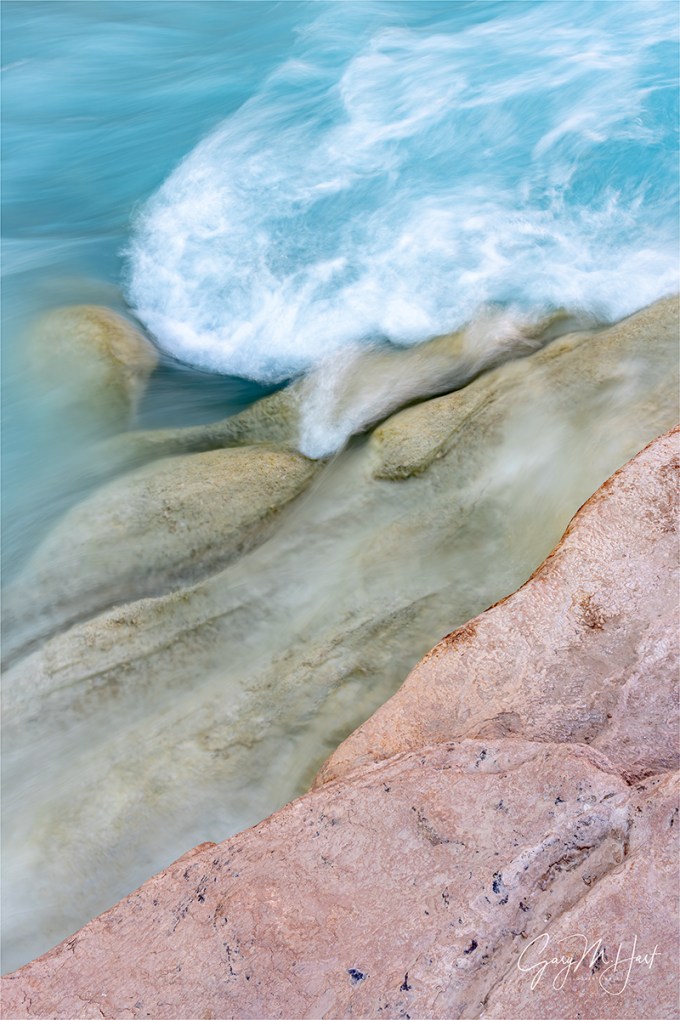
I’ve spent many hours at the bottom of the Grand Canyon, roaming the banks of the incomparable Little Colorado River near its confluence with the Colorado River. I’ll never forget my reaction the first time I saw the Little Colorado’s impossible blue. I had no inkling of what was in store when I hopped from the raft and rounded the corner, but when that blue hit my eyes I stopped short and stared for a few seconds trying to process it, then spun around and strode back to the raft to tell my lead guide, “We’re going to need more time here.”
Despite all the time spent here (and admittedly, it hasn’t all been photography—on warmer days my group enjoys cooling off by floating down a natural water chute about 1/2 mile upstream), I’ve struggled to make images that I feel really does the scene justice. But last year something clicked when I started looking closer, emphasizing the intimate beauty at my feet: the juxtaposition of red, white, and blue water and rock; the rock’s rich texture; the curves, angles, and levels of the limestone layers; and the play of the river among all these elements.


This year I took my look-closer approach a step further. After spending a hot afternoon at the Little Colorado doing more swimming than photography, I rose at 5:00 the following morning to return along with a half-dozen hardcore photographers in my raft trip group for a solid hour of just-plain-photography (taking advantage of our campsite directly across the river that allowed us to shuttle back and forth). While I landed that morning with no real plan, after a handful of uninspired clicks I came across this little rapid that stopped me in my tracks. Exactly 101 images later it was time to hustle back to the raft.
That’s right, 101 images of this one little rapid—and it was probably the most photography fun I’ve had all year. Every single frame was different from the others, and know I’d have found 101 more unique captures if I’d have had time.
Using my Sony 24-105 G lens on my Sony α1, I started with a tighter, horizontal composition, refining until the framing felt balanced, then ran a series of shutter speeds (by varying my ISO) ranging from 1 second to 1/100 second in (more or less) 1-stop increments. Then I’d find a new composition by going slightly wider, and occasionally changing my position and orientation. For each composition I’d use a similar series of shutter speeds, though it wasn’t long before I decided that the range I liked best was between 1/2 second and 1/30 second. (I like shooting motion with a range of shutter speeds so I can defer my final choice until I can view everything on my large monitor at home.)
Not until the last 10 minutes or so did I expand my composition enough to include the red rock platform on which I stood. Sometimes it takes working a scene for a while to distill it to its truest form, and it turns out really I love the strong diagonal this originally overlooked addition adds, not to mention the extra color and texture.
Like many of my favorite images, I know this one won’t accumulate the abundance of Likes that a landscape icon beneath a vivid sunset might, but it’s these intimate frames that capture the essence of the scene that make me happiest.
Join me as I do it all over again next year
Tapping the Essence
Click an image for a closer look, and to view a slide show.


Hidden Gem
Posted on June 1, 2022

Hidden Gem, Elves Chasm, Grand Canyon
Sony 𝛂1
Sony 12-24 f/4 G
1.3 seconds
F/16
ISO 50
Yesterday I wrapped up my eighth Grand Canyon raft trip. I had no idea on my first one in 2014 that I’d still be doing this trip 8 years later (with number nine already on the schedule), or that it would have such a profound effect on my life. But here I am.
Most people’s perception of the Grand Canyon comes courtesy of expansive views from the rim, ideally in person, but often only in photographs. But on my first trip I learned that Grand Canyon’s obvious macro beauty from the rim belies the micro beauty below. Down here, the potential to be surprised by a bubbling spring, tumbling waterfall, or narrow slot canyon awaits at every twist of the river.
And some of the raft trip’s appeal is more visceral than visual. I’m thinking specifically of the river itself, which offers long stretches of contemplative floating, punctuated by thrilling E-ticket (look it up) rapids. Early in the trip I’ll need to reassure a nervous bunch of rafters cowering toward the back of the raft with each approaching riffle (baby rapid); by trip’s end, the bigger the rapid, the more rafters we have jockeying for a spot up front on the raft’s pontoons.
Another reason to love this trip is the Grand Canyon’s night sky, which is quite likely the darkest sky I (or anyone else) has ever experienced. Every night on the river I shun the tent in favor of a celestial shelter. Reclined on my cot, eyes plastered open, I fight sleep until I spy a meteor. While waiting, my gaze drifts across stars that range from brilliant to completely invisible virtually anywhere else on Earth, connecting these pinpoint lights into patterns as I try to comprehend our Universe’s expansiveness.
But honestly, as great as all this other stuff is, my favorite part of these trips is the people. We enter the canyon as a disorganized cohort of uncertain, anxious, strangers, and emerge, bonded by teamwork and shared experience, a cohesive knot of friends. One of my greatest (and proudest) pleasures is standing back and observing the interaction of the new friendships that my trip has enabled—many friendships will last the rest of these individuals’ lives. And I’d be remiss not to acknowledge the friendships I make, the new people with whom I’ve formed (what I hope will become) lifelong relationships.
About this image
After tumbling over layers representing millions of years Earth’s history, Royal Arch Creek drops into an emerald pool nestled in a mossy, fern lined, red rock alcove: Elves Chasm. Getting there requires a bit of rock scrambling—there’s a trail of sorts, but in several places the route is interrupted by an inconvenient rock, ledge, or pool. Fortunately, Elves Chasm is only a couple of hundred yards from the Colorado River (mile 116). With small cascades and pools along the way, even those who can’t make it all the way to the pool will find plenty to see and photograph.
Despite the difficult access, this little gem isn’t a secret, and it often teems with gawkers. I’ve been doing this raft trip long enough that my guides and I have become pretty good at timing our Elves Chasm visit so we have it to ourselves (fingers crossed), in the best light (full shade), and this year we succeeded wonderfully.
Because of the confined space, my group had to negotiate photo opportunities, with everyone taking turns at the best spots and no one locking into one place for too long. I waited until everyone was done before setting up this shot on a narrow shelf along the chasm’s right wall. A few years ago I captured a horizontal version of this scene that I like, so this time I concentrated here on something vertical.
By the time I clicked this frame, the morning sun had already started to stain the rocks above, and it wasn’t long before it leaked into the chasm itself, marking the end of photography time and the beginning of tourist time. Appropriately, as my group joyfully scrambled back down to our rafts, we encountered another group on their way in, thrilled to find their destination in full sun.
This is the only image of the trip I’ve processed so far, but I promise more are on the way…
Join me on next year’s Grand Canyon Raft Trip for Photographers (and Friends)
Workshop Schedule || Purchase Prints || Instagram
Visions of Raft Trips Past


 Eloquent Images by Gary Hart