Eloquent Images by Gary Hart
Insight, information, and inspiration for the inquisitive nature photographer
Shock and Awe
Posted on February 27, 2025
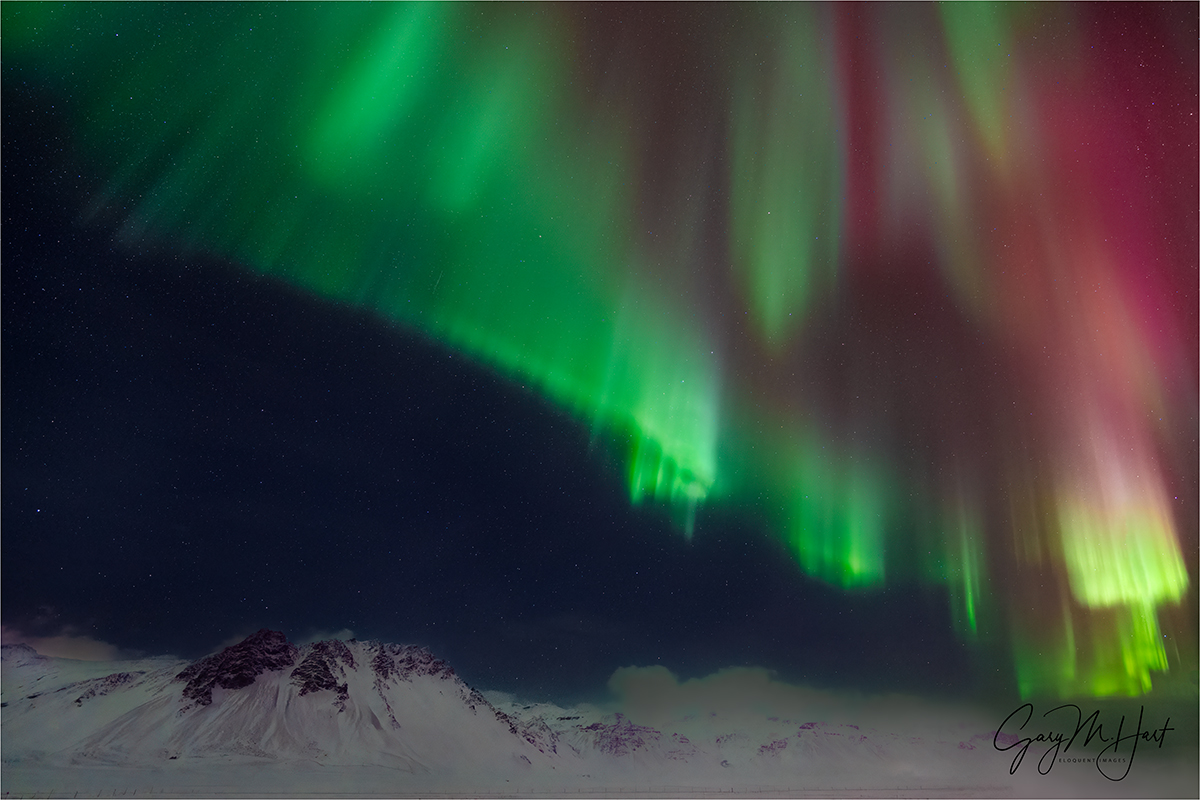
Night Lights, Snaefellsnes Peninsula, Iceland
Sony α1
Sony 14mm f/1.8 GM
ISO 3200
f/1.8
5 seconds
That night at dinner, one person in the workshop group asked if there was a chance we’d see the northern lights, or if he could safely have another beer. I laughed and told him, while I can’t predict the future, I’d be shocked if the northern lights happened this night and to just go ahead and have that beer. I’ve never been happier to be wrong (and that my advice didn’t ruin his evening).
Each winter Don Smith and I do a winter workshop in Iceland. There are many reasons to visit Iceland in winter, but for most of our workshop students, at the top of the list is the northern lights. Because northern lights success doesn’t just happen, each day Don and I powwow with our Iceland guide to assess our odds for aurora success that night, and to plan our strategy to be there when it happens. We base these decisions on forecast aurora activity, expected cloud coverage, dark sky (no light pollution) views of the northern sky, and the experience we’ve gained from prior northern lights shoots.
Our second night on Snaefellsnes Peninsula (the workshop’s third night), the expected KP-index (the universally accepted 0 to 9 scale of aurora activity) was a very disappointing 1—about as low as we ever see in Iceland. Worse still, an incoming storm had already started to spread clouds, further reducing the night’s aurora expectations.
But regardless of the target (aurora, lightning, Milky Way, and so on), past surprises have taught us to never not have a plan in the event of the unexpected, so at dinner this evening we laid out the bad news to the group, but promised to keep an eye on the sky and notify them if anything changes. Though the incoming storm meant we wouldn’t be able to drive to another location if the aurora surprised us, we told the group that just across the road from our remote hotel was an unobstructed, dark-sky view of the northern sky above snowy peaks—perfect for the northern lights.
With a plan in place, everyone retreated to their rooms for the night with the lowest of expectations. At about 9:30 I was still up, answering e-mails and doing other boring business stuff, when I glanced at my phone and saw at least a dozen notifications from the WhatsAp Iceland group thread. Well that’s interesting…
It seems that Siggi, our exceptional Icelandic guide, had gone outside at around 9:15 and discovered clear skies and aurora. Without bothering to read all the other exclamations from the group, I bundled up, grabbed my gear, and rushed out as fast as I could. I expected something similar to the aurora display we had over Kirkjufell the prior night—enough to show up in the camera, but not bright enough for our eyes to register—but as soon as I stepped out into the cold and looked up, I spotted a soaring shaft of light that told me tonight would be different. Much different.
I hurried to the outline of photographers assembled across the road and quickly trudged through two feet of snow to set up at barbed wire fence. Out here, away from the hotel’s lights, it was even more apparent that something special was underway.
Don, Siggi, and I had prepared the group for photographing the northern lights, but with any type of night photography, there’s no substitute for experience. Since this was the first aurora experience for many in the group, I spent my first few minutes out there moving around, helping get people up to speed. While focus is always tricky at night, aurora focus is no different than any other night scene. The greatest challenge for aurora first timers, even those with lots of night experience, is the need to constantly monitor the rapidly changing exposure. An exposure bright enough to reveal foreground detail and aurora color one minute, might completely blow out the aurora the next. And a 15 second exposure might be fine when the aurora is changing slowly, but it blurs intricate detail when the aurora’s activity ramps up. Fortunately, it didn’t take long for everyone to settle in, and soon my instructions were down to occasional shouts reminding everyone that the brightness had changed, or to point out a different area of the sky that had ramped up.
The WhatsAp notice had gone out to everyone, but I soon realized it had only been a fluke that I’d noticed, so after a few minutes I decided to take attendance. Easier said than done in the extreme darkness, especially since there were a few people out there who weren’t in our group, and everyone was bundled head-to-toe. But I did determine that Don wasn’t out there, and one other person in the group (turns out there was a second person missing, but we didn’t realize it until the next morning). I called the missing workshop participant first, but that call went straight to voicemail—then another person in the group said she’d called him and he’d decided to pass (apparently he’d been asleep and regrettably wasn’t thinking rationally when he got that call). Don, on the other hand, was especially grateful for the call and made it out in record time.
An aurora show is special anytime, but it wouldn’t be an understatement to say this one truly shocked me by its unexpected splendor that ranks right up there with the very best I’ve seen in my half dozen years of photographing Iceland in winter. It was very bright, covered most of the sky, and was infused with lots of red, but what stood out most for me this evening was the dancing waves and shafts that twisted and fold right before our awestruck eyes.
Join Don and me for a very special Iceland photo workshop in 2026
Iceland Aurora Collection, 2019 – 2025
Click any image to scroll through the gallery LARGE


2025 Horsetail Fall: Success—and a Surprise
Posted on February 23, 2025

Molten Stripe, Horsetail Fall, Yosemite (5:43 p.m., February 20, 2025)
Sony a7R V
Sony 100-400 GM
ISO 100
f/10
1/6 second
I just returned from Yosemite, where I basked in another year of Horsetail Fall mayhem. But before I get into this year’s experience, let me just sing the praises of the Horsetail Fall experience in general. Horsetail Fall (don’t call it the Firefall) is a narrow, unassuming waterfall that, for a couple of weeks each February, gets thrust into the spotlight when a fortuitous confluence of location and light sets it ablaze with sunset color.
So what’s going on? With no clouds blocking the sun’s rays, in mid-afternoon a vertical shadow appears on El Capitan’s south-facing wall and commences an eastward march across the sheer granite. As this shadow marches eastward with the descending sun, the sunlit section of El Capitan shrinks and its light warms. Though the sun is no longer visible from the valley floor, towering El Capitan remains lit past sunset—when the unseen (to Horsetail gawkers) sun reaches the horizon, the only part of El Capitan not in shadow is the narrow strip of granite that includes Horsetail Fall. For a few glorious minutes, this normally anonymous waterfall is bathed in orange that resembles flowing lava, framed by dark shadow. Occasionally, when all the stars align, this thin stripe of orange turns a seemingly impossible shade of red that rivals the best sunset color you’ve ever seen.
I know it’s fashionable for some photographers to look down on any subject so popular and heavily photographed, and Horsetail Fall seems to be the poster child for these feelings. But I believe that, first and foremost, true nature photographers pursue their craft as much to marvel at, and honor, Nature’s gifts as they do for the images they capture. Camera or not, the Horsetail Fall spectacle should be experienced by all who find joy in natural beauty (which should be ALL nature photographers).
I’ve been photographing Horsetail Fall long enough to remember the days when I could arrive 30 minutes before sunset and join a small handful of other photographers in on the secret. But the photography renaissance spurred by digital capture, combined with social media saturation, has made the phenomenon a must-see (and must-photograph) event for the masses. I used to lament the crowds, but since the National Park Service implemented management and control measures that (slightly) limits the crowds, and (more importantly) the viewing locations, I’ve come to enjoy the tailgate-party atmosphere the phenomenon engenders.
Having witnessed the range of Horsetail Fall’s annual display at least 50 times, from disappointing flops (no water of sunset light) to absolute euphoric splendor, today it’s the vicarious thrill I pull from the crowds that keeps me coming back. Last week was no different, and I’ll be back next year.
Success
The amount of water in Horsetail varies from year to year, ranging from bone dry, to wet stain, to rainfall run-off infused gush. And while I wouldn’t say it was gushing this year, the flow was at least average, and definitely photographable.
The Horsetail crowds this year, at least for the four sunsets I was in Yosemite (February 18-21), were by far the most I’ve ever encountered. Since I usually do my Horsetail Fall workshop a week earlier, largely to avoid the crowds of February’s third week (because that’s when the light has been labeled “best”), it’s hard to know how much this year’s crowds were just a function of my timing, or whether there really were more people than previous years. I suspect it was some of both.
Consensus says that the best Horsetail Fall light, when it’s most tightly focused on the fall, comes 2 or 3 days either side of February 20 (where we are in the leap year cycle matters too). The reason I usually schedule my Horsetail Fall workshop for weekdays a week earlier is that contenting with significantly fewer people more than makes up for any minor difference in the perceived quality of the light. In fact, some of my best Horsetail Fall experiences have come around February 10. But this year, knowing I’d have just returned from Iceland, I pushed the Horsetail Fall workshop back a week.
I also wonder if this year’s extra people were a byproduct of the new NPS reservation system that’s designed to keep weekend crowds more manageable. It’s possible that those who would ordinarily go on a weekend but couldn’t score a reservation, or maybe they just decided not to hassle with the reservation system, just took advantage of the unrestricted entrance weekdays offer.
Whatever the reason, the crowds are only a problem where parking is concerned—once you park and get yourself to the viewing area, there’s plenty of room for everyone. Back when Southside Drive was in play (closed now due to riverbank damage and unruly photographers), people who opted for that (arguably much better) vantage point had to contend with an order of magnitude more photographers than there was space to accommodate them—not to mention all the tension (and hostility) that comes with that. Not only are there many more viewing sites on NPS-approved and mediated Northside Drive, the view there (being closer to El Capitan) is more up and over the heads of the throngs of gawkers. Since it’s primarily a telephoto shot, even when stacked multiple people deep, no one is in anyone’s way. The result is a genuine tailgate party vibe that I’ve grown to love: frisbees, barbecues, and actual socialization among friends and strangers alike.
After monitoring last week’s weather forecast, I decided to pass on Horsetail for my workshop’s first two days, targeting Thursday, with Friday as a backup. And though Wednesday turned out to be an absolutely epic Horsetail Fall event for all who stuck it out through the clouds that delivered rain right up until sunset (we weren’t in the Horsetail Fall viewing area, but did have a good view of the fall), my group got something better Wednesday evening (if you like rainbows), and still experienced the coveted Horsetail Fall red light the next evening. Win-win! The rainbow is a story for a different day, but waiting until Thursday freed us to take advantage of all my other favorite Yosemite locations in relative peace (because most of the photographers were congregated beneath Horsetail Fall) the rest of the week.
And even though we photographed Horsetail Fall just once, we did drive through the viewing area each evening, sometimes multiple times, which gave us a firsthand view of the bedlam. How crowded was it? I have no idea when the Yosemite Valley Lodge parking area—the closest dedicated Horsetail parking, an easy 1 1/2 mile walk—filled each evening, but I know we saw it barricaded with “Full” signs as early as 2:30 p.m. Not only that, all of the ADA parking within the viewing area was full and closed as well. This concerned me because I’ve never seen ADA parking fill so early, and I had a participant with an ADA placard, plus a couple of others who weren’t crazy about a 2 or 3 mile roundtrip walk.
I have a few parking tricks up my sleeve, so on Thursday evening we were able to deposit limited carload just slightly more than 1/2 mile from the viewing area (less than ideal but manageable), while the rest of us found parking about 1 1/4 mile away. By 4:30—more than an hour before the 5:43 sunset—we were all set up beneath El Capitan with fingers crossed, ready for the show.
The morning had been cloudless, but by mid-afternoon patches of thin clouds had drifted in, never completely extinguishing the direct sunlight, but intermittently dulling it significantly as the sun dropped. Every time the sunlit granite brightened, I advised my group to start clicking, because we never know when the light will disappear for good.
The light teased us like this all the way up until go-time, about 5 minutes before sunset. Then, as if a magic hand was keeping the clouds at bay, the sun brightened and held steady all the way until sunset (the picture at the top of this post). When the light started to fade slightly, we heard applause and cheering in the distance as other groups of viewers assumed the show was over, but I told my group (and, it turns out, a number of other people eavesdropping nearby), that we’re not leaving until at least 5 minutes after sunset because the fading we were seeing now was caused by clouds, not the sun dropping below the horizon. Turns out, the show had just begun….

Last Light, Horsetail Fall, Yosemite (5:48 p.m., February 20, 2025)
Sony a7R V
Sony 100-400 GM
ISO 100
f/10
1/5 second
A minute or so later, Nature dialed its rheostat back up and the light returned—but this time it was red. As the red intensified, a shadow crept up from the bottom of the fall, extinguishing the lowest light. The image below was captured 5 minutes after sunset, and you can see the bottom third of the fall isn’t lit. Shortly after this, the light faded uniformly and the show was over. The red we got this evening was as red, and as brilliant, as I’ve ever seen on Horsetail Fall. I’ve seen it get this red a handful of other times, but never any redder than this.
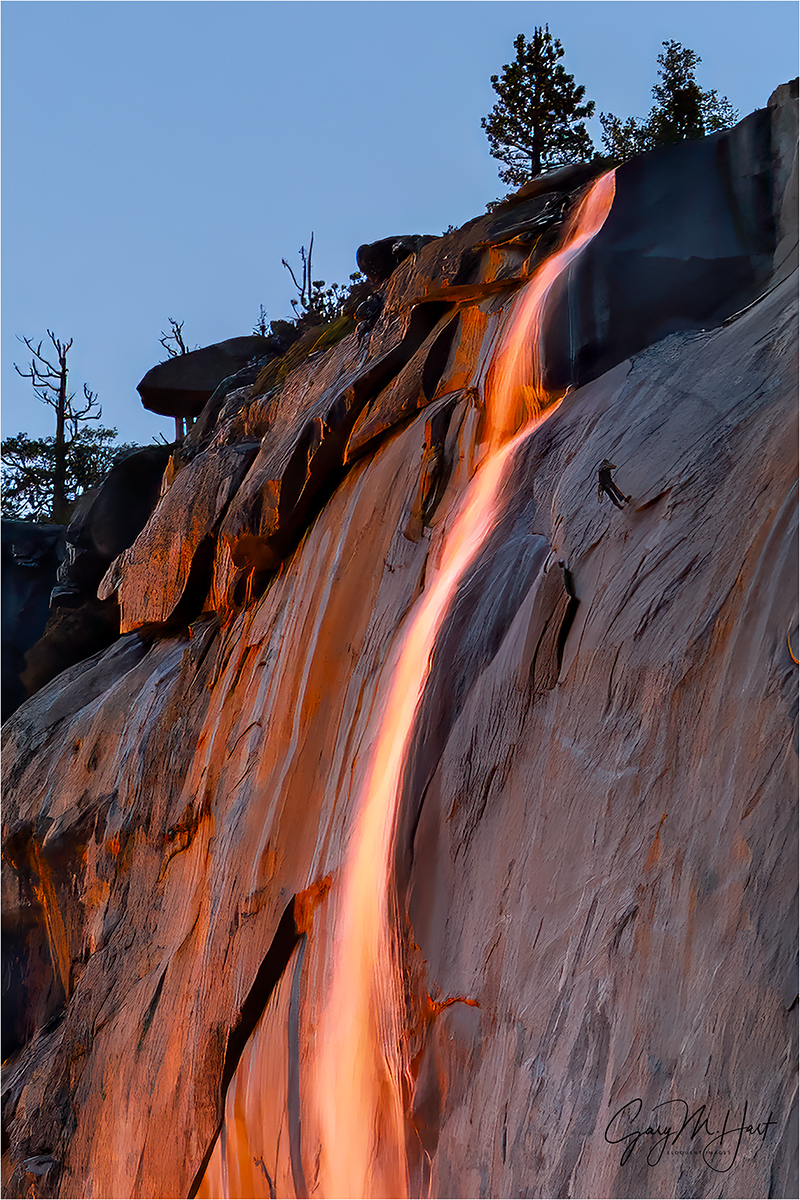
Horsetail Fall Climber, El Capitan, Yosemite (February 20, 2025)
Surprise
The evening’s biggest surprise wasn’t pointed out to me until our image review session the next day. Apparently, unbeknownst to us at the time, we’d been photobombed by 3 climbers on El Capitan, including one dangling right next to the fall. You can see him (or her?) in both of the top-to-bottom fall images above, but immediately above is a tighter crop of the first image, showing the climber more clearly.
Here’s my article on getting the most from the Horsetail Fall experience
Join me in a Yosemite Photo workshop
Workshop Schedule || Purchase Prints || Instagram
Horsetail Fall Through the Years
Click any image to scroll through the gallery LARGE


Iceland, Weather or Not
Posted on February 14, 2025

The Green Night, Aurora Above Kirkjufell, Iceland
Sony α1
Sony 16-35 GM
10 seconds
f/2.8
ISO 3200
As I’ve probably said a million times before, and likely will say a million more times, the best weather for photography is the worst weather to be outside. I mean, why else would Don Smith and I schedule a workshop for Iceland in January?
Of course our number one reason for an Iceland winter trip is the northern lights, which means winter clouds aren’t always our friend. But when I’m not waiting for the aurora to fire up, I love the way Iceland’s storm clouds are illuminated (all day) by beautiful low-angle sunlight (the sun never rises above 10 degrees during our visits). There are Iceland’s 2-hour winter sunrises and sunsets, its storm-churned surf, and ocean to mountaintop snow-covered landscape. And a surprising truth I’ve come to appreciate over the years is that, while Iceland in January is indeed quite cold, it really isn’t as cold as most people expect. (I swear.)
In this year’s workshop, that “not as cold as you expect” claim was challenged on our very first day of shooting, when we piled out of the bus at our first stop into 5°F air. Fortunately, that’s the coldest we experienced all workshop, and great photography creates an inexplicable warming factor that seems to make even the harshest conditions more tolerable. And regardless of the quality of the photography, even temperatures as low as 5°, (especially without wind) are quite tolerable with the right clothing.
My first year I attacked Iceland’s cold with copious layers of conventional California cold-weather gear. That worked well enough, but following each subsequent visit, I refined my non-California winter-wear (warmest) to the point where I’m now armed with an entire Iceland ensemble that rarely comes out for my domestic trips.
For example, a few years ago I decided that I was tired of having to layer a rain-shell on top of my (extremely warm but not waterproof) puffy down jacket, not to mention having to deal with a chronically cold butt exposed by a jacket that barely hung below my belt (yes, I was still wearing pants). So I sprung for LL Bean’s warmest waterproof down parka that covers me all the way down to mid-thigh. I still travel to Iceland with a lightweight, waterproof down jacket that’s compact enough to stuff in my camera bag and is ideal for milder days and short jaunts from the bus to a restaurant or hotel.
This two-way system—one heavy-duty option for the coldest, windiest conditions; another that’s lightweight but still warm enough for normal daily activity—works really well for me in Iceland. In addition to two jackets, I also have a couple of hats, pairs of gloves, and boots, that I can choose between, depending on the conditions. And, unlike many in this year’s group, I managd to pack everything into one (large) suitcase that I (barely) keep below Icelandair’s 23 kg (50-ish pounds) weight limit.
This year’s difference-maker upgrade was my new warm boots. I’m a cold feet (and fingers) kind of person, cursed with digits that never seem to be warm enough. Where my boots are concerned, it’s not so much the walking that’s a problem, but photography requires a lot of standing around in frigid cold (especially at night, when the aurora is dancing). In previous years I’ve gone more conventional, trying an assortment of insulated hiking boots and thick wool socks, upgrading to something warmer after almost every trip, vowing that next year will be better. The result has been persistently cold toes, and a boot-graveyard in my garage that rivals Imelda Marcos’ closet.
This year I tried something different, switching to super-warm, waterproof, lined Sorel work boots. But that was just the start. In New Zealand last July, I stocked up on (wait for it) possum fur socks. Possum fur (it’s actually a possum/merino blend) is absolutely the warmest material I’ve ever worn (also soft and lightweight), and it’s everywhere in New Zealand. But before you start visualizing acres of bred possums, caged and awaiting slaughter, and imagine that I’m supporting the heartless New Zealand possum-breeding industry, you need to know New Zealand’s possums (which are quite different from American possums) are a non-native scourge that’s decimating the country’s native bird population (among other things). A massive effort is underway throughout the country to eliminate possums by 2050—the only possum fur apparel I purchase in New Zealand is a byproduct of possums trapped for eradication (they were doomed anyway). But anyway…
And as if new boots and socks weren’t enough, I also sprung for a few thin merino wool liner socks from REI, to wear under my possum socks (no, possum don’t wear socks—you know what I mean). After returning last week following nearly two weeks in Iceland’s winter cold. After that first morning, I exited the 5° chill confident that my popsicle toes days were behind me.
Though the temperature warmed slightly throughout the day, by afternoon the wind had picked up and we started to see a few clouds heralding the approach of the storm that would batter us the following day. Nevertheless, after dinner we drove out to Kirkjufell hoping for some northern lights because in Iceland in winter, you always have a northern lights plan.
Seeing clouds from the Kirkjufell parking area, it would have been easy to pack it in and return to our warm hotel. But a few breaks were enough to give us pause, and when quick test snaps revealed green sky behind the broken clouds, we decided to stay and shoot for a while. We shot from the parking area, using our bus as a windbreak.
What started as a low expectation, “What the heck, we’re here anyway” shoot, turned into a very productive evening of photography, and a harbinger of the great stuff in store. It also gave us an opportunity to get the group up to speed with night photography—some had never done it before, while others were pretty rusty.
It’s especially fun when a group gets to witnesses something exciting. Many in this group had never seen an aurora, and though the color wasn’t bright enough to see with our eyes, everyone was pretty thrilled to capture images that featured Iceland’s most iconic mountain. But the real star this evening was the clouds, which built and raced behind Kirkjufell, but never completely filled in the window to the sky and aurora behind the peak.
After we’d finished, Don and I talked about the relief we felt getting at least enough aurora to please people, but agreed that more would be better, because those who’d never seen a good display didn’t really understand what they were missing. It turns out we didn’t need to wait long, but I’ll get to that in a future post.
Join Don Smith and Me in Iceland
Weather or Not
Click any image to scroll through the gallery LARGE


Grand Finale
Posted on February 6, 2025

Lunar Lift Off, El Capitan, Yosemite
Sony α1
Sony 200-600 G
Sony 1.4x teleconverter
ISO 800
f/13
1/25 second
For most of my full moon workshops, I try to schedule the moonrise main event for the workshop’s final sunset. Sometimes other factors prevent this (for example, in Yosemite I try to avoid weekends), but when the schedule works, a nice moonrise gives the group something exciting to anticipate throughout the workshop. This becomes especially important when some or all of the workshop’s hoped-for conditions fail to materialize.
Last month’s Yosemite Winter Moon workshop lacked to winter snow and cloudy skies we hope for in a Yosemite winter workshop, but the moon (among other things) saved the day for us by not only giving us something to look forward to, but also by photobombing an earlier sunset. The true star of that prior sunset was the clouds and color, and as nice as it was to accent the scene with the moon, it was the final night moonrise that I most looked forward to.
As I’ve written before, despite all the unjustified “supermoon” hype, the key to photographing a big moon is focal length—the longer the better. Period. If you don’t care about what’s in the foreground, or for that matter choose not to include any foreground at all, any location where the moon is visible will do. But if you want to complement your legitimate big moon (a moon image that happens in one click) with a striking landscape feature, the farther you position yourself from your landscape subject, the longer the focal length you can use, and the bigger the moon will be. Of course if you make the moon bigger with a longer focal length, the less of your foreground you can include, and the more precise the moon/foreground alignment must be.
In Yosemite, the best place to set up for a telephoto moonrise that also includes photo-worthy foreground features, is Tunnel View. At Tunnel View, the prime moonrise subjects are El Capitan and Half Dome, three and eight miles distant. From there, I can include all of Half Dome with a focal length up to 400mm; with a longer lens, I can enlarge the moon further, while still including some of Half Dome—if the alignment is right.
The most important part of photographing a moonrise from Tunnel View is to align it with a desirable foreground subject. Most of the year, the moon rises much too far south to include in a Tunnel View scene, but for 2 or 3 months each winter, the full moon rises far enough north to align beautifully with Tunnel View’s magnificent monoliths.
But success is not simply a matter of showing up at Tunnel View the night of the full moon. Each winter the solar/lunar choreography is different, which is why the moon is all over the place in my many Tunnel View moonrise images in the gallery below: left of Half Dome, right of Half Dome, directly aligned with Half Dome, and occasionally closer to El Capitan than Half Dome.
This winter’s geometry was especially exciting to me when I realized the January moon would rise farther north, and therefore closer to El Capitan, than I’d ever photographed it. I have photographed the moon arriving from behind El Capitan’s vertical face, but I’d never seen it come up from behind the top of El Capitan. Always up for photographing something new (especially in Yosemite), I scheduled a workshop for it.
Which is how my workshop group and I ended up at my favorite Tunnel View vantage point on a Sunday evening last month. Sunset that evening was 5:05, and my calculations said the moon would at just about the same time—pretty much perfect timing for a moonrise, because you want the sky dark enough for the moon to stand out in contrast, while still bright enough that the landscape has enough light to reveal detail without blowing out the moon.
I’d set up with two tripods and cameras, one with my 200-600 lens, the other my 24-205 lens. The long telephoto was for the moon’s arrival; the wider lens was for when the moon elevated enough to separate from El Capitan. I’d planned to increase the magnification of the telephoto with my 2x teleconverter, but trying to attach the teleconverter to the lens, I fumbled it and helplessly watched it roll down the steep granite toward a vertical drop of several hundred feet. Fortunately, it lodged in small crack just before taking the plunge, but when I put it on the view was completely blurred, so I switched to my 1.4X teleconverter, giving me a focal range of 280-840.
As the sun dropped and the time approached, I became aware that a thin film of clouds had drifted across the eastern horizon above El Capitan—so thin that they weren’t visible at all in daylight brightness, but just substantial enough to reflect some color as sunset approached.
The moon arrived right on schedule, and we immediately started clicking. My earliest shots were almost entirely long telephotos, like this one at 840mm. It’s always shocking to see how fast the moon moves across a long telephoto frame, but I soon started mixing in a few wider frames (that required less frequent adjustments) as the moon started separating from El Capitan. By this time sky had pinked up beautifully, adding an element of color I hadn’t expected.
We all come to a workshop with expectations, students and leaders alike, but rarely are all of them met. And while the January group’s hopes for snowy winter scenes were dashed, I think that loss was more than made up for by other things we witnessed, some complete surprises, and some just a little better than our already high expectations—like this sunset moonrise to finish the workshop.
Join me in a Yosemite photo workshop
Workshop Schedule || Purchase Prints || Instagram
Yosemite Moonrise Collection
Click any image to scroll through the gallery LARGE


 Eloquent Images by Gary Hart