Eloquent Images by Gary Hart
Insight, information, and inspiration for the inquisitive nature photographer
Who’s Counting?
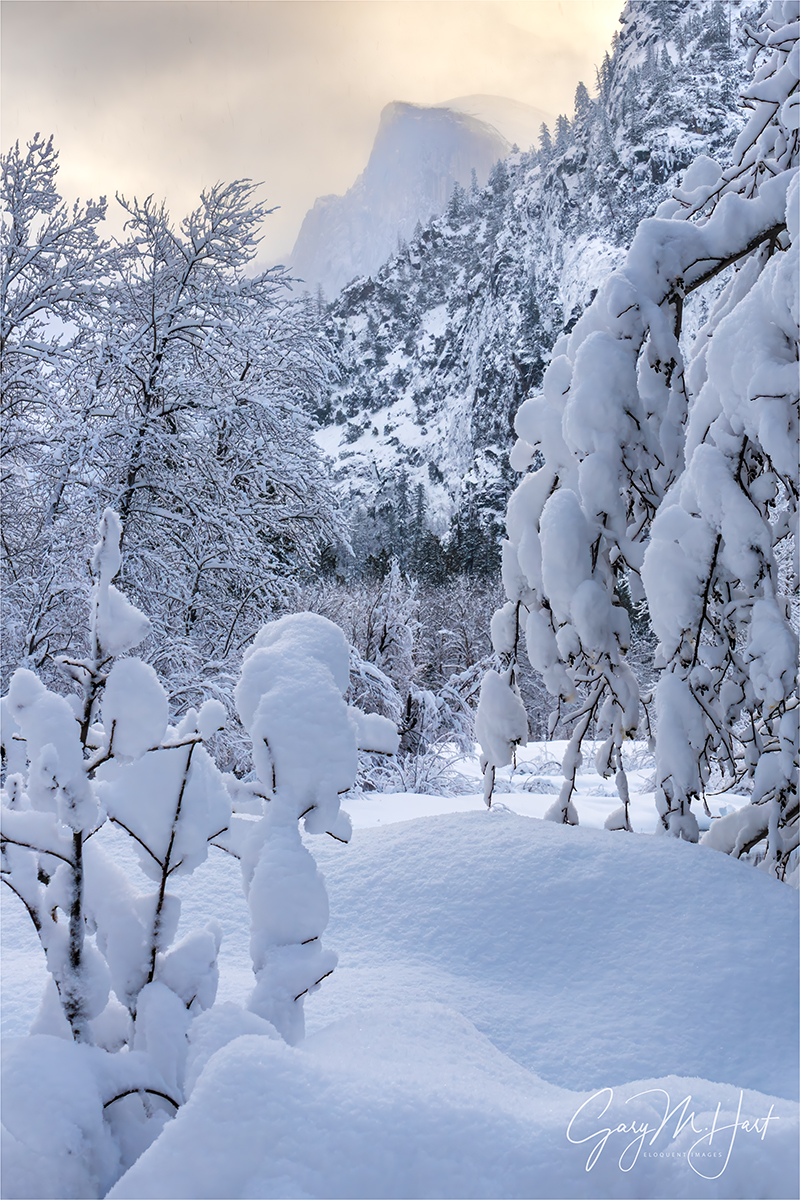
Winter Morning, Half Dome and Clouds, Yosemite
Sony a7R V
Sony 24-105 G
1/25 seconds
F/11
ISO 100
I get a lot of questions during a photo workshop, but about 80% of them are some version of, “Should I do it this way or that way?”:
- “Should I shoot this with a wide or telephoto lens?”
- “Should I shoot this horizontal or vertical?”
- “Should I include that rock or leave it out?”
- “Should I polarize this or not?”
- “Should I freeze or blur the waterfall?”
- “Should I…?”
Some photographers are so paralyzed by these choices, they choose to do nothing rather than make a “mistake.” They forget that, as with every other artistic endeavor, in photography there’s no universal right or wrong, no consensus on the best way to render a scene.
Other photographers are inhibited by the subconscious need to conserve resources at all costs. That need to conservative probably started way back in our childhood, when we were constantly warned not to waste: clean your plate, turn off the light when you leave the room, don’t leave the water running, and a host of other waste-related proclamations are a right of passage for American (and likely everywhere else) youth.
Adding to our formative-years’ “don’t waste” anxiety, when film shooters graduated to our first “grown-up” camera (one that didn’t involve a film cartridge and pop-on flash cube—I’m looking at you, Kodak 104), after being rendered destitute by our complex new equipment, we were suddenly punched in the wallet again (and again, and again…) by the perpetual expense of film and processing. It’s no wonder we grew accustomed to sparing every frame, an inclination that for most became ingrained.
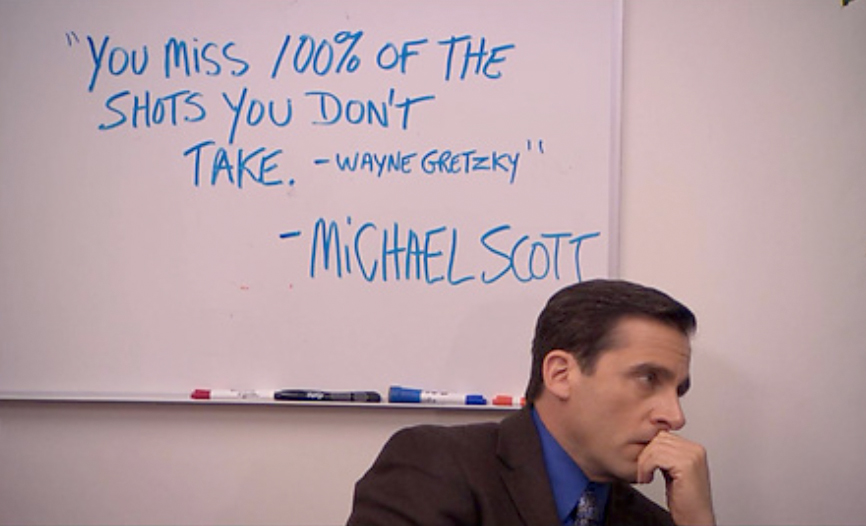
Conserving resources is certainly important, but that parsimony shouldn’t come at the expense of your photographic success. In the immortal words of Michael Scott:
Still not convinced? Here’s a paradigm bending insight that might help: While every click with a film camera costs money (film and processing), every click with a digital camera increases the return on your investment. That’s right: each time you take a picture with your digital camera, your cost per click drops. So click freely and stop counting—there’s no limit to the number of pictures it takes to get to the one you’re hoping for.
I’m not suggesting that you put your camera in continuous shooting mode and fire away*. But I am encouraging you to shoot liberally, the more the better—albeit with a purpose. And there’s no law saying that purpose must be a successful image.
A shutter click can just be a way to get in the mood, or to determine whether there really is a shot there (I don’t always know whether a scene is worth shooting until I’ve clicked a couple of frames), or simply an experiment.
Following that mindset, I frequently play “what-if?” games with my camera: “What if I do this?” I’d be mortified if people saw some of these what-if? images, but I do usually learn something from even the worst of them. Often that learning is simply what not to do, because a failure is at least a way to understand why something didn’t work, and often leads to ideas for how it might work the next time.
Even when a scene is so beautiful that a successful picture feels inevitable, I always consider my first click a draft: rather than a completed masterpiece, my goal for the first few clicks of a scene is to establish a foundation that I can incrementally improve until I’m satisfied the finished product is as “perfect” as it can be.
When I’m not sure of the best way to handle a scene, I shoot it multiple ways, deferring the decision until I view the images on a large monitor. Not only using a variety of compositions, but a variety of depth, exposure, and motion effects as well.
And never settle for just one excellent image. When photographing a scene that truly thrills you, slow down and shoot it with as much variety as possible: horizontal/vertical, wide/tight, as well as multiple foregrounds, backgrounds, and framing—as many variations as you can come up with. I mean, you never know when a magazine might want to put a vertical version of that horizontal Half Dome in the snow image on their cover—even if it’s not obvious at first, most great horizontal scenes have great vertical scenes as well (and vice-versa).
Which brings me to today’s image of, not coincidentally, Half Dome in the snow.
This was the first morning of the workshop formerly known as “Yosemite Horsetail Fall.” Click the images below to read more (I’ll still be here when you get back):
Circling Yosemite Valley, we feasted our eyes on the new snow covering every exposed surface. My job was to find the best views to put with all that still pristine snow. Beauty surrounded us, but with filling the bowl of Yosemite Valley, views beyond 100 yards had disappeared.
Approaching Sentinel Bridge, I glimpsed Half Dome peeking through the clouds; my instant inclination was to pull into the Sentinel Bridge parking lot, but we found the lot covered with a foot of overnight snow still waiting for the day’s first snowplow. I was pretty sure my Outback could handle it, but I was less confident about the other two cars in our caravan. So I crossed my fingers that Half Dome would hang in a little longer and continued toward another favorite, and less known, view of Half Dome.
We found the parking at this next spot, about a mile beyond Yosemite Lodge, a little less problematic. The downside here was that getting to the view requires a (roughly) quarter mile “hike” on a flat and normally well-worn riverside trail. But of course that trail was now obscured by at least a foot of fresh powder. Since I was the only one who knew where we were going, it fell to me to blaze a new trail. Concerned about missing the window to photograph Half Dome before it disappeared again, I quickly grabbed my camera bag and headed through the forest as fast as the snow allowed, my group in tow.
At first the going was pretty manageable, but whenever we exited the evergreen canopy into a more open stretch, the powder doubled and I sunk in above my knees with each step. Normally when leading a group to a new spot, I need to take care not to walk too fast, lest those not familiar with the route lose track of me. But battling through the snow slowed me enough to allow everyone drafting behind me to keep up—and even if someone did fall a little behind, they’d have no problem following the path cut by the rest of us.
Needless to say, bundled for winter and hurrying as quickly as I could, I worked up a real sweat in that quarter mile. The rest of the group wasn’t far behind, and we shared the thrill of the workshop’s first peek at Half Dome, never a certainty in stormy weather. We photographed here for nearly an hour, watching Half Dome disappear and emerge from the clouds many times, creating new opportunities every minute, and also a constant reminder Half Dome could disappear for good any second.
To my eye, the obvious composition was horizontal, with a foreground that included the river (with a partial reflection) and lots of snow-draped trees and rocks. But after working on many versions of that scene, including some vertical versions, I went exploring to see what else I could find.
Less than 20 feet from my original spot, I found this view of Half Dome framed by snowy trees and the graceful curves of drifting snow. I tried many versions of this scene as well, both horizontal and vertical, before landing on this one that was a little tighter than most of the other frames I’d come up with.
In the dozens of photos I came away with are probably more clunkers than classics, but I don’t care. And honestly, this was one of those extra frames that I forced myself to shoot because the scene was too nice to quit, not because I saw something special—it wasn’t until I reviewed my images on my big monitor at home that I realized it was an image worth processing and sharing. (And I know there are probably more keepers in this morning’s folder, just waiting for me to uncover.)
Photography often requires instantaneous choices, and Nature doesn’t usually wait until you’re ready. Just because you’re not sure what you’ll end up with, or don’t have a pro photographer whispering guidance and reassurance in your ear, doesn’t mean you should stop shooting. Even if you don’t see any winners at the time, at the very least you’ll learn something—and who knows, you might just surprise yourself later.
* True story: I once had a woman in a workshop put her Nikon D4 in continuous shooting mode, hold the camera in front of her, depress the shutter button, and spin. When I asked her what in the world she was doing, she replied, “It’s Yosemite—there’s bound to be something good in there.”
Workshop Schedule || Purchase Prints || Instagram
Half Dome Views
Click any image to scroll through the gallery LARGE


Pingback: More Than a Pretty Picture | Eloquent Images by Gary Hart