(More) Tunnel View magic
Posted on November 17, 2011
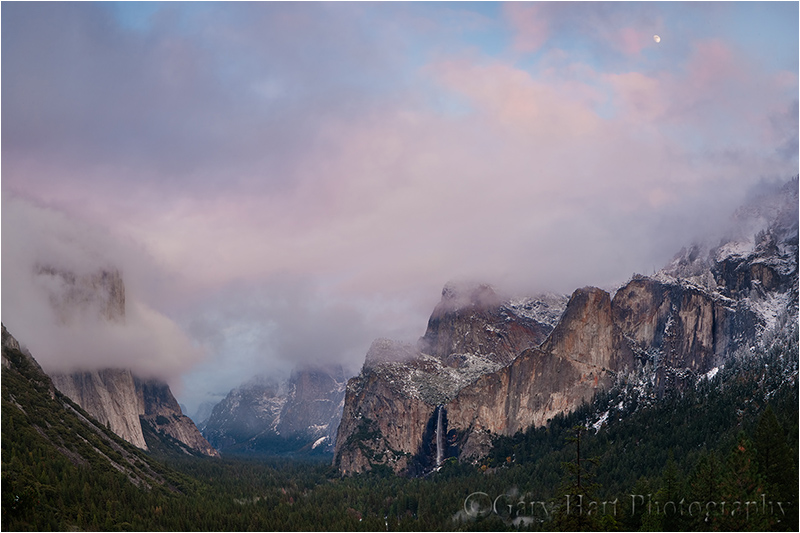
Moon at Twilight, Yosemite Valley from Tunnel View
This post is for everyone who woke up this morning thinking, “Gee, I sure wish there were more pictures from Tunnel View in Yosemite.” Well, you’ve come to the right place.
Okay, seriously, the world really doesn’t need any more Tunnel View pictures, but sometimes I just can’t help myself. Call me biased, but I’ll put this view up against any in the world. I’ve been here hundreds (thousands?) of times, but still try to make it my first stop every time I enter Yosemite Valley (even though it’s a slight detour from my standard route into the park). And Tunnel View’s position overlooking the west end of the valley makes it the first place to clear after a storm, so it’s usually where I wait out any weather.
Since most of my workshops usually include a few people who have never experienced Yosemite, I get vicarious thrills by making Tunnel View my first workshop stop. Of course we usually return as I have many favorite times to share this view: any clearing storm, a crescent moon rising in the predawn twilight, a fiery sunset, Bridalveil Fall’s colorful ascending prism each spring afternoon, Half Dome and El Capitan against a post-sunset pink and blue pastel sky, a rainbow arcing across Yosemite Valley, and a full moon rising above Half Dome at sunset. Nevertheless, with a vast portfolio of all these magic moments, I rarely photograph here anymore.
So what possessed me to take out my camera on the first sunset of last week’s Yosemite workshop? I’m guess still a hopeless sucker for a clearing storm, but the tipping point for me that evening came when I moon popped out, a rare opportunity to photograph something a little different from anything else I have. Including the moon in my frame required going a little wider than I normally do here, about 30mm in this case, which reduced the moon to a small accent punctuating the scene. If you read my post on visual balance, you understand why I like a small moon that’s not necessarily the focal point the frame.
But enough about me. As much as I enjoyed photographing this, it was more fun watching everyone else watch the sunset unfold. The swirling clouds went from gray, to white, and then pink, before finally parting to reveal blue sky and the moon suspended above Leaning Tower. Between clicks I heard giggles of excitement and even a few audible gasps. Pretty cool.
Isolation
Posted on November 11, 2011
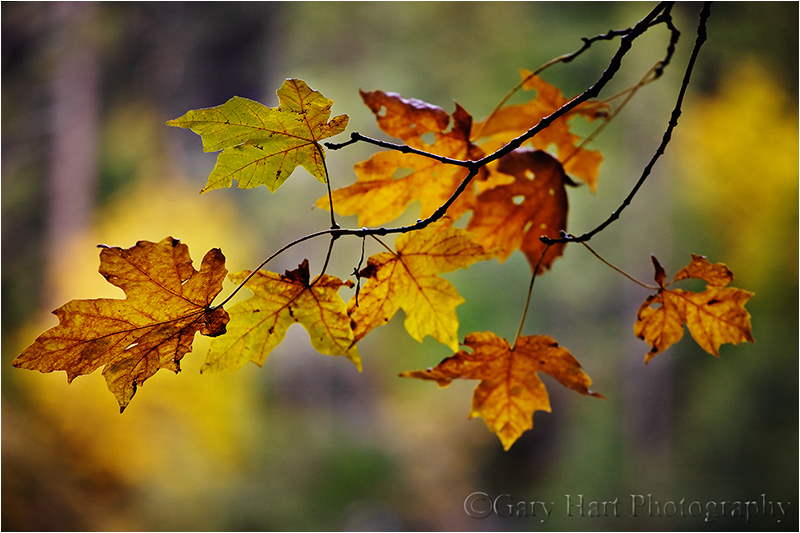
Forest Autumn, Yosemite
Canon EOS-1Ds Mark III
200 mm
1/25 second
F/4
ISO 200
I love sweeping panoramas, but when I’m alone I often gravitate to the intimate locations that make nature so personal. In Yosemite’s dark corners, places like Bridalveil Creek beneath Bridalveil Fall, and the dense mix of evergreen and deciduous trees lining Merced River near Fern Spring and the Pohono Bridge, I scour the trees and forest floor for subjects to isolate from their surroundings.
Helping your subjects stand out is often the key to a successful image. Sometimes subject isolation is a simple matter of finding something that stands out from its surroundings, an object that’s physically separated far from other distractions. But more often than not, effective isolation requires a little help from your camera settings, using contrast, focus, and/or motion to distinguish it from nearby distractions.
A disorganized tangle of weeds or branches can become a soft blur of color when you narrow your depth of field with a large aperture, close focus point, and/or long focal length. Likewise with motion, where a long shutter speed can smooth a rushing creek into a silky white ribbon. And a camera’s inherently limited dynamic range can render shadows black, and highlights white, creating a perfect background for your subject.
After finding these dangling leaves, just across the road and a little downriver from Fern Spring in Yosemite Valley, I juxtaposed them against the vertical trunks of background maples and evergreens. Zooming to 200mm reduced my depth of field, separating the sharp leaves from the soft background of trunks and branches. A large aperture further blurred the background to a simple, complementary canvas of color and shape. Slight underexposure and a polarizer (to remove glare) helped the color pop.
On my website you can read more about my favorite Yosemite photo locations.
A gallery of isolation


Sweet moment
Posted on November 6, 2011

Winter Moon, Half Dome, Yosemite
Last November I planned a trip to Yosemite to coincide with the full moon rising above Half Dome at sunset. When a prematurely cold storm blew through and blanketed Yosemite with snow. While the photography was fantastic, I resigned myself to waiting another year for the moonrise I’d hoped for. And I certainly didn’t complain. After a full day of photography in conditions than ranged from overcast to downright stormy, as sunset approach I saw nothing to give me hope for the anticipated moonrise. Nevertheless, I headed to Tunnel View to finish the day.
What happened next was a reminder of why I never try to predict Yosemite’s weather in five minutes based on Yosemite’s weather right now. As many times as I’ve visited Tunnel View (surely it must be in the thousands), the view as a storm clears can still take my breath away. That evening I arrived to find Yosemite Valley coated in a sugary glaze; within minutes Mother Nature served up the next course, turning the clouds above Half Dome cotton candy pink. Then, as if by magic, a gap materialized in the clouds to the right of El Capitan to reveal the moon, like a glowing lollipop. Within sixty seconds the clouds had swallowed the moon and the visual feast was over.
Making sense of nature
Posted on November 2, 2011

Cascades, Bridalveil Creek, Yosemite
I love the iconic captures as much as the next person–scenes like Yosemite’s Horsetail Fall in February, Antelope Canyon’s heavenly beam, or McWay Fall’s tumble into the Pacific, are gorgeous and a thrill to photograph. But standing elbow-to-elbow with tens (or hundreds!) of photographers, each recording identical images that are already duplicates of thousands of prior images, while lots of fun, isn’t enough to stimulate my creative juices. What keeps me going is the opportunity to experience nature with more than just my eyes. Nothing in photography makes me happier than enduring images (my own or others’) that stir the non-visual senses, evoke emotion, and soothe the soul. Colorful sunsets and dramatic clouds might draw the ooohs and ahhhs so many photographers covet, but give me images that convey the sound of running water, the fragrance of evergreen, the texture of granite.
Once upon a time photographing even the most popular scenes in solitude wasn’t difficult. The tourists who overwhelm the best known views during the comfortable times of day would vacate just when the photography started getting good. But the proliferation of digital photographers, combined with the easy exchange of information in our connected world, means there are no secrets anymore and opportunities for solitude have become few and far between. Today if you capture a beautiful image, posting it anywhere is sure to immediately draw photographers like cats to a can-opener.
Given that Yosemite Valley’s eight square miles attracts nearly four million visitors each year, you’d think it would be impossible to find the solitude I crave. But on even the busiest summer day, rising for sunrise will give you at least a couple of peaceful hours. And of course in Yosemite’s backcountry, while relatively crowded by wilderness standards, solitude is always just a short detour away. But even when I’m not in the backcountry, and the sun is up and tourists teem like ants at a picnic, I still have a few quiet spots that get my creative juices flowing.
Near the top of my list are the cascades beneath Bridalveil Fall. Here in the shadow of Yosemite Valley’s shear south wall, with just a little bit of scrambling I can photograph in hours of quiet (contrast-soothing) shade. Variety is no problem here because Bridalveil Creek is different each time I visit: In February it might be frozen solid or smothered by snow; in May the creek roars with snowmelt; in August it’s a quiet trickle beneath a canopy of green. My favorite month might be October, when the gentle stream tumbles through a carpet of colorful leaves.
This fall Yosemite’s color was a little late. Rather than the explosion of color I often find in late October, the leaves were simple accents for the whispering cascades. After playing with some tighter compositions that featured individual leaves among the rocks, I spent at least an hour with this set of cascades–the longer I stayed, the more I felt there would never be enough time to capture everything I saw. I’ve been doing this long enough to know that images like this won’t excite people the way my more dramatic images do, but they make me happy, and that’s what matters most.
Chasing the moon (the cure for boring skies)
Posted on October 31, 2011

Twilight Crescent, Olmsted Point, Yosemite
Whether I’m shooting on my own or (especially) leading a photo workshop, there are no weather conditions I stress about more than blue skies. As nice as it is to be outside on a sunny day, cloudless skies are not a photographer’s friend. Not only do blue skies limit productive photography time to a ninety minute (or so) window sandwiching sunrise and sunset, even in the best light, they’re just plain boring.
In recent years my antidote for blue skies has been to plan as many trips as possible around the moon. The obvious example is Death Valley, which averages about one inch of rain per year and is therefore quite possibly the blue sky capital of the world. Scheduling my Death Valley workshop to include a full moon ensures that, even with cloudless skies, we’re at least able to do moon and moonlight photography. With careful planning I’m able to get the group in position for two sunset moonrises and two sunrise moonsets–always a big hit (for students and instructor).
Of course Death Valley isn’t the only place I photograph that suffers from blue skies. Yosemite is much more likely to have interesting weather, but it’s by no means a sure thing. To hedge my bet in Yosemite I try to time as many workshops there around the moon. For example, I love the way the autumn full moon aligns with Yosemite’s Half Dome and always schedule a fall workshop to coincide with this. But since I can usually fill at least two fall workshops in Yosemite, and there’s only one full moon per month (who do I talk to about that?), I try to plan a second Yosemite fall workshop around a crescent moon.
Because it’s always in the sky opposite the sun, a full moon is relatively easy to photograph if you know what you’re doing. But a crescent moon is always in the brightest part of the sky–the thinner the crescent, the closer to the sun it is. A waning crescent precedes the sun in the east at sunrise, shrinking each day until one morning it’s obliterated by the rising sun. A day or two later the “new” moon reappears at sunset as a waxing crescent, trailing the sun to the western horizon just after sunset–each evening it sets a little later and larger (and “older”).
The crescent moon’s proximity to the sun is a particular problem in Yosemite, as Yosemite Valley is a bowl that’s in deep shade when a crescent moon is in the sky. My solution is to find an elevated location–such as Tunnel View, Glacier Point, Sentinel Dome, or Olmsted Point–with a view of Half Dome (which is elevated and always brighter than the valley floor).
The trick is to align the moon with Half Dome. For the workshop that just ended Sunday, I determined that the best moon location was Olmsted Point where, on Saturday night, a 12% crescent would hang high above Half Dome at sunset. Moon or not, Olmsted Point is one of my favorite easily accessible locations in Yosemite–it offers a perspective of Half Dome that’s different from the standard views, and glacial erratics (boulders deposited by retreating glaciers) on Olmsted’s sloping granite make great foreground subjects. I knew a thin moon in an otherwise empty sky above Half Dome would make a perfect accent.
I got my group up to Olmsted early so everyone had time to get familiar with the surroundings and find their compositions. The moon was visible when we arrived, but wasn’t prominent enough to photograph until close to sunset, when the sky darkened enough to allow the daylight-bright crescent to stand out. We photographed until darkness was nearly complete, starting with wider shots that included the moon and the reflective granite foreground illuminated by the glowing sky, and continuing until the only shots remaining were moderate vertical telephotos that featured the descending moon above the darkening Half Dome.
Staying out this late, gazing toward the horizon where the sun just disappeared, is a great reminder of how vivid sunset color is, even when there are no clouds. (Next time you watch a sunset, don’t leave when the sun leaves–stay out at least a half hour longer and watch the color in all directions–if you didn’t know better, you’d swear God was taking liberties with the saturation slider.) Eventually our scene became too dark to photograph, but the color just kept getting deeper and deeper. The last few minutes were spent not photographing but appreciating.
You had to be there
Posted on October 22, 2011

Moonset, Candlestick Butte, Canyonlands National Park
If you read my blog enough, you know that I do lots of advance planning, particularly when I want to put the moon in my frame. I have my own workflow for determining the moon’s position relative to the landscape, a workflow I established long before tools like “The Photographer’s Ephemeris” simplified the process immensely. (TPE is a new trick, and I’m an old dog, so I stick with my tried-and-true methods.) But even the best resources and plotting are no substitute for familiarity, not a big problem at nearby locations like Yosemite or the mountains, but not quite so easy at the spots I only get to once a year.
After two years of co-leading Don Smith’s Arches/Canyonlands workshop with mostly boring blue skies, I suggested to Don that we try the approach I use for my Death Valley workshop. Death Valley is notorious for its blue skies (it averages one inch of rain per year), so despite the fact that I schedule that workshop for the middle of winter to maximize the chance for weather, I also synchronize it around the full moon–even if we get shut out in the weather department, we can still add interest to the sky by including the moon in several sunrise and sunset shoots. And moonlight photography beneath clear desert skies is always a highlight.
So this year Don scheduled his Arches/Canyonlands trip for the October full moon, and as feared, a few days before we started the National Weather Service confirmed that Mother Nature would be serving us a week of blue skies. This time, rather than stress, we found solace in our secret weapon: the moon.
As we always do, Don and I arrived a day early to re-familiarize ourselves with the area we hadn’t seen in a year. That night we made the trek up Delicate Arch for sunset, and to get an idea of where the moon would rise relative to the arch. We saw immediately that we’d need to get creative with our position to line the moon up with the arch (that’ll be a post for a different day).
Since I’m the designated “moon guy” on our trips, following the Delicate Arch shoot I immediately started thinking about locations for moonrise and moonset for the rest of the week. The next morning I purchased a topo map (my trusty topo software doesn’t include Utah) and started studying the options. Don and I hate taking groups to spots we haven’t scouted thoroughly in advance, so after an hour or so with the map, I decided to forego the workshop orientation and head up to the Canyonlands’ Island in the Sky district to scout the possibilities.
I returned three hours later feeling giddy. Not had I found the above unmarked vista that would align the setting moon with the Candlestick on our penultimate sunrise, I also found a great sunset spot that would allow us to photograph the full moon rising above the La Sal Mountains the evening before. Those two shoots turned out to be the highlight of the workshop, not just because of the moon, but also because we got a perfect mix of unexpected (and welcome!) clouds to catch the color.
On the drive to this sunrise shoot the group was still buzzing about the sunset shoot the night before, but quickly forgot as we made our way to the canyon’s rim and saw the moon hanging low above the Candlestick. There was room here for everyone to spread out, and while the foreground when we started was too dark to allow lunar detail, the light rose quickly, filling the sky with glorious pink pastels to complement the red canyon below. We found something for every focal length, from ultra-wide compositions with lots of foreground (like this image), to long telephoto frames that isolated the moon above the Candlestick. Don and I spent a great deal of time reminding people to bracket their compositions, but in between we managed to capture a few frames of our own.
One of the great pleasures of these workshops is seeing the variety of compositions possible at a single location. At image review that afternoon it was clear that everyone had not only captured the scene well, but had also found their own unique perspective. Pretty cool.
Monument Valley by moonlight
Posted on October 19, 2011

Big Dipper Above Monument Valley, Utah/Arizona border
After a successful and satisfying week co-leading Don Smith’s Arches/Canyonlands workshop, Don and I detoured to Monument Valley on our way home. The evening of our arrival we hired a guide to take us to Teardrop Arch at sunset, but with cloudless skies and a 14+ hour drive home to Central California, we decided to pass on a sunrise shoot that was unlikely to yield anything the world hadn’t seen before. Instead, we rose at 4:30 to photograph Monument Valley by moonlight.
Monument Valley is part of the Navajo Nation; access to pretty much any location off the main road or hotel grounds requires a Navajo guide. Unable to explore, Don and I trekked, still bleary-eyed, to the vista platform adjacent to the hotel restaurant, a hike of at least 150 feet from our room (not to mention a 10 foot elevation gain).
The first thing I saw from the platform was the Big Dipper, to the left of the Mittens, but not so far left that I wouldn’t be able to use it in a composition. I do so much moonlight photography that exposure and focus are routine, so almost all of my time was spent cycling through a variety of horizontal and vertical compositions covered the entire scene and most of the focal range of my 24-105 lens.
Whether it’s extreme weather, a strenuous hike, or sleep deprivation, I find it interesting how frequently the most memorable shoots result from the most difficult conditions. It wasn’t easy to get out of bed at 4:30 a.m., but the experience that followed was one of my most memorable in a long time, and surely had lots to do with the drive home being much better than we expected.
Tuba City, Flagstaff, Kingman, Needles, Barstow, Tehachapi, Bakersfield, Kettleman City, Santa Nella…. Home!
Visual balance
Posted on October 16, 2011
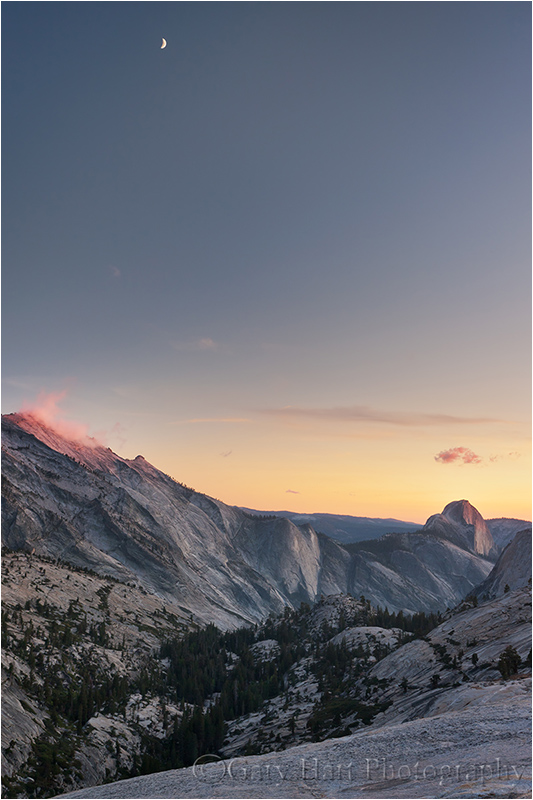
Olmsted Point is one of my favorite easily accessible locations in Yosemite. I enjoy it for the different (from the more common Yosemite Valley angles) view of Half Dome, the range of wide to tight composition possibilities, and for its many foreground options. I visit Olmsted Point a lot, both on my own and with workshop groups. It’s where we shoot the final sunset of my Eastern Sierra workshop, which is how I ended up there two weeks ago.
Before arriving I knew the waxing crescent moon would be quite high that evening, but standing there on Olmsted Point’s granite I saw a wide vertical composition that would form a triangle connecting the moon, Half Dome, and Cloud’s Rest. Going that wide meant that the moon would be quite small in an otherwise empty sky, but I know from experience that even a very small moon carries enough “visual weight” to support a significant portion of the frame.
In my previous post I talked about distilling a scene to its essence through the use of color, shape, light, and line. Usually these essential qualities define or in some significant way affect physical objects such as a tree, a rock, an iconic landmark, or the moon. The (subjective) difference separating a snapshot from effective artistic expression is coherent assembly of these compositional elements. Among other things.
Also important is avoiding distractions and balancing the frame. Which brings me back to this tiny crescent. Volumes have been written on artistic composition. While I won’t deny their validity or function, my experience has been that many aspiring photographers get so bogged down trying to follow photographic canons like the rule of thirds and leading lines, that they fail to trust the instincts that are the true source of creativity. For that reason my training avoids prescriptive instruction in favor of intuitive concepts.
As much as many aspiring photographers would like a composition formula that dictates where to locate each element in their frame, successful composition ultimately comes down to feel. The last thing I check before clicking my shutter–after I’ve identified the general composition, determined depth of field, eliminated distractions–is the sense of balance in the frame. To explain photographic balance I use a term I call “visual weight,” which I define as any object’s ability to pull the viewer’s eye–think of it as gravity for the eye.
If you’re looking for a formula, you’ve come to the wrong place because an object’s visual weight is subjective and determined by the viewer. Visual weight can be a function of the object’s size (or not), brightness (or not), color (or not), shape (or not), or position in the frame (or not). Imagine a rectangular plane perfectly balanced horizontally on a fulcrum–to maintain its equilibrium, any added weight must be counterbalanced by a corresponding weight elsewhere on the plane. Visual weight is the virtual equivalent: Imagine your frame (or print) balanced on a fulcrum; any visible element that pulls the eye tips the frame from horizontal (makes it out of balance) and must be counterbalanced by an element with corresponding visual weight.
So what does all this have to do with a tiny moon’s ability to balance a frame? I thought you’d never ask. Visual weight defies quantification because it’s mostly a function of each viewer’s perception: The largest component of visual weight is an object’s emotional tug. Years of photographing the moon whenever possible and in any phase, has caused me to realize that to most people few things in nature have a stronger emotional tug than the moon.
I was once told by a magazine that moon images don’t work because they’re too small (a misconception they’ve since corrected)–if I’d have stuck with “conventional wisdom,” I’d have never followed my instinct to shrink the moon with wide compositions, and in the process discovered that they do indeed work. And if I hadn’t tried to understand why I’m able to get away with a tiny moon, I’d have never attempted to comprehend and define visual weight. I suppose the most significant message here is more than the concept of visual weight, it’s to never let conventional wisdom trump your instincts.
That evening on Olmsted Point I was already pretty pleased with my results when Mother Nature punctuated Cloud’s Rest and Half Dome with pink-fringed clouds, just as the setting sun bathed the scene with its last light. It’s these little gifts that make memorable moments feel like magic.
Keeping it simple
Posted on October 10, 2011
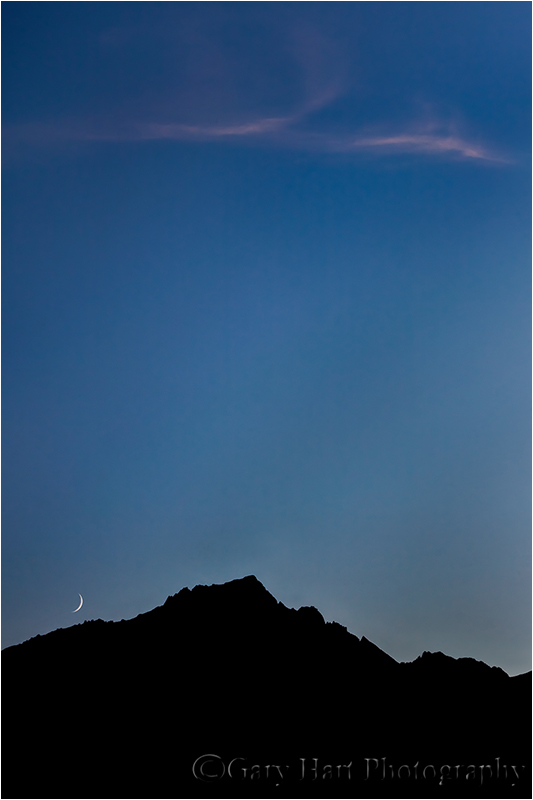
Setting Crescent, Lone Pine Peak, California
Last week I guided my Eastern Sierra workshop group into the Alabama Hills to photograph the Sierra crest at sunset. We stayed until the sky darkened enough to reveal a sliver of moon low in the west, just about to vanish behind Lone Pine Peak. While my eyes easily pulled detail from the shadows of the distant mountains and nearby boulders, and simultaneously registered the deep twilight blue in the much brighter sky, I knew there was no way a camera could capture both.
The conventional “solution” to limited dynamic range like is to use a computer blend multiple frames at different exposures into a single HDR (high dynamic range) image, or to suppress the brightness of the sky with a graduated neutral density filter. While these are perfectly valid techniques, I’m afraid the knee-jerk inclination to render the world exactly as we see it short-changes the camera’s unique ability to remove distractions and distill the world to its essential elements: color, shape, light, and line.
On this evening in the Alabama Hills, nothing else my eyes registered could compete with the color in the sky, the sharp outline of Lone Pine Peak, and the disappearing slice of moon. Metering on and slightly underexposing the sky, I captured nothing but the crescent moon above Lone Pine Peak’s strong outline, both embedded in the sky’s natural blue. All of the shadowed detail that would have distracted from the scene’s essence, disappeared in the black. The punctuating wisp of cirrus, pink with sunset’s last gasp, was a gift.
Macro magic
Posted on October 4, 2011

Rose Grape (Medinilla), Hawaii Tropical Botanical Garden, Hawaii
The Hawaii Tropical Botanical Garden is photographer heaven. Meandering its verdant paths through a breathtaking assortment of tropical plants, a photographer could take an hour to move ten feet. Eventually the trails make their way all the way down to the crashing surf of Onemea Bay. And if that isn’t enough to occupy you, just as you think you’re ready to exit, you stumble upon a multi-tiered waterfall that could occupy a photographer for hours by itself. I gave each of my recent workshop groups four hours to explore the garden’s immaculate trails, but I don’t think anyone felt they came close to tapping the potential there.
The first group visited the garden in rain that ranged from gentle mist to tropical downpour. Rain softens the light and adds glistening drops to every surface–if you’re prepared, there are no better conditions for macro photography. Because Hawaii’s rain is warm and (usually) vertical, an umbrella is sufficient to keep the camera and lens dry. And a person can only get so wet–you quickly reach a point where you won’t get any wetter, no matter how long you stay out. My approach to photographing in Hawaiian rain is to wear at little as possible (no cotton!)–in this case I wore a swimsuit, running tank-top, and flip-flops; my camera (on a tripod) sported a plastic garbage bag that came off only when it was time to shoot. An umbrella sheltered the camera and lens while I composed and clicked.
One of the things I love most about macro photography is the way the intimate, invisible world suddenly snaps into focus. This world is always present–all you need to do is look. And unlike many broad landscape images, no two macro images ever seem the same.
Not only is the macro world magnified, so are changes in each composition’s creative components: The relationship between objects changes dramatically with any repositioning of the lens; tiny depth of field changes significantly alter the result; the smallest miss in focus point can ruin an otherwise beautiful image; and even minuscule motion can blur a delicate line into a distracting smudge.
For these reasons, I can’t imagine attempting serious macro photography without a tripod. I start with a composition, exposure setting, focus point, and DOF that I think will work, then stand back and carefully scrutinize the result in my camera’s LCD. It’s a rare image that I don’t improve following this initial review. My changes can range from a different f-stop to change the DOF, to a complete repositioning of the lens to alter a foreground/background relationship. Regardless, with my camera on a tripod, I can take my time identifying problems and compositional variations, comfortable in the knowledge that the image I’m reviewing is still sitting right there in my viewfinder until I’m ready to make my adjustments.
In this image, captured in a light rain, I used an extension tube on my macro lens to get as close as possible to these colorful medinilla berries. My focus point was the dangling water droplet. Capturing the scene’s miniature reflection in the drop required perfect focus, so I used my camera’s live-view, magnified ten times, to ensure precision. I clicked several frames until I got the composition just right, then several more for at different f-stops for DOF variety. Reviewing the choices on my large display at home, I decided that the wide-open, f2.8, image gave me a smooth background that allowed the berries to stand out, and was pleased to see that I had indeed nailed my focus point (thank you, live-view).

 Eloquent Images by Gary Hart