Eloquent Images by Gary Hart
Insight, information, and inspiration for the inquisitive nature photographer
A Moving Experience
Posted on December 18, 2025

Fire on High, Kilauea Eruption 33, Hawaii
Sony α1
Sony 16-35 GM II
1/50 seconds
F/8
ISO 200
I’ve been photographing Kilauea’s eruptions, in many forms, for 15 years, but never anything close to the spectacular display my workshop group and I witnessed in September. It wouldn’t be hyperbole to say that this was one of the most memorable experiences of my life. (I’ve said that about Kilauea eruptions before, but each time I say it, Kilauea seems to say, “Oh yeah? Hold my Mai Tai.”)
As a photographer who obsesses about controlling every pixel in my frame, and who (semi-) jokingly asserts that I don’t photograph anything that moves, there was a lot going on atop Kilauea this morning. Anybody up there with a camera could have snapped a few frames and captured something worthy of sharing, but whether it’s a vivid sunset, dancing aurora, or fountaining lava, serious photographers need to separate themselves from the “anybodys” and pay attention to the little things easily overlooked in the thrill of the moment. This morning on Kilauea, with an obvious focal point and empty foreground, the biggest (and most easily overlooked) challenge was the constant motion in the scene.
Let’s review: Photography is the futile attempt to convey a dynamic world using a static medium. Though that’s literally impossible, what is possible is conveying the illusion of motion—that is, capturing the scene in a way that enables viewers to infer its motion. Finding the shutter speed that freezes a moving subject in place or renders it with some degree of motion blur, while getting the light perfect, is a basic photography skill that simply requires mastery of the three exposure variables.
Motion in a landscape image can take many forms, some easier to address than others. Though waterfalls and whitewater rapids may move fast, at least they stay in one place while the water moves within. But other natural subjects move more unpredictably. Lightning, for example, comes and goes so suddenly, I never even consider using my own reflex/reaction skills to freeze its transient existence—I simply connect my Lightning Trigger, aim my camera, and wait for my trigger and camera to do the work. Ocean waves, while less organized than whitewater, are at least predictable enough to anticipate and time—that said, I generally prefer to simply shoot a series of wave images with varied timing and motion effects, then pick my favorite later.
Somewhere between lightning and waves on the predictable/random continuum are atmospheric phenomena like the northern lights, and regular old clouds. Though they’re in constant (seemingly) random motion, that motion is usually more my speed—slow enough to anticipate and adjust my composition and exposure without feeling too rushed.
But it’s not just about how you render the motion—another complicating factor is paying attention to subjects that don’t stay put: a composition that was perfect seconds ago could be completely out of whack right now. Which happens to be the biggest challenge this memorable morning in Hawaii.
Now might be a good time to mention that part of my desire to control my entire frame makes me especially obsessive about both the borders of my images, as well as the relationships of the elements in my frame that draw the eye. That means trying to avoid cutting strong elements on the edges of my frame, creating a sense of connection and balance between strong visual elements, and avoiding (or minimizing) visual elements that compete with my subject or subjects. So when my subjects are in motion, as they were on Kilauea this morning, I need to monitor and adjust continuously.
Arriving with my workshop group several hours before sunrise, the total darkness meant I only had to contend with 800-foot explosive lava fountains and the lava rivers surrounded by a sea of black. The lava fountains, while exploding violently and pretty much non-stop, were far enough away that they seemed to be moving in slow motion. The lava rivers, though constantly ebbing, flowing, and changing course, moved slowly enough to be relatively manageable too.

Fountain of Fire, Kilauea Eruption, Hawaii
My goal was to freeze the lava’s motion in place, and soon I settled on a shutter speed I was confident would do that even at my longest focal length. With the unchanging light (dark) and a shutter speed I knew was fine, it wasn’t long before I found a rhythm, complementing compositions centered on the “stationary” lava fountain (the lava was moving, but the fountain stayed in one place) with the current position of the flowing lava rivers, then timing my shutter click for when the latest fountain peaked or spread most dramatically. I worked this way for a couple of hours, mostly using my 100-400 and 1.4X teleconverter, zooming in and out and switching between horizontal and vertical compositions.
Things changed when sunrise started painting the sky pink and revealing a previously unseen plume of billowing smoke, vapor, and tephra. Suddenly, my priorities switched to wide angle to capture all the additional beauty brought by the increasing light. And just as suddenly, I had to adjust the compositional imperatives underlying my prior rhythm, now factoring into the mix the wind-whipped smoky plume tower that expanded and shifted by the second, the pink clouds, and even new detail on the caldera floor. And with the rapidly brightening sky, an exposure that worked 30 seconds ago, now blew out the sunlit highlights. Not only that, I knew the plume’s gorgeous warm light was peaking and would only last for another minute or two, further ratcheting up my urgency.
Switching to my 16-35 lens, I framed up a completely new composition and adjusted to a new combination of motion considerations. In this case, including the lava and rising plume were no-brainers, but the goal should be more than simply taking a picture that includes both—everything needs to work together to create something that stands out from the thousands of other images captured at the caldera that morning.
Managing all of a scene’s moving parts is what good photographers are supposed to do. That said, I notice—both in my workshops and online—that many photographers seem so focused on their scene’s one or two most prominent features that they lose track of still important secondary and tertiary elements. And when one or more of those less essential elements is moving, for example waves or clouds, their new position is easily overlooked, leading to random and often less than ideal results.
In this case, while keeping an eye on the active lava as I’d done all morning, I suddenly also needed to keep track of an expanding smoke plume that was in constant motion, illuminated by ever-changing sunlight. While not especially difficult if you’re paying attention, this doesn’t just happen automatically (and I have the pictures to prove it).
Keeping my borders as clean as possible became a prime concern, so I kept a constant eye on the shifting smoke plume to avoid cutting it off. On the left and top I just needed to keep the plume off the borders of my frame; since the wind had stretched the smoke far beyond any reasonable frame on the right side, I also needed to find the best place to cut that side with the right border. And as with my rapidly changing exposure, a composition that worked one second might need to be completely adjusted the next.
I tried to go just wide enough on the right to include all of the main (and most dramatic!) vertical section of the sunlit plume, and on the right went just a little wider than that to include that one small splash light—any farther right would have shrunk my subjects while adding nothing more than a homogenous horizontal band of brownish-gray smoke.
The result of all these machinations is this wide vertical frame that includes the fountaining and flowing lava that was the star of the show that morning, plus all of the sunlit portion of the beautiful smoke plume. Accomplishing this was not rocket science, and I’m not pretending to be special for achieving it. But I do think photographers often fall down when they get so caught up in the majesty of the moment that they fail to take that one extra step to account for the scene’s motion, and the importance of those subtle changes from one frame to the next.
Workshop Schedule || Purchase Prints || Instagram
World in Motion
Click any image to scroll through the gallery LARGE


Kilauea Eruption Episode 33, Part 2: Grand Finale
Posted on September 29, 2025
Fountain of Fire, Kilauea Eruption, Hawaii
Sony a7R V
Sony 100-400 GM
ISO 400
f/5.6
1/125 second
For the full context of my experience with Kilauea eruptions in general, and the events leading up to the fountaining portion of this episode (33), check out my prior blog post: Kilauea Eruption Episode 33, Part 1: So You’re Telling Me There’s a Chance…
The euphoria of our (very) early Thursday morning Kilauea eruption shoot powered my workshop group through the day and into Thursday night. Since we hadn’t made it back to the hotel until 4:00 a.m., I pulled the plug on our sunrise shoot (with zero objections), and the group didn’t gather again until our 1:00 p.m. image review session. It turns out many were so excited by the eruption experience, they opted for downloading and processing over sleep, but the few eruption images we did see definitely turbocharged the eruption enthusiasm.
The discussion during the afternoon meeting centered around whether the fountaining we saw was Kilauea’s new normal, or whether there might be more to come. My inherent optimism went straight to the fact that the prior episode (episode 32, in early September) had delivered the second greatest volume of lava to the caldera floor of all the episodes —the most of 2025 so far. And the latest USGS report said that continuing inflation at the summit meant more was coming. Yay.
The pessimist in me, that annoying little voice that keeps reminding me of the times Mother Nature has thrown cold water on high hopes, kept reminding me of the signs that the reliable eruption sequence that started in December 2024 might be flagging: the fountain height of recent eruptions had decreased significantly from its 1000+ foot peak; the gap separating each fountaining phase was increasing; and most significantly (in my mind), live webcams focused on the eruption’s vents showed that the activity we’d photographed the prior night had completely died—only smoke was visible where we had once seen bubbling, flowing lava.
Shortly after the image review session, we departed for the workshop’s sunset shoot at my favorite beach on the Puna Coast. That evening’s spectacular sunset pushed the eruption buzz to the background, and in a way felt like a fitting wrap-up to a fantastic workshop. We did have one more sunrise shoot planned, but I think everyone felt like it would be anticlimactic following all we’d photographed in the workshop so far. In fact, with flights to catch and coming off a night with very little sleep, when I suggested that we stay in Hilo and stick to the sunrise plan even if the eruption resumed during the night, the agreement was unanimous—we’d already had a great volcano shoot that would be tough to beat. (We’d already been up to Kilauea twice, so I also suggested that anyone who changed their mind should feel free to go up on their own if the eruption started.)
That plan lasted until 3:30 a.m. One of the workshop participants (who had his office manager in Ohio, where midnight in Hawaii is 6 a.m., monitoring the Kilauea webcams and reporting any changes) messaged the group, “It’s fountaining!” I was sound asleep, but the messaging frenzy that followed quickly roused me enough to grab my phone and check the webcam. I instantly knew the sunrise plan was out the window and we were going back to Kilauea, sleep be damned. When he said fountaining, he meant FOUNTAINING!!!
This fountaining was on an entirely different scale from what we’d seen the prior night, or even from anything I’d ever seen—like someone had kicked a giant sprinkler head on the caldera floor. (I learned later that it was the highest fountaining since early July.) Almost all of the group was wide awake and on the road in 20 minutes.
Even though we arrived before 5:00 a.m., a little more than an hour after the fountaining began, the park was much more crowded than we’d seen the previous night. We found parking, but just barely, and I knew the way cars were streaming into the park the open spaces wouldn’t last long.
Because of the crowds, we’d implemented an “every car for itself plan,” each doing its own thing while staying in contact. My car started at Kilauea Overlook, but found the view, while very close, was partially obscured behind the caldera rim. So we quickly doubled back to the Wahinekapu Steaming Bluff (steam vents), for the best combination of direct view to the fountaining vents, and fast access. There we reconnected with most of the rest of the group.
The view to the fountaining vents from the Wahinekapu is about 2 miles—our other option was the closer vantage point at Keanakako’i Overlook, on the other side of the caldera (where I shot the 2023 eruption). This is about 1.25 miles from the fountains, but also required a 15 minute drive followed by a 1 mile walk, and I knew that even if we found parking there (far from a sure thing), it would probably be starting to get light by the time we got our eyes on the eruption. Plus, having shot the eruption from Wahinekapu already, I knew we’d be close enough that 400mm would be plenty long enough.
I’m so glad we took the path of least resistance and stayed at Wahinekapu. Even though my brother Jay (who was assisting me in this workshop) and I had a very small window to shoot before we needed to head back to Hilo to catch our flight home, the timing of the eruption and our arrival couldn’t have been better. We started with nearly an hour of complete darkness, allowing exposures that froze the fountains without blowing out the highlights (overexposing the lava) to create the virtually black background that I think makes the most dramatic lava images. Following the complete darkness, we photographed through the slow transition into a beautiful sunrise. Finally, as the day brightened, we enjoyed about a half hour of the eruption’s towering plume warmed by lava-light from below, and low sunlight from above. Absolutely spectacular.
When I first photographed lava in 2016, I was learning on the fly. At night, standard histogram rules don’t apply to lava because a properly exposed frame will be almost completely smashed agains the left side (with much cut off), and often, especially on wider shots, with just few small highlight blips on the far right. Basically, job-one is to make the lava as bright as possible without blowing it out. And job 1a is to do that using a shutter speed that freezes the lava’s motion (unless motion blur is your objective). And finally, you really should do this using the best (lowest) possible ISO.
The mistake people make for any kind of motion blur, and I’ve heard a lot of “best shutter speed for Kilauea’s lava fountains” advice, is to assume that there’s one ideal shutter speed for freezing the lava fountains. There isn’t. Just as with flowing water, the shutter speed that freezes a lava fountain is a function of several factors: the speed at which the lava is moving—the higher the fountain, the faster the lava will be moving when it reaches the ground, the distance to the fountain, and the focal length.
Back in 2016 I started with extremely high ISOs to maximize my shutter speed, but have gradually, through trial and error, dropped both my ISO and decreased my shutter speeds for my lava images. At night, since depth of field is usually no concern, for most of my long telephoto shots using my 100-400, I now just shoot wide open, at f/5.6 for that lens. My exposure trial and error process involves taking a shot at a certain focal length, verifying that the lava is close to maximum brightness without blowing out, then magnifying the image in my viewfinder (or LCD) to confirm that there’s no motion blur in the lava fountain (make sure you check the lowest lava blobs, as they’ll be moving fastest). If that works, I lower my ISO and increase my shutter speed further, until I find the threshold where blur is discernible. Then, for a just-to-be-safe cushion, I bump my ISO and shutter speed back up to just slightly more than the prior settings (that I thought froze the lava).
I had to do this for every significant change in focal length, but it wasn’t long before I became pretty comfortable with my settings. And by the time this Friday morning lava fountaining started—having done it in 2016, 2022, 2023, and earlier that week—I was feeling so comfortable with my exposure settings that it was no longer a distraction. In fact, I was varying my focal length so frequently and clicking so fast, to simplify the process I just kept my exposure settings in the range I knew would work all the way out to 400mm. I was fine with this because a very satisfactory ISO 400 gave me a shutter speed in the 1/100 to 1/200 second range that I knew worked.
So bottom line? In total darkness, standing 2 miles away, at 400mm I was perfectly comfortable with f/5.6, ISO 400, and 1/100. But I hope you can see that my exposure settings probably won’t work for you if you’re much closer than 2 miles, and might be overkill if you’re farther away. In other words, I strongly encourage anyone who wants to photograph fountaining lava to apply my process, not my settings. (And there are many people with far more experience photographing lava than I have, so feel free to defer to them if their results confirm that they know what they’re talking about.)
This experience, the final shoot of my 2025 Hawaii Big Island workshop, wasn’t just the grand finale for this workshop, it was the grand finale of 15 years of Hawaii workshops. As I pare down my workshop schedule and ease (slowly) toward retirement, I decided a few months ago that this would be my final Hawaii workshop. Not because I don’t enjoy it (I do!), or because it no longer fills (it does!), but simply because I had better reasons to keep other workshops. Just as my final Grand Canyon raft trip was gifted with a beautiful, albeit less dramatic, crescent moon for our final sunrise, I can’t imagine a better Hawaii memory to go out on.
Workshop Schedule || Purchase Prints || Instagram
Kilauea Memories (2010-2025)
Click any image to scroll through the gallery LARGE


Kilauea Eruption Episode 33, Part 1: So You’re Telling Me There’s a Chance…
Posted on September 24, 2025

River of Light, Kilauea Eruption, Hawaii
Sony a7R V
Sony 100-400 GM
ISO 400
f/5.6
1/250 second
One out of a million…
One of the great motivators for a nature photographer is the potential for the unexpected. As much as I love planning my photo shoots, especially when things come together exactly as hoped, the euphoria of the unexpected feels like photography’s greatest reward.
Some natural phenomena can be predicted with surgical precision—events like a rising or setting sun or moon, a total solar eclipse, the moonbow that materializes every spring full moon at the base of Yosemite Falls, and the sunset light that colors Horsetail Fall in late February—with the only variable being whether or not the clouds will cooperate enough to allow us to view the show.
I love those reliable phenomena and have made my living scheduling photo workshops to share them with others. But I also have a few workshops scheduled around the hope of something spectacular—a high risk, high reward roll of the dice that can only be timed to provide the best chance of success. In this category I include the Iceland aurora workshops Don Smith and I do each year, my Grand Canyon monsoon workshops where we cross our fingers for lightning and rainbows, and my latest obsession, chasing supercells and tornadoes across the US and Canadian plains.
But let me submit a third category: those phenomena where there’s absolutely nothing strategic about the timing, and when it occurs, it feels like a gift from Heaven. I guess that could describe any random sunset, rainbow, or unexpected snowfall, but I’m thinking more about those one-out-of-a million phenomena that are so spectacular and rare, for many they’re a once in a lifetime event. Like an erupting volcano.
My personal volcano history
I’ve been visiting Hawaii’s Big Island every (non-Covid) September since 2010. Through 2017, the lava lake in Halemaʻumaʻu on Kilauea’s summit bubbled away 24/7, allowing each of my workshop groups to view and photograph beneath the Milky Way. This was so reliable, I simply took lava’s nightly glow for granted. Until 2016 I never saw actually the lava itself, just its rising smoke and vapor plume during the day, and the lava’s orange radiance illuminating the caldera walls after dark. But in 2016 the lava lake rose to the top of Halemaʻumaʻu and overflowed onto the caldera floor, and my group and I were gifted with the rare opportunity to view bubbling, exploding lava. Then in 2017 everything was back to normal, and my group returned to photographing the glow (and me to taking the eruption for granted).
But in a frustrating exhibition of Mother Nature’s fickle whims, in 2018 she reminded me to never take her for granted, and completely shut off the summit eruption the week before my workshop. Of course there’s lots of other stuff to photograph on the Big Island (my favorite Hawaiian island), but it’s pretty hard to top a volcanic eruption.
Since 2018, Kilauea has been mostly quiet, with a handful of relatively minor eruptions each year, most measured in hours or days, arriving with very short notice, and vanishing just as suddenly. In other words, impossible to plan a workshop around, and rare enough to never be expected.
My groups got nothing from the volcano in 2018, 2019, and 2021 (2020 was lost to Covid). Then in 2022, my workshop group and I were fortunate enough to get a long distance view of an eruption and the Milky Way from a brand new location. And in 2023 we hit the jackpot when a very active eruption started the day before my workshop, and ended the day after. For that one, I got to photograph numerous small fountains and lava rivers across a wide area of the caldera floor three different times, and my group enjoyed the same show twice. Then in 2024, Kilauea was quiet again.
I knew that Kilauea’s eruption history meant that the next one could be tomorrow, or years away. Or never. But in December of 2024, a whole new kind of eruption started on Kilauea. Instead of smaller fountains spreading across the caldera as we’d seen in 2023, this one was limited to one or two massive fountains. And instead of the recent one-and-done eruptions that would last for days or (occasionally) weeks, this new eruption came in short and sweet bursts separated by days. The first few lasted longer, up to 8 days, but after a while this latest eruption established a fairly regular routine, coming every week or so and lasting less than a day.
The fountaining in some of these episodes exceeded 1000 feet (a height I struggled to imagine, despite the many pictures and videos shared online), with most reaching at least 300 feet—far higher than anything I’d seen before, including in 2023.
Finally, we get to this image
(That’s a lot of context for just one image, so thanks for sticking with me.)
Since I scheduled the 2025 Hawaii workshop in the summer of 2024, I added it with no expectations of photographing an eruption. I simply knew any eruption, while always possible, was quite unlikely. Of course Hawaii has plenty to photograph without an erupting volcano, but a person can dream….
When the current eruption started late last year, nothing in recent history gave hope that it would last long enough to still be going by the time my workshop came around. With 10 months to go, my hope meter stayed pegged on zero. But as the volcano settled into its once-a-week routine and the months clicked past with little change in that pattern, I started to notice a slight quiver in the meter’s needle.
But as we all know, Mother Nature toys with hope. No sooner had my meter shown signs of life, the reliable one-week span between eruptions started stretching out to 10-14 days, the episode duration dropped to less than 12 hours, and the fountain heights dropped well below 500 feet. By the time episode 32 came and went in early September, I was down to hoping my workshop group would be lucky enough that the 12-hour or less span of the next episode (if there was a next episode), would fall sometime in the workshop’s 4 1/2 days. Not great odds, but to be safe, a few weeks before the workshop I e-mailed my group explaining our poor odds, but also reassuring them that if any eruption did happen during the workshop, we’d drop all other plans and I’d do everything in my power get us up to Kilauea to view it, regardless of the hour.
But in the secret recesses of my mind, despite my overwhelming desire to see and share this unprecedented sight, the possibility (no matter how small) that I might be responsible for navigating a dozen photographers and 3 vehicles through the mayhem reported to accompany every prior episode—gridlock and hours just getting into the park, no parking once we get in, and limited viewing space—was daunting at best. Combine that with the fact that I obsess about getting my eyes on a scene before guiding a group to it—not only did I not have any experience with the best viewing locations for this eruption (each eruption happens at a different location in or near the crater), if it did happen during the workshop, I’d be learning on the fly, with my group depending on me.
I did as much research and preparation as possible from 2600 miles away, scouring the internet, reaching out to others I knew who had viewed prior episodes, and practically memorizing the viewing instructions on the NPS Hawaii Volcanoes website. But I knew all this planning would be of little use if we made the 45 minute drive from our Hilo hotel to the park and found it teeming with double-parked photographers and gawking tourists.
Then, just a few days before the workshop, the USGS posted an eruption forecast stating that the earliest the next episode would start would be September 19, and possibly later if summit inflation (the amount of magma in the subterranean chamber) decreases. Since my workshop wraps up following the sunrise shoot on September 19, I knew we’d almost certainly miss it. A disappointment for sure, but also a significant stress reliever.
On my pre-workshop scouting visit, I learned that the vent of the eruption had been glowing the last couple of nights, a sign that the magma chamber was filling. With that information I realized there might be an opportunity to give my group a caldera night shoot for the first time since 2017. Not only that, as I scouted the views to the current eruption vents, I realized that I’d be able to align the caldera’s glow with the Milky Way, just like the olden days. Even without an eruption, things were looking up.
On Tuesday, our second night, I took the group to the caldera for sunset, and we stayed for a magnificent Milky Way shoot beneath a spectacularly (and unusually) clear sky. In fact, unlike all the prior Kilauea Milky Way shoots, where we just photographed a glowing hole at the bottom of a featureless caldera floor, subsequent eruptions (and especially the current one) had raised the caldera floor from 100 to 300+ feet, and replaced the dull rocks and shrubs with brand new beautifully textured lava. And the glow now emanated from a discernible volcanic cone that at times during our shoot emitted visible splashes of lava.
I went to bed that night overjoyed to have given my group an actual active volcano experience. And then I woke Wednesday morning. Checking the USGS Kilauea status update, I did a double-take. The earlier September 19 – 23 episode 33 forecast had been revised to indicate that an eruption was imminent, and could start any time from September 17 (today!) to 19. Whoa.
Along with the euphoria that we might indeed get to witness an actual fountaining eruption came the prior anxiety of not knowing exactly how I’d navigate it. So I devised a plan. Knowing that we’d all been up to the volcano the prior day, I decided that if the eruption does start, we’d drop everything and immediately beeline to Kilauea as a group, in no more than 3 vehicles (there were 14 of us, including me and my brother Jay). Once there, we’d do our best to stay together, but if it was too crowded and unmanageable, each car would have full autonomy to go where its occupants wanted to go, and to stay as long as they wanted. If that happened, we’d still keep in constant contact via our workshop WhatsApp group (which we’d already been using all week), and share any insights we learned about parking or vantage points. With a plan in place, we went about the day’s workshop plans (Akaka Falls and Hawaii Tropical Botanical Garden), keeping a constant eye on the USGS eruption webcams and status updates.
Nothing had happened by the end of the day, so before sending everyone off for the evening, I checked to see who wanted to be awakened if the eruption started overnight, and found that all but three were up for an overnight adventure.
At 11:30 p.m. I’d already been asleep for a couple of hours when my phone started lighting up with notifications that the eruption had started. We were awake, dressed, and on the road in 15 minutes. By 12:15 a.m. (Thursday morning) we in place at the caldera and clicking madly.
What we saw this evening was not the promised fountaining, but no one was disappointed by the bubbling vent, lava falls, and lava river we did see. The splashes this night reached up to 50 feet, and our vantage point at the Steam Vents gave us a perfect view straight to all the action. We stayed to photograph it until 3:00 a.m., and drove back to the hotel completely euphoric. Needless to say, we passed on the sunrise shoot.
Stay tuned for Part Two…
Unplanned Beauty
Click any image to scroll through the gallery LARGE


It’s Not All Skill and Hard Work
Posted on December 7, 2024

Molten Churn, Kilauea, Hawaii
Sony a7R V
Sony 100-400 GM
ISO 800
f/5.6
1/1250 second
There’s not a nature photographer alive who hasn’t heard someone exclaim about a coveted capture, “Wow, you were so lucky!” And indeed we are lucky—but that sentiment completely discounts the time and effort that put us in the right place at the right time.
Louis Pasteur’s assertion that chance favors the prepared mind has been co-opted by photographers—mostly, I suspect, to reclaim some (much deserved) credit for capturing Nature’s ephemeral beauty: vivid sunrises/sunsets, rainbows, lightning, the aurora and other celestial displays, volcanic eruptions, and on, and on….
Yes, it was indeed very lucky when that rainbow appeared, or the sky turned crimson, or the clouds parted to reveal a rising full moon—at just the moment I happened to be there with my camera. Most of those times, despite insinuations to the contrary, my presence wasn’t a total fluke and I’d like credit for it thankyouverymuch.
On the other hand…
Let’s not forget that two things can be equally true. I fear that some photographers become so defensive of the effort they put into capturing a special moment, they fail to appreciate that there was indeed luck involved too. But conceding our good fortune doesn’t diminish our skill and vision, it just acknowledges that we are never in complete control of Nature’s fickle whims. Not only that, appreciating the luck involved helps bolster the sense of wonder and awe a nature photographer must have.
As hard as I try to anticipate an outcome, and the number of times that effort has succeeded, I have to admit that sometimes my presence for a beautiful moment was an absolute fluke. I mean, I still had to know how to work my camera and frame a composition, but what I witnessed was not part of the original plan.
For example, scheduling my 2013 Maui workshop more than a year in advance, I had no inkling of Comet PanSTARRS. When I did learn about the approaching potential naked-eye comet, and that it would be paired with a crescent moon on possibly the best day for viewing, I checked my schedule and discovered that I’d be on Maui for a workshop. In fact, the day the comet would appear closest to the moon just happened to be the day I’d planned to photograph sunset from the summit of Haleakala—coincidentally, the site of the very telescope that discovered PanSTARRS more than a year earlier.
Another special experience I can’t take much credit for was morning I got to photograph the most active, longest lasting Grand Canyon lightning display (that included a rainbow right at sunrise) I’ve ever seen. Based on that morning’s weather forecast (clear skies, 0% chance of rain), and the 12-hour drive home following the shoot, I’d probably have stayed in bed had there not been a workshop group counting on me.

I’m thinking about these unexpected blessings because recently I’ve been going through old, unprocessed images and came across this one (of many) from the September 2023 Kilauea eruption. I’d love to be labeled a Pele-whisperer capable of anticipating a Hawaiian eruption early enough to get myself to the Big Island, blessed with prescient insight into the ideal vantage point before the lava fountains appear. But alas….
I’ve been leading a Hawaii Big Island workshop every year since 2010 (minus the 2020 COVID year). Since Halemaʻumaʻu (Kilauea’s summit caldera) had been erupting continuously since 2008, for the first eight of those years it was easy to take Kilauea for granted. I’d show up, take my group at least one time (often more) to the spot I’d found that perfectly aligned the eruption with the Milky Way. As long as the clouds didn’t deny us, I’d have a workshop full of thrilled photographers.
But in 2018 Pele sent a “don’t ever take me for granted” message, providing a dazzling, 4-month pyrotechnic display before rolling over and going to sleep less than a month before my workshop started. Since 2018, Kilauea has stirred only periodically, so scheduling workshops more than a year in advance has made it impossible to time my workshops to coincide with an eruption.
Putting a positive spin on it, that has made the good fortune of the eruptions we have witnessed even more special. For example, I completely lucked out in 2022 with a nice, albeit distant, eruption that included lava fountains and an opportunity to get the caldera and the Milky Way in the same wide frame.
And then there was 2023. As the workshop approached, things appeared to be back to business as (post-2018) usual. After a couple of minor eruptions over the past year or so, Kilauea had been quiet for several months leading up to my September workshop. Though it had been showing a few signs of stirring, by the day before my workshop, nothing seemed imminent. There’s so much more than enough to photograph on the Big Island, so this wasn’t a big concern, but it was still a minor personal disappointment because I never tire of viewing an erupting volcano.
With the workshop starting Monday, my brother Jay and I had arrived the Friday prior to check out all my workshop locations. We spent Sunday afternoon out of cell phone range, scouting along the Puna Coast, our final area before the workshop. Entering the relatively isolated Puna region, Kilauea was quiet when my phone went dark—so imagine my surprise when we emerged from the cellular void a few hours later to see two notifications from the USGS in my inbox. When I saw Kilauea in the subject line, my heart jumped, but when I opened the first e-mail and saw that it started with, “Kilauea is not erupting,” I scanned the message enough to see that it report signs of increased activity. Okay, then what’s this second message about?
The first sentence grabbed my eyeballs and I didn’t bother to read further: “Kilauea is erupting.” I instantly punched the gas detoured straight to the volcano. The eruption had started at 3:15 p.m., and at exactly 5:00 p.m. we were rolling up to the Visitor Center. There we learned that we could view the eruption right across the street, from Volcano House.
Racing over there, we joined the crowd oooh-ing and ahhh-ing at the billowing smoke, orange glow, and occasional bursts of lava that jumped high enough to be visible the steep crater wall. Rather than photograph from there, I decided to see if there might be a better view. We found more of the same at the steam vents: spurts of lava, lots of smoke, and a distinct orange glow. But while there we ran into a couple who told us the best view was at Keanakakoi, on the other side of caldera. So off we went.
At Keanakakoi we snagged one of the last parking spots, grabbed our camera bags, and bolted down the trail (a paved road now closed to non-official vehicles). After a brisk (understatement) one-mile walk, we made it to the vista about 10 minutes before sunset.
I’ll never forget the sight that greeted us. On the caldera floor clearly visible directly below us were at least a two-dozen lava fountains of varying size, churning among a honeycomb of just-cooled black lava that appeared etched by thin, glowing cracks. Splitting this fiery orgy was a broad lava river, and several narrower streams. We quickly joined the throngs who had jumped the improvised rope that had not doubt been placed to prevent us gawkers from plunging to our deaths (safety-schmafety).
What followed was a clicking frenzy. I started with my 24-105 lens, eventually switching to my 100-400. (I also snuck in a couple of quick iPhone photos—the lava field was close enough to fill the frame without cropping). Monitoring my RGB histogram, I quickly determined that an exposure that completely spared the red channel skewed the rest of the histogram far to the left, which of course made perfect sense and was no problem because pretty much the only thing that mattered in this scene was the orange lava.
So focused was I on scene below me that it was a couple of minutes before I registered that I was working in what might be the windiest conditions I’ve ever photographed in. I’ve probably experienced stronger gusts (I’m looking at you, Iceland), but this wind was steady, brutal, and relentless. So strong in fact that it nearly ripped the glasses of my face, and forced me to actually keep one hand on them most of the time.
Given the rapidly approaching darkness, with most subjects this wind would have been a significant problem. But because my primary (only?) subject was imbued with its own built-in light source, and was in constant, frenetic motion that required an extremely fast shutter speed anyway, I found it all quite manageable—I was actually more concerned about getting blown into the maelstrom than I was about camera shake.
Throughout the evening I varied my exposure settings, shooting wide open with shutter speeds varying between 1/500 and 1/1500 second, and ISOs ranging from 800 to 3200. Focal lengths ranged from fairly wide (wider than 50mm at the start) to 400. In fact, many of my 100-400mm frames were closer to the 100mm range so I could include groups of fountains. I tried to time each shot for peak explosiveness in whatever fountain or fountains I’d targeted, but honestly, since these peaks came every second or two, that wasn’t much of a challenge.
Every once in a while I got a strong whiff of sulfur, a reminder of the risks of being so close to a volcanic eruption. It seemed like we’d been out there at least an hour when I was aware of shouting behind me. I turned to see rangers running around shoeing us from the edge. At first I thought all of us who had crossed the rope barrier were in trouble, but it turns out we were being evacuated—and they meant business. A review of the timestamps on my images showed that what seemed like more than an hour was in fact only 33 minutes.
How close were we to the eruption? I calculated later that we’d been only 1/2 mile away from the lava field, but it seemed much closer. Unfortunately, the closure that caused us to be evacuated wasn’t lifted until the eruption ended, so I wasn’t able to take my group out there. But I did learn about other vantage points that were nearly as good, and got my group out there two more times.
How lucky was I (and my workshop group)? This eruption that started the day before the workshop started, was finished the day after the workshop ended.
Join me in Hawaii
Workshop Schedule || Purchase Prints || Instagram
Lucky Shots
Click any image to scroll through the gallery LARGE


Danger in Paradise
Posted on September 21, 2024
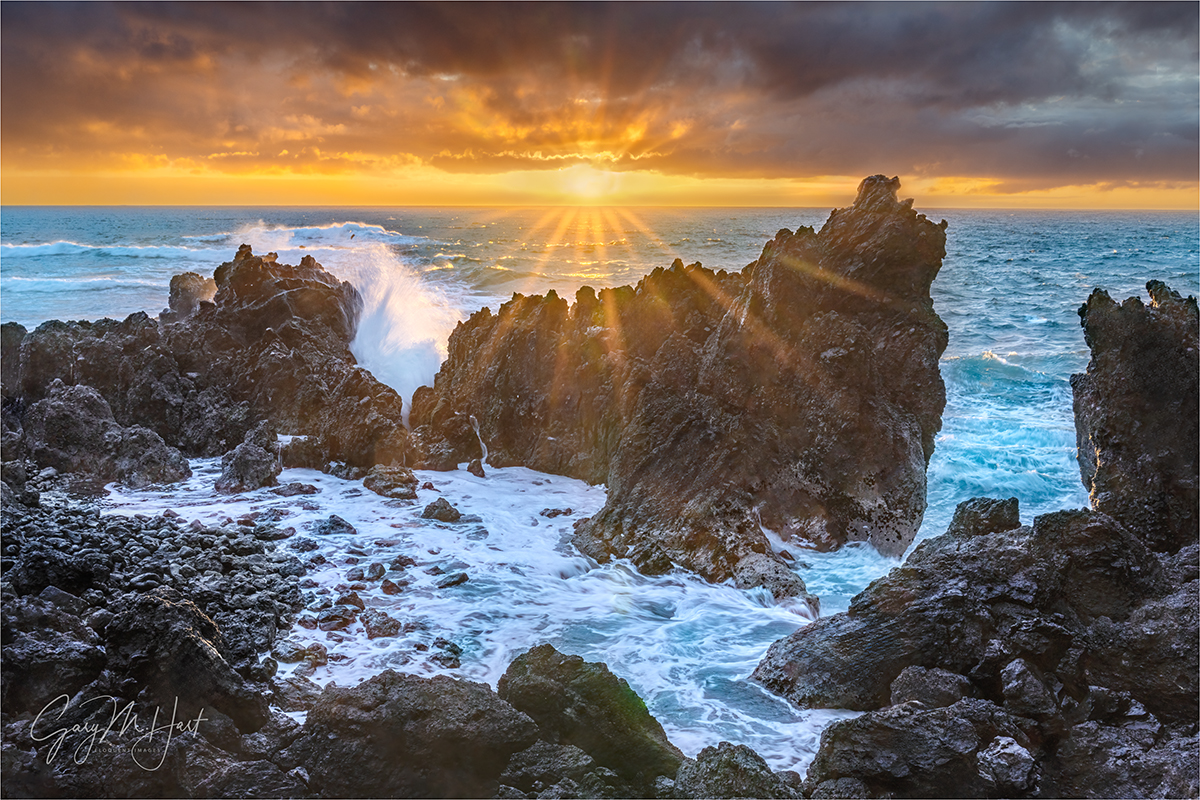
Sunrise, Laupahoehoe Point Sunstar, Hawaii
Sony a7R V
Sony 24-105 f/4 G
ISO 100
f/18
1/13 seconds
Battered for millennia by earthquakes, floods, volcanic eruptions, and tropical cyclones, it’s no wonder Hawaii’s residents keep one eye on the ocean, the other on the mountains—all while closely monitoring the sky overhead. I’ve visited each of Hawaii’s major islands many times (okay, so technically, on Oahu I haven’t been outside the airport, which is its own sort of disaster), and have personally experienced a veritable smorgasbord of these natural events. (Yet somehow I keep returning—go figure.)
The Hawaii earthquakes I’ve felt have been relatively minor jiggles to my earthquake-hardened California bones, but each served as a reminder that Hawaii has a history of large earthquakes, with magnitudes at least into the high 7s. Active volcanism makes the Big Island particularly vulnerable: as recently as 2018 it was shaken by a magnitude 6.9 earthquake; in 1975 a magnitude 7.7 quake rocked the Puna Coast just south and west of Hilo. Moving north, the Hawaiian Islands’ earthquake risk decreases: Maui has experienced a couple of magnitude 6 quakes in historic times (just offshore), while Oahu only gets a moderate jostling from time to time (but does get a pretty good jolt from the strongest Big Island quakes)—only Kauai, the oldest island, is (relatively) seismically stable.
Hawaii’s volcanoes are sexier than its earthquakes, actually attracting visitors (you don’t see too many people rushing toward an earthquake). I missed the recent Mauna Loa eruption, but have witnessed numerous Kilauea eruptions, in many forms: many time I’ve enjoyed standing on the rim at night to view the glow and smoke emanating from the lava lake bubbling just out of sight on the caldera floor far below; last year, I stood on the edge of (the recently seismically remodeled) Kilauea caldera with my workshop group and peered down at dozens of towering lava fountains less than a mile away. In 2010, Don Smith and I hiked close enough to a Kilauea lava flow that we felt its heat and heard trees explode. But despite their dramatic aesthetic appeal, Hawaii’s volcanoes are still too powerful to be taken lightly. While most of its eruptions lack the explosiveness of many more dangerous volcanoes around the world, as recently as 2018 Hawaii’s effusive lava flows have wiped out entire towns, destroying hundreds of homes on their way to the ocean.
And then there are the tropical cyclones that lash the islands several times each decade. By far the most significant storm damage to a Hawaiian island was inflicted by Hurricane Iniki in 1992, striking Kauai as a Category 4 storm with winds up to 140 miles per hour. While I’ve never experienced anything that extreme on my visits, in September of 2018, each of my two workshops was altered by a different hurricane: first on the Big Island when, a few days before that workshop started, a close brush with Category 5 Hurricane Lane deposited up to 58 inches of rain that flooded many of my locations. I departed Hawaii for Maui and my second workshop, only to have Hurricane Olivia (downgraded to a tropical storm just before landfall) force me to relocate the workshop’s two nights in Hana, and find replacement locations for those days.
I’ve also learned firsthand that it doesn’t take a hurricane to generate floods in Hawaii. In 2016 I was on Maui when just regular old torrential rainfall caused a 500-year flood in the Iao Valley and Central Maui, destroying homes and swamping cars. While driving through Central Maui after the water receded, I saw cars still mired in water to their doors.
Even given this history of disasters, compounded by my own personal experience with some of Hawaii’s most extreme natural elements, I would argue that Hawaii’s greatest natural risk is tsunamis. Despite their relative rarity, tsunamis have killed more people than all other Hawaiian natural disasters combined. The islands’ position smack in the middle of the Pacific Ring of Fire, which happens to be the source of nearly 3/4 of Earth’s tsunamis, means Hawaiians need to think in terms of when, not if, the next tsunami hits, and plan accordingly.
Unlike conventional waves, which are wind-generated and affect only the ocean’s surface, a tsunami is formed when a cataclysmic event displaces water from the ocean surface all the way down to the ocean floor. Potential ocean-moving events include submarine landslides, volcanic eruptions, and meteor impacts. But by far the most frequent force behind a tsunami is subduction earthquakes, when one tectonic plate thrusts beneath another and displaces the overlying plate and all the water above it.
In the simplest terms possible, the energy of an ocean wave is the product of its amplitude (maximum height) and wavelength (the distance between amplitudes). In the open ocean, with deep water and no obstructions, a tsunami’s energy is almost entirely committed to spreading outward at 400-600 miles per hour (around the speed of a commercial airliner). At those speeds, a tsunami’s wavelength could be 100 miles, with amplitudes of a foot or two. In fact, with an open ocean amplitude of just a foot or so, when a tsunami passes beneath a boat, the boat’s occupants feel nothing.
But as a tsunami approaches land, it starts dragging on the ocean floor, eventually slowing to around 30 miles per hour. Since the next waves in line are still racing through open ocean at hundreds of miles per hour, when the wave in front of them slams on the brakes, water begins piling up as most of the forward energy is suddenly transformed into wave-building energy: A massive wave is born.
As we’ve seen in recent, and not so recent, history, the power and suddenness of a tsunami can be catastrophic. The Indian Ocean tsunami of 2004 killed over 230,000 people, some as far away as 3,000 miles. The 2011 Japan tsunami killed 10,000 people in Japan, and was directly responsible for the meltdown at the Fukushima nuclear power plant. (It also caused some minor damage in Hawaii, among other places.)
Hawaii’s long tsunami history includes many small and moderate events, and a handful that can be labeled major (and tragic). Since the beginning of the 20th century, three especially significant tsunamis stand out:
- April 1, 1946: Generated by a magnitude 8.5 in the Aleutian Islands, this tsunami is considered as Hawaii’s most significant for the 159 lives it took, and the major damage dealt to every Hawaiian island.
- May 23, 1960: Generated by a magnitude 9.5 earthquake near Chile—the largest earthquake ever measured and more than 30 times stronger than the 1946 Aleutian earthquake. Despite the lessons of 1946, many lives were lost by Hilo residents who didn’t heed warnings.
- November 29, 1975: Generated by a magnitude 7.7 earthquake south of Hilo. on the east flank of Kilauea—though its damage was mostly limited to Hawaii’s southeast coast, this tsunami arrived too quickly following the quake for its victims to flea to safety.
I’m reminded of Hawaii’s tsunami history each time I visit Laupahoehoe Point on the Big Island’s east coast. This is where the 1946 tsunami took the lives of 24 residents, including 16 students and 5 teachers who were waiting at the local schoolhouse for school to start. Adding to the tragedy, warnings of the approaching peril were ignored as April Fools’ Day jokes.
Based on the inexplicable inability to warn people thousands of miles, and many hours, from the tsunami’s source, the US Tsunami Warning Center was formed. Another response to this tragedy was the significant upgrade of local building practices. For example, the 8-story Hilo Hawaiian Hotel, where my Big Island workshops are based, is right on Hilo Bay (you could literally hit the water with a rock from our balconies) and potentially ground-zero for the next tsunami. Constructed in 1975 atop (extremely reinforced) concrete columns, significant sections of the Hilo Hawaiian’s bottom two floors are completely open to the elements, with no walls on either side, designed specifically to allow any large wave to sweep right through rather than push against the structure. Throughout Hilo are tsunami warning sirens that are tested once each month, and evacuation routes are clearly signed.
In 2015 I actually got a firsthand look at how seriously tsunamis are taken in Hilo when, while there for a workshop, a magnitude 8.3 earthquake near Chile triggered a Pacific tsunami warning. Fortunately, today’s satellite technology and ocean buoy network enables much better tsunami tracking than was available in 1946 and 1960, so not only did we get many hours notice, by the time the wave reached Hawaii it was measured in inches and the warning had been long suspended (and I enjoyed a peaceful sleep rather than spending the night in an evacuation shelter).
About this image
Sunrise, Laupahoehoe Point Sunstar, Hawaii
In most of my workshops, our first sunrise is at Laupahoehoe Point. Before we start, I emphasize to my group the location’s tsunami history, and point out some of the tsunami damage still visible. In fact, the location where we photograph is just a few hundred feet from the location of the teachers’ cottages that were swept away in the 1946 tsunami.
You may (or may not) notice that I have several very similar images of this scene. That’s partly because it in fact provides a very nice composition that I always enjoy photographing, but mostly because we’re at Laupahoehoe at the beginning of the workshop, making it especially important that I stay tethered to my group. Which means the variety I get at Laupahoehoe Point is more about conditions than compositional inspiration.
This morning was especially nice for a couple of reasons: first, recent hurricane near-misses had seriously stirred up the Hawaiian surf; second, getting a break in the clouds right on the horizon isn’t especially common in Hawaii. Seeing the opening this morning, I was able to anticipate the opportunity for a nice sunstar and believed I was ready for it.
Unfortunately, I made a couple of mistakes because I’d spent most of the morning working with my group. The first was that I thought I was using my 16-35 f/2.8 lens that provides a much better sunstar than the 24-105 f/4 lens I was actually using. The second mistake was forgetting to remove the ND filter I’d been using earlier in the morning to smooth the waves. After helping people in my group prepare for their sunstar opportunity, I rushed to my camera and started clicking as soon as the sun appeared, realizing with the first click that I’d need to wait out the 20-second exposure my camera had started. Fortunately, it all worked out, and I was actually able to get a couple of frames like this one, capturing the instant of an explosive wave’s impact.
At the risk of stating the obvious, another thing I want to point out is how hard it is to photograph directly into the sun. When I got around to processing this image at home, not only did I have serious dynamic range problems to deal with, I also had tons of nasty lens flare blobs to clean up. Fixing lens flare was mostly just a tedious process with the Remove tool; the dynamic range was a matter of processing the sky and foreground separately. Since I no longer use graduated neutral density filters, and I never blend multiple exposures, my margin for exposure error was extremely small, but by monitoring my histogram and pushing my highlights to the limits of recoverability when I captured the image, I ended up with shadows that still contained enough clean detail to work with.
Workshop Schedule || Purchase Prints || Instagram
Lots More Sunstars


Confessions of a Happy Photographer
Posted on September 19, 2021

Stairway to Heaven, Milky Way Over the Puna Coast, Hawaii
Sony a7SIII
Sony 14mm f/1.8 GM
ISO 6400
f/1.8
20 seconds
More than anything else, photography needs to make you happy. When photography was my hobby, that wasn’t really a problem—I photographed what I wanted, where I wanted, when I wanted, with no pressure to please anyone else. Pretty nice. But, as I mulled turning photography into my livelihood (nearly 20 years ago!), I couldn’t help thinking about the photographers who had become unhappy after turning their passion into their profession. Suddenly their choices were fueled not by their own creative juices, but rather by their need to pay the bills.
So one of the promises I made to myself when I decided to pursue photography as a career was that I’d only photograph what I want to photograph. Over the years that approach has evolved to cover more than just subject choices—it also applies to my overall approach to photography, from capture through processing, all the way to what I share and how I share it. So I think a more accurate way of expressing my personal key to photography happiness would be that I photograph to please no one but myself.
It’s personal
When you look at one of my images, you’re viewing a subject that resonates with me personally (while I don’t think every photographer can say that, I also don’t think this makes me unique). That personal connection is why most of my images feature some version of the natural processes that have always fascinated me, camera or not: weather and its many manifestations (such as clouds, rainbows, lightning, and snow), geology (like mountains, volcanism, and the other natural processes of landscape building), and of course all things celestial. Communicating that connection is also why I virtually never share an image without writing something about it and/or the natural processes at play.
This need for connection to my subjects also influences my personal photography rules—not the same “rules” that guide and constrain aspiring photographers, but my own rules for what and how I photograph. Rules like natural light only (no light painting, flash, or any other artificial light), and no arranging of subjects in my scene, and so on.
One and done
A big personal rule for me is one-click capture. Though I never really felt much nostalgia for the color transparencies I shot for over 25 years, I’m still driven by a film photographer’s mindset. That doesn’t mean I don’t process my images, or that I don’t appreciate the power of digital processing to convey my subjects at their very best. But I do (among other things) like knowing that each image represents the photons that struck my sensor in the span of a single shutter click. In other words, I am a one-click photographer who gets no pleasure from merging, blending, combining multiple images into a single image.
Preemptive disclaimer
It seems that every time I try to explain these personal motivations and guiding principles, I get a few defensive responses from people who believe I’m saying that everyone should follow my rules, or that I’m somehow superior to photographers who don’t do things the way I do them. Nope. I’m simply saying that my images need to please me and no one else, and hope your own images, however they’re achieved, make you just as happy as mine make me.
Which brings me to…
I’m thinking about all this because today I’m sharing a Milky Way image from my recently concluded Hawaii Big Island photo workshop. And nothing underscores the difference between my own (dinosaur?) approach than today’s computer-enabled (and beautiful) astro images.
For most of my photography life, I was frustrated by the camera’s low light limitations. In my pre-digital days, using my medium of choice (color slides) to photograph the Milky Way above a landscape was just a dream. And my first digital cameras, while perhaps better than slides in darkness, were still not up to the night photography task.
But over the last fifteen or so years, I watched technology improve to the point that one-shot, night-landscape photography became possible—and it keeps getting better. In my first digital attempts, I found that while I could capture the Milky Way, there was not enough light for the camera to pull in discernible landscape detail to go with it. Instead, in those early digital days I settled for moonlight night images—no Milky Way, but plenty of stars above a beautifully moonlit scene.
As I became hooked on moonlight photography, I watched other photographers start having Milky Way success by blending two (and sometimes more) images—one for the Milky Way, and another much longer exposure for the landscape. I actually tried this approach myself, had enough success to appreciate the technique, but soon realized that I derived absolutely no pleasure from these manufactured images and stopped doing it without ever sharing a blended creation with another soul.
My first real Milky Way success came at Kilauea, about ten years ago. Here the orange glow from the churning lava lake provided enough light to illuminate the surrounding caldera, and sometimes even painting the clouds with its volcanic glow. I was hooked.
The next major Milky Way milestone came when I switched to Sony and started using the Sony a7S. Suddenly, not only could I include lots of foreground detail in my one-click Milky Way images, I could see the scene in my viewfinder well enough to compose and focus quickly, without guessing.
And while my night cameras been evolving—from the a7S, then the Sony a7SII, and now the a7SIII—Sony has slipped the final piece of the night photography jigsaw into place with a great selection of fast, wide, and sharp lenses that seem made for the Milky Way.
Waxing nostalgic
For many years I looked forward to my Hawaii workshop more than any other workshop, in no small part because of the opportunity to return to Kilauea, the location of my first Milky Way success and still one of my very favorite Milky Way locations. Then, in August 2018, the Kilauea eruption went out in a blaze of glory—suddenly, I had to scramble for Milky Way locations on the Big Island.
With many locations lost to the recent eruption, in September 2018 I took my group to the Mauna Kea summit, nearly 14,000 above the Pacific. We had a great shoot among the array of telescopes at the summit, but the only thing more brutal than the wind and cold at the top was drive up there. My rental car started losing power and flashing an engine warning light, and a couple of other drivers were (understandably) less than thrilled about violating their rental car agreements. We also had to send a couple of people back down the mountain when they started feeling altitude sickness. (I’d still recommend the experience to anyone—it’s just not something I’m comfortable doing with a group.)
In 2019 scouted the Puna Coast for a good spot, but found much of the access still limited by the 2018 lava flow. I finally settled for section of brand new lava above the ocean, but clouds and moisture-thickened air hindered visibility, and the moonless darkness made it very difficult to safely get close enough to include much crashing surf. The Milky Way made enough of an appearance that were were able to photograph it, but the overall experience was less than ideal.
Given all the obstacles Mother Nature had thrown at me—not just locations and access lost to lava flows, but recent hurricane and flood damage to other locations too—I decided to take 2020 off from Hawaii. (Turns out I’d have had to cancel anyway.) But I missed Hawaii and realized, eruption and Milky Way or not, it’s a pretty great place to photograph. So the Big Island went back on my schedule in 2021.
Despite the aborted eruption and the prior night location difficulties, I was determined to give the Milky Way another shot in 2021. Thinking it might be easier to photograph away from the coast, I found a nice elevated view on Chain of Craters Road in Hawaii Volcanoes National Park. It was about three miles from the coast, but had a great view of the ocean and recent lava flows, and a few striking trees for the foreground.
I gave the group some Milky Way training on our second afternoon, then drove out to the chosen spot after that evening’s sunset shoot. While the view was indeed magnificent, the wind was so strong that we couldn’t even consider setting up tripods. But since we were there anyway, I kept everyone out long enough for everyone to see the Milky Way emerge from the darkness. While that was more of a consolation prize for people with their hearts set on Milky Way images, it was pretty cool, especially for the folks who have never really seen the Milky Way’s core in a truly dark sky.
Some groups are more excited than others about the chance to photograph the Milky Way, and I could tell that this group was pretty disappointed that our shoot didn’t work out. So I decided to give it one more shot, on the workshop’s final night—no guarantees, but we’d at least go down trying.
Since our final sunset would be on the Puna Coast, I decided that we’d just find a spot out there for the Milky Way. A check of the map confirmed that the galactic core would align nicely with the rocky coast from MacKenzie Point, my planned sunset spot, we just stayed put there and waited for the Milky Way to come to us.
The downside of this location is that it’s rather precariously perched above quite violent surf. But since we were already out there for sunset, I knew everyone would be able to get situated and set up for the Milky Way early enough to avoid moving around much (or at all) in the dark.
The biggest unknown in this plan was the clouds that always seem to lurk along the Puna Coast. But after a day of sky mostly obscured by clouds, a little opening appeared in the south around sunset, and I crossed my fingers. We ended enjoying the most colorful sunset/sunrise of the workshop, then crossed our fingers that the sky would remain open until darkness was complete.
For this shoot I used my Sony a7SIII and Sony 14 f/1.8 GM exclusively. Usually my Milky Way compositions favor the sky over the foreground. But here, long exposures of the waves exploding against jagged volcanic rock created ethereal motion blur that nicely complimented the Milky Way, so I wanted to include as much surf as sky. Not only did I want more foreground than usual, the lower the latitude, the higher in the sky the Milky Way’s core is—having such a wide lens allowed me to include lots of surf and sky.
I only managed to capture seven frames while I “bounced” (tiptoed gingerly) in near total darkness, hyper-conscious of the consequences of a misstep, between people to provide assistance. The southern sky was virtually clear in my first two captures, but each subsequent click revealed an ominous cloud bank encroaching on our sky. Knowing how quickly the rain can strike in Hawaii, and wanting to avoid anything that might cause people to move suddenly in the dark, I called the shoot after about 30 minutes. This is my final image of the night.
Since this was the workshop’s last night and there were no more image reviews, I can’t say that everyone finished that shoot with a great Milky Way image. But I do know that everyone did at least capture the Milky Way, and gained enough insight to do it better the next time. I also know that everyone was happy with the entire experience—which is really what it’s all about.
Learn more about Milky Way photography
Join Me In Hawaii
Workshop Schedule || Purchase Prints || Instagram
Milky Way One Click Wonders
Click an image for a closer look, and to view a slide show.


The Motion of the Ocean
Posted on November 24, 2019
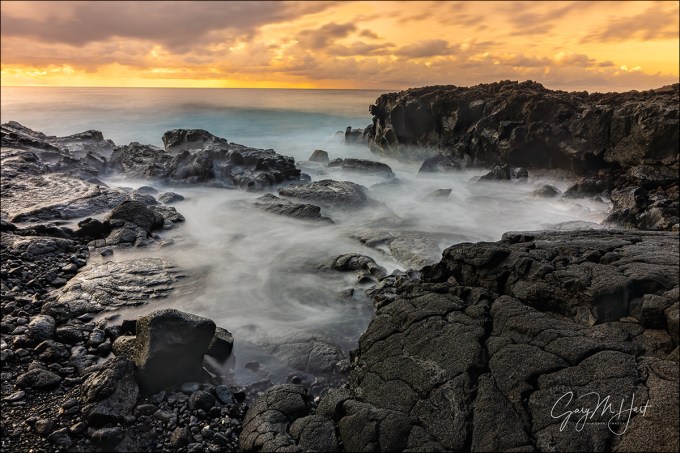
Golden Sunrise, Puna Coast, Hawaii Big Island
Sony a7RIV
Sony 16-35 f/2.8 GM
13 seconds
F/16
ISO 100
Silky water images take a lot of flak for being overused and unnatural. Sure, long exposures that blur a rushing creek into a white stripe, or smooth crashing surf into to a gauzy haze, can be trite (no judgement—these effects can also be beautiful). But the argument that motion blur in a water image is always invalid because it’s not “natural” just doesn’t hold wat…, uhhh…, up to scrutiny.
Think about it—there really are only two ways to capture moving water in a still photo: you can freeze water in place, or blur it. And a water droplet suspended in midair is no more representative of the human experience of that scene than silky water. That’s because the world unfolds to us like a seamless movie of continuous instants, while a camera accumulates light throughout its exposure to conflate those instants into a single frame.
Your options for expressing motion in a still frame aren’t binary—either frozen or blurred—they’re a continuum of choices ranging from discrete airborne droplets to blur completely devoid of detail. The key to capturing flowing water in a still photograph is conveying a sense of motion—how you do it is your creative choice (and blurring water simply because you can, and it looks “cool,” maybe isn’t the best approach).
Not only does your choice for handling water’s motion determine the effect’s visual appeal, it also affects the image’s mood. I find stopped water action in an image to be more stimulating, and blurred water more soothing.
And all motion blurs aren’t alike. There’s a big difference between slight blur that expresses a wave’s movement while retaining its overall size and shape, and extreme blur that purees every detail into a homogenized soup. Whether your goal is to freeze in midair the airborne droplets of a waterfall, smooth wind-whipped chop in a mountain lake, or reveal flow patterns in waves washing over a rocky shore, the key to controlling your point on the water motion continuum is understanding the reciprocal relationship between ISO, f-stop, and shutter speed.
I usually start with a general idea of the amount of blur I want, and try to determine the shutter speed that will get me there. Unfortunately, there is no one-to-one relationship between shutter speed and blur because shutter speed isn’t the only variable. You also need to consider the speed of the water, its distance, your focal length, and whether it’s moving toward/away from you, or across your frame. So I start by guessing the shutter speed (the more you do it, the better you’ll get), then figuring out the ISO/f-stop combination that gets me there. And if I can’t do it with ISO and f-stop, I reach for my neutral density filter.
After my first click I evaluate my blur effect on my in my mirrorless view finder or on my LCD screen and adjust accordingly. I usually take a range of frames at a variety of shutter speeds to have more options later, when I’m viewing my images on my big screen. This is especially true with crashing surf—often I’ll take multiple frames at the same shutter speed because there’s so much variation from wave to wave.
Golden Sunrise, Puna Coast, Hawaii Big Island (September, 2019)
My flight to Hawaii departed on a Friday, and my new Sony a7RIV was scheduled to arrive Monday. But the arrival of a new camera is to a photographer what Christmas morning is to a 5-year-old (do you know any 5-year-olds who would delay Christmas by a week?)—so I had Sony ship the camera to my hotel in Hawaii. So far so good—until Hawaiian Airlines lost my suitcase. In addition to having no change of clothes or toiletry items, I was suddenly without a tripod. The clothing and toiletry essentials were handled with a trip to the Hilo Target, but a camera with no tripod? In my world that’s not much different than that 5-year-old unwrapping the remote-control helicopter he asked for and learning Santa didn’t think to include batteries. Fortunately, after lots of hand wringing and panicked pleas for help, the good folks at Breakthrough Filters overnighted one of their new carbon fiber tripods and I was whole again (Hawaiian got the bill for the $178 FedEx overnight charge as well).
Or so I thought. But using a tripod requires a way to mount the camera to the tripod, and my tripods require a camera-specific mount plate (for the photographers in the audience, that would be an Arca-Swiss-compatible L-Plate from Really Right Stuff). But the a7RIV was so new, RRS didn’t have its L-plate ready. Damn. Just about the time my internal 5-year-old was about to melt down in line at the grocery store, I figured that with a little creative engineering, my Sony a7RIII L-plate could (kind of) attach to my a7RIV—not an ideal arrangement, but enough to get by. I was in business.
A couple of days into the workshop I took the group out to one of my favorite Puna Coast spots for sunrise. As you can see from this picture, the Puna beaches aren’t great for swimming, but its rugged volcanic rock and black sand, along with very violent surf, make the photography here off the charts. I’ve photographed the California Coast from Big Sur to Mendocino, and the Oregon Coast from Bandon to Cannon Beach, but I like the Puna Coast south of Hilo just as much.
Every rock down here is lava. And being just down the mountain from Kilauea (one of the most active volcanoes in the world), all of the Puna lava is relatively new. In fact, the age of most of the Puna rock is measured in decades—during this workshop we did a Milky Way shoot on lava flows that were just one year old.
You’ll primarily find only two kinds of lava on Hawaii: aa and pahoehoe. Both are actually basalt, so the difference between aa and pahoehoe isn’t their composition, it the way the lava flows and cools. Rapidly flowing aa hardens into a jagged jumble, while slower flowing pahoehoe is a smoother, and often ropy, rock. (Pro Tip: I could never remember which lava type was which until I realized that “ah! ah!” is what I’d say if I were to walk barefoot on aa.) In this image, you can see both aa and pahoehoe: pahoehoe in the foreground and on the left (you can even see a little ropiness), and aa in the background on the right.
At any ocean scene, if you stand and watch the surf and rock interaction long enough, you become aware of patterns in the water’s flow. This scene in particular had some wonderful wave action that I very much wanted to convey. When we arrived it was so dark that motion blur impossible to avoid, but that changed as the sun approached the horizon (it always surprises me how quickly the light comes up at the lower latitudes).
By sunrise I’d become pretty familiar with the scene and knew I wanted to start my exposure as a wave large enough to sweep through the foreground was about to break, and that a shutter speed between 10 and 15 seconds would capture all of a single wave’s motion.
With the sun up, achieving a 10-15 second shutter speed is only possible with a neutral density filter. But there was a distracting sheen on the rocks that I wanted to minimize with a polarizer. In these situations in the past, I had to decide between an ND filter or a polarizer, or live with significant vignetting by stacking the two (or by using a Singh-Ray Vari-N-Duo filter). But my Breakthrough 6-stop Dark CPL works as a polarizer, but it also cuts 6 stops of light. And because it’s no thicker than a standard polarizer, it does this without vignetting. (As you can see, I didn’t get rid of all the sheen on the rocks, but I was definitely able to reduce it to a manageable level.)
Since I’m not a big fan of Sony’s wired remote (an understatement), since switching to Sony I’ve almost exclusively used the 2-second timer, making timing waves kind of a pain. But my new Sony Bluetooth Wireless Remote Commander made timing the waves a piece of cake. Though I shot a number of frames with this composition, the action of the water made each frame different. I chose this image because it was the best combination of sunrise light and wave motion.
Epilogue
After a couple of days on the lamb, my suitcase eventually turned up—but it waited until after I’d purchased an entirely new Hawaii wardrobe, plus all the other essentials. Since I always pack my suitcase to within a couple of ounces of the maximum weight allowed anyway, all this extra stuff, not to mention the addition of a new camera and tripod, created a bit of a weight problem. I was able to get back under airline’s weight limit by filling a USPS large flat-rate box with all of my heaviest (non-camera) stuff and mailing it home. And to Hawaiian Airline’s credit, they reimbursed every penny of my extra expenses without blinking.
Read more about photographing motion

Fern Cascade, Russian Gulch Fall, Mendocino
Workshop Schedule || Purchase Prints
World in Motion
Click an image for a closer look and slide show. Refresh the window to reorder the display.


Rules are a crutch
Posted on September 17, 2017
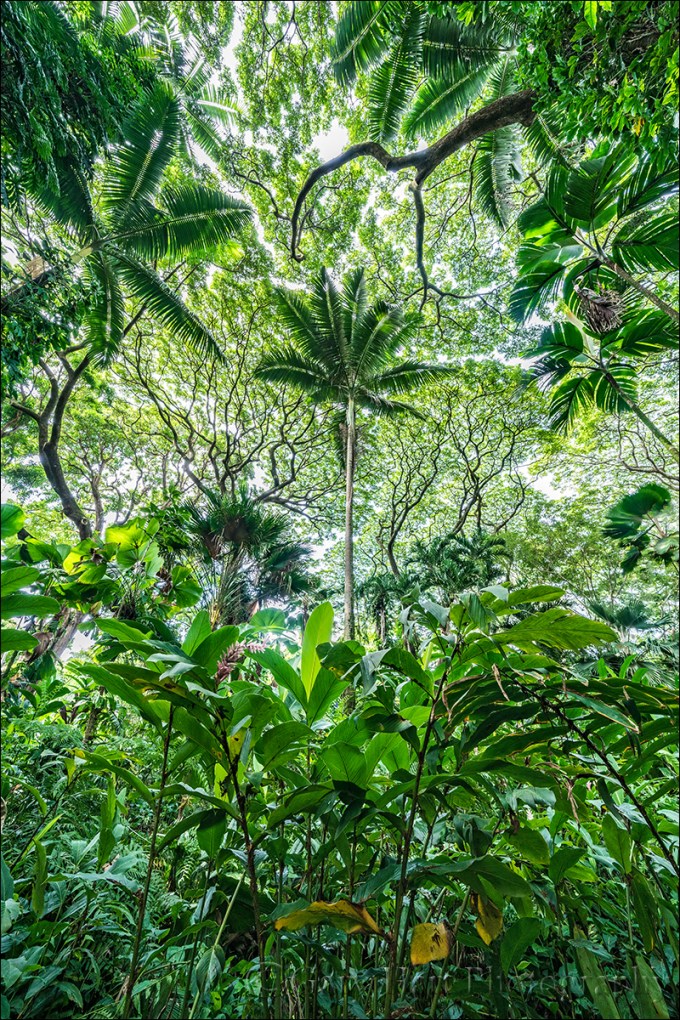
Looking Up, Hawaii Tropical Botanical Garden, Hawaii
Sony a7R II
Sony 12-24 f4 G
12mm
1/8 second
F/8
ISO 800
Aloha from Hawaii!
Let’s have a show of hands: Who feels like their photography has stagnated? Let me suggest to all with your hands up that what’s holding you back may be the very rules that helped elevate you to your current level of proficiency. I’ll be the first to acknowledge that rules are important, the glue of civilization. Bedtimes, homework, and curfews got us through childhood and taught us to self-police as adults. Now we get enough sleep (right?), meet deadlines at work, and toe the line well enough to have become productive members of society with very little supervision (give yourself a gold star). But let me suggest that many of us have become so conditioned to follow rules that we honor them simply because they’ve been labeled “rule.”
As important as this conditioning is to the preservation of society, our reluctance to question rules sometimes impacts areas of our lives that might not be so cut-and-dried. One example would be photographers’ blind adherence to the (usually) well-intended “experts” proliferating online, in print, and at the local camera club. These self-proclaimed authorities spew absolutes for their disciples to embrace: Expose to the right!; Never center your subject!; Tack-sharp front-to-back!; Blurred water is cliché! Blah, blah, blah…. (My standard advice to anyone seeking photographic guidance is to beware of absolutes, and when you hear one, beeline to the nearest exit because the truth is, there are very, very few absolutes in photography.)
Rules serve a beginning photographer the way training wheels serve a five-year-old on a bike: They’re great for getting started, but soon get in the way. At first, following expert guidance, beginners’ photography improves noticeably and it’s easy to attribute all this success to rules. But by the time the improvement slows or even ceases altogether, those rules have become so deeply ingrained that it’s difficult to realize they now hold us back. You wouldn’t do Tour de France with training wheels, or run the Boston Marathon on crutches.
If photography were entirely rule-bound, engineers could write algorithms and design robots that did our photography for us. But the very definition of creativity is venturing beyond the comfortable confines of our preconceptions to create something new. In other words, if you’re not breaking the rules, you’re not being creative.
For example
For the last eight years I’ve spent one or two weeks on Hawaii’s Big Island. And on each trip I make multiple visits to the (fabulous) Hawaii Tropical Botanical Garden just north of Hilo. There’s so much to love here, but I’m always drawn to the bottom of the garden overlooking Onomea Bay, where the luxuriant jungle unfolds beneath an interlaced canopy of towering monkeypod trees (albizia saman). Every time I’m down here I try to find a composition that captures the lushness I feel in the saturated air, and the way the monkeypod’s branches seem etched against the sky. And each time I come away a little disappointed.
This year, armed with my new Sony 12-24 f/4 G lens, I decided to give the scene another shot beneath the late afternoon overcast. With a decent breeze stirring the leaves, I pushed my ISO to 800 to be safe. Widening my view to 12mm and pointing up, it soon became clear that the palm tree I needed to anchor my frame belonged in the middle. And even without metering I knew that the crazy dynamic range (the shaded side of every leaf juxtaposed against a bright sky) would force me to sacrifice the texture in the clouds in favor of the essential detail and color in the jungle’s dense shadows.
Both of these important considerations flew in the face of rules that have constrained photographers for years. For as long as we’ve held a camera, our inclination to bullseye every subject has been stifled by voices whispering the “rule” of thirds (horizon 1/3 up from the bottom or down from the top; primary subjects at the intersections of an imaginary tic-tac-toe grid on our frame) in our ear. And of course digital photographers everywhere know to never blow the highlights.
In this case, even though it would get me booted from many camera club photo competitions, I’ve been scoffing at the rule of thirds long enough that centering the palm tree wasn’t hard. But seeing nearly half my frame flashing highlight warnings was a little more difficult. Nevertheless, I held my breath and went ahead with the shot you see here. And it turns out, instead of creating a problem, the white (overexposed) sky becomes a feature that only enhances the rich green and etched branches.
Homework
Sit down and write out your strongest, longest held photography rules (trust me, they’re there). Challenge yourself to break at least one of these rules each time you go out with your camera. Don’t expect miracles—at first your resulting images might not thrill you, but I promise that you’ll grow as a photographer, and you just might learn something in the process. (Oh, and you can put your hands down now.)
Mahalo!
Breaking the rules
Click an image for a closer look and slide show. Refresh the window to reorder the display.


Photograph the Milky Way: Part Two
Posted on March 9, 2017
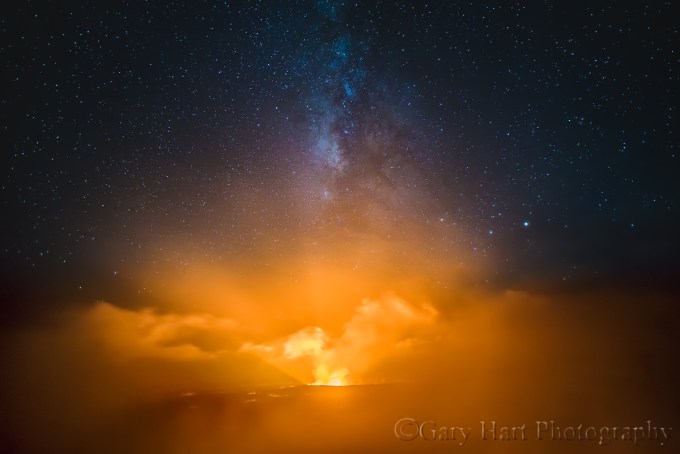
Fire and Mist, Halemaumau Crater, Kilauea, Hawaii
Sony a7S
Sony/Zeiss 16-35 f4
10 seconds
F/4
ISO 3200
Previously on the Eloquent Nature blog: Photograph the Milky Way: Part One
Viewing the Milky Way requires nothing more than a clear, dark sky. The Milky Way’s luminosity is fixed, so our ability to see it is largely a function of the darkness of the surrounding sky—the darker the sky, the better the Milky Way stands out. But because our eyes can only take in a fixed amount of light, there’s a ceiling on our ability to view the Milky Way with the unaided eye.
A camera, on the other hand, can accumulate light for a virtually unlimited duration. This, combined with technological advances that continue increasing the light sensitivity of digital sensors, means that when it comes to photographing the Milky Way, well…, the sky’s the limit. As glorious as it is to view the Milky Way with the unaided eye, a camera will show you things your eyes can’t see. In fact, not only does the right camera in the right hands resolve far more Milky Way detail than we can see, it also reveals color too faint for the human eye.
Knowing when and where to view the Milky Way is a great start, but photographing the Milky Way requires a combination of equipment, skill, and experience that doesn’t just happen overnight (so to speak). But Milky Way photography doesn’t need to break the bank, and it’s not rocket science.
Equipment
Bottom line, photographing the Milky Way is all about maximizing your ability to collect light: long exposures, fast lenses, high ISO.
Camera
In general, the larger your camera’s sensor and photosites (the “pixels” that capture the light), the more efficiently it collects light. Because other technology is involved, there’s not an absolute correlation between sensor and pixel size and light gathering capability, but a small, densely packed sensor almost certainly rules out your smartphone and point-and-shoot cameras anything more than a fuzzy snap of the Milky Way. At the very least you’ll want a mirrorless or DSLR camera with an APS-C (1.5/1.6 crop) size sensor. Better still is a full frame mirrorless or DSLR camera. (A 4/3 Olympus or Panasonic sensor might work, but I’ve not been overly impressed with the high ISO images I’ve seen from these smaller sensors.)
Another general rule is that the newer the technology, the better it will perform in low light. Even with their smaller, more densely packed sensors, many of today’s top APS-C bodies outperform in low light full frame bodies that have been out for a few years, so full frame or APS-C, if your camera is relatively new, it will probably do the job.
If you’re shopping for a new camera and think night photography might be in your future, compare your potential cameras’ high ISO capabilities—not their maximum ISO, but read some reviews to see how your camera candidates fare in objective tests by credible sources like DP Review or Imaging Resource (there are many others).
An often overlooked consideration is the camera’s ability to focus in extreme low light. Autofocusing on the stars or landscape will be difficult to impossible, and you’ll not be able to see well enough through a DSLR’s viewfinder to manually focus. Some bodies with a fast lens will autofocus on a bright star or planet, but it’s not something I’d count on (though I expect within a few years before this capability becomes more common).
Having photographed for years with Sony and Canon, and working extensively with most other mirrorless and DSLR bodies in my workshops, I have lots of experience with cameras from many manufacturers. In my book, focus peaking makes mirrorless the clear winner for night focusing. Sony’s current mirrorless bodies (a7R II, a7S, and a7S II) are by far the easiest I’ve ever used for focusing in the dark—what took a minute or more with my Canon, I can do in seconds using focus peaking with my Sony bodies. That said, of the major DSLR brands, I’ve found Canon’s superior LCD screen makes it much easier to focus in extreme low light than Nikon. (More on focus later.)
Lens
Put simply, to photograph the Milky Way you want fast, wide glass—the faster the better. Fast to capture as much light as possible; wide to take in lots of sky. A faster lens also makes focus and composition easier because its larger aperture gathers more light. How fast? F/2.8 or faster—preferably faster. How wide? At least 28mm, and 24mm or wider is better still. I do enough night photography that I have a dedicated, night-only lens—my original night lens was a Canon-mount Zeiss 28mm f/2; my current night lens is a Rokinon 24mm f/1.4.
Tripod
It goes without saying that at exposure times up to 30 seconds, you’ll need a sturdy tripod and head for Milky Way photography. You don’t need to spend a fortune, but the more you spend, the happier you’ll be in the long run (trust me). Carbon fiber provides the best combination of strength, vibration reduction, and light weight, but a sturdy (heavy) aluminum tripod will do the job.
An extended centerpost is not terribly stable, and a non-extended centerpost limits your ability to spread the tripod’s legs and get low, so I avoid tripods with a centerpost. But if you have a sturdy tripod with a centerpost, don’t run out and purchase a new one—just don’t extend the centerpost when photographing at night.
Read my tips for purchasing a tripod here.
Other stuff
To eliminate the possibility of camera vibration I recommend a remote release; without a remote you’ll risk annoying all within earshot with your camera’s 2-second timer beep. Don’t forget a flashlight or headlamp for the walk to and from the car. And it’s never a bad idea to toss an extra battery in your pocket.
Getting the shot
Keep it simple
There are just so many things that can go wrong on a moonless night when there’s not enough light to see camera controls, the contents of your bag, and the tripod leg you’re about to trip over. After doing this for many years, both on my own and helping others in workshops, I’ve decided that simplicity is essential.
Simplicity starts with paring down to the absolute minimum gear: a sturdy tripod, one body, one lens, and a remote release (plus an extra battery in my pocket). Everything else stays at home, in the car, or if I’m staying out after a sunset shoot, in my bag.
Upon arrival at my night photography destination, I extract my tripod, camera, lens (don’t forget to remove the polarizer), and remote release. I connect the remote and mount my lens—if it’s a zoom I set the focal length at the lens’s widest—then set my exposure and focus (more on exposure and focus below). If I’m walking to my photo site, I carry the pre-exposed and focused camera on the tripod (I know this makes some people uncomfortable, but if you don’t trust your head enough to hold onto your camera while you’re walking, it’s time for a new head), trying to keep the tripod as upright and stable as possible as I walk.
Flashlights/headlamps are essential for the walk/hike out to to and from my shooting location, but while I’m there and in shoot mode, it’s no flashlights, no exceptions. This is particularly important when I’m with a group. Not only does a flashlight inhibit your night vision, its light leaks into the frame of everyone who’s there. And while red lights may be better for your night vision, they’re particularly insidious about leaking into everyone’s frame (so before you ask, no red light!). If you follow my no flashlight rule, you’ll be amazed at how well your eyes adjust. I can operate my camera’s controls in the dark—it’s not hard with a little practice, and well worth the effort to learn. If I ever do need to see my camera to adjust something, or if I need to see to move around, my cell phone screen (not the phone’s flashlight, just its screen) gives me all the light I need.
Composition
A good Milky Way image is distinguished from an ordinary Milky Way image by its foreground. Simply finding a location that’s dark enough to see the Milky Way is difficult enough; finding a dark location that also has a foreground worthy of pairing with the Milky Way usually takes a little planning.
Since the Milky Way’s center is in the southern sky (for Northern Hemisphere observers), I look for remote (away from light pollution) subjects that I can photograph while facing south. Keep in mind that unless you have a ridiculous light gathering camera (like the Sony a7S or a7S II) and an extremely fast lens (f/2 or faster), your foreground will probably be more dark shape than detail. Water’s inherent reflectivity makes it a good foreground subject as well, especially if the water includes rocks or other features to add a little visual weight.
When I encounter a scene I deem photo worthy, not only do I try to determine its best light and moon rise/set possibilities, I also consider its potential as a Milky Way subject. Can I align it with the southern sky? Are there strong subjects that stand out against the sky? Is there any water I can include in my frame?
I’ve found views of the Grand Canyon from the North Rim, the Kilauea Caldera, and the bristlecone pines in California’s White Mountains that work spectacularly. On the other hand, while Yosemite Valley has lots to love, you don’t see a lot of Milky Way images from Yosemite Valley because there just aren’t that many south views there, and Yosemite’s towering, east/west trending granite walls give its south views an extremely high horizon that blocks much of the galactic core from the valley floor.
To maximize the amount of Milky Way in my frame, I generally (but not always) start with a vertical orientation that’s at least 2/3 sky. On the other hand, I do make sure to give myself more options with a few horizontal compositions as well. Given the near total darkness required of a Milky Way shoot, it’s often too dark to see well enough to compose that scene. If I can’t see well enough to compose I guess at a composition, take a short test exposure at an extreme (unusable) ISO to enable a relatively fast shutter speed (a few seconds), adjust the composition based on the image in the LCD, and repeat until I’m satisfied.
Focus
Needless to say, when it’s dark enough to view the Milky Way, there’s not enough light to autofocus (unless you have a rare camera/lens combo that can autofocus on a bright star and planet), or even to manually focus with confidence. And of all the things that can ruin a Milky Way image (not to mention an entire night), poor focus is number one. Not only is achieving focus difficult, it’s very easy to think you’re focused only to discover later that you just missed.
Because the Milky Way’s focus point is infinity, and you almost certainly won’t have enough light to stop down for more depth of field, your closest foreground subjects should be far enough away to be sharp when you’re wide open and focused at infinity. Before going out to shoot, find a hyperfocal app and plug in the values for your camera and lens at its widest aperture. Even though it’s technically possible to be sharp from half the hyperfocal distance to infinity, the kind of precise focus this requires is difficult to impossible in the dark, so my rule of thumb is to make sure my closest subject is no closer than the hyperfocal distance.
For example, I know with my Rokinon 24mm f/1.4 wide open on my full frame Sony a7S II, the hyperfocal distance is about 50 feet. If I have a subject that’s closer (such as a bristlecone pine), I’ll pre-focus (before dark) on the hyperfocal distance, or shine a bright light on an object at the hyperfocal distance and focus there, but generally I make sure everything is at least 50 feet away. Read more about hyperfocal focus in my Depth of Field article.
By far the number one cause of night focus misses is the idea that you can just dial any lens to infinity; followed closely by the idea that focused at one focal length means focused at all focal lengths. Because when it comes to sharpness, almost isn’t good enough, if you have a zoom lens, don’t even think of trying to dial the focus ring to the end for infinity. And even for most prime lenses, the infinity point is a little short of all the way to the end, and can vary slightly with the temperature and f-stop. If you know your lens well enough to be certain of its infinity point by feel (and are a risk taker), go for it. And that zoom lens that claims to be parfocal? While it’s possible that your zoom will hold focus throughout its entire focal range, regardless of what the manufacturer claims, I wouldn’t bet an entire shoot on it without testing first.
All this means that the only way to ensure night photography sharpness is to focus carefully on something before shooting, refocus every time your focal length changes, and check focus frequently by displaying and magnifying an image on your LCD. To simplify (there’s that word again), when using a zoom lens, I usually set the lens at its widest focal length, focus, verify, then never change the focal length again once I know I’m focused. And remember, the best way to ensure focus is to set your focal length and focus before it gets dark.
But sometimes pre-focusing isn’t possible, or for some reason you need to refocus after darkness falls. If I arrive at my destination in the dark, I autofocus on my headlights, a bright flashlight, or a laser 50 feet or more away. And again, never assume you’re sharp—always magnify your image and check it after you focus.
For more on focusing in the dark, including how to use stars to focus, read my Starlight Photo Tips article.
Exposure
Exposing a Milky Way image is wonderfully simple once you realize that you don’t have to meter because you can’t (not enough light)—your goal is simply to capture as many photons as you can without damaging the image with noise, star motion, and lens flaws.
Basically, you can’t give a Milky Way image too much light. What I mean by that is, capturing the amount of light required to overexpose a Milky Way image is only possible if you’ve chosen an ISO and/or shutter speed that significantly compromises the quality of the image with excessive noise and/or star motion.
In a perfect world, I’d take every image at ISO 100 and f/8—the best ISO and f-stop for my camera and lens. But that’s not possible when photographing in near total darkness—a usable Milky Way image requires exposure compromises. What kind of compromises? Each exposure variable causes a different problem when pushed too far:
- ISO: Raising ISO to increase light sensitivity comes with a corresponding increase in noise that muddies detail. The noise at any particular ISO varies greatly with the camera, so it’s essential to know your camera’s low-light capability(!). Some of the noise can be cleaned up with noise reduction software (I use Topaz DeNoise 6)—the amount that cleans up will depend on the noise reduction software you use, your skill using that software, and where the noise is (is it marring empty voids or spoiling essential detail?).
- Shutter speed: The longer the shutter stays open, the more motion blur spreads the stars’ distinct pinpoints into streaks. I’m not a big fan of formulas that dictate star photography shutter speeds because I find them arbitrary and inflexible, and they fail to account for the fact that the amount of apparent stellar motion varies with the direction you’re composing (you’ll get less motion the closer to the north or south poles you’re aimed). My general shutter-speed rule of thumb is 30-seconds or less, preferably less—I won’t exceed 30 seconds, and do everything I can to get enough light with a faster shutter speed.
- F-stop: At their widest apertures, lenses tend to lose sharpness (especially on the edges) and display optical flaws like comatic aberration (also called coma) that distorts points of light (like stars) into comet shaped blurs. For many lenses, stopping down even one stop from wide open significantly improves image quality.
Again: My approach to metering for the Milky Way is to give my scene as much light as I can without pushing the exposure compromises to a point I can’t live with. Where exactly is that point? Not only is that a subjective question that varies with each camera body, lens, and scene, as technology improves, I’m less forgiving of exposure compromises than I once was. For example, when I started photographing the Milky Way with my Canon 1DS Mark III, the Milky Way scenes I could shoot were limited because my fastest wide lens was f/4 and I got too much noise when I pushed my ISO beyond 1600. This forced me compromise by shooting wide open with a 30-second shutter speed to achieve even marginal results. In fact, given these limitations, despite trying to photograph the Milky Way from many locations, the only foreground that worked well enough was Kilauea Caldera, because it was its own light source.
Today (early 2017) I photograph the Milky Way with a Sony a7S II and a Rokinon 24mm f/1.4 lens. I get cleaner images from my Sony at ISO 6400 than got a ISO 1600 on my Canon 1DSIII, and the light gathering capability of an f/1.4 lens revelatory. Now I can stop down slightly to reduce lens aberrations, drop my shutter speed to 20 or 15 seconds to cut star motion 33-50 percent, and still get usable foreground detail by starlight.
I can’t emphasize enough how important it is to know your camera’s and lens’s capabilities in low light, and how for you’re comfortable pushing them. For each of the night photography equipment combos I’ve used, I’ve established a general exposure upper threshold, rule-of-thumb compromise points for each exposure setting that I won’t exceed until I’ve reached the compromise threshold of the other exposure settings. For example, with my a7SII/Rokinon combo, I usually start at ISO 3200, f/2, 20 seconds. Those settings will usually get me enough light for Milky Way color and a little foreground detail. But if I want more light (for example, if I’m shooting into the black pit of the Grand Canyon from the North Rim), my first exposure compromise is to increase to ISO 6400; if I decide I need even more light, my next compromise is to open up to f/1.4; if that still isn’t enough light, my next compromise is to bump my shutter speed to 30 seconds. Finally, if I want more light that ISO 6400, f/1.4, 30 seconds delivers, I’ll try ISO 12,800 (and cross my fingers)*. If that’s not enough, I go home (or just sit and enjoy the view).
These thresholds are guidelines rather than hard-and-fast rules, and they apply to my setup only—your results may vary. And even though I’m pretty secure with this workflow, for every Milky Way composition I try a variety of exposure combinations before moving to another composition. Not only does this give me a range of options to choose between when I’m at home and reviewing my images on a big monitor, it also gives me more insight into my camera/lens capabilities, allowing me to refine my exposure compromise threshold points.
* In normal situations the Sony a7SII can handle ISO 12,800 without even breathing hard, but the long exposure time required of night photography generates a lot of heat on the sensor with a corresponding increase in noise.
It’s time to click that shutter
You’re in position with the right gear, composed, focused, and exposure values set. Before you actually click the shutter, let me remind you of a couple of things you can do to ensure the best results: First, lower that center post. A tripod center post’s inherent instability is magnified during long exposures, not just by wind, but even by nearby footsteps, the press of the shutter button, and slap of the mirror (and sometimes it seems, by ghosts). And speaking of shutter clicks, you should be using a remote cable or two-second timer to eliminate the vibration imparted when your finger presses the shutter button.
When that first Milky Way image pops up on the LCD, it’s pretty exciting. So exciting in fact that sometimes you risk being lulled into a “Wow, this isn’t as hard as I expected” complacency. Even though you think everything’s perfect, don’t forget to review your image sharpness every few frames by displaying and magnifying and image on your LCD. In theory nothing should change unless you changed it, but in practice I’ve noticed a distinct inclination for focus to shift mysteriously between shots. Whether it’s slight temperature changes or an inadvertent nudge of the focus ring as you fumble with controls in the dark, you can file periodically checking your sharpness falls under “an ounce of prevention….” Believe me, this will save a lot of angst later.
And finally, don’t forget to play with different exposure settings for each composition. Not only does this give you more options, it also gives you more insight into your camera/lens combo’s low light capabilities.
The bottom line
Though having top-of-the-line low-light equipment helps a lot, it’s not essential. If you have a full frame DSLR that’s less than five years old, and a lens that’s f/2.8 or faster, you probably have all the equipment you need to get great the Milky Way images. Even with a cropped sensor, or an f/4 lens, you have a good chance of getting usable Milky Way images. If you’ve never done it before, don’t expect perfection the first time out. What you can expect is improvement each time you go out as you learn the limitations of your equipment and identify your own exposure compromise thresholds. And success or failure, at the very least you’ll have spent a magnificent night under the stars.
Workshop Schedule || Purchase Prints
A Milky Way Gallery
Click an image for a closer look and slide show. Refresh the window to reorder the display.


Nature’s transcendent moments
Posted on October 28, 2016

Kilauea Fountain, Hawaii
Sony a7RII
Tamron 150-600 (Canon-mount with Metabones IV adapter)
1/100 second
F/8
ISO 400
It’s a rare photo trip that doesn’t include a moment to savor, a special confluence of location and light that seems to virtually assure great images. But every year or two I get to witness something that transcends photography, a moment that will be forever etched in my brain, camera or not. These moments are special not simply for their visual gifts, but also for the emotional connection to nature they foster.
I’ve written about some of these experiences here:
- An unexpected Grand Canyon electrical storm that dazzled us for over two hours, and was accented by a delicate rainbow fragment just as the sun crested the canyon rim
- A perfect night with friends beneath the stars in the bristlecone pines
- Clouds in perfect formation, aglow with sunrise light, mirrored perfectly atop Mono Lake
- Sitting in the rain, rewarded by a double rainbow above Yosemite Valley
- A double rainbow arcing rim-to-rim above the Colorado River in the Grand Canyon
Last month I added a new transcendent moment to my list, this time on the summit of Kilauea on Hawaii’s Big Island. While spending the prior week dodging raindrops on Maui, I started hearing rumblings of extreme activity in Kilauea’s Halemaumau Crater. Though this eruption has been going since 1983, it’s usually not directly visible from the caldera’s rim (which is as close the public is allowed)—from here the only sign of crater’s churning lava lake is the rising plume of gas and steam, and the red glow that colors the sky after the sun goes down. But according to reports, the lake had risen high enough to be viewed directly from the rim, and there were even rumors of lava fountains.
On the evening before the workshop I visited Kilauea’s Jaggar Museum vista to see what all the excitement was about (though it’s about a mile from the crater, this is the closest and best view). The lake was indeed high enough to see from the rim (a personal first!), but all I could see was a mostly static black crust of cooling basalt lava. Several times a submerged wave opened a crack in the crust, creating a thin, barely visible window to the orange liquid below. It was cool to witness, but not anything particularly dramatic.
Two days later I guided my workshop group to Kilauea. Everyone was most excited about the chance to photograph the caldera beneath the Milky Way, but before the Milky Way the plan was to kill time with a trip the Visitor Center, a walk through the Thurston Lava Tube, sunset at the Jaggar vista, and a nice dinner. Everything went as planned until we reached Jaggar.
We pulled into the parking lot without high expectations, and as the group gathered their equipment, I jogged over to the caldera. To my complete shock (and awe), since my last visit, subterranean forces had whipped the previously placid lava lake into a roiling frenzy. Even from a mile away the volcano’s power was on plain display. Undulating jigsaw cracks zigzagged across the entire lake surface, but the main activity was focused on one region that every few seconds sent a new fountain of lava exploding skyward, splattering the lake surface and nearby wall with molten droplets. I turned and raced back to hurry the group.
Everyone quickly spread out along the wall and started shooting. After making checking on everyone I could find, I went to work with my Sony a6300 and Tamron 150-600. It was still daylight when we started, but dark by the time we had to leave for dinner. At some point during the festivities I remember uttering (and probably multiple times) to all within earshot that this was one of the highlights of my life. That night’s Milky Way shoot was lost to clouds, but no one felt cheated (and we finally got it a couple of nights later).
We returned to the caldera the next night, ostensibly to try again for the Milky Way, not daring to hope for a volcanic reprise. Again the clouds obscured the stars, but to our amazement, we found the lake as at least as agitated as the first night and everyone got a chance to correct whatever mistakes they’d made the previous night. For example, I decided I didn’t need the extra reach of the a6300’s 1.5 crop sensor and switch to my Sony a7RII. I also made a point of taking time to savor the experience a little more. The image I share here is from that second shoot.
The third night the caldera’s activity had calmed, but we finally got the Milky Way. I’ve loved the night sky since I was a kid, and will never tire of photographing the Milky Way above Kilauea. But I’m equally fascinated by the tectonic forces that mold our planet (enough to major in geology for several semesters), and will be forever grateful for (and humbled by) this experience on Kilauea and the opportunity to witness the process firsthand.
Join me in Hawaii
A Gallery of my Transcendent Moments


 Eloquent Images by Gary Hart