Eloquent Images by Gary Hart
Insight, information, and inspiration for the inquisitive nature photographer
A Photographer’s Vision
Posted on February 9, 2026
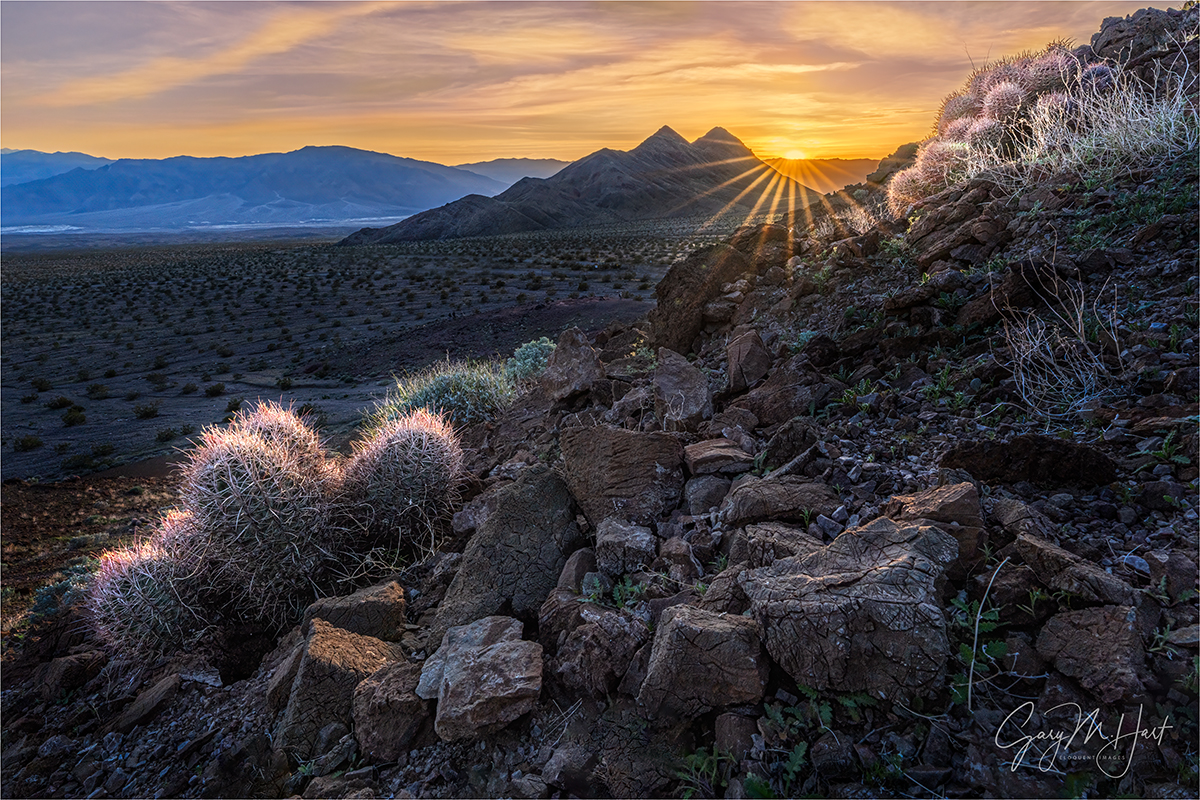
Day’s End, Hell’s Gate, Death Valley NP
Sony α1
Sony 16-35 GM II
1/80 second
F/20
ISO 100
I just returned from a spectacular workshop in Death Valley, one of the most fascinatingly unique locations on Earth. After missing Death Valley last year, it was especially nice to return. (Of course it didn’t hurt that I had a great group that enjoyed fantastic conditions from beginning to end.)
I first got to know Death Valley as a kid, when my family camped there several times over the Christmas school break. We’d spend a most of the week between Christmas and New Year’s Day exploring all kinds of cool stuff that would thrill any young boy: Scotty’s Castle, Rhyolite (a ghost town), and collections of abandoned mining equipment scattered about the desert. We also went to all the standard vistas like Zabriskie Point and Dante’s View, and hiked some of the shorter, most popular trails (Golden Canyon, Mosaic Canyon, Natural Bridge). But with all the cool old stuff, I was much less interested in the scenery and hiking part of those trips, and never really registered Death Valley’s spectacular natural beauty.
About 20 years ago I returned with a camera and saw Death Valley in a completely different way. Suddenly, beauty was everywhere. It would have been easy to—and I probably did—think to myself some version of, “Gee, I don’t remember Death Valley being this beautiful.”
When traveling more with my camera to other childhood family vacation destinations kept eliciting similar epiphanies, I started noticing the way photography was enhancing my overall view of the world. Suddenly, I was seeing the world as a photographer and finding beauty everywhere.
Today, camera or not, my eyes naturally scan my surroundings for scenes, large and small, that resonate personally. Even without a camera, I now seem to unconsciously create compositions in my brain, mentally identifying striking features and their relationships to one another, and figuring out the best way to position myself and frame the scene.
This photographer’s vision isn’t limited to a scene’s physical objects, it also extends to weather and light, both current and potential. What conditions will complement this scene best, and how do I get here to enjoy them? Warm early/late light, moonrise or moonset, fall color, overcast, the Milky Way, a reflection, sunstar—anything that might elevate the scene.
I don’t think this makes me especially unique—in fact I’d venture to guess that many (most?) serious nature photographers view the natural world similarly. And for those who don’t, I believe it’s a quality that can be cultivated with a little conscious practice until it comes naturally.
A great example of putting this mindset to use came the day before this year’s Death Valley workshop, while checking out the conditions at Hell’s Gate on Daylight Pass Road. At the end of an 8-hour drive that started a 7:00 a.m. (to ensure I could get here before dark), I pulled up to Hell’s Gate about 15 minutes before sunset.
I’ve been taking my groups here on my workshop’s first night for many years, but despite that familiarity, there are a few variables I always like to check out for their current status. And with heavy rain earlier this winter washing out many Death Valley roads and locations, I was especially keen to make sure there would be no surprises here.
What I like about Hell’s Gate is that it’s not commonly shot view, and it has a variety of photography options in multiple directions. Directly across the road from the Hell’s Gate parking area is a small mound dotted with photogenic rocks and shrubs that all make nice foregrounds for the long view down the valley toward Telescope Peak and beyond, and west toward pyramid-shaped Death Valley Buttes. There’s even a mini-canyon—7-foot vertical walls and no more than 30-feet long—that can be used to frame the view of the Funeral Mountains to the east and south.
Uphill from this little canyon is a short (100 yards or so) but steep (-ish) trail to an elevated prominence with a similar view. Foreground options up here include more striking rocks, plus an assortment of very photogenic cacti. My favorites are the many clumps of barrel cactus sprinkled around the surrounding slopes. Depending on the year, the condition of the barrel cacti can range from fresh pink with small flowers, to a dried out brown-gray. Though there were no flowers this year, I was happy to see that they were all beautifully pink and alive.
Walking up the trail on this visit, my eyes picked out the best cacti and I started making mental pictures without really realizing it. A little later, visualizing a potential sunstar I took note of exactly when and where the sun would drop behind the nearby buttes and distant Cottonwood Mountains.
Satisfied all was well, I hopped in my car and, instead of making the 30-minute drive to my hotel in Furnace Creek, I added 2 hours to my already long day by detouring to Pahrump so I purchase essential grocery items I’d foolishly left at home. (This is actually an improvement over my prior Death Valley workshop, when I forgot to bring my computer. And in my defense, that’s the only time in my 20 years of leading workshops I’ve done that, and I now triple-check to ensure it never happens again.)
But anyway… When I returned to Hell’s Gate with my group the following evening, I was able to point out all the possibilities and describe exactly what the light would do as the sun dropped. I encouraged everyone to identify the views they like best, as well as foregrounds to put with them, so they wouldn’t be scrambling around looking for shots when the light was at its best. (I’ve noticed that this kind of anticipation doesn’t happen naturally for some people at the start of a workshop, so it’s become a particular point of emphasis.)
On the first shoot of any workshop I try to get around to everyone and therefore rarely shoot, but as the sun dropped and I saw that everyone was quite content, I returned to a composition that I’d identified the prior evening.
Earlier I’d pointed out to my group the very large barrel cactus clump perched on the hillside about 20 feet above the trail, but I think the steep slope covered with loose rock, not to mention lots of easier access compositions nearby, had discouraged them from scaling the hill. So up I went. Reaching my target cactus, I checked out the even larger barrel cactus clump farther up the hill and maybe 20 feet away.
My vision on the first visit was to frame Death Valley Buttes and the sunstar (if the clouds permitted it) with these two cacti; once I was actually in position in front of the closest barrel cactus, I was pleased to confirm that what I’d visualized would in fact work. I just had to tweak my composition to account for the rocks at my feet and clouds near the horizon. The other thing I had to be careful about was my camera bag, which could very easily tumble down the hillside if I didn’t plant it firmly braces and balanced on the rocks.
To deemphasize the (ugly) brown foreground, I dropped my tripod to about a foot above the ground, which made the foreground all about the beautiful cactus and interesting rocks. And though scenes rarely fully cooperate with my goal for clean borders, I took special care to find the best place to cut the rocks at the bottom and sides of the frame, and the clouds at the top.
When I was satisfied with my composition, I picked my focus point—with the closest rocks about 18 inches away, it helped that I already needed to stop way down for the sunstar. Since I wanted everything in this frame sharp, I applied my tried-and-true seat-of-the-pants focus point technique: pick the closest thing that must be sharp (the rocks), then focus a little bit behind it—because focusing on the closest thing gives me sharpness in front I don’t need. (“A little bit” varies with the scene, focal length, f-stop, and subject distance, but the more you do this, the better you get at deciding what “a little bit” is.) I chose f/20 and focused on the close cactus, about 2 feet away.
When the sun reached the horizon, I started with a shutter speed that the balanced black shadows and white highlights as much as possible (knowing I’d be able to recover some of each in processing), and started clicking. After each click, I adjusted my exposure in 2/3 stop increments—first up about 3 stops above my starting point, then back down to 3 stops to below, continuing until the sun disappeared. This gave me a broad range of exposures to choose between on my computer later.
When we were finished, everyone seemed pretty happy with our start. Though I didn’t get a chance to process my own images until after the workshop, from what I saw in the image review, I’d say their excitement was justified.
Workshop Schedule || Purchase Prints || Instagram
A Death Valley Gallery


Near and Far: Thinking in Three Dimensions
Posted on January 27, 2020

Prickly Sunset, Hell’s Gate, Death Valley
Sony a7RIV
Sony 12-24 G
.4 seconds
F/11
ISO 100
Photography is the futile attempt to render a three dimensional world in a two dimensional medium. It’s “futile” because including actual depth in a photograph is literally impossible—but impossible doesn’t mean hopeless. One of the simplest things photographers can do to elevate their images is to think about their scene in three dimensions, specifically how to create the illusion of depth by composing elements at multiple distances from the camera.
Many photographers miss opportunities by simply settling for the beautiful scene before them instead of looking for ways to make it even better. A more productive approach is to start with the beautiful aspect of the scene you want to emphasize (brilliant sunset, backlit flower, towering peak, vivid rainbow, plunging waterfall, whatever), then aggressively seek an object or objects nearer or farther to complement it (this is one reason I love including the moon in my images). Of course it’s sometimes easier said than done, but this near/far mindset should drive every capture.
Thinking foreground and background is a great start, but merely having objects at varying distances usually isn’t enough—you also need to be aware of how those objects guide your viewer’s eye through the frame. We hear a lot of photographers talk about using “leading lines” to move the eye, but a line doesn’t need to be a literal (visible) line to move the eye because viewers will subconsciously connect certain elements to create virtual lines.
To help me achieve virtual leading lines, a term I like to use is “visual weight”: a quality in an object that tugs the eye like gravity, subconsciously pulling the viewer’s gaze in its direction. Qualities in an object that can create visual weight include mass, shape, brightness, contrast, color, texture, and sometimes just position in the frame. A single one of these qualities can give an object visual weight, but usually a combination of more than one is more effective.
Additionally, an object’s emotional power can boost its visual weight. For example, a small moon will pull the eye more than a larger bright cloud, and Half Dome has more visual weight than a random rock occupying the same amount of frame real estate.
With my primary subject and complementary (eye moving) objects identified, I still need to consider the linear connection between these visual components. I usually prefer diagonal relationships because I like the visual tension created by moving the eye along multiple planes. Creating these virtual diagonals requires careful positioning, but it’s surprising how many photographers just remain planted with their tripod as if it has grown roots—either they don’t see the benefit of repositioning, or don’t think moving is worth the effort.
Whatever the reason, it’s important for photographers to understand the power of shifting position to control foreground and background relationships: move left and your foreground shifts right relative to the background; move right and the foreground shifts left relative to the background. Either way, the closer the foreground is relative to the background, the more dramatic the shift. And contrary to what you might believe, it’s impossible to change foreground/background perspective with focal length—to change perspective, you must change position: forward/backward, left/right, up/down.
An often overlooked shift that can be quite powerful is the up/down shift. Often I’m able to un-merge objects at different distances by simply raising my tripod or climbing atop a nearby rock. And when my frame has a large and boring empty space (such as a field of weeds or dirt) between the foreground and background, I drop lower to shrink that gap.
For example
On the first evening of my Death Valley Winter Moon workshop earlier this month, I took my group to Hell’s Gate. At Hell’s Gate the view south is straight down the valley toward Furnace Creek and Badwater; in the east are rutted hills that turn gold with the sun’s last light; the view west takes in nearby Death Valley Buttes, with the Panamint Range in the distance. While I like this spot for these grand vistas, it’s the assortment of cacti, rocks, and shrubs to include with the vistas that especially appeal to me.
Of the many barrel cacti that dotting the hillside at Hell’s Gate, I’m especially drawn to a large specimen above the trail and about halfway up the steep slope. But because I’m leading a group and this barrel cactus usually taken by someone else, I rarely get to photograph it at prime time. This year, however, the rest of the group was occupied with other foreground subjects, so when the sky started to turn pink with sunset, I scrambled up the talus and went to work.
The color was best in the direction of the pyramid-shaped Death Valley Buttes, so I started working on a composition in that direction. I knew my foreground would be the barrel cactus, and the background subject would be the buttes, but I still needed to turn the scene into a picture. Using my Sony a7R IV, I started with my Sony 12-24 G lens to allow me to get as close as possible to the photogenic barrel cactus. Scanning the scene, I quickly recognized the visual weight potential in the bare shrub—not for its inherent beauty, but for the its contrast (against the dark rock) and flame-like shape. These qualities gave it enough visual weight to balance the right half of the frame and move the viewer’s eye diagonally toward the buttes.
I positioned myself so the cactus was closest to the frame and left of center, and the shrub was right of center, with the Death Valley Buttes right down the middle. With my camera at eye level the empty plain in the middle distance occupied too much of the frame, so I dropped down to near cactus level. Doing this had the added advantage of increasing the prominence of the interesting jumble of rocks in the near-right—they don’t stand out enough to pull the eye from the cactus-shrub-buttes path I’d laid out, but their texture added some secondary visual interest in that part of the frame.
At 12mm I had a ridiculous amount of depth of field to play with, but I still took care with my focus choices. My rule of thumb for these extreme front-to-back scenes is to identify the closest thing that must be sharp (the cactus), and focus a little behind it—if I focus on the cactus, I get near sharpness I don’t need, at the potential risk of essential distant sharpness. I probably could have gotten away with f/8, but since the light was changing fast, I didn’t want to take the time to check my hyperfocal app. I stopped down to f/11, focused on a rock a foot or so behind the cactus, metered, and clicked.
Near and Far
Click an image for a closer look and to view a slide show.


 Eloquent Images by Gary Hart