Eloquent Images by Gary Hart
Insight, information, and inspiration for the inquisitive nature photographer
Nature’s transcendent moments
Posted on October 28, 2016

Kilauea Fountain, Hawaii
Sony a7RII
Tamron 150-600 (Canon-mount with Metabones IV adapter)
1/100 second
F/8
ISO 400
It’s a rare photo trip that doesn’t include a moment to savor, a special confluence of location and light that seems to virtually assure great images. But every year or two I get to witness something that transcends photography, a moment that will be forever etched in my brain, camera or not. These moments are special not simply for their visual gifts, but also for the emotional connection to nature they foster.
I’ve written about some of these experiences here:
- An unexpected Grand Canyon electrical storm that dazzled us for over two hours, and was accented by a delicate rainbow fragment just as the sun crested the canyon rim
- A perfect night with friends beneath the stars in the bristlecone pines
- Clouds in perfect formation, aglow with sunrise light, mirrored perfectly atop Mono Lake
- Sitting in the rain, rewarded by a double rainbow above Yosemite Valley
- A double rainbow arcing rim-to-rim above the Colorado River in the Grand Canyon
Last month I added a new transcendent moment to my list, this time on the summit of Kilauea on Hawaii’s Big Island. While spending the prior week dodging raindrops on Maui, I started hearing rumblings of extreme activity in Kilauea’s Halemaumau Crater. Though this eruption has been going since 1983, it’s usually not directly visible from the caldera’s rim (which is as close the public is allowed)—from here the only sign of crater’s churning lava lake is the rising plume of gas and steam, and the red glow that colors the sky after the sun goes down. But according to reports, the lake had risen high enough to be viewed directly from the rim, and there were even rumors of lava fountains.
On the evening before the workshop I visited Kilauea’s Jaggar Museum vista to see what all the excitement was about (though it’s about a mile from the crater, this is the closest and best view). The lake was indeed high enough to see from the rim (a personal first!), but all I could see was a mostly static black crust of cooling basalt lava. Several times a submerged wave opened a crack in the crust, creating a thin, barely visible window to the orange liquid below. It was cool to witness, but not anything particularly dramatic.
Two days later I guided my workshop group to Kilauea. Everyone was most excited about the chance to photograph the caldera beneath the Milky Way, but before the Milky Way the plan was to kill time with a trip the Visitor Center, a walk through the Thurston Lava Tube, sunset at the Jaggar vista, and a nice dinner. Everything went as planned until we reached Jaggar.
We pulled into the parking lot without high expectations, and as the group gathered their equipment, I jogged over to the caldera. To my complete shock (and awe), since my last visit, subterranean forces had whipped the previously placid lava lake into a roiling frenzy. Even from a mile away the volcano’s power was on plain display. Undulating jigsaw cracks zigzagged across the entire lake surface, but the main activity was focused on one region that every few seconds sent a new fountain of lava exploding skyward, splattering the lake surface and nearby wall with molten droplets. I turned and raced back to hurry the group.
Everyone quickly spread out along the wall and started shooting. After making checking on everyone I could find, I went to work with my Sony a6300 and Tamron 150-600. It was still daylight when we started, but dark by the time we had to leave for dinner. At some point during the festivities I remember uttering (and probably multiple times) to all within earshot that this was one of the highlights of my life. That night’s Milky Way shoot was lost to clouds, but no one felt cheated (and we finally got it a couple of nights later).
We returned to the caldera the next night, ostensibly to try again for the Milky Way, not daring to hope for a volcanic reprise. Again the clouds obscured the stars, but to our amazement, we found the lake as at least as agitated as the first night and everyone got a chance to correct whatever mistakes they’d made the previous night. For example, I decided I didn’t need the extra reach of the a6300’s 1.5 crop sensor and switch to my Sony a7RII. I also made a point of taking time to savor the experience a little more. The image I share here is from that second shoot.
The third night the caldera’s activity had calmed, but we finally got the Milky Way. I’ve loved the night sky since I was a kid, and will never tire of photographing the Milky Way above Kilauea. But I’m equally fascinated by the tectonic forces that mold our planet (enough to major in geology for several semesters), and will be forever grateful for (and humbled by) this experience on Kilauea and the opportunity to witness the process firsthand.
Join me in Hawaii
A Gallery of my Transcendent Moments


I love you, goodbye…
Posted on November 18, 2015

Fire and Mist, Halemaumau Crater, Kilauea, Hawaii
Sony a7S
Sony/Zeiss 16-35 f4
10 seconds
F/4
ISO 3200
Last week I said goodbye to my Sony a7S. More than any camera I’ve owned, this is the camera that overcame photography’s physical boundaries that most frustrated me.
I’ve been interested in astronomy since I was ten, ten years longer than I’ve a been photographer. But until recently I’ve been thwarted in my attempts to fully convey the majesty of the night sky above a grand landscape.
What was missing was light. Or more accurately, the camera’s ability to capture light. Light is what enables cameras to “see,” and while there’s still a little light after the sun goes down, cameras struggle mightily to find a usable amount.
When faced with limited light, photographers’ solutions are limited, and each solution is a compromise. In no particular order, we can increase:
- Shutter speed: We can increase the time the light strikes the sensor. While we can usually keep our shutter open for as long as the battery lasts, the longer it’s open, the more motion we capture.
- Aperture (a ratio measure in f-stops): Larger apertures (the f-stop number shrinks as the aperture opens) allow more light, with a loss of depth of field. While the DOF loss is usually insignificant in most night photography scenes (because all subjects are usually at infinity), the laws of optics limit the size of of a lens’s aperture.
- ISO: We can increase the sensor’s sensitivity to light by increasing the ISO, but not without significant image quality degradation (noise).
Most night photography attempts bump into the limits of each solution before complete success is achieved. For me, the first barrier is usually the f-stop, which is soon maxed. With my f-stop maxed, I’m left with a dance between ISO and shutter speed as I attempt to balance acceptable amounts of motion and noise.
So why not just add more light? Duh. But, while adding light solves some problems, it introduces others. Anything bright enough to illuminate a large landscape (sunlight or moonlight) washes out the stars, and artificial local light (such as light painting or a flash) violates my own natural-light-only objective. Another option some resort to is image blending (one frame for the foreground, one for the sky), but that too violates my personal single-frame-only goal.
My first shot at the night photography conundrum came about ten years ago, when I started doing moonlight photography. I immediately found that the reflected sunlight cast by a full moon beautifully illuminated my landscapes, while preserving enough celestial darkness that the brighter, most recognizable constellations still shined through. But walking outside on a clear, moonless night far from city lights was all the reminder I needed that my favorite qualities of the night sky—the Milky Way and the the seemingly infinite quantity of stars—remained beyond my photographic reach.
To photograph a moonless sky brimming with stars, my next step was star trail photography—long exposures that accumulated enough light to reveal my terrestrial subjects at manageable ISO (not too much noise). Star trails have the added benefit of stretching stellar pinpoints into concentric arcs of light that beautifully depict Earth’s rotation.
While both enjoyable and beautiful, moonlight and star trail photography were not completely satisfying. But the laws of physics dictated that lenses weren’t going to get any faster, and Earth wasn’t going to rotate any slower, so the solution would need to be in sensor efficiency.
Unfortunately, camera manufactures remained resolute in their belief that megapixels sold cameras. So as sensor technology evolved, and photographers saw slow but steady high ISO improvement, we were force-fed a mind-boggling increase in megapixel count.
But cramming more megapixels onto a 35mm sensor requires: 1) smaller photosites that are less efficient at capturing light, and 2) more tightly packed photosites that increase (noise inducing) heat.
The megapixel race changed overnight when Sony, in a risky, game-changing move, decided to offer a high-end, full-frame camera with “only” a 12 megapixel sensor. What were they thinking!?
Acknowledging what serious photographers have known for years, that 12 megapixels is enough for most uses (just 12 years ago, pros paid $8,000 for a Canon 1Ds with only 11 megapixels), Sony bucked the megapixel trend to embrace the benefits of fewer, larger, less densely packed photosites. The result was a light-sucking monster that can see in the dark: the Sony a7S.
Since purchasing my a7S less than a year ago, I’m able to photograph the dark night sky above the landscapes I love. Additionally, I found that its fast shutter lag (since matched by the a7R II) made the a7S ideal for lightning photography. It was love at first click.
And now it’s gone. Last month Sony released the a7S II, and given my satisfaction with the upgrade from the a7R to the a7R II, it was only a matter of time before I upgraded to the a7S II. I’m happy to say that I found a good home for my a7S and in fact may even get to visit it in future workshops.
I haven’t had a chance to use the a7S II, but I assure you it won’t be long, and you’ll be the first to know.
About this image
The image at the top of this post was captured in September (2015) during my Hawaii Big Island Volcanos and Waterfalls photo workshop. Each time I visit here I hold my breath until I see what the sky is doing. I’ve encountered everything from completely cloudless to pea soup fog. I’ve come to hope for a mix of clouds and sky—enough sky for the Milky Way to shine through clearly, but enough clouds to reflect the orange light of the churning volcano.
On this evening we got a combination I hadn’t seen before—clear sky overhead, a few low clouds, and a heavy mist hanging in the caldera. Not only did the mist frame the scene with a translucent orange glow, it subdued the volcano’s fire enough for me to use a long exposure to bring out the Milky Way without blowing my highlights.
We’ll do it again in my next Hawaii Volcanos and Waterfalls workshop
An a7S homage
Click an image for a closer look, and a slide show. Refresh the screen to reorder the display.


A small dose of mind-bending perspective
Posted on October 12, 2014
Earth and Sky, Kilauea Caldera, Hawaii
Canon EOS-5D Mark III
16 mm
20 seconds
F/2.8
ISO 3200
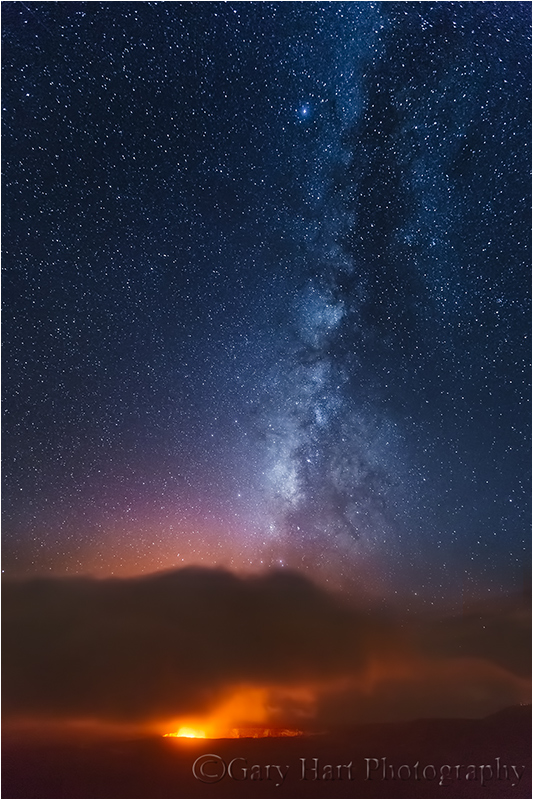
So what’s happening here? The orange glow at the bottom of this frame is light from 1,800° F lava bubbling in Halemaʻumaʻu Crater inside Hawaii’s Kilauea Caldera, reflecting off a low-hanging bank of clouds. The white band above the crater is light cast by billions of stars at the center our Milky Way galaxy. So dense and distant are the stars here, their individual points are lost to the surrounding glow. Partially obscuring the Milky Way’s glow are large swaths of interstellar dust, the leftovers of stellar explosions and the stuff of future stars. Completing the scene are stars in our own neighborhood of the Milky Way, stars close enough that we see them as discrete points of light that we imagine into mythical shapes—the constellations.
The Milky Way galaxy is home to every single star we see when we look up at night, and 300 billion more we can’t see—that’s nearly 50 stars for every man, woman, and child on Earth. Our Sun, the central cog in the solar system that includes Earth and the other planets wandering our night sky, is a minor player in a spiral arm near the outskirts of the Milky Way. But before you get too impressed with the size of the Milky Way, consider that it’s just one of 500 billion or so galaxies in the known Universe—that’s right, there are more galaxies in the Universe than stars in our galaxy.
Everything we see is the product of light—light created by the object itself (like the stars), or created elsewhere and reflected (like the planets). Light travels incredibly fast, fast enough that it can span even the two most distant points on Earth faster than humans can perceive, fast enough that we consider it instantaneous. But distances in space are so great that we don’t measure them in terrestrial units of distance like miles or kilometers. Instead, we measure interstellar distance by the time it takes for a beam of light to travel between two objects—one light-year is the distance light travels in one year.
The ramifications of cosmic distance are mind-bending. Imagine an Earth-like planet revolving the star closest to our solar system, about four light-years away. If we had a telescope with enough resolving power to see all the way down to the planet’s surface, we’d be watching that planet’s activity from four years ago. Likewise, if someone on that planet today (in 2014) were watching us, they’d see Lindsey Vonn claiming the gold in the Women’s Downhill at the Vancouver Winter Olympics, and maybe learn about the unfolding WikiLeaks scandal.
In this image, the caldera’s proximity makes it about as “right now” as anything in our Universe can be—the caldera and I are sharing the same instant in time. On the other hand, the light from the stars above the caldera is tens, hundreds, or thousands of years old—it’s new to me, but to the stars it’s old history. Not only that, every point of starlight here is a version of that star created in a different instant in time. It’s possible for the actual distance separating two stars to be so great, that we see light from the younger star that’s older than the light from the older star.
So what’s the point of all this mind bending? Perspective. It’s easy (essential?) for humans to overlook our place in this larger Universe as we negotiate the family, friends, work, play, eat, and sleep that defines our very own personal universes. I doubt we could cope otherwise. But when I start taking my life too seriously, it helps to appreciate my place in the larger Universe. Nothing does that better for me than quality time with the night sky.
About this image
My 2014 Hawaii Big Island photo workshop group made three trips to photograph the Kilauea Caldera beneath the Milky Way. On the first night we got a lot of clouds, with a handful of stars above, and just a little bit of Milky Way. Nice, but not the full Milky Way everyone hoped for. So I brought everyone back a couple nights later—this time we got about ten minutes of quality Milky Way photography before the clouds closed in. The following night we gave the caldera one more shot and were completely shut out by clouds. Such is the nature of night photography in general, and on Hawaii in particular. This image is from our second visit.
My concern that night was making sure everyone was successful, ASAP. I started with a test exposure to determine the exposure settings that would work best for that night (not only does each night’s ambient light vary with the volcanic haze, cloud cover, and airborne moisture, the caldera’s brightness varies daily too). Once I got the exposure down and called it out to the group, most of my time was spent helping people find and check their focus, and refine their compositions (“More sky! More sky!”). Bouncing around in the dark, I’d occasionally stop at my camera long enough to fire a frame, never staying long enough to see the image pop up on the LCD. I ended up with a half dozen or so frames, including this one from early in the shoot.
Join me on the Big Island next year
Learn more about starlight photography
A starlight gallery
Click an image for a larger view, and to enjoy the slide show


One eye on the ocean, the other on the volcano
Posted on September 16, 2014
Heavenly Fire, Kilauea Caldera, Hawaii
Canon EOS-5D Mark III
16mm
10 seconds
F/16
ISO 3200
September 16, 2014
It’s easy to envy residents of Hawaii’s Big Island—they enjoy some of the cleanest air and darkest skies on Earth, their soothing ocean breezes ensure that the always warm daytime highs remain quite comfortable, and the bathtub-warm Pacific keeps overnight lows from straying far from the 70-degree mark. Scenery here is a postcard-perfect mix of symmetrical volcanoes, lush rain forests, swaying palms, and lapping surf. I mean, with all this perfection, what could possibly go wrong?
Well, let me tell you….
Last month Tropical Storm Iselle, just a few hours removed from hurricane status, slammed Hawaii’s Puna Coast with tree-snapping winds and frog-drowning rain that cut electricity, flooded roads, and disrupted many lives for weeks. Touring the area in and around Hilo, it’s easy to appreciate Hawaiian resilience—thanks to quick action, hard work, and continuous smiles, most visitors would find it difficult to believe what happened here just a month ago. But on the drive south of Hilo along the Puna Coast, I witnessed firsthand Iselle’s power in its aftermath. There beaches have been rearranged beyond recognition and entire forests have been leveled.
But despite its impact, Iselle is already old news. This month residents of Hawaii’s Puna region have done a 180, turning their always vigilant eyes away from the ocean and toward the volcano. In late June Kilauea’s Pu`u `O`o Crater dispatched a river of lava down the volcano’s southeast flank. Since Pu`u `O`o has been erupting continuously since 1983, this latest incursion didn’t initially raise many eyebrows. But the flow has persisted, advancing now at about 250 yards per day. While this isn’t “Run-for-your life!” speed, it’s more like high stakes water torture because there’s very little that can be done to stop, slow, or even deflect the lava’s inexorable march. Residents of the communities of Kaohe and Pahoa can do nothing but watch, pray, and prepare—if the volcano persists, they’re wiped out. Not only that, the lava flow also threatens the Pahoa Highway, currently the only route in and out for the thousands of residents of the Puna region.
Recent reports of increased activity on Muana Loa have also notched up the anxiety. Lava from its last eruption, in 1984, threatened Hawaii’s capital, Hilo, before petering out with just a few miles to spare. Because Muana Loa eruptions tend to be larger and more explosive than Kilauea eruptions, any increased activity there is taken very seriously.
Had enough? Well, there’s more thing: With its funnel-shaped bay and bullseye placement in the Pacific Ring of Fire, Hilo is generally considered the most tsunami vulnerable city in the world. Fatal tsunamis have struck the Big Island in 1837, 1868, 1877, 1923, 1946, 1960, and 1975. Yesterday my photo workshop group photographed sunrise at Laupahoehoe Point, where damage from the most deadly tsunami to strike American soil is still visible. That tsunami, in 1946 (before Hawaii became a state), traveled 2,500 miles from the Aleutian Islands to kill 159 Hawaiians, including 20 schoolchildren and 4 teachers in Laupahoehoe.
Despite this shopping list of threats and hardship, I don’t get the sense the Hawaiians want sympathy. Despite the unknown but potentially devastating consequences facing them, both imminent and potential, no one here is feeling sorry for themselves. There’s much talk about the current lava flow that will directly or indirectly impact every resident of the Big Island’s Hilo side, but no hand-wringing—life goes on and smiles abound. Indeed, everyone here seems to have sprung into action in one way or another, shoring up old long abandoned roads (the jungle claims anything left unattended with frightening speed), helping people move possessions to safe ground, offering temporary shelter, and whatever else might help.
The Aloha spirit is alive and well, and I have no doubt that it will persevere in the face of whatever adversity Nature throws at them.
About this image
My Hawaii photo workshop began Monday afternoon, but my brother and I arrived on the Big Island on Friday because I hate doing any workshop without first running all my locations to make sure there are no surprises. And this time it turned out to be a wise move—not only did I get a couple of extra days in paradise, I did indeed encounter surprises, courtesy of Iselle, when I discovered two of my go-to locations rendered inaccessible by storm damage. I spent Saturday searching for alternatives and by Saturday’s end had a couple of great substitute spots. That night we celebrated with a night shoot on Kilauea. (I was going to visit Kilauea anyway, but if I’d still been stressing about my locations, I probably wouldn’t have been in the right mindset to photograph.)
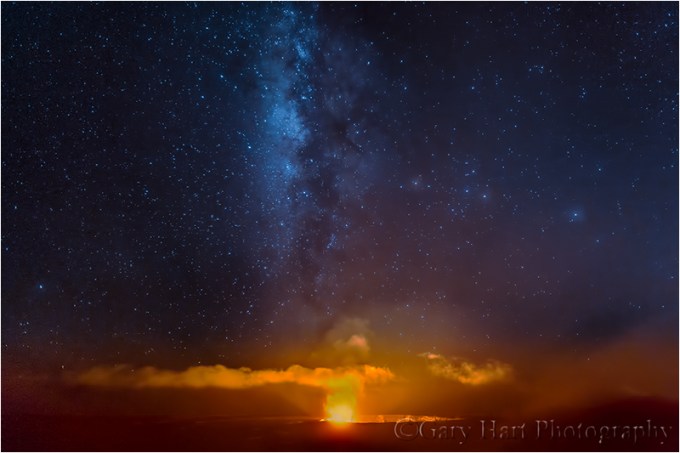
We arrived to find the Milky Way glowing brightly above the caldera and immediately started shooting. Because I don’t have as many horizontal compositions of the caldera as vertical, I started horizontal. By the time I’d captured a half dozen or so frames, a heavy mist dropped into the caldera to quickly obscure the entire view (one more example of our utter helplessness to the whims of Nature).
In this frame I went quite wide, not only to capture as much of the Milky Way as possible, but also to include all of the thin cloud layer painted orange by the light of the caldera’s fire. This is a single click (no blending of multiple images), though I did clone just a little bit of color back into the hopelessly blown center of the volcano’s flame.
A Kilauea Gallery
Click and image for a larger view, and to enjoy the slide slow


Heaven and Hell
Posted on September 8, 2013

Gates of Hell, Halemaʻumaʻu Crater, Kilauea, Hawaii
Canon EOS 5D Mark III
4 seconds
F/2.8
ISO 3200
27 mm
Caving to demand, I took my Hawaii workshop group back up to Kilauea last Thursday night. While we didn’t get stars this time (not even close), we found something that was equal parts different and cool. If the first night’s display was Heavenly, the reprise was Hellish. We finished Tuesday with a new appreciation for our small place in this magnificent Universe; Thursday we were left awestruck by the power of nature’s creative force churning beneath us.
Everyone was thrilled to have the dark, clear skies we saw Tuesday night, but given that this was the first time doing night photography for most of the group, everyone wanted another opportunity apply their new-found skill. Before departing, I reminded them of Mother Nature’s fickle inclinations, and warned them that repeating Tuesday’s clear skies was far from a sure thing. However, I told them, clouds can be pretty cool too. They were dubious, and somewhat disappointed upon arrival—until the first images popped up on their LCDs.
Believe it or not, these images from our two volcano nights are pretty much what we all saw on our camera LCDs (very little processing necessary). They’re a good reminder of our camera’s ability to show aspects of the natural world that are missed in the human experience. A frequent photographer’s lament is the camera’s limited dynamic range (the range of tones between the darkest shadows and brightest highlights), but one advantage a camera does have over human vision is its ability to accumulate light over time. On Tuesday night, our sensors pulled from the darkness stars that were invisible to the naked eye (and also nicely brightened the Milky Way); on Thursday night, a long exposure revealed unseen cloud detail illuminated by Halemaʻumaʻu’s orange glow. Also, on Tuesday night so much of Kilauea’s glow escaped into space that the caldera floor (beyond the inner crater) remained nearly black despite a lengthy, high ISO, large aperture exposure. But on Thursday night the clouds reflected the volcano’s light back to Earth, bathing the caldera floor in an orange glow that our cameras captured beautifully.
Our cameras also allowed us to infer one more difference between the two nights: The crater glowed significantly brighter on Thursday night. I learned from a rim-side chat with a naturalist on Tuesday that Halemaʻumaʻu’s luminosity varies with the composition of its output—the higher the ratio of sulfur gas to water vapor, the brighter it glows. While this difference is sometimes difficult to detect with the naked eye from one night to the next, it became obvious when I realized that in Tuesday’s images the highlights in the crater’s burning core were recoverable in Lightroom, while the same bright region in Thursday’s images was hopelessly blown at the same exposure. Fortunately, on Thursday night I opted for a shorter shutter speed to better “freeze” Halemaʻumaʻu’s gas plume—this left the caldera a little dark (but still brighter than Tuesday), but really reveals the plume’s character.

Halemaʻumaʻu Crater, Kilauea, Hawaii
Canon EOS 5D Mark III
15 seconds
F/2.8
ISO 3200
16 mm
Last night, at the volcano…
Posted on September 4, 2013
Milky Way Above Halemaʻumaʻu Crater, Kilauea, Hawaii
Canon EOS 5D Mark III
15 seconds
F/2.8
ISO 3200
16 mm
Sitting here on my balcony above Hilo Bay, it’s hard to believe that 10 days ago I was photographing sunrise lightning on a chilly morning at the Grand Canyon. But there’s Mauna Kea, and over there is Mauna Loa. And it’s 6 a.m. and I’m in shorts and flip-flops, so this really must be Hawaii. Ahhhh.
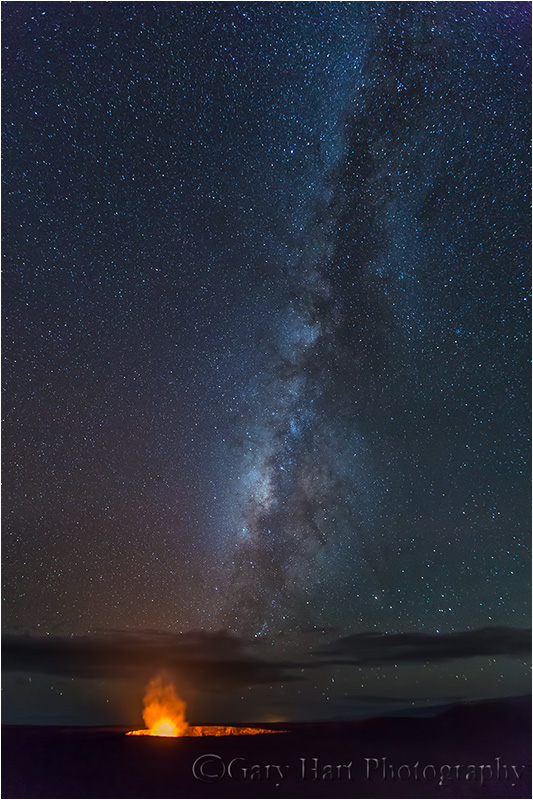
Oh yeah, it’s all coming back to me…. Last night I took my Hawaii workshop group up to Kilauea to photograph the volcano beneath the stars. I always stress about this shoot in particular because the opportunity to photograph the glow of Halemaumau Crater beneath the Milky Way is what brought many of the workshop participants to Hawaii in the first place. My stress is due to factors largely beyond my control: clouds, inadequate equipment (“The guy at Best Buy said this tripod should be fine”), technical problems (“Oh, I thought a five percent battery charge would be enough”), and just plain user error (“It looked sharp in the LCD”). Each year I do my best to mitigate as many problems as I can: I send copious reminders (“Don’t forget to bring…”) and how-to documents (starting months in advance), give a night photography training session the afternoon of the shoot, do a group equipment set-up and checklist in the parking lot before we walk out to the view point, and frequently check on participants during the shoot. But while all that preparation seems to help, so far I haven’t been able to do anything about the weather. The best I’ve been able to do is time my primary volcano shoot early enough in the workshop to allow us the option of returning in the event of a mass fail.
So yesterday afternoon we drove up to Kilauea, stopping first at the Visitor Center (I’m something of a souvenir T-shirt addict), then walking through the lava tube (always a hit), before wrapping up the daylight portion of the day with a really nice sunset at the Jaggar Museum (the closest point from which to view the caldera). Then we headed to dinner beneath a tantalizing (traumatizing) mix of clouds and sky—were the clouds incoming or outgoing? Dinner was great, but I’d have surely enjoyed it far more if I’d have known we’d leave the restaurant and see starry skies. And stars there were, millions and millions (or so it seemed). Phew.
Once the stars did their part, the rest of the night was up to me—despite all the preparation, I know from experience that basic photography skills such as composition, camera adjustments (even though I’d given everyone starting exposure values in the parking lot, most people usually need to tweak something), and (especially) finding focus, become completely foreign in the near absolute darkness of a moonless night. These problems are compounded by the fact that a flashlight, while necessary to light the path to the location, is absolutely taboo once we’re there (their light can leak into others’ frames, and flashlights make it almost impossible to adjust to the darkness)—instead we rely on the soft glow of our cell phone screen to see our controls.
I started with a test exposure to verify the exposure values I’d had everyone set earlier. So far, so good. Then the real fun began—for the next 45 minutes I bounced from pleading shape to pleading shape (faces are unrecognizable): “My camera won’t focus” (Try auto-focusing on the caldera—if that doesn’t work, we try creative solutions such as auto-focusing on a flashlight 100 feet up the trail or a best-guess manual focus on the caldera rim); “My camera won’t shoot” (Turn off autofocus);“ Is this image sharp?” (Magnify the LCD and zoom in on the stars or caldera wall); “My picture is black” (The correct exposure is 30 seconds, not 1/30 second). And so on. (I should make clear that these problems were more an indication of the disorientation caused by the darkness than a reflection of the photographer’s skill.)
But slowly the cries for help turned to exclamations of joy as successful images started popping up on LCDs. Pretty soon I was wandering around looking for someone who needed help, anyone…. When it finally became clear that my offers to help were more of a distraction, I returned to my camera (no small feat in the dark) and tried a few frames of my own. While I had no illusions of getting anything new (or even anything much different than what others had), I tried several variations. Most of my images were oriented vertically to maximize the length of the serpentine Milky Way, and to minimize the black void surrounding the glowing crater. I also varied my focal length a bit, and played with my ISO and shutter speed settings so I could choose later (with the benefit of a larger screen) between more noise, less star motion and vice versa.
In addition to the photography, I always make a point to stop everyone and remind them to simply appreciate what we’re viewing. The orange glow is molten rock, the newest material on the Earth’s surface; overhead are pinpoints of starlight that originated tens, hundreds, even thousands of years ago. It’s both humbling and empowering.
We finally wrapped up a little before 11. Everyone seemed quite happy (okay, downright giddy) with what they’d gotten. At breakfast this morning a few people said they’d checked their images after returning to the hotel, but most said they just collapsed into bed. Nevertheless, I’m already starting to receive whispered requests to return to Kilauea one more time. I won’t take a lot of convincing.
* * * *
:: Join me next year as we do this all over again in the 2014 Hawaii Big Island Volcanoes and Waterfalls photo workshop ::
Literally breathtaking
Posted on July 6, 2013
Under the Milky Way, Kilauea Caldera, Hawaii
Canon EOS-1Ds Mark III
30 seconds
F/2.0
ISO 800
28 mm
Even with the number beautiful things I get to photograph, certain natural wonders will forever thrill me. Near the top of that list is the view into the Kilauea Caldera on Hawaii’s Big Island. I thought I knew what to expect, but even after a lifetime of National Geographic specials and an occasional “Breaking News!” disaster video, I was little prepared for the in-person experience of peering into an active volcano.
Approaching Kilauea from Hilo, the first sign that something unusual is in store is the plume of thick smoke and vapor rising in the distance and spreading with the wind. If you didn’t know a volcano was nearby, you might mistake the smoke for a forest fire. The billowing plume becomes more prominent as you draw closer to the volcano, and once in Hawaii Volcanoes National Park you’re soon surrounded by white puffs of steam rising from the ground on both sides of the road.
On the drive to the caldera you’ll be tempted by several vista opportunities, but the best perspective is from the Jaggar Museum at the end of the road (the loop road that once circumnavigated the caldera is now closed at the museum due to the risk of noxious fumes beyond). For first-time visitors I recommend foregoing the preliminary views in favor of the Jaggar view, which makes the most impactful first impression—you can return to the other views on the drive out.
When visiting during the day you’ll see white smoke pouring from a large hole on the caldera’s floor, but no sign of orange flame—the sunlight simply overpowers the volcano’s fire. While any view of a volcano is memorable (trust me), nothing compares to the experience of seeing the caldera after dark. I usually arrive at the caldera in time for sunset, go to dinner, then return once darkness is complete. Not only does this break allow time for darkness, I also find that the clouds that frequently obscure the sunset sky dissipate once the sun is down (in other words, don’t forego a night visit simply because your daytime visit was cloudy).
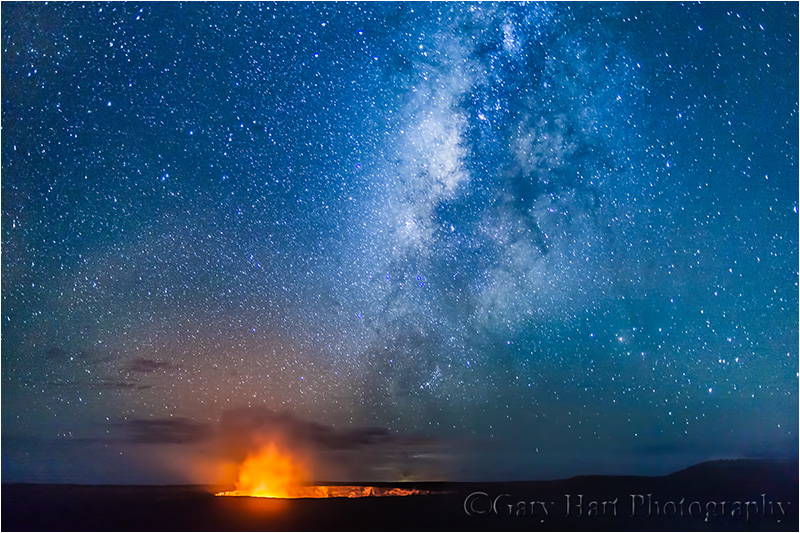
Even if you do find clouds after dark, the clouds beautifully radiate the caldera’s glow to bathe the entire scene in orange, a subtle effect to the naked eye that comes alive in a long exposure. If you’re lucky enough to visit on a night with few or no clouds, you’ll be treated to the churning lava’s orange fire, reflected by belching white smoke, beneath a sea of stars. My first time seeing the caldera beneath the Milky Way I literally gasped, and it was several seconds before I realized I was holding my breath. Breathtaking indeed.
* * * *
Let me add that finding the Milky Way above the caldera isn’t without its difficulties. Even if the clouds cooperate, simply showing up at the Jaggar Museum after dark isn’t enough because the properly aligned vantage point varies with the date and time of night you visit. In the Northern Hemisphere the best views of the Milky Way are moonless summer nights (moonlight washes out the sky as much as city lights). If you find yourself there with the Milky Way visible, aligning it with the caldera is usually a matter of driving or walking the rim until you find the spot.
We’ll be photographing the Milky Way above Kilauea in my upcoming Hawaii Big Island workshop is September 2-6. While it filled several months ago, a recent cancellation leaves me with one opening. And I still have lots of openings in my 2014 Hawaii workshop, September 15-19.
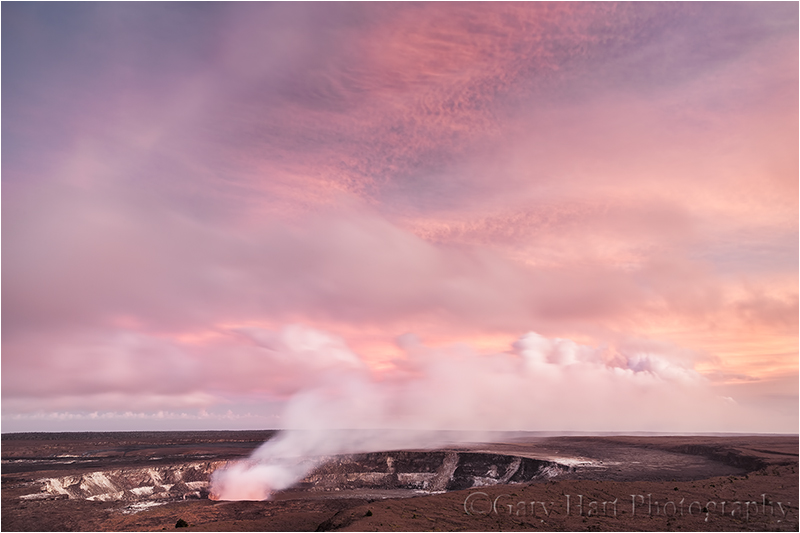
Earth on Fire, Kilauea Caldera, Hawaii :: The sunset light had dimmed just enough that the lava lake’s fiery orange is just visible. Even just few minutes earlier the scene was too bright to see any color in the caldera.
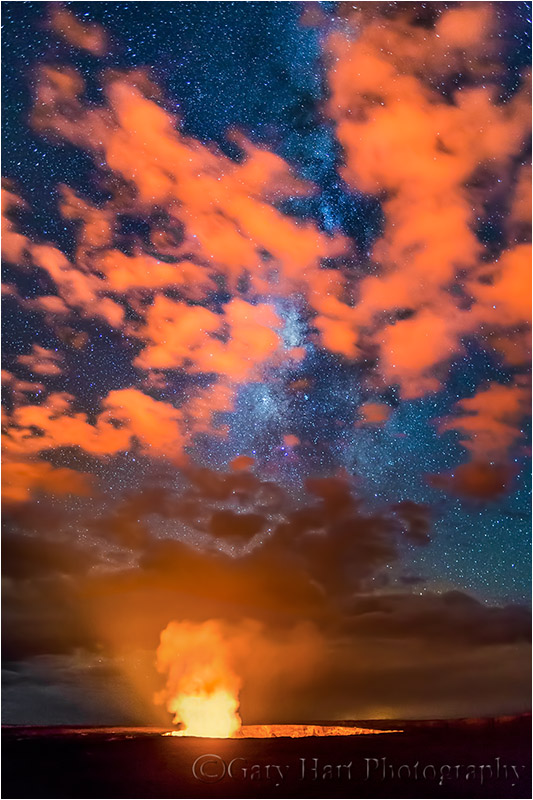
Milky Way and Clouds, Kilauea Caldera, Hawaii :: Here the clouds reflect the lava’s glow, but part just enough to reveal the Milky Way behind.
Glow in the dark
Posted on September 25, 2012

Kilauea Caldera, Hawaii
* * * *
An unfortunate reality of photographing the things I photograph, at the times I photograph them, is the doubt the results foster—“Is that real?” Sigh. That skepticism is compounded by the (understandable) ignorance of people who expect cameras to duplicate human reality, a fallacy no doubt perpetuated by photographers who proclaim each image to be, “Exactly the way the way my eyes saw it.” And then there are those unscrupulous photographers who alter images for personal or financial gain by adding or moving objects (the moon seems to be a popular subject), cranking up the color, and embellishing the hardship the capture required. It’s no wonder people don’t know what to believe.
So let’s take a look at this night shot of the Kilauea Caldera, captured during my recent Hawaii Big Island photo workshop. Is this the way I saw it? Absolutely not. First, my experience was three dimensional. It included wind motion in the caldera’s vapor plume, a dome of sky saturated with thousands of stars, the Milky Way stretching from horizon to horizon, and clouds wafting in and out, intermittently revealing and obscuring parts of the sky. The magic I experienced was far beyond my camera’s capability.
But my camera has reality of its own, and its own magic. By increasing my ISO (the sensor’s sensitivity to light), aperture (the size of the opening that allows light to reach the sensor), and exposure time, I was able to capture more light in one frame than my eyes could see at any instant. All this additional light on my sensor gave me a section of sky containing even more stars than my eyes saw, and clouds fully illuminated by the volcano’s glow.
This particular image was captured on the second of three nights on the rim. My first workshop group nailed it on the first attempt (see my September 9 post), but the second group’s first attempt was largely thwarted by the large cloud you see in this image. Nevertheless, as you can see, we had a small window of opportunity on this night as well, so while the group wrestled with their camera’s and tripods in the dark, I took a test exposure and gave everyone exposure values. As I moved around making sure they all had their settings dialed in and focus set, it was a blast listening to the gasps up and down the rim when the first image popped on each person’s LCD. But once that cloud settled in, the show was pretty much over. After waiting nearly two hours for more sky we packed it in, but by then everyone was hooked, so we returned a couple of nights later to smashing success.
The processing for this image was minimal. In fact, what you see here is pretty much we all saw on our LCDs, with mostly minor tweaks. In Lightroom I brushed a little color temperature reduction to cool the sky, made some slight exposure adjustments, and bumped the clarity to help the stars stand out. In Photoshop I did moderate noise reduction with Topaz DeNoise (love the high ISO performance of my new 5D III) and dodged the underside of the trailing vapor plume a little. And so intense was the color in the clouds that I desaturated the red channel somewhat. None of these adjustments were major, and in fact I was already mostly satisfied with the raw image and Adobe Standard processing (my Lightroom default) that I started with.
The one significant adjustment I did make in Photoshop was to fix the blown highlights at the caldera’s core, at the very center of the fire where it burned hottest, an area the width of the fire in length and about 2/3 of that width high (about 3/4 of the bright area you see beneath the smoke). That core area, while yellow to my eyes, was hopelessly blown (no color or detail) by the extreme exposure the rest of the scene required. To fix it I used Photoshop’s Eyedropper tool to select the yellow just beneath the cooler orange, and the Paint Bucket tool at about 20 percent opacity to replace the pure white with (very) pale yellow.
The objective of any art form is not to show us exactly what we can all see with our own eyes, but rather to expand our perception of reality and and help us see the world differently. While this is not they way my eyes saw it, it is the way my camera saw it (with the one exception noted above). As with a moonbow that’s not visible to the naked eye, streaking stars or blurred water recorded with a long exposure, and the enhanced contrast and shape of a black-and-white image, the camera gives us fresh insights into the natural world. That’s why I choose not to lament perceived “limitations” such as my camera’s inability to capture the range of light my eyes see, preferring instead to celebrate its ability to reveal things my eyes can’t see—in this case faint stars and the fiery, natural light illuminating the clouds and Kilauea’s plume. Nothing can compete with the experience of being there, but I’m thrilled to have images to remind me of that experience, and to show me what my eyes missed.
* * * *
Join me next September as I try to duplicate this shot in my Hawaii Big Island Volcanoes and Waterfalls photo workshop, September 2-6, 2013.
Wow, wow, wow…
Posted on September 7, 2012

Fire on High, Kilauea and Milky Way, Hawaii
Canon EOS-5D Mark III
15 seconds
F/2.0
ISO 3200
28 mm
In a life filled with special moments, a few in particular stand out for me. Near the top of that list would be my annual trip to Hawaii and more specifically, the opportunity to photograph the Milky Way above an active volcano. I do this enough that it’s no longer novel for me, but it’s always special, and each time I get vicarious joy seeing my group’s reaction. And no Kilauea shoot was more joyful than this night.
After photographing a nice sunset at the caldera, my workshop group hightailed it to the Kilauea Lodge in nearby Volcano for dinner and to wait for total darkness. The sky was mostly cloudy when we went inside, but I’ve done this enough now to know that the clouds surrounding Kilauea often clear once the sun goes down. Stepping outside after dinner, we were thrilled to see that the clouds had indeed departed, exposing a sky that some in the group said was filled with more stars than they’d ever seen. (Camera or not, I encourage each of you to get away from town late on a moonless night and spend some quality time with the sky.)
We started our night shoot at the Jaggar Museum overlook, which offers the closest view of the caldera. I got the group set up with their exposures and focus and we stayed until I knew everyone had at least one successful image. Its proximity to the caldera makes the Jaggar overlook the most crowded place to view Kilauea, so I quickly hustled the group to another spot a little farther back along the rim where I knew we could align the Milky Way with the glowing caldera. By that time a few clouds had started to move back in, but I reassured everyone that some clouds would add some character to the sky and reflect the color from the volcano. Little did we know….
Our second vantage point was completely empty, and the clouds couldn’t have been more perfect if I’d have commissioned them myself. For at least thirty minutes we photographed a jigsaw of cloud fragments drifting over the volcano, glowing like embers with the light of the churning lava but parting just enough to reveal the stars behind and frame the Milky Way.
Waiting fifteen to thirty seconds for an exposure to complete leaves lots of vacant time, which we managed to fill quite easily with laughter. Despite the hilarity, everyone managed to keep shooting until the cloud pieces assembled and the Milky Way rotated away from the volcano’s glow. But not before everyone in the group had an assortment of images like this (and memories to match). Besides the amazing images, I think my greatest pleasure came from the spontaneous exclamations of joy (“Oh my God!”, “Wow! Wow! Wow!”) I heard from each workshop student when the first image popped up on their LCD.
And for those dubious minds who don’t believe this image is “real,” I can assure you that this is pretty much the way the scene appeared on everyone’s LCD (and I have a dozen witnesses with their own images to prove it). To our eyes the scene was darker, not nearly bright enough for our eyes to discern this much color in the clouds (but no less beautiful). But boosting exposure to bring out more stars in the Milky Way had the added benefit of enhancing the caldera’s glow reflected by the clouds.
Join me on the Big Island each September as I help my workshop group duplicate this amazing shot
A Big Island Gallery
Click an image for a closer look and slide show. Refresh the window to reorder the display.


 Eloquent Images by Gary Hart