Eloquent Images by Gary Hart
Insight, information, and inspiration for the inquisitive nature photographer
Still Learning
Posted on March 31, 2026
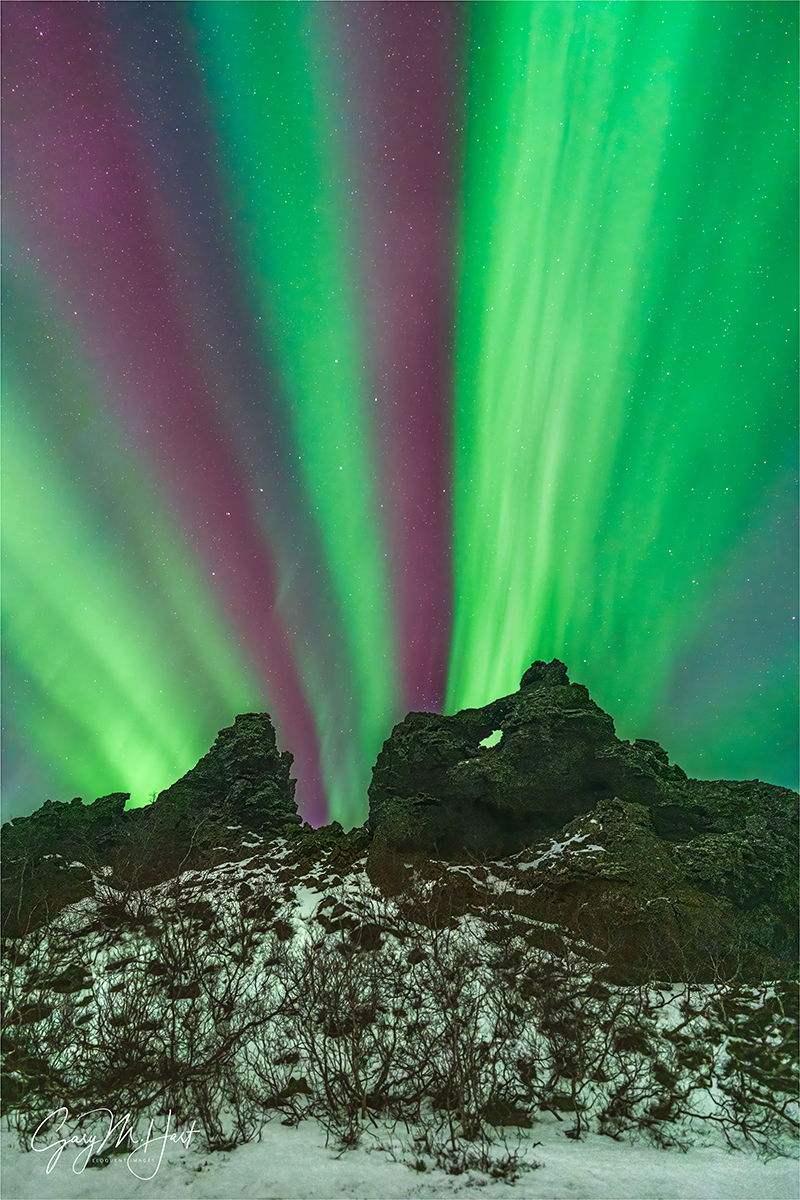
Aurora and Big Dipper, Dimmuborgir Lava Fields, Iceland
Sony α1
Sony 14mm f/1.8 GM
ISO 4000
f/1.8
4 seconds
Whether it’s rafting Grand Canyon, gaping at a comet, or chasing supercells and tornados across the Midwest, instead of scratching an itch and moving on (as I’d expected would happen), checking-off a bucket-list item only seems to fuel my desire for more.
Case in point
I saw my first aurora in 2019. As with all my prior bucket-list experiences, the aurora experience actually exceeded my lofty expectations. Puzzling over why sights I’ve dreamed of for so long so consistently exceed my expectations helped me appreciate the power of experience over simple observation. For me, the experience component—that feeling like I’m part of something—is what motivates me to learn as much as I can about my subjects. Speaking only for myself (your results may vary), simply photographing beauty without taking time to understand just feels superficial.
Though I’d done a little research on auroras before my first Iceland visit, that obsession to truly understand what was going on didn’t fully kick in until I actually stood beneath those multi-colored shafts and sheets and watched them twist and fold above my head. Game on.
I learned about solar cycles, solar storms, the solar wind, Earth’s polarity, the magnetosphere, the magnetotail, ionization of atmospheric molecules, and how all these elements conspire to put on this dazzling show. And since, for photographers, a significant aspect of aurora science centers on the ability to predict when and where it will appear, I paid special attention to the Kp index: the measure of aurora-causing electromagnetic activity in Earth’s magnetosphere that is the prime focus of most aurora prediction resources.
So, armed with just enough knowledge to be overconfident, and a Kp-based app that validated it, I enjoyed reasonable aurora success in subsequent Iceland visits. But despite this success, and access to Kp forecasts that stretched out 30 days, it didn’t take long to realize that predicting tonight’s aurora activity by Kp-tracking alone is not very reliable—less reliable even, than a weather forecast that says it’s going to rain in 7 days. While there was a clear correlation between high Kp values and an active aurora, I couldn’t figure out why so many high Kp nights disappointed, and low Kp nights dazzled.
What was I missing?
Digging deeper, I saw that my aurora app measured a lot of electromagnetic behavior besides Kp. I’d never really paid a lot of attention to these other cryptic values, but having become pretty comfortable with aurora-science basics, I thought my brain cells might be primed to dig a little deeper. The first thing I learned was that many of these measurements, while significant to solar scientists, aren’t terribly useful to aurora watchers. But I did identify one that is: Bz.
In the simplest terms possible, Bz measures the north/south orientation of the interplanetary magnetic field (IMF) that originates at the sun and propagates outward, eventually interacting with Earth’s magnetic field. Turns out, for predicting auroras, the Bz orientation might just be more important than the Kp index.
In fact, the Bz value can completely make or break an aurora show. Without getting too deep into the scientific weeds (by diving into knowledge that’s far beyond my pay grade), a south-oriented IMF, represented by a negative Bz value, stimulates Earth’s magnetosphere in way that greatly increases the chances for an active aurora; when the IMF is positive (north oriented), the IMF subdues magnetosphere activity and stifles the aurora.
The problem—and likely the reason aurora forecast apps focus mostly on Kp—is that while Kp can be (kind of) predicted days or (more dubiously) weeks ahead, Bz can only be measured, not predicted. The best we can do is park satellites at the gravitationally stable Lagrange Point 1 (L1)—where Earth/Sun gravity balance each other—to monitor the solar wind as far out in space as possible (about 932,000 miles from Earth). Depending on the speed of the solar wind, the IMF can take from 15 to 60 minutes from the time we measure it until affects the magnetosphere and delivers an aurora show (or not).
Though Bz can’t really be predicted, the 15 – 60 minute lag time between measurement and arrival does provide one extra benefit: the ability to see what’s coming in the next hour or so to decide whether or not this would be a good time to pack up and go home, or maybe stick around a little longer.
Applying my new knowledge firsthand
This year’s Iceland Aurora photo workshop was the first opportunity Don Smith and I had to put our Bz knowledge to the test. Regardless of the Kp forecast, we always go out unless the sky is completely covered by clouds, with no hope for clearing. This year we made it out 4 nights, at 3 different locations.
Winter Night, Aurora Over Vatnsnes Peninsula, Iceland
Our first attempt was at Kirkjufell, but the Kp was low and the Bz stayed positive and, as expected, the aurora was never more than a faint green, invisible to our eyes and barely visible in our images. We ended up having a beautiful moonlight shoot at one of the most photogenic mountains in the world, but no real aurora display.
The next night was on Vatnsnes Peninsula in far north Iceland. Despite a similarly low Kp forecast, when we finished dinner and saw stars overhead, we went out aurora chasing again. When we started the aurora was definitely better than the prior night, but nothing spectacular. Then the Bz turned moderately negative about half-way through our shoot—it was as if someone had flipped a switch to give us firsthand demonstration of what a negative Bz can do. The show this night far from the most dynamic that Don and I have seen, but it was very nice—especially for the first-time aurora viewers in our group.
The next night we had clear skies again, so our guide took us to Dimmuborgir Lava Fields. With a network of trails that wind beneath striking volcanic rocks (used in Game of Thrones), this turned out to be a fantastic spot for the northern lights—sadly, despite a pretty good Kp forecast, the Bz didn’t cooperate and the aurora that night, while better than the Kirkjufell show, didn’t come close to the prior night.
Which brings me to the workshop’s final northern lights shoot. With a forecast for clear skies, a decent Kp, and a Bz that had been mostly negative for several hours, we returned to Dimmuborgir with high hopes. From the second we exited our van and saw the lights dancing overhead, I knew we were in for a treat. Since the group had already been here twice—once for that earlier aurora shoot, and then again the next afternoon, Don and I just gave everyone a be-back time and set them free (then stood back to avoid being trampled).
I took a lot of pictures of this spectacle, but had almost as much fun watching everyone’s reaction to it. All the while, I monitored the Bz on my aurora app, further confirming its correlation with the brilliance and spread of the aurora above us.
The show this night might not have been the most spectacular northern lights display I’ve ever seen, but it was definitely in my personal top 5—made even better by a location that provided the best variety of striking foreground subjects I’ve ever had for an aurora. And being able to include the Big Dipper with this scene was an unexpected treat.
Join Don and me for next year’s Circle of Iceland Northern Lights photo workshop (a brand new itinerary)
Workshop Schedule || Purchase Prints || Instagram
The Lights Fantastic


Where in the World is Gary?
Posted on March 23, 2026
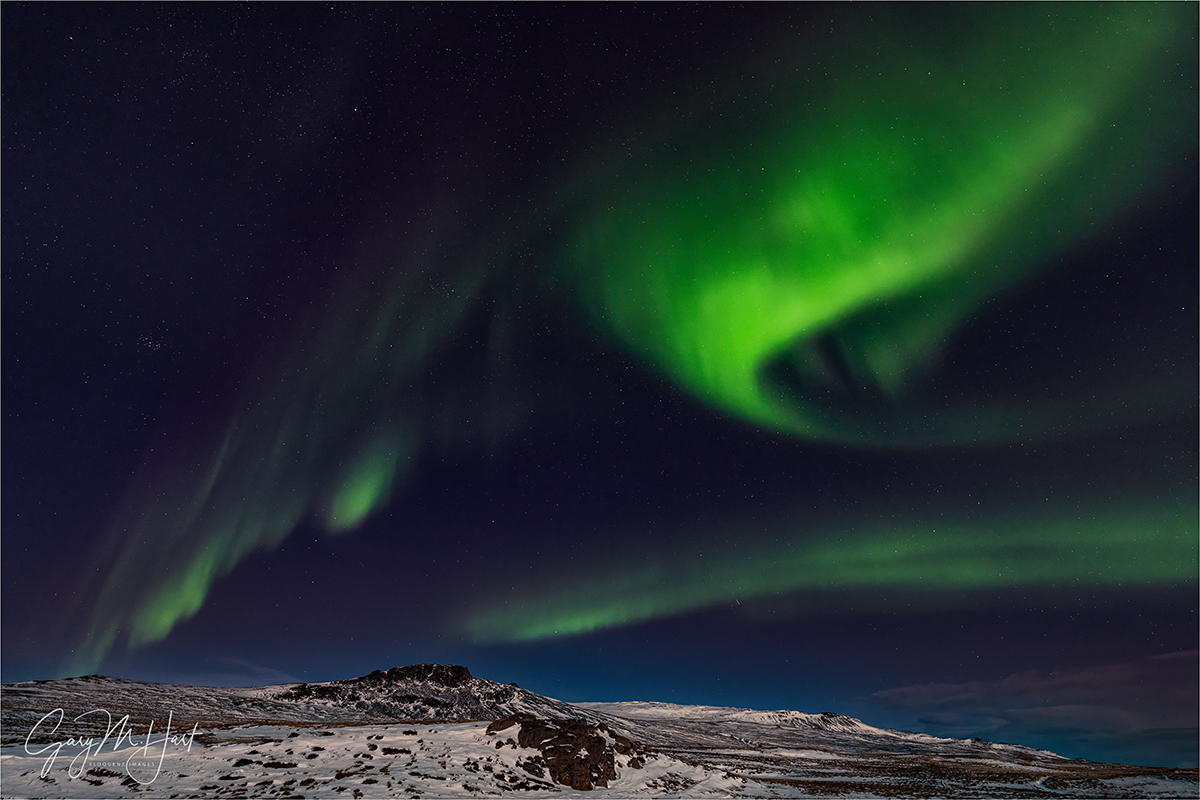
Winter Night, Aurora Over Vatnsnes Peninsula, Iceland
Sony α1
Sony 12-24 GM
3.2 seconds
F/2.8
ISO 3200
You may (or may not) have noticed that my “weekly” blog posts have slowed somewhat in the last month or two. I haven’t gone anywhere—or more precisely, I’m still going the same places and doing the same things I always have, I’m just prioritizing my time differently. After 15 years of stressing, staying up late, missing meals, and in many other ways pushing myself too hard to meet that once-a-week blog goal, I simply decided not to let myself be ruled by arbitrary, self-imposed commitments (I’m a slow learner). I still love writing this blog and have no plans to quit—I’m just going to adjust my time management a bit to emphasize other priorities, especially when my travel schedule starts to take its toll. But anyway…
So exactly where in the world have I been in the last two months? I thought you’d never ask. At the end of January and into early February, I was in Death Valley and the Alabama Hills for my (final) Death Valley workshop; a couple of weeks later I was off to (snowy!) Yosemite for my Horsetail Fall workshop. A storm that dropped record snowfall meant no Horsetail Fall, but seeing Yosemite smothered in white was more than sufficient compensation. A week after that, I jetted off to (snowy and icy) Iceland for Don Smith’s and my annual aurora workshop. Don and I have been doing this trip for many years now, but this year we mixed things up a bit by following a more northerly itinerary. I was home from Iceland for less than 36 hours before making a 13-hour drive to Phoenix for my annual MLB Spring Training trip (go Giants!). Phoenix had record-shattering (for March) highs in the 90s—going from multiple layers of wool and down to shorts, tank tops, and flip-flops was probably the most extreme weather whiplash I’ve ever experienced. And though my Spring Training trip isn’t for photography, I did pack my camera bag because on my drive home I added a day so I could detour through Death Valley to check out the super-bloom (nice, but nothing like the one I witnessed in 2005). I made it home to Sacramento (where our highs are only in the 80s) last Wednesday night, and am looking forward to a 5-week break from the travel.
Thanks to all this recent travel, the only thing in my life accumulating faster than unprocessed images seems to be the dull but essential tasks associated with running a business. Sigh. But I had to process something, so today I’m sharing a northern lights image from the first of two beautiful aurora shows this year’s group enjoyed. The aurora forecast for this night wasn’t great, but the sky was clear (-ish), so despite the late hour, temps in the low 20s (upper teens?), and no specific location in mind, we piled into our spacious Sprinter van decided to go aurora hunting. Why? Because that’s what photographers do.
We were in northern Iceland’s inherently remote Vatnsnes Peninsula, but somehow found an even more remote road and just drove until we liked the view. How remote? We were out there more than two hours and didn’t see a single other car. (I’m pretty sure our guide knew where we were, but no on else had a clue.)
For the first hour or so we had enough green glow to get the aurora newbies excited, but nothing exciting enough to make this grizzled aurora veteran take his camera out. Had I been by myself I might have clicked a frame or two, but I was content to spend my time making sure everyone was ready in the event the activity ramped up. It actually worked out nicely to have a dedicated practice session to get everyone up to speed with the challenges of night photography.
Not long after we told the group we’d give it another 20 or so minutes, a rising, nearly full moon poked through clouds behind us and bathed the snow and rock in moonlight. That was nice, but couple of minutes after the moon’s appearance, almost like magic a green shaft materialized on the northeast horizon and within seconds stretched above our heads to touch the opposite horizon—the real show was on. Soon we were all oooo-ing and ahhhh-ing, spinning around and trying to monitor the ever-changing overhead display—one minute the best show would be in the northeast, the next it would be due west. For the first-timers the priority was the best aurora, regardless of the foreground; those of us with prior aurora successes could afford to be more selective about our foregrounds. Though nothing on the ground out here was spectacular, I liked the view across the road, facing more west and northwest. Wanting to avoid including any road in my frame, I walked to the other side and framed up a small moonlit mountain.
My go-to night photography lens in my 14mm f/1.8—so imagine my surprise after arriving in Iceland to discover that its slot in my camera bag was empty—oh yeah, I took it out right before my Yosemite workshop because we wouldn’t be doing any night photography, then never thought about it again. Oops. If this had been a Milky Way shoot, where every photon counts, I’d have been pretty bummed (understatement). But for a good aurora display, especially one above a moonlight-augmented landscape, f/2.8 is plenty fast. And even though I don’t use my 12-24 f/2.8 a lot, when I do need it I really need it (especially in Yosemite), so it’s a fulltime resident of my camera bag. Which is how I ended up shooting this entire scene at 12mm and f/2.8. It didn’t take long to realize that I appreciated being able to include a little more sky much more than I missed that 1.3 stops of light.
This aurora show was memorable less for its spectacular nature—it was very nice, but didn’t compare to many other northern lights shows Don and I have shared with prior workshop groups—than it was for the fact that it enabled Don and me to breathe a collective sigh of relief, knowing that everyone in our group got to see and photograph the prime reason they signed up for an Iceland winter photo workshop: a legitimate northern lights display.
The next day we traveled to another region farther east, trying for the aurora again that night at a location with a much better foreground. That night we saw a little bit of green, but by then everyone had seen firsthand that it could be much better. What Don and I hadn’t told them after our first aurora success was how much better it could. But before we were done, they learned that for themselves. But that’s a story for a different blog post…
Workshop Schedule || Purchase Prints || Instagram
Celestial Wonders
Click any image to scroll through the gallery LARGE


Breaking My Own Rules
Posted on April 3, 2025

Follow the Lights, Snaefellsnes Peninsula, Iceland
Sony α1
Sony 14mm f/1.8 GM
ISO 3200
f/1.8
6 seconds
My goal is to create images that celebrate Nature, images that allow viewers to imagine a world untouched by humankind. So it makes sense that I avoid including anything manmade in my images. But I also rail against (most) camera clubs for their rule-bound creative constipation, and those strong feelings collided earlier this year on a chilly January night Iceland. I resolved the conflict by reminding myself that any time I’m following rules (even my own rules), I’m not being creative.
Earlier in my photographic life I was somewhat less discriminating with my subject choices. In fact, I’d actively seek any outdoor subject that I found beautiful, regardless of its origins. Though many of my bridge and skyline images from those days were on (or atop) my personal bestseller list ($$$), as my career evolved, I found myself resenting humankind’s intrusion on the natural world and became less inclined to validate that intrusion with a photograph. These subject choices eventually, and pretty organically (not consciously), evolved into my present style: photograph the world untouched by humans, which made the mere presence of a building, fence, path, or human being reason enough to put my camera down.
I don’t think it’s wrong to photograph manmade objects—in fact I enjoy others’ photos of a wide variety of subjects outside my wheelhouse—it’s just that I’m not personally drawn to photograph them. But since I am still a photographer at heart, it’s difficult to pass beauty of any sort. In recent years, I’ve scratched the itch to preserve “unnatural” beauty with my iPhone. Though I rarely do anything with these images spontaneous snaps, somehow knowing I’ve saved the scene makes me feel better.
Since becoming so hardcore about avoiding manmade objects, I have encountered a handful of scenes that tested my resolve. For example, there was that frigid night beneath the Milky Way atop Mauna Kea in Hawaii, when a giant telescope made too perfect a foreground to ignore. And the night, also beneath the Milky Way, at Cape Royal on the North Rim of the Grand Canyon, when a SpaceX Falcon 9 rocket photobombed my scene—that time I almost resisted photographing it, and am so glad I didn’t.


But whether it’s a streaking rocket, dilapidated fence, or photogenic bridge, some things are too beautiful not to preserve just because of some self-imposed rule. Most recently, on this January night in Iceland the northern lights outperformed our most unrealistic expectations, but for a little while the best display included a road and our hotel. (I already described that night in my recent Shock and Awe blog post, so I won’t bore you again with the story.)
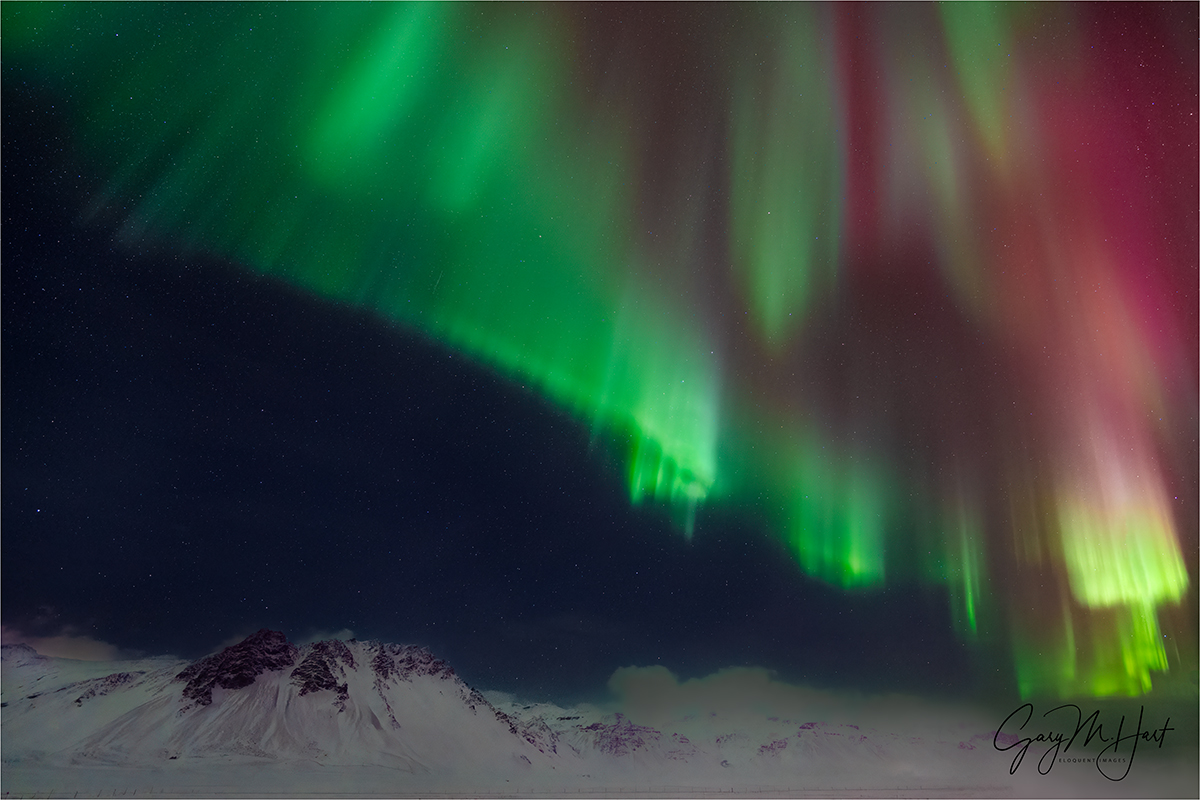
Night Lights, Snaefellsnes Peninsula, Iceland
For most this night’s kaleidoscope display, the aurora danced beautifully above snowy peaks and pristine snowfields—dark sky and no human intrusion involved. But as usually happens in the most intense aurora shows, the lights weren’t limited to the northern sky, and this evening they seemed to be especially drawn westward, where the “highway” (in the sense that it’s the main route encircling Snaefellsnes—we didn’t see a single car while we were out there) and the lights of our small hotel intruded on any scene I could imagine.
Nevertheless, I regularly checked-in on the rest of the sky and at one point just couldn’t ignore what was happening in the west. Grabbing my tripod/camera, I hustled to the road to look for any composition that might work. It was immediately obvious that the road would be unavoidable, but I saw that by moving farther west, I could at least eliminate the hotel and a few other minor distractions.
Given that the road was a non-negotiable condition of photographing in this direction, I just decided to lean into it and make the gently curving blacktop into an actual subject that guided the eye skyward. Orienting my camera vertically maximized the aurora and highway, and minimized potential distractions on the periphery. I only took a couple of frames in this direction, and it wasn’t until I saw the results on my camera that I realized how much I like this “unnatural,” rule-breaking image.
Don Smith and I just added a 2026 Iceland Northern Lights workshop
Workshop Schedule || Purchase Prints || Instagram
Human Interference
Click any image to scroll through the gallery LARGE


Shock and Awe
Posted on February 27, 2025
Night Lights, Snaefellsnes Peninsula, Iceland
Sony α1
Sony 14mm f/1.8 GM
ISO 3200
f/1.8
5 seconds
That night at dinner, one person in the workshop group asked if there was a chance we’d see the northern lights, or if he could safely have another beer. I laughed and told him, while I can’t predict the future, I’d be shocked if the northern lights happened this night and to just go ahead and have that beer. I’ve never been happier to be wrong (and that my advice didn’t ruin his evening).
Each winter Don Smith and I do a winter workshop in Iceland. There are many reasons to visit Iceland in winter, but for most of our workshop students, at the top of the list is the northern lights. Because northern lights success doesn’t just happen, each day Don and I powwow with our Iceland guide to assess our odds for aurora success that night, and to plan our strategy to be there when it happens. We base these decisions on forecast aurora activity, expected cloud coverage, dark sky (no light pollution) views of the northern sky, and the experience we’ve gained from prior northern lights shoots.
Our second night on Snaefellsnes Peninsula (the workshop’s third night), the expected KP-index (the universally accepted 0 to 9 scale of aurora activity) was a very disappointing 1—about as low as we ever see in Iceland. Worse still, an incoming storm had already started to spread clouds, further reducing the night’s aurora expectations.
But regardless of the target (aurora, lightning, Milky Way, and so on), past surprises have taught us to never not have a plan in the event of the unexpected, so at dinner this evening we laid out the bad news to the group, but promised to keep an eye on the sky and notify them if anything changes. Though the incoming storm meant we wouldn’t be able to drive to another location if the aurora surprised us, we told the group that just across the road from our remote hotel was an unobstructed, dark-sky view of the northern sky above snowy peaks—perfect for the northern lights.
With a plan in place, everyone retreated to their rooms for the night with the lowest of expectations. At about 9:30 I was still up, answering e-mails and doing other boring business stuff, when I glanced at my phone and saw at least a dozen notifications from the WhatsAp Iceland group thread. Well that’s interesting…
It seems that Siggi, our exceptional Icelandic guide, had gone outside at around 9:15 and discovered clear skies and aurora. Without bothering to read all the other exclamations from the group, I bundled up, grabbed my gear, and rushed out as fast as I could. I expected something similar to the aurora display we had over Kirkjufell the prior night—enough to show up in the camera, but not bright enough for our eyes to register—but as soon as I stepped out into the cold and looked up, I spotted a soaring shaft of light that told me tonight would be different. Much different.
I hurried to the outline of photographers assembled across the road and quickly trudged through two feet of snow to set up at barbed wire fence. Out here, away from the hotel’s lights, it was even more apparent that something special was underway.
Don, Siggi, and I had prepared the group for photographing the northern lights, but with any type of night photography, there’s no substitute for experience. Since this was the first aurora experience for many in the group, I spent my first few minutes out there moving around, helping get people up to speed. While focus is always tricky at night, aurora focus is no different than any other night scene. The greatest challenge for aurora first timers, even those with lots of night experience, is the need to constantly monitor the rapidly changing exposure. An exposure bright enough to reveal foreground detail and aurora color one minute, might completely blow out the aurora the next. And a 15 second exposure might be fine when the aurora is changing slowly, but it blurs intricate detail when the aurora’s activity ramps up. Fortunately, it didn’t take long for everyone to settle in, and soon my instructions were down to occasional shouts reminding everyone that the brightness had changed, or to point out a different area of the sky that had ramped up.
The WhatsAp notice had gone out to everyone, but I soon realized it had only been a fluke that I’d noticed, so after a few minutes I decided to take attendance. Easier said than done in the extreme darkness, especially since there were a few people out there who weren’t in our group, and everyone was bundled head-to-toe. But I did determine that Don wasn’t out there, and one other person in the group (turns out there was a second person missing, but we didn’t realize it until the next morning). I called the missing workshop participant first, but that call went straight to voicemail—then another person in the group said she’d called him and he’d decided to pass (apparently he’d been asleep and regrettably wasn’t thinking rationally when he got that call). Don, on the other hand, was especially grateful for the call and made it out in record time.
An aurora show is special anytime, but it wouldn’t be an understatement to say this one truly shocked me by its unexpected splendor that ranks right up there with the very best I’ve seen in my half dozen years of photographing Iceland in winter. It was very bright, covered most of the sky, and was infused with lots of red, but what stood out most for me this evening was the dancing waves and shafts that twisted and fold right before our awestruck eyes.
Join Don and me for a very special Iceland photo workshop in 2026
Iceland Aurora Collection, 2019 – 2025
Click any image to scroll through the gallery LARGE


Iceland, Weather or Not
Posted on February 14, 2025

The Green Night, Aurora Above Kirkjufell, Iceland
Sony α1
Sony 16-35 GM
10 seconds
f/2.8
ISO 3200
As I’ve probably said a million times before, and likely will say a million more times, the best weather for photography is the worst weather to be outside. I mean, why else would Don Smith and I schedule a workshop for Iceland in January?
Of course our number one reason for an Iceland winter trip is the northern lights, which means winter clouds aren’t always our friend. But when I’m not waiting for the aurora to fire up, I love the way Iceland’s storm clouds are illuminated (all day) by beautiful low-angle sunlight (the sun never rises above 10 degrees during our visits). There are Iceland’s 2-hour winter sunrises and sunsets, its storm-churned surf, and ocean to mountaintop snow-covered landscape. And a surprising truth I’ve come to appreciate over the years is that, while Iceland in January is indeed quite cold, it really isn’t as cold as most people expect. (I swear.)
In this year’s workshop, that “not as cold as you expect” claim was challenged on our very first day of shooting, when we piled out of the bus at our first stop into 5°F air. Fortunately, that’s the coldest we experienced all workshop, and great photography creates an inexplicable warming factor that seems to make even the harshest conditions more tolerable. And regardless of the quality of the photography, even temperatures as low as 5°, (especially without wind) are quite tolerable with the right clothing.
My first year I attacked Iceland’s cold with copious layers of conventional California cold-weather gear. That worked well enough, but following each subsequent visit, I refined my non-California winter-wear (warmest) to the point where I’m now armed with an entire Iceland ensemble that rarely comes out for my domestic trips.
For example, a few years ago I decided that I was tired of having to layer a rain-shell on top of my (extremely warm but not waterproof) puffy down jacket, not to mention having to deal with a chronically cold butt exposed by a jacket that barely hung below my belt (yes, I was still wearing pants). So I sprung for LL Bean’s warmest waterproof down parka that covers me all the way down to mid-thigh. I still travel to Iceland with a lightweight, waterproof down jacket that’s compact enough to stuff in my camera bag and is ideal for milder days and short jaunts from the bus to a restaurant or hotel.
This two-way system—one heavy-duty option for the coldest, windiest conditions; another that’s lightweight but still warm enough for normal daily activity—works really well for me in Iceland. In addition to two jackets, I also have a couple of hats, pairs of gloves, and boots, that I can choose between, depending on the conditions. And, unlike many in this year’s group, I managd to pack everything into one (large) suitcase that I (barely) keep below Icelandair’s 23 kg (50-ish pounds) weight limit.
This year’s difference-maker upgrade was my new warm boots. I’m a cold feet (and fingers) kind of person, cursed with digits that never seem to be warm enough. Where my boots are concerned, it’s not so much the walking that’s a problem, but photography requires a lot of standing around in frigid cold (especially at night, when the aurora is dancing). In previous years I’ve gone more conventional, trying an assortment of insulated hiking boots and thick wool socks, upgrading to something warmer after almost every trip, vowing that next year will be better. The result has been persistently cold toes, and a boot-graveyard in my garage that rivals Imelda Marcos’ closet.
This year I tried something different, switching to super-warm, waterproof, lined Sorel work boots. But that was just the start. In New Zealand last July, I stocked up on (wait for it) possum fur socks. Possum fur (it’s actually a possum/merino blend) is absolutely the warmest material I’ve ever worn (also soft and lightweight), and it’s everywhere in New Zealand. But before you start visualizing acres of bred possums, caged and awaiting slaughter, and imagine that I’m supporting the heartless New Zealand possum-breeding industry, you need to know New Zealand’s possums (which are quite different from American possums) are a non-native scourge that’s decimating the country’s native bird population (among other things). A massive effort is underway throughout the country to eliminate possums by 2050—the only possum fur apparel I purchase in New Zealand is a byproduct of possums trapped for eradication (they were doomed anyway). But anyway…
And as if new boots and socks weren’t enough, I also sprung for a few thin merino wool liner socks from REI, to wear under my possum socks (no, possum don’t wear socks—you know what I mean). After returning last week following nearly two weeks in Iceland’s winter cold. After that first morning, I exited the 5° chill confident that my popsicle toes days were behind me.
Though the temperature warmed slightly throughout the day, by afternoon the wind had picked up and we started to see a few clouds heralding the approach of the storm that would batter us the following day. Nevertheless, after dinner we drove out to Kirkjufell hoping for some northern lights because in Iceland in winter, you always have a northern lights plan.
Seeing clouds from the Kirkjufell parking area, it would have been easy to pack it in and return to our warm hotel. But a few breaks were enough to give us pause, and when quick test snaps revealed green sky behind the broken clouds, we decided to stay and shoot for a while. We shot from the parking area, using our bus as a windbreak.
What started as a low expectation, “What the heck, we’re here anyway” shoot, turned into a very productive evening of photography, and a harbinger of the great stuff in store. It also gave us an opportunity to get the group up to speed with night photography—some had never done it before, while others were pretty rusty.
It’s especially fun when a group gets to witnesses something exciting. Many in this group had never seen an aurora, and though the color wasn’t bright enough to see with our eyes, everyone was pretty thrilled to capture images that featured Iceland’s most iconic mountain. But the real star this evening was the clouds, which built and raced behind Kirkjufell, but never completely filled in the window to the sky and aurora behind the peak.
After we’d finished, Don and I talked about the relief we felt getting at least enough aurora to please people, but agreed that more would be better, because those who’d never seen a good display didn’t really understand what they were missing. It turns out we didn’t need to wait long, but I’ll get to that in a future post.
Join Don Smith and Me in Iceland
Weather or Not
Click any image to scroll through the gallery LARGE


Aurora Dreams
Posted on March 19, 2024

Northern Lights and Big Dipper, Vik, Iceland
Sony a7R V
Sony 14mm f/1.8 GM
ISO 3200
f/2
8 seconds
Even without the northern lights, there’s enough stuff to photograph in Iceland to more than fill a 10-day winter workshop. But I’d be lying if I said the prime goal of every person who signs up for an Iceland winter photo workshop isn’t the northern lights. And Don Smith and I do our best to fulfill these aurora dreams, but that of course isn’t completely under our control. (Full disclosure: our motives aren’t entirely unselfish because we get as thrilled about the aurora as anyone, and would go chasing the lights by ourselves if everyone else wanted to stay in.)
To maximize our chances for success, we have aurora locations for each of our overnight towns (and multiple locations at most of them), monitor the weather and aurora activity obsessively, and use these forecasts to plan (and adjust) our schedule, sometimes days in advance.
But like most things in nature photography, nothing is guaranteed. For example, last year we had two Iceland workshops back-to-back—the first group enjoyed truly epic northern lights displays on consecutive nights, at two different locations; the second group was essentially shut out, only managing to see a faint green glow on the horizon, visible to the camera but not the eye. But that disappointment wasn’t for lack of trying.
Since knowledge is power, when chasing fickle natural phenomena like the aurora, it helps to have as complete an understanding as possible of the science involved. Not only does this understanding help me maximize my chances for success, it helps me appreciate my subjects and enjoy the experience even more.
Aurora basics
Our planet is continuously bombarded by solar energy. When this perpetual solar wind encounters Earth’s atmosphere, a narrow range of wavelengths (infrared and visible) passes through to warm us and light our way. But other energy wavelengths in the solar wind interact with the atmospheric molecules they encounter, creating a charge imbalance by stripping electrons.
Instead of penetrating our atmosphere to create havoc on Earth’s surface, most of these charged particles (ions) are intercepted by the magnetosphere, our planet’s protective magnetic shield. Continually buffeted by solar energy, the magnetosphere is teardrop shaped, with the battered side that faces the sun compressed, while the side shielded behind Earth thins and stretches much farther into space.
As Earth rotates, at any given moment the side toward the sun (the daylight side) faces the compressed side of our magnetosphere, while the night side of Earth looks out at the less dense, extended region of the magnetosphere. Just as the upwind face of a wall or building channels wind around it, the sunward side of the magnetosphere deflects the charged particles and channels them to upper regions of Earth’s leeward (night) side.
While many of these ionized molecules stream toward the back, extended part of the teardrop-shaped magnetosphere and eventually away from Earth and deeper into the solar system, some are drawn Earthward along magnetic field lines created by our planet’s north and south magnetic poles, creating an oval of charged particles lower into the atmosphere above the poles. It’s these energized particles that we see as an aurora.
The aurora’s color depends on the molecules involved, and the altitude of their activity. Green-emitting oxygen molecules at relatively low altitudes are the most plentiful, which is why green is the most common aurora color. Less common is red, which we see when charged particles strike oxygen at very high altitudes, as well as nitrogen, hydrogen, and helium at lower altitudes. Blue and purple are also possible, depending combinations of altitude and the molecules involved.
Aurora activity is measured by the Kp- (or K-) index, a 0-9 scale of atmospheric electromagnetic activity, with 0 being little or no activity (get some sleep), and 9 being the most extreme activity (don’t forget the sunglasses). Many governments and scientific organizations issue regular Kp forecasts that seem about as reliable as a weather forecast—decent, but far from perfect, and improving as the forecast day draws near. There are many websites and smartphone apps that will provide you with up-to-date Kp forecasts for your current location—some will even issue alerts.
The solar cycle
The size of the aurora oval, and therefore the extent of the area below where we’ll be able to view an aurora, is a function of the amount of activity on the sun. In times of extreme solar activity, not only will the aurora display be visible at lower latitudes, the intensity of the display at higher latitudes will be greater.
Through centuries of observation, solar scientists have identified an 11-year cycle of solar activity tied to the reversal of the sun’s magnetic poles: every 11 (or so) years, the sun’s north and south poles flip. With this solar reversal comes an increase in sunspots (storms on the solar surface) that spawn the solar flares and coronal mass ejections that hurtle energetic particles Earthward to ignite an aurora. And though strong aurora displays are possible at any time during the solar cycle, their occurrence is most frequent around the 11-year max, and least frequent around the 11-year minimum.
For anyone with aurora dreams of their own, all this is especially relevant right now because the sun is approaching its 11-year peak. It’s impossible to know exactly what month the absolute peak will occur, but the activity is still increasing and it’s safe to say that it will probably peak sometime in the next year or two. Whether you join me in an Iceland photo workshop, find some other workshop or tour, or just plan a trip on your own, the time for action is now.
This year’s aurora chase
Based on the aurora forecast, this year’s Iceland workshop group started out very hopeful. And while the aurora was indeed active during our visit, the weather didn’t fully cooperate. After a couple of nights of cloudy skies (and fantastic daytime photography) on Snaefellsnes Peninsula , we made the long drive to Vik beneath a sunny sky that gave us hope for that night’s chances. So, given the day’s horizon-to-horizon blue, it was difficult to believe when an early afternoon forecast suddenly promised clouds by nightfall. But sure enough, as we photographed sunset on the coast near Vik, we were discouraged to see clouds approaching from the south and west.
Despite our pessimism, we went to dinner with a plan to give the aurora a shot if the clouds held off. After dinner (pizza, at a small restaurant that has become an annual favorite) we were pleased to walk outside and see stars in the north. Let’s go!
One of last year’s great aurora shows happened on our night in Vik, a display so spectacular that we were able to photograph it in all directions from a location with the best views west, south, and east. But we knew that on this night, even if the clouds held off long enough, any visible aurora would likely be limited to the northern sky. And with clouds encroaching, we knew south-facing views would likely be fruitless anyway.
Unfortunately, of all the locations we visit in Iceland, Vik has the worst north-facing views. But not to be deterred, we pointed our bus up the steep hill behind the town’s beautiful little church (if you’ve been to Vik, you know what I’m talking about) until we could go no further. We found ourselves at a cemetery parking lot high above town, with an open view northward to nearby mountains and the sky beyond.
Don, Albert (our guide), and I piled out of the bus and could instantly see above the mountains the telltale greenish haze that indicates an aurora—nothing spectacular, but enough to get a group of aurora virgins out of the bus. It only took us about 60 or so seconds to return to the bus, rouse everyone, and grab our gear, but in that short time a distinct green shaft of aurora had shot along the northwest horizon. Since we didn’t know how long it would last, and we could clearly see clouds closing in from the south, we ramped up the urgency to something approaching a fire evacuation.
For the next 30 minutes, until the clouds arrived to shut down the view, the group enjoyed a beautiful aurora display. Though pretty much limited to this one region of the sky, it was quite bright—bright enough that the color was clearly visible—with visible definition and motion.
Since this was the first time photographing an aurora for most of the group, I spent most of my time making sure everyone else was doing alright and didn’t get to take a lot of pictures for myself. I just set up my camera, found a composition I liked, set my focus and exposure, then clicked an occasional frame as I passed my camera on my way to help someone else.
The aurora was more prominent on the left side of this view, but I wasn’t crazy about the foreground in that direction. I decided to put the aurora on the left side of my frame and go wider to balance it with the Big Dipper and nicer peaks. I was less than thrilled about the light from Vik painting mountains, but figured I could minimize that fairly easily in Lightroom/Photoshop.
So, did we have the spectacular aurora show of previous years? We did not. But on this one night, and this night only, we did enjoy a short-lived but beautiful aurora that fulfilled everyone’s aurora dreams.
Don Smith and I will be back in Iceland for more next year
Iceland’s Aurora


A Shot in the Dark
Posted on December 19, 2023

Nature’s Light Show, Aurora Over Dyrhólaey Coast, Iceland
Sony α1
Sony 12-24 GM
6 seconds
F/2.8
ISO 6400
At its best, still photography reveals aspects of the world invisible to, or overlooked by, human vision. In nature photography, we create these visual revelations when we use an extremely fast exposure to freeze the intricate detail of a lightning bolt that’s a memory before our brain registers it. Or when we dial up a long exposure to turn pinpoint stars into symmetrical arcs that reveal Earth’s rotation.
As a lifelong admirer of the night sky, I’m a huge fan of the camera’s ability to see in the dark far better than I can, extracting stars and celestial color too faint for my eyes. This is possible because cameras can accumulate light over an extended period, and because the camera’s ability to “see” color is less dependent on the amount of light it captures than the human eye is.
No subject more clearly demonstrates the camera’s light gathering ability better than the Milky Way. A relatively faint ribbon of light in even the darkest sky, a high ISO (extremely light sensitive), large aperture, multi-second exposure (30 seconds or less to minimize star streaking) brings to life the exquisite color and detail of starlight infused with interstellar dust and gas.
This ability to accumulate light also helps the camera extract color from apparent darkness. But just as important to the camera’s light gathering advantage over the human eye is the way it does it. The human eye uses a collaboration of rods and cones to collect light, with the rods doing the heavy lifting in low light, pulling enough monochrome information for us to discern shapes, while providing little help with color and depth. The cones that complete the scene with color and depth information require much more light to do their job. But a digital sensor, though blind to depth, captures photons using tiny photosites specifically designed to discern color.
With the first DSLRs, way back in the early 2000s, successful night photography required help from external light, like light painting with artificial light (which I never do) or moonlight (which I did all the time). But sensor technology has improved steadily over the years, not just the sensors’ resolution, but their light capturing ability too. Today I don’t hesitate photographing dark sky, the darker the better. Nevertheless, despite many years photographing the night sky, it wasn’t until 5 years ago that I got to photograph an aurora.
In January of 2019 Don Smith and I had traveled to Iceland to scout for a future photo workshop. We chose winter to ensure the longest, darkest nights for the best chance to view an aurora. Having seen thousand of pictures of the northern (and southern) lights, I believed I had an idea of what to expect, but I had no idea. No. Idea.
Before I start raving about the camera’s ability to photograph an aurora’s unseen color, let me just say that no picture can do justice to the experience of witnessing an aurora in person. I’m not talking about the green, horizon-hugging glow that lucky high-latitude Lower-48 residents enjoy from time to time (that’s still worth staying up and freezing for, BTW), but an actual sky-spanning dance of light beams, waves, and swirls. Rivaled only (in my book) by a total solar eclipse and a brilliant comet, a brilliant aurora display might possibly be the most beautiful thing you’ll ever witness in Nature.
But, despite lacking the dynamics of personal aurora experience, a camera does do better than the eye in one important aurora aspect: color. That’s because to the naked eye, many aurora displays aren’t bright enough to engage the cones and appear monochrome to our eyes. A camera, on the other hand, reveals auroras in all their kaleidoscopic glory. And though color in an extremely strong aurora is indeed plainly visible to the unaided eye, no matter how strong the aurora, the camera will always “see” more color than we will.
Since that first visit, I’ve returned to Iceland most winters, and have viewed many beautiful northern lights shows. Each was unique and beautiful in its own way, but hold a gun to my head and ask me to pick a favorite, and I think it would be a tie between back-to-back nights early this year (January)—first at Kirkjufell, then at Dyrhólaey on the South Coast. The Kirkjufell night was special because it featured a spectacular display above an Iceland icon. The Dyrhólaey show, while lacking the instantly recognizable foreground of the previous night, was even brighter and more expansive, at times spanning the entire sky.


I blogged about both nights earlier this year:
- Kirkjufell: It’s All About the People
- Dyrhólaey 1: Lights, Camera, Action!
- Dyrhólaey 2: Blessings
The image I’m sharing today is another one from the Dyrhólaey night. With our eyes we could actually see a little of the green, but not the red. And as beautiful as this image is, even with my 12 – 24 lens at its widest, it didn’t come close to capturing the entire horizon-spanning display.
One more thing
When there’s not enough light for visible color, colors in the night sky become the photographer’s processing choice. For my Milky Way images, that’s mostly a matter of adjusting my white balance in Lightroom until sky color feels right. I find a lot of other photographers’ night images too cyan for my taste, and if you look at my older night images, you’ll see that I used to skew them fairly blue. But in my recent night images, I’ve gone for something closer to black with just a hint of blue/violet, which is what I’ve done with the background sky in this image.
The color of the northern lights is similarly subjective, and starts with the color temperature my camera’s auto white balance chooses. Since I don’t have as much experience photographing auroras as I do the Milky Way, I’ve started identifying northern lights images that I like, taken by other photographers, then try to adjust my own images’ white balance in Lightroom to something that comes close to that. But looking at the gallery below, with greens that skew toward yellow (warmer), and some that skew toward blue (cooler), it’s clear that this is still a work in progress. But it does appear that I’m moving a toward cooler aurora images. And believe it or not, none of my northern lights images have any saturation added because they don’t need it—just giving the scene a little more light than my eyes see is all that’s necessary to bring out this eye-popping color.
The Lights Fantastic
Click any image to scroll through the gallery LARGE


It’s All About the People
Posted on March 6, 2023

Swoosh, Northern Lights Over Kirkjufell, Iceland
Sony a7R V
Sony 12-24 GM
5 seconds
F/2.8
ISO 6400
As I’ve made abundantly clear in earlier blog posts, 2023 started with my busiest ever workshop stretch. But I’ve finally reached enough of a lull in my schedule to start processing the fruits of all this labor—not nonstop, but maybe one or two images a day if I’m lucky. Part of me feels a little overwhelmed by how how long it could take at that rate, especially since I’m just two months into the year with many more trips ahead. But another part of me looks at the things I’ve seen and photographed and remembers how uncertain I was when I turned my stable life upside-down to start leading photo workshops. If you’d have told me that in 17 years I’d have more images than I have time to process, I’d have taken it with no questions asked, so no complaints.
To say that leading photo workshops has exceeded my expectations would be a vast understatement. I came into it with 20 years of technical communications experience (teaching a programming language, tech writing, and tech support), and thirty years as a serious amateur photographer. And as a California native who grew up camping, backpacking, and (later) photographing all of my initial workshop locations (Yosemite, Eastern Sierra, Death Valley), I was intimately familiar with my subjects. Piece of cake, right?
That said, since photo workshops weren’t really much of a thing 17 years ago, I was totally winging it when I started. Having never actually taken a photo workshop myself, I didn’t even have a template for how it should be done, so I just structured mine the way I thought I’d like a workshop to be run if I were to attend one. Since then I’ve learned so much—and of course much of what I’ve learned is stuff I didn’t even know that I didn’t know. (For example, walkie-talkies seemed like a good idea, so I invested in 15 of them and now have a box of 15 once-used walkie-talkies somewhere in my garage.)
A big unknown for me was the people part of the equation—I like people, but (perhaps you’ve noticed) people can be difficult. Would every group have a difficult person (or two, or three, or…), and how would I handle them? I mean, no longer would I be lecturing programmers and IT geeks in an air conditioned training room, delivering a canned presentation I’d offered countless times before. Leading photo workshops would mean herding a group of individuals with a broad range of fitness, skill, equipment, expectations, and needs, through remote areas in extreme, unpredictable conditions. What could possibly go wrong?
It turns out, not too much. First, I’ve always felt that my best photography memories often come in the most extreme conditions. And guess what—it turns out most other photographers feel the same way, and will gladly endure extreme conditions in exchange for great photography. They’ll also forgive difficult conditions that prevent potentially great photography: a downpour that makes photography impossible, clear skies that bathe beautiful scenery in harsh light, clouds that block a much anticipated moonrise, and so on.
But what about basic human diversity? Surely attempting to integrate a bunch of people with so many differences would be a recipe for disaster. Concerned about mixing struggling beginners with impatient experts, I originally toyed with the idea of minimum equipment and experience requirements. What a mistake that would have been. While most of my workshops include photography skills ranging from enthusiastic beginner to experienced pro or semi-pro, rather than generating tension, these differences have created a synergy, as it turns out most experts love sharing their knowledge and experience with those who need it.
Of course diversity encompasses more than photography skill. I’ve had workshop participants from nearly every continent (no penguins so far), and (I’m pretty sure) every state in the U.S. My workshop participants have been, in no particular order, musicians, computer professionals, artists, physicians, writers, lawyers, corporate executives, electricians, accountants, bond traders, active and retired military, other professional photographers, real estate agents, clergy, stay-at-home dads and moms, a classical composer, a Hollywood graphic artist, and a Hooters girl (a very sweet young lady who would completely dash any preconceived impression of what that might mean). In one workshop I had a rocket scientist and a brain surgeon. I’ve gotten to know a woman who biked across America, and a man who hiked the entire Pacific Crest trail. I’ve had (many) gay and lesbian couples, outspoken liberals and conservatives, a couple of people in a wheelchair, a man in the final stages of cancer, the patriarch of a family that endured one of America’s most public (and irrational) scandals, and a 9/11 survivor. So it’s not hyperbole to say that I’ve learned as much from my students as they’ve learned from me.
The common denominator connecting all this disparity? A passion for photography that unites strangers long enough to overcome superficial differences and appreciate deeper similarities: a love of family, friendship, nature, sharing, and laughter.
Of course it hasn’t all been a Disney movie. One question that comes up from time to time is whether I’ve ever had anyone attend a workshop who I would not allow in a future workshop. For a long time my answer was an immediate and emphatic, No, everyone’s been great. About 8 years ago one person changed that answer, but fortunately that turned out to be a one-off situation that hasn’t been repeated. (And thankfully that person has not attempted to sign up for another workshop.)
The bottom line is that a successful photo workshop is more about its people than it is about the location and conditions. My job is to create an environment that fosters connection, guide them to the best photography possible, then step back and let the participants themselves enjoy each other.
About this image

Swoosh, Northern Lights Over Kirkjufell, Iceland
Of course great locations and conditions can certainly contribute to the happiness factor, and nothing makes a group happier than photographing the spectacular sights they signed up for in the first place.
I’ve already shared a couple of northern lights images from the first of the two Iceland workshops Don Smith and I did in January. Both of those images came from the workshop’s third night of photography, which I called the most spectacular aurora display I’ve ever witnessed. But after spending more time with my images from the previous night, I’m thinking maybe that proclamation was a little too hasty. But anyway, it’s not a competition, so who cares?
On our first night the group was completely shutout by an overcast sky. It didn’t help that later that night I got a text from an Icelandic friend congratulating me on getting the northern lights on the workshop’s first night, and I had to reply that unlike his vantage point in Reykjavik, we had wall-to-wall clouds up on the Snæfellsnes Peninsula.
While the aurora forecast was also good for our second night, the clouds persisted all day. But with clearing forecast that night, we ate dinner at a restaurant just a few minutes from Kirkjufell, then kept an eye on the sky. While waiting for the clouds to part after dinner, we got to watch Iceland’s handball team compete in the handball equivalent of the World Cup. I played a little handball in high school, this is a completely different sport (something like a soccer/basketball hybrid) that is clearly a huge deal in Iceland because half the town was crowded into this little pizza place to watch it. (It’s really a lot of fun to watch and many of us in the group got into it enough that we watched Iceland’s remaining tournament games as well.) But anyway…
The sky was just starting to clear when the game ended; by the time our bus parked at Kirkjufell the lights were dancing in all directions and we raced to the view as fast as our crampons would take us. Since this was most of the group’s first northern lights experience, I spent a few minutes getting people situated with exposure and focus. It was nice that we were the only ones out there (when we started), so everyone was free to spread out and make their own compositions.
Looking up at the variety of colors and ever-shifting forms felt like standing inside a celestial lava lamp. I started with my Sony a1 and Sony 20mm f/1.8 G lens, but the lights covered so much sky that I soon switched to my Sony a7R V, which I’d pre-loaded with my Sony 12 – 24 f/2.8 GM lens.
I moved around based on where the display was best at the moment, most of the time trying to align the aurora with Kirkjufell, but at one point I dropped down to the bottom of the slope and shot in the other direction to capture fanning shafts in the sky above Kirkjufellsfoss (the waterfall). When a magnificent arcing beam stretched across the northern sky, starting in the northeast and continuing out toward the western horizon, I was extremely grateful to have a wide enough focal length to capture the entire arc with Kirkjufell.
Though the temperature was about 10 degrees, with a 20+ MPH wind (and gusts closer to 40 MPH), I hardly noticed the cold. And I suspect no one else did either, because I didn’t hear a single complaint.
Join Don Smith and me for our next aurora chasing adventure
Workshop Schedule || Purchase Prints || Instagram
2023 So Far
Click any image to scroll through the gallery LARGE


Blessings
Posted on February 20, 2023

Aurora Ribbons, Dyrhólaey Coastline, Iceland
Sony α1
Sony 12-24 GM
10 seconds
F/2.8
ISO 3200
I just wrapped up what was no doubt the most intense work/travel stretch of my 17 years leading photo workshops. It started the second week of January with 3 weeks in Iceland leading 2 workshops with Don Smith (with no break in between). After the long flight home (that’s a story for different day), I had just one day to recover before driving nine hours to Death Valley (still very much jet lagged) for another workshop that started the next day. Returning from Death Valley, I actually had a few days to lick my wounds before heading off to Yosemite for my Horsetail Fall workshop (with crowds that make it pretty intense by itself).
I have no one to blame but myself for this schedule (it seemed like such a good idea at the time). And I won’t say that I’m not looking forward to a few weeks off before my next workshop. But honestly, I’d do it all again in a heartbeat. And I should also say that despite appearances to the contrary, I’m actually home far more than I’m on the road, and when I’m home, I’m really home (unless I’m at Starbucks, without a lot of places I’m expected to be. So don’t feel too sorry for me.
The people I get to share my workshops with are constant source of energy and joy that sustains me through these difficult stretches. But today I’m (selfishly) thinking about the bucket-list worthy sights and locations my frequently nomadic life has afforded me. It’s an exercise I try to go through regularly to avoid taking my many blessings for granted.
I’m thinking about this right now because I returned just a few days ago from another Horsetail Fall workshop, where I could be at serious risk of taking for granted a truly beautiful and unique spectacle that I’ve seen literally dozens of times, but that is a genuine bucket list experience for so many others.
One way I try to avoid taking my blessing for granted is to revisit my annual Highlights galleries: 2016, 2017, 2018, 2019, 2020, 2021, 2022. I love creating these galleries not only because the process reminds me of the sights I’ve seen over the past year, but also because it gets me excited for the still unknown sights in the upcoming year. And each time I revisit them, I’m reminded of how lucky I was to have been witness to such beauty. Invariably, after opening a gallery, I’ll find myself thinking, oh wow, surely this was my best year (not necessarily my best photographs—just my best year for the things I got to see), then I go on to another year and have exactly the same thought.
Another thing this exercise makes pretty clear is the things in Nature that excite me most. I’ve always believed that we each make our best pictures when we follow our heart to the subjects we love most. For me that’s locations to which I feel a personal connection, like Yosemite and Grand Canyon, and natural phenomena like weather and all things celestial. Not so coincidently, these are also the subjects I most love studying and understanding.
For the longest time I would say the most beautiful sight I’d ever witnessed was a comet—I just couldn’t imagine anything matching it. Then in 2017 I witnessed a total solar eclipse and that list became two. Then (I bet you know where I’m going here) I saw the northern lights. So now my most-beautiful list is three.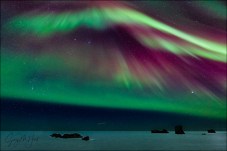
I’ve seen the northern lights many times since that first experience, but that first one always stood out as the best. But Nature always seems to be trying to top itself, and this year it finally managed. The first Iceland workshop group got two consecutive nights with spectacular northern lights shows—the first night at least matching my previous “best,” the second night topping it.
Because I blogged about that night a few weeks ago, I won’t go into all the details. The image I shared in that earlier post was more of a spontaneous capture away from the best scene, simply because the display was so spectacular. The image I’m sharing today is the scene I spent most of the night pointing at because it had the best combination of foreground and aurora display. The dancing lights changed so much from one minute to the next that I could pluck any one of dozens of images from this scene, label it “best,” and get no argument.
Workshop Schedule || Purchase Prints || Instagram
A Few of My Many Blessings


Lights, Camera, Action!
Posted on January 23, 2023

Wings of Angels, Aurora Above Dyrhólaey, Iceland
Sony α1
Sony 12-24 GM
10 seconds
F/2.8
ISO 3200
A couple of posts back I wrote about Nature’s gifts, natural phenomena that sometimes augment the ordinary enough to defy belief. In that post I cited reflections, relatively ubiquitous phenomena that improve nearly every scene they touch. Toward the other end of the commonness continuum are auroras, colorful lights that dance randomly in the frigid darkness high above Earth’s extreme latitudes.
While everyone has seen reflections, many live their life without ever witnessing an aurora. For most of us, viewing an aurora requires travel at the absolute worst time of year for travel, and then venturing outdoors in the darkest, coldest hours of the day. And even then, there’s no guarantee of success. Some nights the aurora simply doesn’t show up, other (many) nights auroras perform their dance behind a curtain of clouds.
So what’s the deal?
Despite all appearances to the contrary, auroras aren’t magic. Our planet is continuously bombarded by solar energy; a narrow range of these wavelengths (infrared and visible) battles all the way through Earth’s atmosphere to the surface to warm our bodies and light our way. But other wavelengths in the solar wind interact with atmospheric molecules they encounter, stripping their electrons to create ions, which causes a charge imbalance in the atmosphere.
Instead of penetrating the atmosphere to generate havoc on Earth’s surface, most of these ions are intercepted by the magnetosphere, our planet’s protective magnetic shield. The magnetosphere is a teardrop-shaped barrier surrounding Earth—battered by the relentless solar bombardment, its sun-facing side is spread out and compressed to about 6 to 10 Earth radii thick, while the shielded side behind Earth (from the Sun’s perspective) is stretched up to 60 Earth radii into space behind us (beyond the Moon’s orbit).
As Earth rotates inside the magnetosphere, the daylight side at any given moment looks through the wide, compressed region, while the night side peers out toward the extended region. Particles ionized by the sun are pushed by the solar wind from the daylight side of the magnetosphere to the upper regions of the polar latitudes on Earth’s leeward (night) side.
The result of these atmospheric machinations is an accumulation of ionized molecules dancing high in the night sky, creating an atmospheric oval of geomagnetic activity that waxes and wanes with solar activity and the intensity of the solar wind.
The aurora’s color depends on the molecules involved, as well as their location in the magnetosphere. The most plentiful and frequently activated molecules vibrate in the green wavelengths, but reds and blues are possible as well, depending on the intensity and altitude of the activity.
Known colloquially as the northern or southern lights, and more technically the aurora borealis in the Northern Hemisphere and aurora australis in the Southern Hemisphere, to see them you need all of the above: the correct location on or near Earth’s surface, activity in the magnetosphere, and dark, clear skies.
As with terrestrial weather, great effort is taken to predict the aurora, but there’s no such thing as an aurora “sure thing”—the best we can do is put ourselves in position to be as close to the auroral oval on nights with the greatest chance for activity. Planning a winter trip to the high latitudes (the higher the better), like Iceland, is a good start—then just pray for an active sun and clear skies.
Another key to successful aurora chasing is access to and comprehension of the Kp- (or K-) index. The Kp-index is a 0-9 scale of atmospheric electromagnetic activity, with 0 being little or no activity (get some sleep), and 9 being the most extreme activity (don’t forget the sunglasses). Many governments and scientific organizations issue regular Kp forecasts that seem about as reliable as a weather forecast—pretty good, but far from perfect. There are many websites and smartphone apps that will provide you with up-to-date Kp forecasts for your current location—some will even issue alerts. On my iPhone I find the Aurora Pro app essential for both planning and real-time aurora chasing.

Electric Night, Kirkjufell Aurora, Iceland
Last week, armed with all this aurora knowledge, loads of preparation, and a healthy dose of hope, Don Smith and I embarked on the first of this year’s back-to-back Iceland photo workshops ready for action. We’ve had pretty good luck in all of our previous visits, but are wise enough to Nature’s fickle ways not to be too cocky.
After having (what from all reports was) a beautiful display erased by clouds the workshop’s first night, we were blessed with a truly magnificent show at Kirkjufell the next night. Not only did the sky behind the mountain light up, the colorful lights careened about the sky in all directions. On our ride back to the hotel, Don and I agreed that this show rivaled the Glacier Lagoon aurora show on our first trip to Iceland that we considered the best we’d seen so far. The group was happy and life was good.
Departing Snaefellsnes Peninsula for Vik the next morning with a tremendously successful aurora shoot already in the bank, I thought to myself that wishing for anything more would be downright greedy. And since Vik lacks the really great north-facing views that are ideal for photographing the aurora, I wasn’t counting on another northern lights shoot that night.
Nevertheless, because the sky was clear and the aurora forecast was decent, after dinner in Vik we went aurora chasing anyway. Rather than opt for the more sure but mediocre north-facing view, we instead drove to Dyrhólaey, a coastline/ocean vista with nice views in all directions except north. Our rationale was that a truly great display can be viewed in any and all directions, and since we already had our northern lights success in the books, why not just go for broke?
Smart move. An aurora was already blasting so strongly when we arrived that we started photographing the instant we rolled off the bus and didn’t make it out of the parking lot for about 15 minutes. And while the previous night’s aurora display at Kirkjufell rivaled our best ever, this one easily topped it.
Once ensconced at the vista, we spent most of our time photographing westward, where the view up the coastline was the best available, and from where a persistent series of brilliant red and green beams radiated. Very much aware that the show was great in all directions, at one point I glanced southward, out over the Atlantic, and just had to photograph what I saw.
There really wasn’t a lot happening in the foreground, but a few small islands (more like large rocks) saved the day. I took several frames facing south, but chose the one I’m sharing today because it I find its beautiful angel wing shape truly unique.
After using my brand new Sony a7R V at Kirkjufell the previous night (it performed wonderfully), for this entire shoot I used my Sony a1. For both shoots, because the aurora spanned most of the sky, I shot almost exclusively with my Sony 12 – 24 f/2.8 GM lens at 12mm—and would have gone wider if I could have. With the aurora changing continuously, I shot wide open and used ISOs between 3200 and 6400 to keep my shutter speed at 10 seconds or faster. I’m thrilled with how clean these high ISO images were from both cameras, and won’t hesitate to use either one for any future aurora shoot.
2 FAQs
Here are my answers to the two aurora questions I hear most frequently:
- Can you see the aurora’s color?
- For most auroras there simply isn’t enough light to see any (or much) color. But in no way does this detract from the beauty. And when the aurora really gets going, yes, you can indeed see color—at one point this night it did brighten enough that the color was clearly visible, so bright in fact that I had to drop my exposure by 4 stops to avoid blowing out the highlights. And the color you see in my (and probably most) aurora images appears right there on the LCD after capture—in other words, rather than a Photoshop manipulation, aurora color in an image is mostly a simple product of the camera’s ability to accumulate photons.
- Can you see the aurora move?
- Sometimes you can’t see the aurora’s actual motion, but from minute to minute you become aware that its shape is noticeably different. And the bigger and brighter the aurora’s display, the faster it moves, until its motion becomes clearly visible—I’d compare the speed to a fast moving cloud. And a better word than “move” for what an aurora does might be “change.” While clouds seem to scoot across the sky, an aurora continually shifts and moves—the more intense the display, the faster the change.
Workshop Schedule || Purchase Prints || Instagram
A Gallery of Iceland Auroras


 Eloquent Images by Gary Hart