Eloquent Images by Gary Hart
Insight, information, and inspiration for the inquisitive nature photographer
Blinded by the light
Posted on March 29, 2014
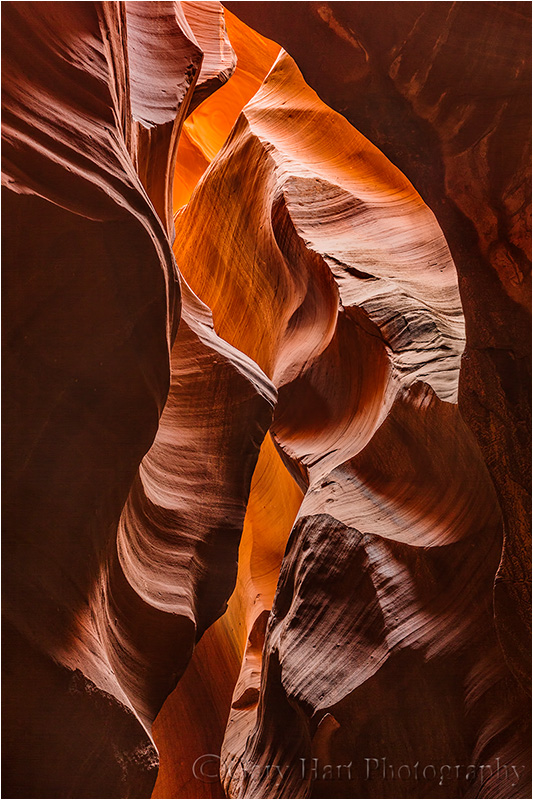
Inner Glow, Upper Antelope Canyon, Arizona
Canon EOS 5D Mark III
2.5 seconds
67 mm
ISO 400
F16
Sometimes we’re so focused on the spectacular, we overlook the sublime
Upper Antelope Canyon near Page, Arizona, is known for its brilliant light shafts that seem to originate from heaven and streak laser-like through open air to spotlight the canyon’s red sandstone walls and dusty floor. Sometimes multiple shafts are visible, ranging from pencil thin to tree-trunk thick. The rare combination of conditions the shafts require include clear skies and the high sun angle only possible midday on the long side of the equinoxes. The shafts also require airborne dust—easily stirred by wind or footfall, but often augmented by the Navajo guides who carry plastic scoops to toss the powdery particles skyward.

Beam, Upper Antelope Canyon, Arizona
Canon EOS 5D Mark III
1 second
70 mm
ISO 400
F11
Photographers from around the world flock to Page each spring and summer, packing Upper Antelope Canyon like Manhattan subway commuters in hopes of capturing their version of this breathtaking phenomenon. Given the crowds, it would be an understatement to say that the experience isn’t as inspiring or peaceful as the photos make it appear. But it is mesmerizing, so much so that when the beams fire, it’s difficult to concentrate on anything else. And therein lies the rub—the color, curves, and lines that are Antelope Canyon’s essence are overpowered its most famous quality.
The only way to get access to Upper Antelope Canyon is to join a tour led by a Navajo guide (I’ve never had a bad guide). The photo tour (as opposed to the standard, shorter “tourist” tour) of Upper Antelope gets you two hours in the canyon—one hour to photograph the beams in the company hundreds of oblivious tourists and competing, desperate photographers, and a second hour once the canyon has emptied, when it’s possible to walk its one hundred or so yards in relative peace and appreciate the qualities that make Antelope Canyon special.
As cool as the light shafts are, it’s this quiet hour that I’ve come to enjoy most, both as a photographer and as a lover of all things natural. Without the shafts hypnotic pull, I’m free to appreciate light’s interaction with Mother Nature’s handiwork. Layered sandstone carved by centuries of sudden, violent flash floods separated by months of arid heat. The floods have scoured the hard walls smooth, crafted narrow twists and broad rooms, and finished the walls with multifaceted curves and lines that reflect sunlight in all angles like a house of mirrors. Each ray of light entering from the extremely narrow opening at the ceiling is reflected at least once, and usually many times before reaching its viewer’s eyes (or camera). Shaded sections create dark frames for the illuminated sections that seem to glow with their own light source. As the light shifts or the viewer moves, shapes appear—a face, a bear, a heart—and disappear to replaced by new shapes limited only by the viewer’s imagination.
The bifurcated Antelope Canyon experience exposes an important reality: Dramatic light and color can blind viewers to a scene’s true beauty. While brilliant light and vivid sunsets grab your eyes in much the same way a rich dessert immediately satisfies your taste buds, we can’t live forever on this visual dessert. The images that sustain, the ones that draw us back and hold our attention once we’re there, are more often the subtle explorations of indirect light that allow us to make our own discoveries.
* * *
Read more about photographing Antelope Canyon
* * *
Antelope Canyon Gallery
-

- Beam, Upper Antelope Canyon, Arizona
-
- Glow, Upper Antelope Canyon, Arizona
-

- Focused Beam, Upper Antelope Canyon, Arizona
-
- Twin Beams, Upper Antelope Canyon, Arizona
-
- Rock Face, Upper Antelope Canyon, Arizona
-
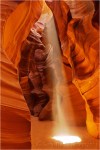
- Divine Spotlight, Upper Antelope Canyon, Arizona
-

- Inner Glow, Upper Antelope Canyon, Arizona
-

- Nature’s Cathedral, Upper Antelope Canyon, Arizona
My photography essentials, part 3
Posted on March 23, 2014

Dawn, Puna Coast, Hawaii
Canon EOS-1Ds Mark III
10 seconds
F/11
ISO 100
19 mm
A couple of weeks ago the editors at “Outdoor Photographer” magazine asked me (and a few other pros) to contribute to an upcoming article on photography essentials, and it occurs to me that my blog readers might be interested to read my answers. Here’s how I answered the third of their three questions:
What three things contribute to keeping you inspired, energized and creative on your shoots and why does each keep you inspired, energized and creative?
- When I’m photographing a particularly beautiful moment—such as a moonrise over Yosemite, lightning and a rainbow at the Grand Canyon, or the Milky Way I force myself to turn off my photographer brain and for a few minutes just become a regular human who might be witnessing the most beautiful thing happening on Earth at that moment. The sense of appreciation and marvel is a vital connection to my subjects that fuels my photography.
- Throughout the year I plan excursions that keep me motivated: Each spring I’m recharged by drives through the Sierra foothills and its rolling green hills, studded with poppies and oak trees and cut by brimming creeks and rivers, that just beg to be photographed. My calendar is loaded with the days I’ll find a crescent moon dangling in the amber/blue transition separating night and day. And nothing exhilarates me more than a dark sky dotted with stars. Since so much of my photography time is spent guiding others to my favorite locations (at my favorite times), these personal trips establish an essential balance in my life.
- And most of all, I’m inspired by viewing the work of other photographers:
- Ansel Adams is an obvious inspiration—not only was he a great photographer, Adams navigated uncharted territory to pave the way for all who followed. I chuckle when other photographers defend their captures with, “That’s the way it really looked,” because Adams’ absolute connection with his camera’s reality, and the synergy between his capture and processing, proved that duplicating human (visual) reality is absolutely not a nature photographer’s goal.
- Galen Rowell is another inspiration, for his understanding of light, his obsessive inquisitiveness, and his willingness to explore photography’s physical and mental boundaries. Rowell possessed a synergy between his brain’s creative and logical capabilities—an ability to understand, anticipate, and calculate, combined with an instinctive ability to turn all that off and simply create. From him I learned to follow the light to the exclusion of all distractions, no matter how tempting.
- David Muench, was an influence long before I entertained thoughts of becoming a photographer. I have memories dating back to my childhood of paging through Muench’s massive coffee-table books and being awed by the beautiful scenes he’d witnessed. At the time I had no idea of how much skill those images required—I just thought he was incredibly lucky to have been there to see it. Of course now I appreciate Muench’s unique ability to see and manage the front-to-back aspect of a scene to create the illusion of depth, an approach I’m now convinced was made easier for me by a lifetime of exposure to those images.
- Charles Cramer’s meticulous compositions extract beauty from simple scenes and subtle light and can transfix me for hours. Each of Cramer’s images feel to me like personal discoveries, as if he’s uncovered nature’s true beauty while everyone else’s camera was pointed in the other direction. Browse his galleries and note how many images use indirect light and no sky. More than any other photographer, Charles Cramer’s images inspire me to grab my camera and run outside.
About this image
On every visit to Hawaii’s Big Island I visit this unnamed beach on the Puna coast south of Hilo. I’ve photographed it in a variety of dramatic conditions: colorful sunrises and sunsets, crashing surf, rainbows, but this nearly monochrome image beneath heavy gray clouds is my favorite.
In addition to the color and light, the scene varies greatly with the tide and surf. This morning, finding pillows of basalt cradling still pools that reflected the morning sky, I dropped low and moved close with a wide lens to fill my foreground. Working in shadowless, pre-sunrise light, I used a long exposure to smooth the water and create a serenity to more closely matched my state of mind.
My photography essentials, part 2
Posted on March 17, 2014
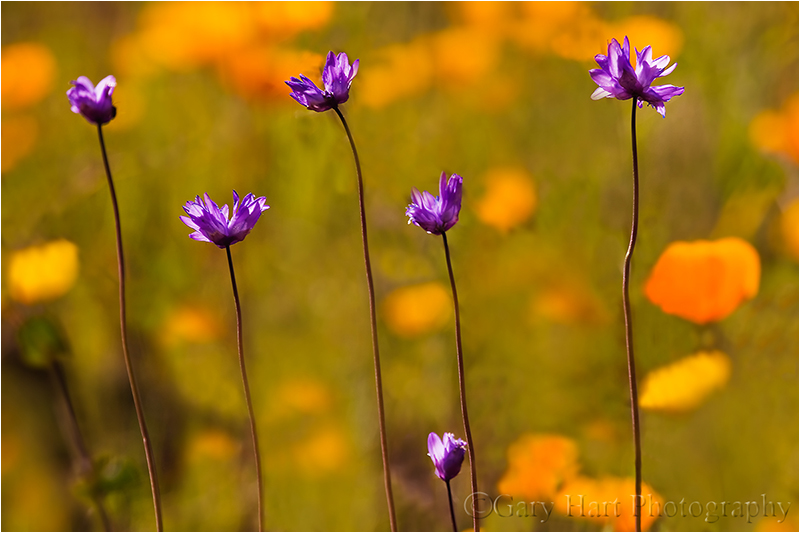
Spring Potpourri, Sierra Foothills, California
Canon EOS-1Ds Mark III
1/125 second
F/7.1
ISO 200
340 mm
A couple of weeks ago the editors at “Outdoor Photographer” magazine asked me (and a few other pros) to contribute to an upcoming article on photography essentials, and it occurs to me that my blog readers might be interested to read my answers.Here’s my answer to the second of their three questions:
What are your three most important non-photo pieces of gear that you rely on for making your photographs and why do you rely on each of the three?
- How did I ever get by without a smartphone? Among other things, and in no particular order, it keeps me company on long trips (that are often far off the grid), informs, entertains, guides, provides essential sun and moon rise/set time and location, helps me choose the best f-stop, allows me to manage by business from any location, and even gives me traffic and weather warning. My iPhone (there are many similarly great Android and Windows phones) is 64GB (the largest available) to allows plenty of room to store maps, more podcasts than I can listen to on a single trip, and a lifetime worth of music. Of course a smartphone is be of little value without its apps. When choosing apps, a primary requirement is usability without Internet connectivity. My favorite connection-independent apps are: Focalware, for sun/moon info for any location on Earth; Depth of Field Calculator by Essence Computing, for hyperfocal info; and Theodolite, for general horizon and direction angles (among other things). I also make frequent use of the Dropbox Favorites option, which allows me to pre-download any file for review when I’m not connected.
- My dash-top GPS is compact enough to slip into any suitcase (there are many viable options; while I use Garmin, interface frustrations stop me short of endorsing it). Because I visit many distant locations that I’m not able to return to as frequently as I’d like, I save every potential photo spot in my dash-top GPS. For example, there are usually many months between my Hawaii visits. Over the years I’ve found far more incredible spots to photograph than my feeble brain can retain. But traveling with a GPS, I don’t have to re-familiarize myself with anything—I just pop it on my dash before driving away from the airport and instantly navigate to my locations like a native. (Or to the nearest Starbucks.)
- Here’s a just-discovered non-photo essential that didn’t get passed on to “Outdoor Photographer”: After many, many years of trying to find a hands-free way to communicate on my long drives in the middle of nowhere, my new Plantronics Voyager Legend bluetooth earpiece feels like a godsend. Wired earbuds get tangled and have lousy noise cancellation; sound quality makes bluetooth radio connections virtually unusable. And I’ve lost track of the number of earpieces I’ve discarded for some combination of discomfort, poor receiving sound quality, poor sending sound quality, and lousy battery life. I can wear my Voyager Legend for hours and forget it’s there; I can answer calls without taking my eyes off the road; and most importantly, I can hear and be heard as if I’m sitting in a quiet room.
About this image
My GPS guided me to this remote, wildflower-dotted hillside, discovered the previous spring and now a regular destination on my annual spring foothill forays. The wildflower bloom varies greatly each year, so without the GPS sometimes it’s impossible to know whether I’ve found a spot that thrilled me the year before. In this case I found the bloom everything I dared to hope.
Rather than pull out my macro lens, I twisted an extension tube onto my 100-400 lens and went to work. Since there were virtually no shadows, the dynamic range wasn’t a problem, despite the bright, direct sunlight. Metering on the brightest part of the scene and underexposing by about one stop (about 2/3 stop above a middle tone) prevented the brightest highlights from washing out and saturated the color.
Most of my attention that afternoon went to the poppies, but here I concentrated on a group of small, purple wild onions and let the limited depth of field blur the poppies into the background. Clicking the same composition at a half dozen or so f-stops from f5.6 to f16 allowed me to defer my depth of field selection until I could view my images on my large monitor.
My photography essentials, part 1
Posted on March 11, 2014

Morning Light, Yosemite Falls from Sentinel Dome, Yosemite
Canon EOS-1Ds Mark II
1/50 second
F/16
ISO 400
105 mm
A couple of weeks ago the editors at “Outdoor Photographer” magazine asked me (and a few other pros) to contribute to an upcoming article on photography essentials, and it occurs to me that my blog readers might be interested to read my answers. Here’s my answer to the first of their three questions:
1. What are the top three most important pieces of photo gear for you to create your particular style of landscape photography and why is each important?
(Since we all need cameras and lenses, I stuck to optional items.)
- At the top of my list, and it’s not even close, is a tripod/ball-head combo that’s easy to use: sturdy, light, and tall enough to use without a (destabilizing) center post. More than just a platform to reduce vibration, my tripod is a compositional aid that allows me to click a frame, evaluate my image, refine my composition and exposure settings, and click again. I often repeat this process several times until I’m satisfied. Using a tripod, the composition I’m evaluating is sitting right there, waiting for my adjustments; without a tripod, I need to recreate my composition each time. Another unsung benefit of the tripod is the ability to make exposure decisions without compromising f-stop or ISO to minimize hand-held camera shake. I’m a huge fan of Really Right Stuff tripods and heads.
- Adding an L-plate to my bodies was a game-changer—not only does it make vertical compositions more stable, they’re closer to eye level and just plain easier. In my workshops I often observe photographers without an L-plate resist vertical oriented shots, either consciously or unconsciously, simply because it’s a hassle to crank their head sideways, and when they do they need to stoop more. And some heads are not strong enough to hold a heavy, vertically oriented camera/lens combo. But since switching to the L-plate, my decision between a horizontal or vertical composition is based entirely on the composition that works best.
- Given the amount of travel I do, not to mention the hiking once I get there, I need a camera bag that handles all my gear (including my tripod and 15” laptop), has room for extra stuff like a jacket, water, and food, is comfortable for long hikes, durable, easy to access, and (this is huge) fits all airline overhead bins. I’ve tried many, and the F-stop Tilopa is the only one I’ve found that meets all my criteria.
* * *
Because people always seem interested in the equipment I use
For what it’s worth, I have relationships with a few photo equipment vendors that allows them to use my name, and in return I get a price break on their equipment. But I’ve never been one to play the endorsement card to great benefit, or too allow the whole freebie/discount thing affect my recommendations. For example, I’d never heard of F-Stop Gear when they asked if I’d like to be one of their staff pros. When they offered to send me a bag to try, I made it very clear that I’d only use or endorse it if I liked it better than anything else I’ve tried, but they sent it anyway, no strings attached. I’m happy to say that I absolutely fell in love with my F-Stop Tilopa, and haven’t used another bag in over three years (before that I used different bags for different needs).
Likewise, I used (and sung the praises of) Really Right Stuff heads and L-plates long before RRS had ever heard of me. I own four Gitzo tripods, and while I think they’re great, I have to say that my new Really Right Stuff tripod (TVC-24L) is demonstrably better—lighter, sturdier, and easier to use—than my Gitzo 3530LS. And I’ve always found RRS customer service second to none.
Now if I could only get Apple to notice me….
About this image
Follow the light. Here atop Sentinel Dome it would have been easy to concentrate on one or more of a variety of dramatic subjects, including El Capitan, Yosemite Falls, Half Dome, and Cathedral Rocks. But the best light this morning was the warm sunrise glow on an anonymous tree and a clump of wildflowers.
I’d spent the night in the back of my truck a few miles down the road from the Sentinel Dome trailhead. The hike is only about a mile—it’s relatively easy in daylight, but I wanted to be atop the dome about 45 minutes before sunrise, so I did the whole thing in the dark (not something I’d recommend unless you’re extremely familiar with the trail, as I was). Since this was late June, sunrise was around 5:30, which meant an extremely early morning. As it turned out, the sunrise, while magnificent to experience, wasn’t terribly noteworthy photographically.
As I started my walk back to my truck, the light on this tree stopped me. I positioned myself to align the wildflowers, tree, and Yosemite Fall, moving as far back as I could to allow a telephoto that would compress these three primary elements. I dropped low and focused to emphasize the wildflowers and weathered tree in the warm light, relegating unlit Yosemite Falls to background status by allowing it to go slightly soft.
It’s Greek to me
Posted on March 3, 2014

Double Rainbow, Tunnel View, Yosemite
Canon EOS-1Ds Mark III
1/5 second
F/16.0
ISO 100
38 mm
Photograph: “Photo” comes from phos, the Greek word for light; “graph” is from graphos, the Greek word for write. And that’s pretty much what we photographers do: Write with light.
Because we have no control over the sun, nature photographers spend a lot of time hoping for “good” light and cursing “bad” light. There’s no universal definition of good and bad light; it’s usually more a function of whatever it is we want to do at the moment. Just as portrait photographers have complete understanding of the artificial light they use to illuminate their subjects, nature photographers should understand the sunlight they photograph: what it is, what it does, and why it does it.
It’s this understanding of light that allows me to be in the right place for vivid sunrises and sunset, to know the best time and location for blurring water, and that helped me anticipate this amazing rainbow. To learn more about light, read the Light article in my Photo Tips section.
About this image
May 26, 2009
On my drive to Yosemite the sky above the San Joaquin Valley was clear, but I was encouraged to see dark cumulus clouds billowing above the Sierra to my east. Sierra thunderstorms in May are rare, but not unprecedented. At the very least I knew the clouds would make for interesting photography. As I entered the park via Big Oak Flat Road, a few large drops dotted my windshield. The afternoon sun was now obscured by clouds, but the sky to the west remained virtually cloudless, a good sign, but nothing I hadn’t seen before.
By the time I reached Yosemite Valley the rain had increased enough to require me to engage my wipers and get my mental wheels turning. I was in the park for a one day, private photo tour with a couple from Dallas. The arrangement was to meet at Yosemite Lodge for dinner to plan the next day’s activities, then to go shoot sunset. As I continued toward my appointment I allowed myself to consider the possibility of a rainbow. Going for it would require rushing to meet my customers, delaying dinner, and possibly sitting in the rain with no guarantee of success.
Still undecided but with about 20 minutes to spare, I dashed up to Tunnel View to survey Yosemite Valley. I liked the way things were shaping up; if I’d have been by myself I’d have skipped dinner. Leaving Tunnel View I continued surveying the sky—by the time I reached the lodge I knew I could be sued for malpractice if I didn’t at least suggest the possibility of a rainbow.
We completed our introductions in front of the cafeteria, but before entering I suggested that maybe we should forget dinner for now. Robert and Kristy were as excited about the conditions as I was (phew) but had just completed a long hike and were famished, so we rushed in and grabbed pre-made pizzas to eat on the road.
Twenty minutes later we were sitting on my favorite granite slope above Tunnel View. We were immediately greeted by a flash of lightning, followed not too many seconds later by a blast of thunder. As a lifelong Californian, I’m not particularly experienced with lightning, so I deferred to the Texans and found comfort in their lack of concern (knowing what I know now, I probably should have been more concerned).
Rainbow photography is equal parts preparation and providence. The preparation comes from understanding the optics of a rainbow, knowing the conditions necessary, where to look, then putting yourself in the best position to capture it; the providence is a gift from the heavens, when all the conditions align exactly as you envisioned. Robert, Kristy, and I had been admiring the view and photographing intermittently in a light, warm rain for about thirty minutes when a rainbow appeared. It started slowly, as a faint band in front of El Capitan, and quickly developed into a vivid stripe of color. For the next seven minutes we shot like crazy people—I varied my compositions with almost every shot and called to them to do the same. When it ended we were giddy with excitement—never let it be said that a professional nature photographer can’t get excited about his subjects—and even though the rainbow never quite achieved a complete arc across the valley, it had been everything I dared hope for.
Little did we know that this first rainbow was just a prelude—less than ten minutes later a second rainbow appeared, becoming more vivid than the first, growing into a full double rainbow that arced all the way across Yosemite Valley, from the Merced River to Silver Strand Fall. It lasted over twenty minutes, long enough for me to set up a second camera and do multiple lens changes on each. We actually reached the point where we simply ran out of compositions and could only laugh as we continued clicking anyway.
One more thing: This is the third time I’ve processed this image. I’ve never been completely happy with some of the color tones and overly bright highlights, so I decided to give it one more shot. Using Lightroom 5 and Photoshop CS 6, I was finally able to come up with something that more accurately represents the experience of this unforgettable moment.
Workshop Schedule
A Gallery of Rainbows


 Eloquent Images by Gary Hart