Eloquent Images by Gary Hart
Insight, information, and inspiration for the inquisitive nature photographer
Get Centered
Posted on February 27, 2024
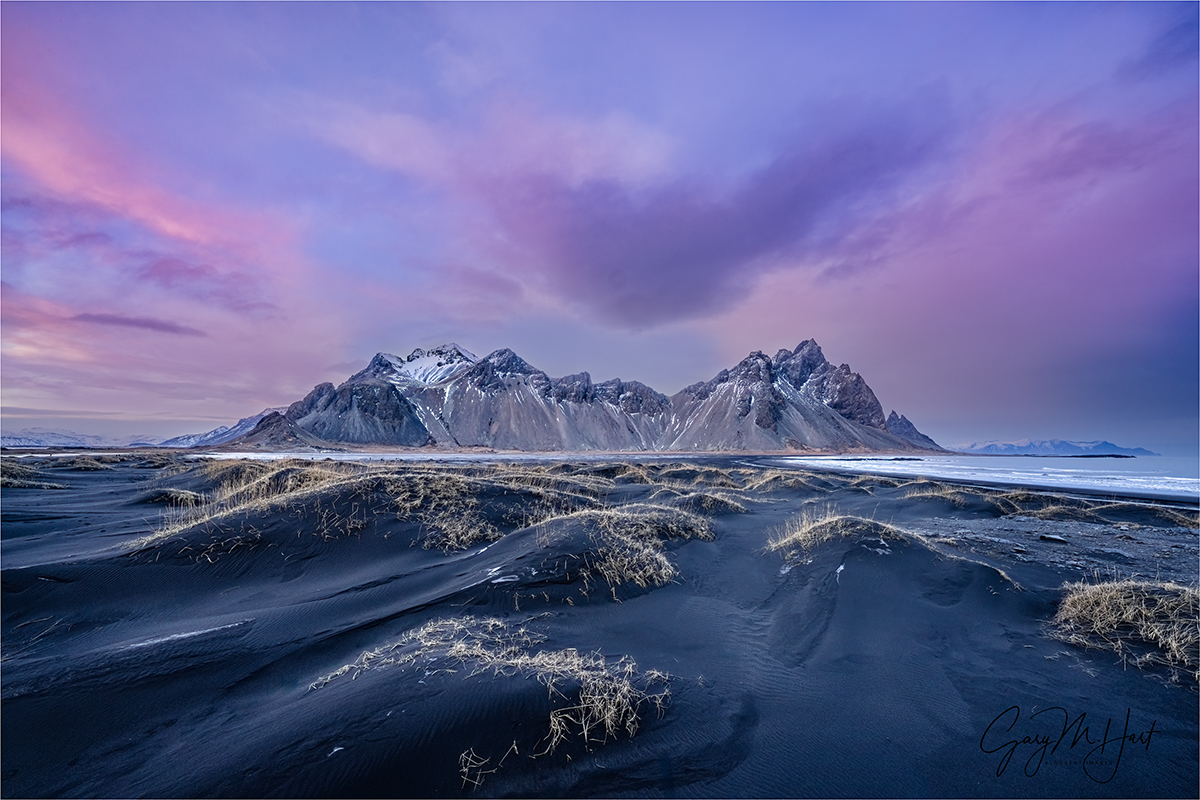
Winter Twilight, Vestrahorn, Iceland
Sony a7R V
Sony 12-24 GM
1/8 second
F/11
ISO 200
This day started with one of the most disturbing experiences of my photo workshop life, so finishing with a sunset like this was comforting relief for the entire group.
But before I get to the sunset, let me wind the clock all the way back to our short drive to Diamond Beach for this morning’s sunrise. In February Iceland’s sunrise arrives at around 10 a.m., but with the high latitude also comes extremely long twilight hours, so we were on the road for the 10-minute drive to the beach at 8:30, stomachs full of breakfast. The sky was still quite dark, but hints of a beautiful sunrise were already creeping up along the eastern horizon as we drove. In a workshop filled with special, Diamond Beach is extra special, so despite the darkness outside, everyone was pretty energized as we bounced along the highway.
Gazing through the windshield from my seat near the front of our (small—26 passengers) bus, I caught sight of a dark shadow approaching from the left. Simultaneously, someone in the back yelled, “Look out!”, and our driver Vincenzo braked hard. The shadow was just ambling, showing no sign of awareness of its immediate peril, neither slowing or speeding as it moved About the time my brain identified the shadow as a reindeer, it was directly in front of us and smack! From the first instant of the reindeer’s appearance to our bus’s direct hit, I’d guess less than a second elapsed.
We were traveling around 45 miles per hour, a pretty reasonable and safe speed in Iceland’s icy darkness. We’ve all been in accidents (right?)—almost without exception the situation changes from perfectly normal to dire before your brain has time to register what’s happening. Given that, I have to say that Vincenzo did an amazing job: Instead of following the normal human reflex to swerve (as I’m afraid I might have done), he simply braked quickly and continued forward into the reindeer. Textbook. While not the best result for the reindeer, Vincenzo’s response on that frozen highway almost certainly spared us a rollover and many injuries, perhaps worse.
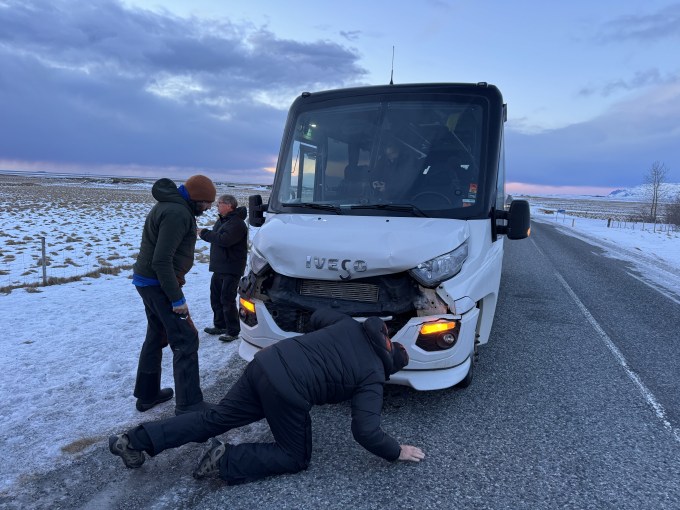
Bus reindeer damage. I took this picture quite a while after the accident, shortly before we tried to limp home.
We immediately pulled over, all pretty shaken, but no one more-so than Vincenzo. After a minute or two to recenter, the four group leaders (Iceland guide Albert Dros, driver and photographer Vincenzo Mazza, Don Smith, and me), exited to assess the damage. There was no doubt that the reindeer was down for the count on impact, a small comfort to know that it didn’t suffer. But when I saw our headlights still shining bright before exiting, I’d held out slight hope that damage to the bus would be cosmetic and not impact our trip. No such luck.
In addition to the obvious damage to the grill (which doesn’t really show up well in the picture), we were losing coolant. Only a few minutes from Diamond Beach, we briefly toyed with the thought of continuing on to sunrise and letting Vincenzo deal with the damage while we photographed, but ended up making the incredibly wise decision to cut our losses and turn around to attempt the 3 mile drive back to our hotel where we could regroup.
Even poking along at around 5 MPH, and despite the frigid outside temperature, the bus’s thermostat needle immediately started creeping northward, toward the red. I know Vincenzo was watching its climb as closely as he watched the road, and after about 10 minutes he pulled us to a stop to let the engine cool. After about a 15-minute respite, we (fingers crossed) fired up the engine and limped the rest of the way back—3 miles in 45 minutes.
Back at the hotel, immediate problem solved, we still needed to figure out how we were going to complete the second half of our workshop minus our trusty chariot. But within a couple of hours, Don and I got word that our tour company had pulled some strings and our replacement “bus” would be delivered by 1 p.m. We were back in business.
The arrival of this replacement van might be a good time to remind you that beggars can’t be choosers. Normally Don and I cap the Iceland workshop at 12 participants, but since this group would be led by 4 qualified photographers, and we knew our bus would be more than big enough for everyone, we went to 14 participants. With the 4 leaders, that meant 18 people in our 26-passenger bus—no problem, especially since the bus had ample storage. Sadly, that calculus didn’t account for an encounter with a reindeer, and the reality that our replacement vehicle would turn out to be more of a large van, with seats only for 21, and very limited storage space—more designed for day excursions than multi-day trips.
Having missed just the morning’s sunrise shoot, that afternoon we motored off to Vestrahorn in our new wheels, certainly cozy, but (more or less) comfortable. Since we were already using virtually every inch of available space for our bodies and camera bags, we all scratched our heads at how, when we checked out in a couple of days, we were going to squeeze all of our luggage in to our new ride. When questioned, Albert simply answered that we’d do it because we had no choice, and I chose not to stress about it. (Much.) And there was still photography to be done!
Vestrahorn is rivaled only by Kirkjufell on the list of recognizable Iceland peaks. Towering about 1500 feet above the North Atlantic, Vestrahorn’s intrusive origins distinguish it from many of its mostly extrusive Icelandic neighbors. The mountain’s rock formed about 10 million years ago, when subterranean volcanism injected iron- and magnesium-rich magma from Earth’s mantle into the crust above. Protected by this crust from exposure to the much cooler atmosphere on the surface, this magma cooled slowly to form Vestrahorn’s hard, crystal-infused core. Over time this hardened core was pushed upward by the region’s relentless geological forces. With this increasing elevation, the much softer crust entombing the mountain gradually eroded away, leaving only the peak we see today.

Vestrahorn Reflection, Stokksnes Beach, Iceland (2021)
On any day, Vestrahorn is a photographer’s delight. Though visually quite different, I liken the photography experience here to the Alabama Hills beneath California’s Sierra Crest, where an infinite variety of foreground composition possibilities stretch beneath the dramatic mountain peaks. At Vestrahorn, the foreground variety comes courtesy of black sand dunes, icy ponds, faceted ice patterns, and the mirror reflections left behind each time the surf retreats from gently sloping Stokksnes Beach.
I like to get around to everyone in the group before starting my own photography, but more than any other location in Iceland, here people seem to scatter like shotgun pellets. After about a half hour of wandering I finally gave up on finding everyone and started looking for my own foreground to put with the mountain. A sucker for reflections, I normally beeline to the beach, but with the tide out I decided this might be a good day to try the dunes. I’m so glad I did.
I poked around the dunes, searching for a grouping I could compose into something coherent and complementary, and that hadn’t been soiled by footprints. After about 20 minutes I landed at the spot you see in my image at the top of the post and didn’t move more than 20 feet for the rest of the evening.
As you can see from the image above, Vestrahorn this evening was a particular treat. One of the many reasons I like Iceland so much in winter is the snow decorating the peaks. And though I’ve seen Vestrahorn with much more snow, I found the peak’s snowy accents this evening especially appealing (compared to the barren slopes that dominate in Iceland’s warmer months). But the evening’s real show came courtesy of the interplay of clouds and light above the peak as the sun dropped.
Because the sun ascends and descends the sky at such a shallow angle at this high latitude, sunrise and sunset seem to unfold in slow motion. When the reds fired up this evening, much of the color above the mountain was obscured by clouds. But because the really nice color hung-in for at least 30 minutes, the clouds had more than enough time to thin and spread enough to allow the late light through, eventually blanketing much of the sky with persistent pink. By the time it reached this stage, I’d become so familiar with all the compositional opportunities in my little corner of the island that I had a pretty good idea of how I wanted to handle it.
I fell in love with the foreground dunes early on, and after it became pretty clear that the color would stretch far overhead, switched to my 12-24 lens to include as much of the entire scene as possible: dunes, mountain, sky. But how to handle a sky that rivals a classically beautiful landscape? There are very few absolutes in photography, but one of the most damaging “absolutes” is the admonition to never center the horizon, or your subject on the frame’s horizontal or vertical axes. This usually well-intended edict might have value to the raw novice who automatically centers every horizon and subject, but can actually be damaging to insecure neophytes not confident enough to trust their own creative vision. If centering feels right, go for it!
My own “rule” is to decide where most of the scene’s visual interest resides, foreground or background, and allocate a proportional percentage when I set my horizon. Sky better than the foreground? The sky gets most of my frame. Foreground better than the sky? The foreground gets most of my frame. Both sky and foreground too beautiful to decide? I have no problem splitting my scene right down the middle.
Reflections are probably the most frequent example of scenes that can be split down the middle, but this choice isn’t limited to reflections. And as far as centering a subject is concerned, I don’t hesitate when I want it to dominate my scene, or when there’s nothing else in the frame to balance a dominant subject. If you’re not sure, or simply don’t trust your own instincts, just do it both ways and decide later.
Epilogue
Striking an animal leaves a persistent knot in the pit of your stomach. We all felt it, but no one more than Vincenzo, who told us later that he’s never struck anything with a vehicle—person, animal, or other vehicle. He was pretty shaken, but I think having a job to do, plus the interaction with, and support of, the rest of the group distracted him enough to make it through the trip. For the rest of us, knowing we’re all dealing with this shared trauma helped a lot, as of course did being the distraction of wonderful photography.
Another unexpected bonding opportunity came from the impossible solution Albert and Vincenzo devised to get us back to Reykjavik with all of our stuff. Without going into great detail (lest we get them into trouble for violating some kind of Iceland vehicular safety code), no person or gear was left behind or strapped to the outside of the vehicle, and we each had our own seat (and seatbelt). Hardly a square-inch of space, horizontal or vertical, went unused, and even after getting the group choreography polished, entering exiting the van still took at least five minutes. But we made it, and I think everyone would agree that the tight quarters became a catalyst for much fun and laughter that proved just the necessary medicine.
Join Don Smith and Me in Iceland Next Year
Sublimely Centered Subjects
Click any image to scroll through the gallery LARGE


This is Why We Can’t Have Nice Things
Posted on February 20, 2024

Golden Touch, El Capitan and Horsetail Fall, Yosemite
Sony a7R V
Sony 24-105 f/4 G
ISO 64
f/10
1/10 second
I was planning to just write a brief Horsetail Fall update following last week’s workshop, but before I get into that, a couple of recent experiences have me wanting to say a few words about the bad photographer behavior I witness in my many travels.
The first occurred in Iceland, where Don Smith and I, along with our tour guides Albert Dros and Vincenzo Mazza (look them up!), guided our group on a short hike to a beautiful, and slightly off the beaten path, waterfall. Thrilled to find the scene blanketed with pristine snow, and to be the only ones there, we quickly set up on the footbridge spanning the river (the only place to photograph legally).
Everyone was quite content until a couple of other photographers wandered up the trail and joined us. Despite the fact that there was more than enough room for all of us on the bridge, these two newcomers ignored the “Keep Out” signs and hopped the barricade, trampling our perfect snow to set up shop in everyone’s frame as if we were all invisible. We tried in vain to get their attention (they clearly heard us but refused to acknowledge). Soon one of them whipped out a drone (also a violation of posted rules), launching it directly in front of the fall, while the other guy walked straight up to the base of the fall and planted himself directly in the middle of the scene (where it was impossible to compose him out).
I try not to stress too much about photographers who are simply unaware that they’re in my frame because it’s usually not too hard to remove them later, in Photoshop. But this kind of willful disregard for others transcends photography, damaging the experience for all visitors and reflecting poorly on all photographers.

Horsetail Fall Southside Drive crowd (2017): This is why we can’t have nice things (picture from the Yosemite Exploration Center)
The other instance of selfish photography is the “My shot is more important than the wellbeing of the natural beauty I’ve come to photograph” attitude that I witness every time I try to photograph Horsetail Fall. (This isn’t unique to Horsetail Fall.)
The general consensus among Yosemite photographer, with which I agree, is that the best Horsetail Fall photography spot on the valley floor is a raised riverbank on the Southside Drive side of the Merced River. Believe it or not, I used to be able to show up with a group to this location about 45 minutes before sunset, confident that all in my care would be able to find an unobstructed view.
But when the crowds took over (some photographers even claiming the prime spots for this sunset shot before breakfast) and the number of photographers far exceed the number of available places to set up, I started opting for the relative peace of the Northside Drive locations. I wasn’t terribly surprised to witness cars actually driving off-road and into the forest to park, and by the reports of Southside Drive fisticuffs that started to appear. All this Southside mayhem culminated with the riverbank’s collapse under the weight of the assembled masses, leading to the complete shutdown of Merced River south bank Horsetail Fall photography. Problem solved—or so I believed.
Put me in the camp of those who think that the NPS does an amazing job managing the virtually unmanageable crowds that swarm Yosemite Valley to photograph Horsetail Fall each February. The whole experience has gotten better (more enjoyable) with the Southside Drive ban, relatively liberal reservation system (it’s not that hard to view the Horsetail phenomenon with only a little planning and effort) to curtail crowds, and Northside Drive pedestrian accommodations.
Nevertheless, each year I still see photographers attempting to sneak into the prime Southside Drive view as if the rules don’t apply to them. Some simply park in the Southside Drive turnouts clearly marked “No Parking,” apparently oblivious to the $280 that will await their return.
More egregious (because it can’t be written off to ignorance) in my mind are the photographers who park legally, then sneak along the south river, shielded from view from the road by the elevated riverbank. This year, while waiting with the joyful crowd on Northside Drive, I actually saw several of these scofflaws (such a great word) skulking about across the river, apparently completely oblivious to the fact that they are quite visible to everyone on Northside Drive, including the numerous rangers (with 2-way radios), or to the fact that the rangers actually patrol the south riverbank each February afternoon and evening.
Maybe I’m just getting old, but it both angers and saddens me that there are photographers whose selfish desire exceeds their respect for their subjects, because it’s attitudes like these that lead to even further restrictions for everyone. A photograph should never be more important than its subject.
Now I need to go chase some kids off my lawn…
So anyway…
Some years Horsetail Fall is completely dry in February, other years it’s there but you really have to look closely to locate the Horsetail wet spot on El Capitan. This year I’d say the baseline flow in Horsetail Fall is good but not great, clearly visible as a thin white stripe descending from the top of El Capitan’s sloped east shoulder. By “baseline flow” I mean the minimum you can expect on any given day—a decent flow with the potential to ramp up nicely with a warm storm that drops heavy rain on the Horsetail watershed (above 7000 feet). Also this year, thanks to recent high country snowfall, there’s enough snow in that watershed that a few days of sunlight and above average temperatures could bring a noticeable flow increase.
FYI, if you want to photograph the Horsetail Fall phenomenon this year, you have about a week of good light remaining (as I write this on February 20)—but don’t forget that weekend visits require reservations. The crowds this year seem pretty typical, and shouldn’t pose a problem if you can park and start the 1 1/2 mile walk a couple of hours before sunset (the longer you wait to park, the farther you’ll need to walk). (Learn more about photographing Horsetail Fall in my Horsetail Fall Photo Tips article.)
Last week’s workshop group had two successful Horsetail Fall shoots—neither “epic,” but both very nice in their own way (and definitely worth the walk and wait). The workshop started last Tuesday—given the week’s weather forecast, I was more hopeful than optimistic about our Horsetail Fall chances. Since it looked like that first day might be our best (and maybe only) shot at getting it, after our orientation we headed straight up to Yosemite Valley and got ourselves into position beneath the fall, near the El Capitan Picnic Area (not my favorite spot, but the best for this group because of some mobility challenges).
We found the fall flowing decently (well enough to photograph) and the light good, until about 40 minutes before sunset when the afternoon’s promising mix of sunlight and clouds was replaced without warn by sunlight-swallowing clouds. As we waited (hoped) for the sunlight to return, I kept telling my group about my many last-minute Horsetail Fall miracle experiences, when the has dropped into an unseen (from our location the valley floor) gap on the horizon to paint the fall red.

Red Horsetail Fall, El Capitan, Yosemite
And that’s exactly what we got. This time it came so late that the light completely skipped the golden phase, going straight to red for about five minutes before turning off for the night. While the light this evening wasn’t as intense as I’ve seen it, the color was great and everyone was pretty thrilled.
But we weren’t done. The forecast improved as the week progressed, so after a Wednesday rain that recharged the flow, combined with a (new) “mostly sunny” Thursday promise from the weatherman, I decided to give the group another shot. I wouldn’t have done this if I thought the best we could do would be to repeat Tuesday, but because I knew the fall was flowing better, and I’d formulated a plan to get the whole group into an even better position about a quarter mile east of the picnic area, I thought it would be worth going for it. Still, I gave everyone the option to opt out for a different location, but no one took me up and we all returned to Horsetail.
For most of Thursday evening everything went exactly as planned: the fall’s flow was noticeably better, we ended up exactly where I’d hoped, and the sunlight was brilliant. Better still, a collection of clouds spent the evening performing a beautifully choreographed dance atop El Capitan.
The Horsetail Fall great light window lasts less than 10 minutes, starting out brilliant gold before slowly transitioning to orange, then coral, and ultimately (if the light lasts all the way to the end) ruby red. This evening we clicked like crazy as the shadow approached Horsetail and the light warmed to the intense gold stage. But just about the time started to get just a little optimistic that we might be in store for something truly special, the sunlight faded and never returned.
Fortunately, we did end up catching all of the gold phase, which was further enhanced by a few puffy clouds catching the same light, so all was not lost. Even though we missed the red of Tuesday evening, it seemed pretty unanimous that this was the better of the two shoots.
So I guess maybe sometimes we still can have nice things.
Join Me In Yosemite
Workshop Schedule || Purchase Prints || Instagram
Horsetail Fall
Click any image to scroll through the gallery LARGE


Reflecting on Reflections
Posted on February 14, 2024

Sweet Sunset, Lake Manly and Badwater Basin, Death Valley
Sony a7R V
Sony 24-105 f/4 G
ISO 100
f/11
1/30 second
One of the (many) great things about choosing landscape photo workshops to earn my livelihood is that selling images is optional. Don’t get me wrong, I love selling images (and every image you see on my blog or in social media is for sale), but since my income doesn’t depend on it, I don’t need to sell images. That allows me to photograph only the things I want to photograph, as many times as I want to photograph them, and to never choose a subject based on the image’s potential salability.
It seems like I’m most drawn to subjects and phenomena that feel to me like gifts, with the ability to elevate “ordinary” beauty. People following my blog or browsing my galleries probably have a pretty good idea of what those things are. If you’ve been paying attention, you’ve probably figured out that I find immense joy in the night sky (moon, stars, Milky Way), dramatic weather (lightning, rainbows, and so on), poppies, dogwood, fall color—I could go on, but you get the idea.
Another subject near the top of that list of joys is reflections. Without discounting reflections’ inverted doubling of Nature’s beauty that engages the brain in fresh ways, I think the thing that most draws me to a mirror reflection is the utter stillness required, and the soothing tranquility that stillness conveys.
Water reflections come in many forms, from a mirror-sharp inverted mountain peak atop a still pool, to an abstract shuffle of color and texture on a gently undulating lake. And rainbows are an a particularly special kind of reflection.
Without getting too far into the physics of light, it’s important to understand that every object we see and photograph that doesn’t generate its own light, comes to us courtesy of reflected light. For example, when sunlight strikes Half Dome in Yosemite, some of the sun’s photons bounce straight into our eyes and there it is. Other photons enter the water to reveal submerged sand and rocks, and some strike the surface and carom like a billiard ball ricocheting of the cushion and up into our eyes, creating a reflection. In other words, what we know as a reflection is in fact re-reflected light (reflected first from Half Dome, and again by the river).
When the reflective surface is disturbed by waves, the angle of the reflective light is continuously shuffled—depending on the amount of disturbance (size and frequency of the waves), the reflection can range from slightly distorted to abstract blends of color and shape to totally erased.
The best reflections happen when the reflective subject is fully lit, while the calm reflective surface is shaded from direct light. But that doesn’t mean good reflections aren’t possible when the subject is shaded or the surface is sunlit, or when small waves disturb the water.
Some locations are known for their reflections. That’s usually because they’re in an inherently calm, wind-sheltered environment, and/or the water is especially shallow (relative to its surface area).
The shallowness of the water is an often overlooked aspect of the reflection recipe, but it makes sense if you understand the fundamentals of wave formation. Waves are actually a circular motion in the water imparted by wind, with most of the wave motion happening beneath the surface—the deeper the water, the larger the potential wave. Unimpeded, waves can travel thousands of miles—until they encounter a beach, or shallow water that interferes with their circular motion. But waves that form atop shallow water are limited in size and travel by the lakebed or riverbed. Not only does shallow water mean smaller waves, the shallower the water, the sooner the surface smoothes when the wind stops.
A perfect example of a large, shallow body of water that seems designed for reflections is almost always dry Lake Manly in Death Valley. The origins of Lake Manly in Badwater Basin date back nearly 200,000 years. In its earliest millennia, Lake Manly was much deeper, far more expansive, and persisted year-round. But in recent millennia, it has become an ephemeral lake, usually dry and filling only when rare intense storms generate enough runoff. The life of these recent versions of Lake Manly is measured in weeks or months.
The current version of Lake Manly formed when Tropical Storm (and former hurricane) Hilary saturated Death Valley with more than a year’s worth of rain (2.2 inches) in one day. Because Death Valley isn’t equipped to handle so much water at once, Hilary brought flooding that washed out roads, displaced rocks, carved new channels, and reshaped canyons. And with no outlet for all this water, after doing its damage, this runoff had to come to rest somewhere—and where better than the lowest place in North America?
At its peak volume last August, the newest incarnation of Lake Manly was 7 miles long and 4 miles wide, but no more than 2 feet deep. By late January its surface area had shrunk to half its original size, and the lake’s depth was measured in inches.
Despite its diminished size, Lake Manly was more than big enough to provide spectacular, valley-wide reflections for my workshop group. In addition to photographing mountain and sky reflections from the valley floor, we also enjoyed beautiful sunset reflections from Dante’s View, more than 5000 feet above Badwater.
My group’s first visit was a planned sunrise shoot, but an unprecedented pea-soup fog—I’d talked to 20-year residents who had never seen fog in Death Valley—thwarted our sunrise dreams, as well as our dreams of catching snow-capped Telescope Peak and its neighbors reflecting in glassy water. Even with the fog we enjoyed truly unique photography that morning, but since I wanted my group to get an opportunity for the dazzling reflections I knew were possible, I brought them back to Badwater that night.
We were fortunate that Death Valley’s chronic blue sky held off for another day, delivering instead a cohort of clouds that caught the sunset color and reflected back to us from the surface of Lake Manly. Since the clouds and color were better to the north, I turned my attention away from Telescope Peak and pointed in this direction, just in time to capture this image.
The scene this evening was so special, we ended up staying out until the sky darkened enough for moonlight photography. But that’s a story for another day….
Workshop Schedule || Purchase Prints || Instagram
A Gallery of Reflections
Click any image to scroll through the gallery LARGE


Searching for Serendipity
Posted on February 8, 2024
 Dante’s Moon, Badwater, Death Valley
Sony a7R V
Sony 24-105 f/4 G
ISO 100
f/11
1/30 second
Miriam-Webster defines serendipity as, “Finding valuable or agreeable things not sought for.” Wikipedia calls it, “An unplanned fortunate discovery.” Though I can’t quibble with these definitions, I think photographers can create their own serendipity by keeping their eyes and mind open to unexpected opportunities.
Sometimes Mother Nature bludgeons us with serendipitous events that are too obvious to ignore—for example, a double rainbow suddenly coloring a gray downpour, a sunset that ramps up just as you’re about to pack up your gear, or maybe a rocket streaking through your Milky Way scene. But Nature’s more subtle gifts usually require our internal serendipity receivers to be tuned a little more sensitively—the unexpected is there if we keep an open mind.
Unexpected gifts from Nature are probably the single greatest joy I get from photography. But given the importance of planning and execution nature photography requires, it’s easy to understand how we might become so fixated on a specific plan that serendipity slips by undetected. The intense focus on a subject that shrinks the world and enables photographers to extract the best from one scene, also leads to overlooked scenes.
Over my many years photographing Nature, I’ve learned that rather than being mutually exclusive, laser focus and openminded awareness not only can coexist, they can actually collaborate to create photographic synergy.
Toward this goal, I’ve established a few techniques that nudge me into examining my surroundings more closely. These simple steps have become so ingrained in my photographic process that they no longer require conscious thought—in other words, the mere act of concentrating on my primary subject doesn’t mean my surroundings are denied the attention they deserve as well.
The first, and simplest, of these techniques is to periodically stop and do a slow 360, keeping a few questions in mind: What’s going on with the light, sky, shadows? What in the surrounding landscape draws my eye? Is anything moving? Then, to force myself to consider these observations even more closely, I try to anticipate what each of these factors will be doing over the next few minutes.
Another way to shake my single-minded focus while working any given scene is making sure I don’t move on without checking in on different perspectives: switch my camera’s orientation, zoom tighter and wider, reframe and/or adjust focus to emphasize different elements in my composition, and reposition my camera to change foreground/background relationships. I can’t tell you the number of times something unexpected and even better has magically appeared just because I adjusted some aspect of my perspective.
Despite these tools, extended periods away from my camera can make my serendipity generator a little creaky. So, following my recent two-and-a-half month workshop break, last month’s Death Valley / Alabama Hills workshop proved to be just what I needed.
Both locations, with their unique and diverse features, are great places to oil up the works and get my vision humming. And this workshop group in particular showed strong and varied vision that inspired everyone (myself included) during our daily image reviews.
I time this workshop to coincide with the full moon. Because the best full moon views in both Death Valley and the Alabama Hills face west, our moonsets come at sunrise. But that doesn’t mean we never see a sunset moonrise too. Even though the view isn’t great, and I never actually plot and plan a Death Valley moonrise, wherever I photograph a Death Valley sunset, I try to keep an eye on the east horizon for the moon’s arrival.
On our second evening, I took the group out to Badwater for sunset and the rare opportunity to photograph Lake Manly. Badwater Basin is almost always dry, but every once in a while extreme runoff will briefly restore it, adding a few inches of water that can stretch for miles, and for a few weeks or months transform the arid basin into a vast mirror. This version of Lake Manly is the vestigial runoff of Tropical Storm (and former hurricane) Hilary that laid waste to Death Valley last August.
The photography this evening was everything we’d hoped for—calm winds for a pristine reflection, and just enough nice clouds to catch the sunset color. The best Badwater views face west, toward 11,000 foot Telescope Peak, and north, up the valley. So while I knew the nearly full moon would be rising above the valley’s east wall this evening, lacking any kind of a view in that direction, the moon’s arrival wasn’t really a priority. Nevertheless, I occasionally glanced that way, and doubled-down when a cohort of clouds scooted across the eastern horizon and started catching sunset light.
And suddenly there it was, edging above the shear valley wall a little north of Dante’s View. With nothing beneath the moon but nondescript brown cliffs, at first I was content to simply watch it climb, but as the clouds closed in on the moon and their pink continued to intensify, I couldn’t help repositioning my camera.
With the clouds, moon, and color moving fast, the composition I ended up with was as simple as the scene was serendipitous. Since the scene really was all about the pink clouds and rising moon, I zoomed my 24-105 lens until my frame included as little of the surrounding (less appealing) elements as possible, and underexposed slightly to ensure lunar detail, emphasize the color, and darken (deemphasize) the barren mountain ridges.
The Badwater view and reflection this evening was so spectacular, especially when sunset started to color the sky, it would have been easy for this convergence of moon, clouds, and color to have unfolded behind my back, completely unseen. Instead, on an evening filled with the beautiful conditions I’d hoped for, I also got to enjoy one of those serendipity moments I love so much.
Workshop Schedule || Purchase Prints || Instagram
A Gallery of Serendipity Scenes (That I Didn’t Come Looking For)
Click any image to scroll through the gallery LARGE


 Eloquent Images by Gary Hart