Eloquent Images by Gary Hart
Insight, information, and inspiration for the inquisitive nature photographer
More Than a Pretty Picture
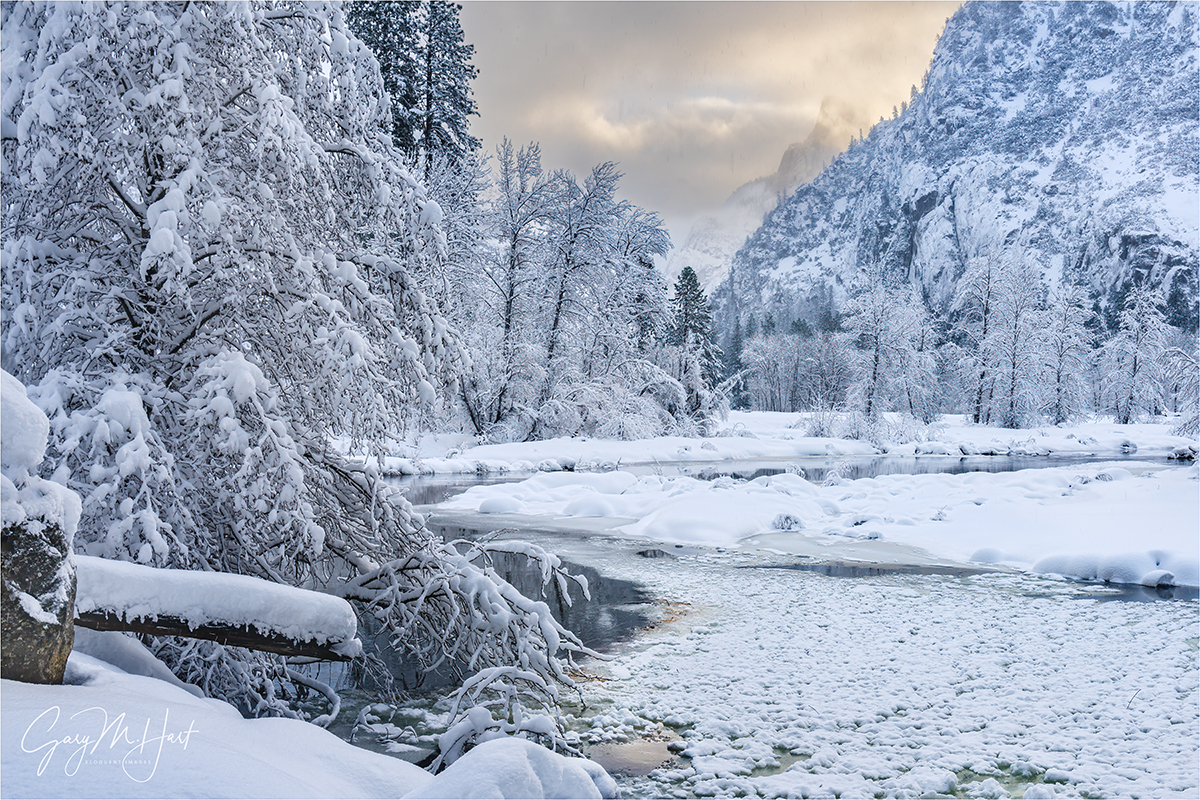
Morning Light, Half Dome and Merced River, Yosemite
Sony a7R V
Sony 24-105 G
1/25 seconds
F/11
ISO 100
Before exploring for the scene that ultimately delivered the image in my prior blog post, I got my February group set up at what I’ve always felt was the primary view at this location. With Half Dome framed on the left by towering evergreens, on the right by a long diagonal ridge, and the tree-lined Merced River in the foreground, this spot has all the landscape ingredients a beautiful image needs. Stir in fresh snow, translucent clouds, and warm sunlight, and the beauty is ratcheted off the charts.
I interrupt this photo blog to share a little about what’s been disrupting my life this week: a “minor” home remodel. In the grand scheme of things you can do to improve a house, upgrading kitchen cabinets (completely new exteriors, all new drawers, pull-out shelves) is no big deal. But anything that requires my wife and me to completely pack up the kitchen and basically camp out in our living room at least feels quite major.
Before the installers even started, our preparation included emptying the original cabinets into boxes, relocating our refrigerator to the dining room, removing the above-range microwave, and expanding the dining room table enough to host our kitchen essentials—convection oven, microwave, espresso machine, and Vitamix—while somehow leaving just enough remaining space for meal prep and dining for two.
Suddenly, our entire downstairs was a an obstacle course of boxes and countertop items (who knew a relatively small kitchen could hold so much?). My wife and I both work from home, but while I could retreat to my upstairs office, her workspace was downstairs amidst the mayhem. To get any work done amidst the din of power saws and sanders, each of us had to resort to noise-cancelling headphones at multiple points.
I’m happy to report that the just-completed cabinets exceed our lofty expectations, and the cars are back in the garage where they belong. On the other hand, at least half of our stuff is still in boxes as we meticulously unpack and reorganize our “new” kitchen.
Since every hardship is a learning opportunity, here are the things this experience taught us to never take for granted again: a kitchen sink, a dishwasher, parking inside, on-demand filtered water straight from the fridge, and not having to rummage through boxes to find that thing we never imagined we should leave out (cheese grater, coffee filters, 1/4 measuring cup, and on, and on…).
Next up? Hmmm, this 20-year old interior paint is starting to look a little dated…
So, anyway…
Finding the confluence of all these landscape and atmospheric elements is the stuff landscape photographers dream of. But I think far too many, when gifted this opportunity, simply settle for capturing the beautiful scene. (Not that there’s anything wrong with that.) In so doing, they miss an opportunity to elevate their images something extraordinary.
I see examples of this kind of settling everywhere. Whether it’s social media, hotel room “art,” screensavers, calendars, postcards, or any other medium that displays beautiful landscape photography, I can’t help shaking my head at clearly beautiful scenes that could have made much better images had the photographer taken a few simple steps.
It seems almost as if they said, “Wow, this is so beautiful, all I have to do is click my shutter before it goes away.” And if your only goal is to save the moment, read no further. But to my mind, the more beautiful a scene, the more important it is to squeeze every ounce of beauty from it. I could probably go on for hours on this topic, but I’ll try to distill my thoughts down to a few basic points.
Foremost is the need to be aware of the way the viewer’s eye moves through the frame. When I decide a scene is worth photographing, I start by identifying what I want the image to be about—a spectacular view, a specific subject, a collection of subjects, beautiful light, and so on (or some combination of these)—then identify the best way to guide my viewers’ eyes there.
With the “about” decided, I survey the scene to identify elements that possess “visual weight”—objects or features that pull the eye like gravity pulls celestial objects. Qualities that give an object visual weight include size, brightness, contrast, color, position in the scene, or any other characteristic that makes something stand out from its surroundings.
The value (in an image) of an object possessing visual weight isn’t necessarily a function of the object’s aesthetic appeal. A very ordinary feature in the right position qualifies as a desirable VW feature when it serves a scene’s most striking element, either by creating a balance point, by completing a virtual line that connects to the primary subject or other VW object, or through some combination of these. On the other hand, a beautiful but poorly positioned feature could actually work against the scene’s primary subject.
Undesirable objects with visual weight draw the eye away from the focal point of the image. I try to compose these out of the scene, or deemphasize them in the composition—for example, putting them in a less prominent location, burying them in the foreground of a silhouette, or deemphasizing them with soft focus. When none of those options are available, burning (darkening) the offending object in processing often works wonders.
Viewers subconsciously draw virtual lines connecting objects with visual weight. Desirable objects with visual weight can be “connected” virtually by creating appealing positional relationships. I’m especially drawn to diagonal connections between these objects, and look to create them whenever possible.
Another frequently overlooked aspect of “pretty scene” pictures that fall short of their potential is distracting elements that pull the eye from whatever the scene is supposed to be about. In addition to, and often even worse than, misplaced visual weight objects in the main part of the scene, is messy borders. Since the visual weight of objects seems to increase on the border of the frame (this is just a personal observation that feel pretty strongly about), I always strive for clean borders by avoiding cutting things off (most of it in the frame, but just a little piece missing), or having them jut in (most of an object outside the frame, with just a small piece visible).
But since we’re photographing the natural world, scenes usually don’t cooperate, often making it impossible to avoid objects cut off or jutting in at the edges of the frame. In that case, it’s most important to make cutting your border objects a conscious choice, rather than not checking at all and placing the border wherever it happens to fall while you concentrate on the main part of the scene. This border awareness includes clouds at the top of the frame, which I find to be an especially overlooked flaw that’s usually a pretty easy to fix—if you make the effort to look.
In the Half Dome image above, in a very general sense this was the first composition I saw when I arrived here. But not wanting to settle for the (undeniably) pretty scene, I went to work finding my about and visual weight objects and overall framing. Half Dome was the obvious “about” choice, but I also wanted to feature the snow and morning light in the clouds.
The first thing I noticed when I framed up something that featured these elements while composing wide enough to include the river too, was the log jutting in on the lower left. Eliminating it completely also eliminated the best part of the river, so I went with Plan B: composing wide enough to make the log one of my VW objects, taking it off the border and far enough into the scene to create a nice diagonal connection with Half Dome.
Including all of the rock (from which the log emerges) meant going much wider than I wanted to, and introduced other undesirable elements, like other workshop students (I know what you’re thinking: no, the students were not undesirable, I just didn’t want them in my frame). But I got enough of the rock so it didn’t appear to be an afterthought, making sure not cut off that small, horizontal patch of snow beneath the (unavoidable) snowy cap.
The right side of my frame was determined by a protruding branch that I didn’t want to include. With the left and right setting my focal length, I just had to aim my camera up and down until I found the right combination of foreground snow below, and translucent clouds above.
Assembly Required
Click any image to scroll through the gallery LARGE


 Eloquent Images by Gary Hart
Thanks for the tips, Gary. Very helpful.