Eloquent Images by Gary Hart
Insight, information, and inspiration for the inquisitive nature photographer
Get Centered
Posted on February 27, 2024
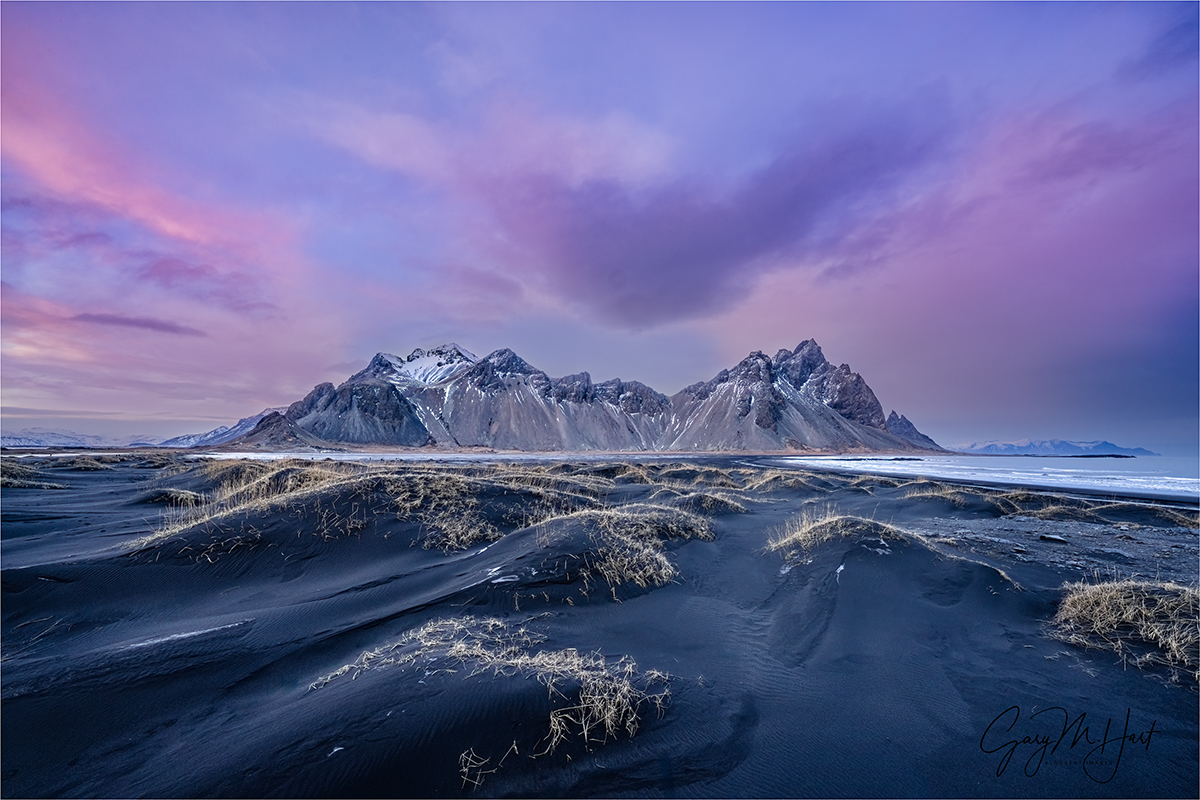
Winter Twilight, Vestrahorn, Iceland
Sony a7R V
Sony 12-24 GM
1/8 second
F/11
ISO 200
This day started with one of the most disturbing experiences of my photo workshop life, so finishing with a sunset like this was comforting relief for the entire group.
But before I get to the sunset, let me wind the clock all the way back to our short drive to Diamond Beach for this morning’s sunrise. In February Iceland’s sunrise arrives at around 10 a.m., but with the high latitude also comes extremely long twilight hours, so we were on the road for the 10-minute drive to the beach at 8:30, stomachs full of breakfast. The sky was still quite dark, but hints of a beautiful sunrise were already creeping up along the eastern horizon as we drove. In a workshop filled with special, Diamond Beach is extra special, so despite the darkness outside, everyone was pretty energized as we bounced along the highway.
Gazing through the windshield from my seat near the front of our (small—26 passengers) bus, I caught sight of a dark shadow approaching from the left. Simultaneously, someone in the back yelled, “Look out!”, and our driver Vincenzo braked hard. The shadow was just ambling, showing no sign of awareness of its immediate peril, neither slowing or speeding as it moved About the time my brain identified the shadow as a reindeer, it was directly in front of us and smack! From the first instant of the reindeer’s appearance to our bus’s direct hit, I’d guess less than a second elapsed.
We were traveling around 45 miles per hour, a pretty reasonable and safe speed in Iceland’s icy darkness. We’ve all been in accidents (right?)—almost without exception the situation changes from perfectly normal to dire before your brain has time to register what’s happening. Given that, I have to say that Vincenzo did an amazing job: Instead of following the normal human reflex to swerve (as I’m afraid I might have done), he simply braked quickly and continued forward into the reindeer. Textbook. While not the best result for the reindeer, Vincenzo’s response on that frozen highway almost certainly spared us a rollover and many injuries, perhaps worse.
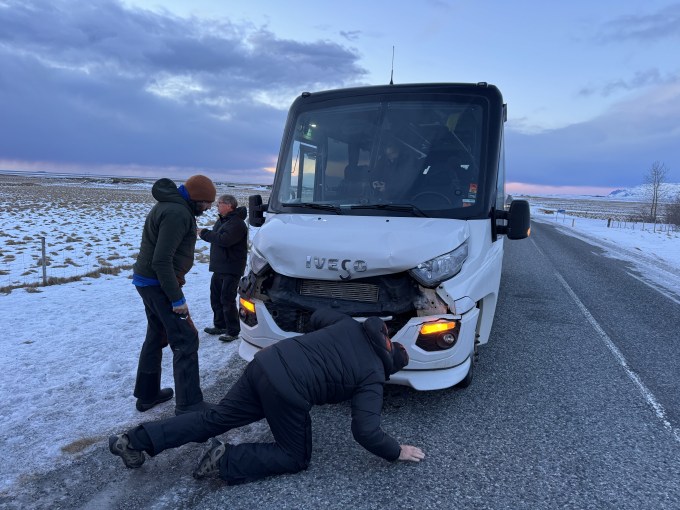
Bus reindeer damage. I took this picture quite a while after the accident, shortly before we tried to limp home.
We immediately pulled over, all pretty shaken, but no one more-so than Vincenzo. After a minute or two to recenter, the four group leaders (Iceland guide Albert Dros, driver and photographer Vincenzo Mazza, Don Smith, and me), exited to assess the damage. There was no doubt that the reindeer was down for the count on impact, a small comfort to know that it didn’t suffer. But when I saw our headlights still shining bright before exiting, I’d held out slight hope that damage to the bus would be cosmetic and not impact our trip. No such luck.
In addition to the obvious damage to the grill (which doesn’t really show up well in the picture), we were losing coolant. Only a few minutes from Diamond Beach, we briefly toyed with the thought of continuing on to sunrise and letting Vincenzo deal with the damage while we photographed, but ended up making the incredibly wise decision to cut our losses and turn around to attempt the 3 mile drive back to our hotel where we could regroup.
Even poking along at around 5 MPH, and despite the frigid outside temperature, the bus’s thermostat needle immediately started creeping northward, toward the red. I know Vincenzo was watching its climb as closely as he watched the road, and after about 10 minutes he pulled us to a stop to let the engine cool. After about a 15-minute respite, we (fingers crossed) fired up the engine and limped the rest of the way back—3 miles in 45 minutes.
Back at the hotel, immediate problem solved, we still needed to figure out how we were going to complete the second half of our workshop minus our trusty chariot. But within a couple of hours, Don and I got word that our tour company had pulled some strings and our replacement “bus” would be delivered by 1 p.m. We were back in business.
The arrival of this replacement van might be a good time to remind you that beggars can’t be choosers. Normally Don and I cap the Iceland workshop at 12 participants, but since this group would be led by 4 qualified photographers, and we knew our bus would be more than big enough for everyone, we went to 14 participants. With the 4 leaders, that meant 18 people in our 26-passenger bus—no problem, especially since the bus had ample storage. Sadly, that calculus didn’t account for an encounter with a reindeer, and the reality that our replacement vehicle would turn out to be more of a large van, with seats only for 21, and very limited storage space—more designed for day excursions than multi-day trips.
Having missed just the morning’s sunrise shoot, that afternoon we motored off to Vestrahorn in our new wheels, certainly cozy, but (more or less) comfortable. Since we were already using virtually every inch of available space for our bodies and camera bags, we all scratched our heads at how, when we checked out in a couple of days, we were going to squeeze all of our luggage in to our new ride. When questioned, Albert simply answered that we’d do it because we had no choice, and I chose not to stress about it. (Much.) And there was still photography to be done!
Vestrahorn is rivaled only by Kirkjufell on the list of recognizable Iceland peaks. Towering about 1500 feet above the North Atlantic, Vestrahorn’s intrusive origins distinguish it from many of its mostly extrusive Icelandic neighbors. The mountain’s rock formed about 10 million years ago, when subterranean volcanism injected iron- and magnesium-rich magma from Earth’s mantle into the crust above. Protected by this crust from exposure to the much cooler atmosphere on the surface, this magma cooled slowly to form Vestrahorn’s hard, crystal-infused core. Over time this hardened core was pushed upward by the region’s relentless geological forces. With this increasing elevation, the much softer crust entombing the mountain gradually eroded away, leaving only the peak we see today.

Vestrahorn Reflection, Stokksnes Beach, Iceland (2021)
On any day, Vestrahorn is a photographer’s delight. Though visually quite different, I liken the photography experience here to the Alabama Hills beneath California’s Sierra Crest, where an infinite variety of foreground composition possibilities stretch beneath the dramatic mountain peaks. At Vestrahorn, the foreground variety comes courtesy of black sand dunes, icy ponds, faceted ice patterns, and the mirror reflections left behind each time the surf retreats from gently sloping Stokksnes Beach.
I like to get around to everyone in the group before starting my own photography, but more than any other location in Iceland, here people seem to scatter like shotgun pellets. After about a half hour of wandering I finally gave up on finding everyone and started looking for my own foreground to put with the mountain. A sucker for reflections, I normally beeline to the beach, but with the tide out I decided this might be a good day to try the dunes. I’m so glad I did.
I poked around the dunes, searching for a grouping I could compose into something coherent and complementary, and that hadn’t been soiled by footprints. After about 20 minutes I landed at the spot you see in my image at the top of the post and didn’t move more than 20 feet for the rest of the evening.
As you can see from the image above, Vestrahorn this evening was a particular treat. One of the many reasons I like Iceland so much in winter is the snow decorating the peaks. And though I’ve seen Vestrahorn with much more snow, I found the peak’s snowy accents this evening especially appealing (compared to the barren slopes that dominate in Iceland’s warmer months). But the evening’s real show came courtesy of the interplay of clouds and light above the peak as the sun dropped.
Because the sun ascends and descends the sky at such a shallow angle at this high latitude, sunrise and sunset seem to unfold in slow motion. When the reds fired up this evening, much of the color above the mountain was obscured by clouds. But because the really nice color hung-in for at least 30 minutes, the clouds had more than enough time to thin and spread enough to allow the late light through, eventually blanketing much of the sky with persistent pink. By the time it reached this stage, I’d become so familiar with all the compositional opportunities in my little corner of the island that I had a pretty good idea of how I wanted to handle it.
I fell in love with the foreground dunes early on, and after it became pretty clear that the color would stretch far overhead, switched to my 12-24 lens to include as much of the entire scene as possible: dunes, mountain, sky. But how to handle a sky that rivals a classically beautiful landscape? There are very few absolutes in photography, but one of the most damaging “absolutes” is the admonition to never center the horizon, or your subject on the frame’s horizontal or vertical axes. This usually well-intended edict might have value to the raw novice who automatically centers every horizon and subject, but can actually be damaging to insecure neophytes not confident enough to trust their own creative vision. If centering feels right, go for it!
My own “rule” is to decide where most of the scene’s visual interest resides, foreground or background, and allocate a proportional percentage when I set my horizon. Sky better than the foreground? The sky gets most of my frame. Foreground better than the sky? The foreground gets most of my frame. Both sky and foreground too beautiful to decide? I have no problem splitting my scene right down the middle.
Reflections are probably the most frequent example of scenes that can be split down the middle, but this choice isn’t limited to reflections. And as far as centering a subject is concerned, I don’t hesitate when I want it to dominate my scene, or when there’s nothing else in the frame to balance a dominant subject. If you’re not sure, or simply don’t trust your own instincts, just do it both ways and decide later.
Epilogue
Striking an animal leaves a persistent knot in the pit of your stomach. We all felt it, but no one more than Vincenzo, who told us later that he’s never struck anything with a vehicle—person, animal, or other vehicle. He was pretty shaken, but I think having a job to do, plus the interaction with, and support of, the rest of the group distracted him enough to make it through the trip. For the rest of us, knowing we’re all dealing with this shared trauma helped a lot, as of course did being the distraction of wonderful photography.
Another unexpected bonding opportunity came from the impossible solution Albert and Vincenzo devised to get us back to Reykjavik with all of our stuff. Without going into great detail (lest we get them into trouble for violating some kind of Iceland vehicular safety code), no person or gear was left behind or strapped to the outside of the vehicle, and we each had our own seat (and seatbelt). Hardly a square-inch of space, horizontal or vertical, went unused, and even after getting the group choreography polished, entering exiting the van still took at least five minutes. But we made it, and I think everyone would agree that the tight quarters became a catalyst for much fun and laughter that proved just the necessary medicine.
Join Don Smith and Me in Iceland Next Year
Sublimely Centered Subjects
Click any image to scroll through the gallery LARGE


Step Aside and Let Nature Do Its Thing
Posted on January 24, 2022

Nature’s Curves, Mesquite Flat Dunes, Death Valley
Sony a7RIV
Sony 24-105 G
1 second
F/11
ISO 125
Once upon a time, my most frequently asked question was some version of, “Did you put that leaf (or whatever) there?” (No.) When digital photography and Photoshop processing started to gather momentum, those questions expanded to whether or not I added the moon or the Milky Way to an image. (Again, no.) And now, with effortless sky replacement, any beautiful sunset seems to generate dubious looks. Sigh.
As discouraging as this cynicism is, given the number of photographers who seem willing to manipulate the natural world, viewers of today’s images have every right to be skeptical of their origin. But nature photography’s prime objective should to reveal natural beauty—and when we succeed, viewers’ first reaction shouldn’t be skepticism.
Order vs. chaos
The main reason I’ve always resisted manipulating scenes and manufacturing images is that I try to approach my photography with the mindset that Nature is inherently ordered and unimprovable. Sometimes natural beauty slaps us in the face; other times we have to look a little harder. But I’m afraid in a world where humans go to great lengths to suppress fires, divert rivers, raze forests, and in countless other ways try to control, contain, and otherwise manage the natural world, we’ve fostered the arrogant mindset that we can do it better.
When Nature gets “out of control,” we label it chaos and try to “fix” it. But what humans perceive as “chaos” is actually just a manifestation of the universe’s inexorable push toward natural order. I mean, think about it: Imagine that all humans leave Earth for an extended tour of the Milky Way. While we’re gone, no lawns are mowed, no buildings maintained, no fires extinguished, no floods controlled, no Starbucks built. Let’s say we return in 100 Earth years*. While the state of things upon our return would no doubt be perceived as chaotic, the reality is that our planet would in fact be closer to its natural state. And the longer we’re away, the more human-imposed “order” would be replaced by natural order—and I dare say, more beautiful.
I’m thinking about all this because there’s nothing like a visit to pristine sand dunes to remind a person that Nature doesn’t need our help when it comes to creating beauty. The exquisite choreography of dipping and soaring arcs, lines, and parallel grooves that form naturally when sand, wind, and gravity combine and are left alone is both beautiful and humbling.
I got my most recent dose of sand dune splendor last week, when I guided my Death Valley workshop group out onto the Mesquite Flat Dunes. Given their proximity to the highway and the tiny enclave of Stovepipe Wells, these dunes are almost aways swarmed by people and stained by enduring footprints. To avoid both, I take my groups on a one-mile cross-country (no trail) hike out to a spot much more likely to reward us with virgin sand.
When last week’s visit delivered as hoped, we made the trek twice—once for sunset, and again the next morning for sunrise. The sunset shoot featured a gorgeous red sky in all directions that had everyone spinning in circles to avoid missing something. But I actually enjoyed our sunrise shoot even more, when an 80-percent cloud cover created a natural softbox that let the dunes do their elegant thing.
It was still completely dark when we parked and started our morning hike—dark enough that I just kind of pointed my headlamp in the general direction I wanted to go, confident that it didn’t really matter exactly where in the dunes we’d end up. Because footprints in sand are forever (in the context of a 90 minute photoshoot), part of my job is finding a spot where we can all set up in relatively close proximity, then to play traffic cop to ensure no one strays into sand that might be photo-worthy. After scaling and descending several dunes, I finally paused atop an elevated sand platform. Surveying our surroundings in the first gray light of dawn, my eye was instantly drawn to a graceful serpentine ridge arcing across the face of the dune just opposite us. With enough space for the entire group, a view that spanned nearly 270 degrees, and a gorgeous foreground element, I decided that we’d found our spot.
One of the things I love about photographing sand dunes is that there are compositions for every lens in my bag, from my Sony 12-24 f/2.8 GM to the Sony 100-400 GM (and the Sony 200-600 if I hadn’t left it in the car). I played with several lenses before zeroing in on the arc that had originally grabbed my eye. For this feature I used my Sony 24-105 GM on my Sony a7RIV, starting fairly wide to include more dunes and some sky, then gradually zooming tighter to isolate the arc.
While I do all of my photography on a tripod, for dunes especially I like to take my camera off the tripod, put my eye to the viewfinder, and slowly scan the scene until something stops me. I can’t even tell you exactly why I stopped with this composition, except to say that it just felt right.
As these dunes illustrate (and I hope my image conveys), Nature creates the most astonishing beauty. I have no illusions I can improve on Nature’s offerings, but as long as I keep looking, I’m pretty confident that there’s enough naturally occurring beauty to keep me occupied for the rest of my life.
* Since this is my fantasy, I’ve chartered a spaceship that accommodates all of humankind and travels at 90 percent of the speed of light. While Earth has indeed aged 100 years during our holiday, we travelers return only a year older. (Dubious? Don’t take my word for it, ask Albert Einstein.)
Sand Dune Splendor
Click an image for a closer look, and to view a slide show.


Look Behind You
Posted on April 3, 2016
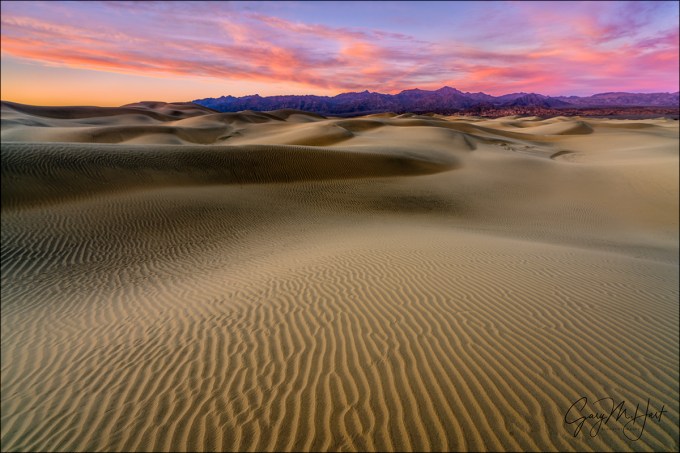
Painted Dunes, Mesquite Flat Dunes, Death Valley
Sony a7R II
Sony/Zeiss 16-35 f4
.4 seconds
F/11
ISO 100
Every once in a while we find ourselves at just the right place when Mother Nature delivers something special. When that happens, the best thing to do is stay calm and keep your head on a swivel.
In January my Death Valley workshop group had one of those moments. We’d walked almost a mile to get out to dunes that hadn’t been trampled, then waited while a sky that was solid overcast broke up just as the sun dipped below the horizon. The result was about ten minutes of horizon-to-horizon red that at its peak painted the dunes as well.
We’d been watching a hole in the clouds to our north shift in our direction, and I started to get an inkling that the ingredients were there for a vivid sunset about fifteen minutes earlier, when peaks in the northeast, then the clouds overhead, started to glow with warm, late light. I’d been using my 70-200 telephoto lens to isolate areas of the dunes, but realized that if the sky did indeed light up, I’d almost certainly want something wider and switched to my 16-35. I also encouraged everyone to do the same, and to anticipate the color and identify sunset compositions now, before it happened. Shortly thereafter we got our first hints of pink and the show was on.
That evening was a great example of something I preach in my workshops: No matter how great the scene you’re photographing, every once in a while take a few seconds to look around. On this evening I was excitedly photographing in one direction when I realized everyone in the group was photographing in the opposite direction. Turning to admonish them, I saw what they were photographing and shut up, quickly aiming my camera in that direction instead.
Read more about that evening, and see a picture of the other direction, here: Finding a new sandbox.
Sunset color
As I’ve written before, the ingredients for sunset (or sunrise) color are clouds, direct sunlight, and clean air (the cleaner the better). The idea that polluted or dusty air is good for sunset is a myth. (If that were true, Los Angeles and Beijing would be know for their sunsets, not Hawaii or the Caribbean.)
The red you see at sunset is the only color remaining after the white sunlight we see at midday has been stripped of all other wavelengths. It’s actually a rather interesting process (to me at least) that you can read more about here: Sunset Color.
Join Me in Death Valley
A gallery of sunset magic
Click an image for a closer look, and a slide show. Refresh the screen to reorder the display.


 Eloquent Images by Gary Hart