Eloquent Images by Gary Hart
Insight, information, and inspiration for the inquisitive nature photographer
2012 Grand Canyon Monsoon Mayhem tour
Posted on August 12, 2012
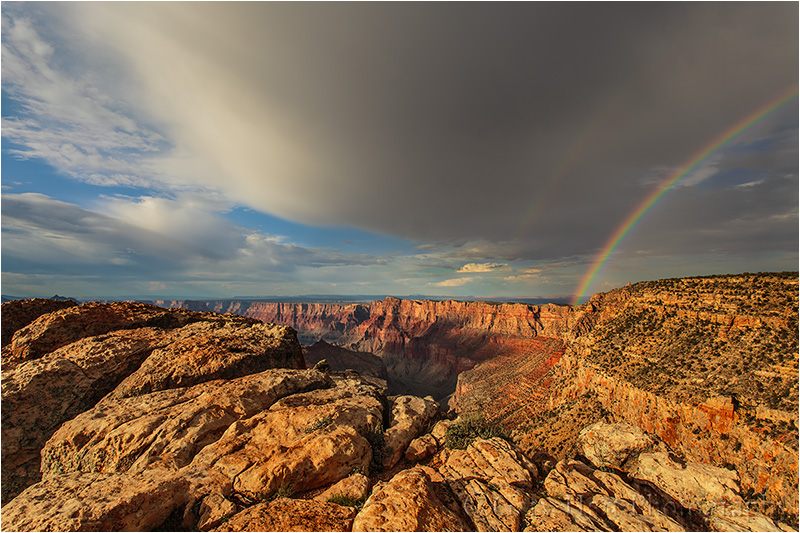
Rainbow, Lipan Point, Grand Canyon
* * * *
The drive from Northern California to the Grand Canyon’s South Rim is about twelve hours. When Don Smith and I scheduled our (first annual) 2012 Grand Canyon Monsoon Mayhem tour, the plan was to leave dark-and-early Monday morning, which experience told us would get us to the canyon just in time to photograph sunset Monday night. But with the National Weather Service forecasting waning monsoon conditions as the week progressed, it looked like Monday afternoon might be the best time to capture our prime goal, lightning. So on Sunday morning we decided to leave that evening, drive as far as we could, then drive the rest of the way Monday. Doing it this way would allow us to arrive by mid-afternoon with a full night’s sleep. Fueled by Starbucks and a steady diet of classic rock, Don and I made it all the way to the acclaimed Route 66 hot-spot, Barstow, California (the gateway to the Mohave Desert).
Monday morning we escaped the desert before the heat kicked in, and by 2 p.m. were rolling up to the Grand Canyon South Rim. After surveying the skies, we pointed the car east, along the rim, toward Lipan Point, a favorite photo spot about forty minutes away. Somewhere near Grandview we encountered a cell that delivered lightning and sheets of rain, a harbinger of what was in store. Though the Grandview cell was behind us, Lipan Point greeted us with looming black clouds that spit occasional raindrops that sounded like ripe grapes striking the roof, a car-rocking wind, and thunder separated from its flash by mere seconds. Hell hadn’t broken loose yet, but it was sure rattling the cage.
We’d counted on a little time to recover from the drive, but there’s nothing like urgency to reveal how unprepared you are. As a Californian (at the sound of thunder, bewildered Californians rush outside), I’d never had an opportunity to use my lightning trigger (an electronic device that detects lightning and fires the shutter in milliseconds); Don had forgotten to pack most of his rain gear. And neither of us had given adequate thought to the impracticality of our plan to avoid electrocution by setting up our expensive tripods and cameras at a popular Grand Canyon vista (in the height of tourist season) while waiting out the danger and discomfort of a thunderstorm in the security of the car. With the storm bearing down on us, what followed was a Keystone Cops swirl of activity—out of driving clothes and into wet-weather gear; extract and attach (and figure out) lightning triggers; find a suitable view comfortably removed from teaming tourists; meter and compose a scene—that culminated in a frantic retreat, sans cameras, when a much-too-close lighting bolt ripped a Niagara-size hole in the sky.
For the next five minutes our cameras couldn’t have gotten more wet if we’d have put them in a shower. Warm and dry in the car, I was suddenly gripped by visions of my wind-tossed camera and tripod plummeting into the Colorado River (5,000 feet below), so when the lightning paused, I mustered the courage rush to the rescue. (I think Don did the same thing, but at that point it was every man for himself.)
As I toweled down my gear back in the car, the wind and rain slowed to a more manageable pace. Unsure of how long our window of lightning opportunity would last, Don and I headed back out, this time in different directions and (somewhat) more prepared. I opted for the best composition that offered the possibility of distant lightning, turning my lens toward a gray curtain of rain a fair distance up the canyon, toward Desert View; Don, who was having technical problems with his lightning trigger, headed a little west and pointed his camera toward a nearby cell that was already flashing behind us.
For the next hour or so I heard my shutter respond to a half-dozen or so bolts in the direction of my composition, a good sign, but since the lightning trigger disables the LCD replay, all I could do was cross my fingers for success. When the electrical activity quieted, Don and I reconnected and traded notes. Though he’d resolved his technical issue (I’ll let him elaborate), he was similarly unsure of his success.
Lightning or not, we agreed that the sky was far better than anything we see in California. As we chatted, the sun appeared and a vivid double rainbow arced above Desert View—back to work. Lightning trigger off, I was happy to be back more familiar territory—trying to work a rainbow into an already magnificent scene without dodging raindrops or lightning bolts.
Because the rainbow touched down south of the rim, finding a composition that featured both the canyon and the rainbow required a wide shot that included close foreground elements. I wasn’t crazy about the shrubs and rocks immediately beneath the rock outcrop I was on, so I stood back from the rim a bit and hid them behind the more interesting texture of my grooved and weathered limestone platform.
For the rainbow’s thirty-minute duration, I moved along the outcrop, capturing about sixty combinations of foreground and sky, horizontal and vertical, wide and tight. I finished with many, many images that make me happy, but chose this one because (right now) I think it offers the most balanced combination of all that made the scene special: the warm light on the Grand Canyon’s south wall, the rainbow (duh), the rugged character of the limestone supporting me, and the saturated, arcing raincloud responsible for the moment.
Epilogue
That great start to our adventure was made even more memorable when Don and I, at the risk of spurring an international incident, selflessly declined the advances of two young German women seeking a bed for the night (seriously).
Viewing on my laptop back at the hotel, I was thrilled to find four frames that included lightning. Given all that was in store the rest of the week, my excitement at four frames now seems a little overdone, as was Don’s frustration that his technical problems resulted in a day-one lightning shutout. By week’s end we each had more than fifty lightning captures, most coming at the North Rim on an action packed final day that shrunk the beauty of this first day to a distant memory. Stay tuned….
A landscape photographer’s time
Posted on June 25, 2011

Double Rainbow, Yosemite Valley
Canon EOS-1Ds Mark II
38 mm
1/5 seconds
F/16
ISO 100
On my run this morning I listened to an NPR “Talk of the Nation” podcast about time, and the arbitrary ways we Earthlings measure it. The guest’s thesis was that the hours, days, and years we measure and monitor so closely are an invention established (with increasing precision) by science and technology to serve society’s specific needs; the question posed to listeners was, “What is the most significant measure of time in your life?” Most listeners responded with anecdotes about bus schedules, school years, and work hours that revealed how our conventional time measurement tools, clocks and calendars, rule our existence. Listening on my iPhone, I wanted to stop and call to share my own relationship with time, but quickly remembered I wasn’t listening in realtime to the podcast. So I decided to blog my thoughts here instead.
Landscape photographers are governed by far more primitive constructs than the bustling majority, the fundamental laws of nature that inspire, but ultimately transcend, clocks and calendars: the Earth’s rotation on its axis, the Earth’s revolution about the Sun, and the Moon’s motion relative to the Earth and Sun. In other words, clocks and calendars have little to do with the picture taking aspect of my life; they’re useful only when I need to interact with the rest of the world on its terms (that is, run the business).
While my years are ruled by the changing angle of the Sun’s rays, and my days are inexorably tied to the Sun’s and Moon’s arrival, I can’t help fantasize about the ability to schedule my spring Yosemite moonbow workshops (that require a full moon) for the first weekend of each May, or mark my calendar for the blizzard that blankets Yosemite in white at 3:05 p.m. every February 22. But Nature, despite human attempts to manipulate and measure it, is its own boss. The best I can do is adjust my moonbow workshops to coincide with the May (or April) full moon each year; or monitor the weather forecast and bolt for Yosemite when a snowstorm is promised (then wait with my fingers crossed).
The insignificance of clocks and calendars is never more clear than the first morning following a time change. On the last Sunday of March, when “normal” people moan about rising an hour earlier, and the first Sunday of November, as others luxuriate in their extra hour of sleep, it’s business as usual for me. Each spring, thumbing its nose at Daylight Saving Time, the Sun rises a mere minute (or so) earlier than it did the day before; so do I. And each fall, on the first sunrise of Standard Time, I get to sleep an an entire minute longer. Yippee.
Honestly, I love nature’s mixture of precision and (apparent) randomness. I do my best to maximize my odds for something photographically special, but the understanding that “it” might not (probably won’t) happen only enhances the thrill when it, or maybe something unexpected and even better, does happen. The rainbow in today’s image was certainly not on anybody’s calendar; it was a fortuitous convergence of rain and sunlight (and ecstatic photographer). My human “schedule” that evening was a 6 p.m. get-to-know/plan-tomorrow dinner meeting with a private workshop customer. But seeing the potential for a rainbow, I suggested that we defer to Mother Nature, ignore our stomachs, and go sit in the rain. Fortunately he agreed, and we were amply rewarded for our inconvenience and discomfort.
Workshop Schedule || Purchase Prints
A Gallery of Rainbows
Click an image for a closer look, and a slide show. Refresh the screen to reorder the display.


Are you a photographer or a tourist?
Posted on January 14, 2011
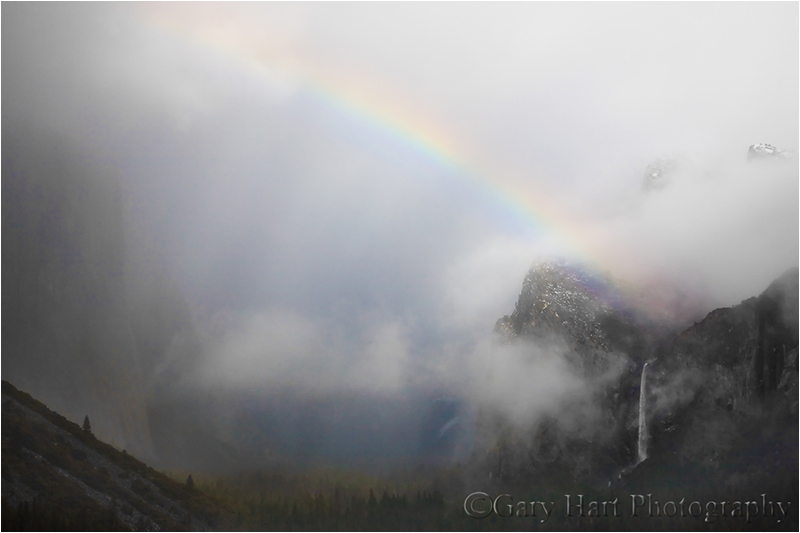
Storm’s End, Yosemite Valley
When the weather gets crazy, do you sprint for cover or reach for your camera? Your answer may be a pretty good predictor of your success as a photographer. It’s an unfortunate fact that the light, color, and drama that make memorable landscape photos all come when most sane people would rather be inside: at sunrise, when the rest of the world is asleep; at sunset, when everyone else is at dinner; and during wild weather, when anyone with sense is on the sofa in front of the fire.
Last spring I guided a photo workshop group through Yosemite. On the final day we circled Yosemite Valley in a steady rain, stopping to photograph many of my favorite cloudy-sky spots. Through it all my hardy group persevered, wet but happy, but by mid-afternoon their energy had started to wane a bit. Rather than risk mutiny, I detoured to Tunnel View to give everyone a breather.
With El Capitan, Half Dome, Cathedral Rocks, and Bridalveil Fall all on prominent display, it’s no secret why Tunnel View is the most photographed location in Yosemite. After a storm, Yosemite’s dramatic landmarks emerge from swirling clouds as if appearing on earth for the first time. Storms in Yosemite clear from west to east, making Tunnel View the first place to capture this unforgettable experience and my go-to place to wait out Yosemite weather.
The rain fell in sheets as we pulled into the Tunnel View parking area. Throughout the workshop I’d tried to impress on everyone how quickly conditions change in Yosemite, but it’s pretty hard to appreciate exactly how quickly until you actually experience a change yourself. So, despite my prodding to the contrary, when I donned my rain gear and invited the group to join me in the rain, they all opted for the warmth of the cars. And there I stood, five soggy minutes later, accompanied only by my tripod and camera (me beneath an umbrella, my camera beneath a plastic garbage bag), when without warning a ray of sunlight broke through, briefly painting a rainbow above Yosemite Valley, from El Capitan to Bridalveil Fall. After rousing the group I had time for three frames before the rainbow faded into the clouds. Everyone else was still wrestling with their gear.
Did I know a rainbow was going to happen? Of course not. In fact, if I were a betting man, I’d have wagered I wasn’t going to get anything but wet. But no matter how slim the odds were, a special image was infinitely more likely in the rain than in the car.
So. Are you a photographer or a tourist? There’s nothing wrong with the tourist mentality that only takes you outdoors with the masses, well rested and appetite sated in midday warmth. On the other hand, if one spectacular success is compensation enough for the other hundred tired, hungry, cold, and wet failures, you may just be a photographer.

 Eloquent Images by Gary Hart